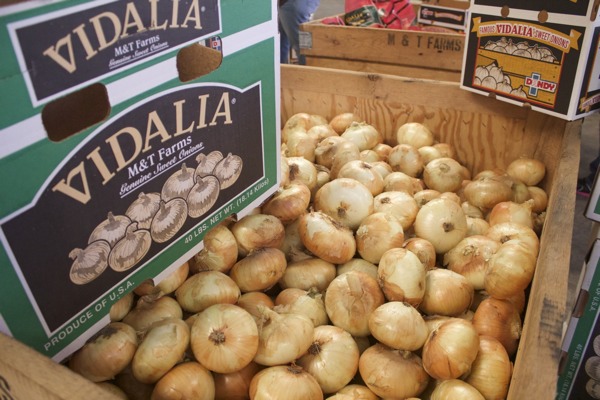
It has been a tale of two winters for Georgia Vidalia onion producers. Last year’s abnormally mild winter was highlighted by warmer temperatures. This season has been characterized by wetter conditions and cooler temperatures.
It has impacted the growth of the state’s onion crop so far this season, says Chris Tyson, University of Georgia Extension Area Onion Agent at the Vidalia Onion & Vegetable Research Center in Lyons, Georgia.
“We had some warm weather in December and January last year and it really got the onions up jumping. This year they’re just off to a much slower start. That’s okay. It’s not a problem. It’s just been a cool, cold, slow start. The growth has just been really slow to begin with,” Tyson said.
Slow Start, Just Not a Bad Start
A slow start is not necessarily a bad thing either for onion producers.
“The sooner the onions get big and get growing, the sooner we have to fight disease and manage fertility. I think recent years have been uncharacteristically warmer, above average; we almost have gotten used to that the last few years. But this year it may be more of an average year,” Tyson said. “You talk to these Vidalia onion growers and they’ll tell you about years when we’ve had really cold weather and we’ve had hard freezes. It’s caused problems in the past. We haven’t seen any extremes like that (this year).
“We don’t want to get the onions too big and have a bad freeze or something like that. When they get big like that, the freeze damage can hurt them worse.”
Sufficient Moisture
Moisture is not a problem either for Georgia onion farmers. According to the US Drought Monitor, only a few coastal counties and some in the southwestern part of the state are abnormally dry. Most of the state got saturated during the New Year’s Holiday weekend.
“A lot of places in the onion belt got 3 to 5 inches. In this time of the year when it’s cold and not much evaporation, it makes things really wet and takes a while to dry off,” Tyson said.
“As far as moisture goes for the onions, we feel like we’re in pretty good shape right now.”
The deadline is Friday for Alabama vegetable and specialty crop farmers seeking financial assistance from Hurricane Zeta.
Producers who suffered losses related to Hurricane Zeta need to submit an application to the Alabama Farmers Agriculture Foundation for assistance from a Hurricane Relief Fund by this week.
According to the alfafarmers.org, the relief fund is designed to help offset farmer losses not covered by a farmowner policy, crop insurance or disaster relief programs. An independent committee will evaluate the applications based on need and award grants in February.
The application for Hurricane Zeta assistance and a link for contributions to the fund are available at AlabamaFarmersFoundation.org.
Hurricane Zeta made landfall in Louisiana as a strong Category 2 storm on Oct. 28 and maintained tropical storm winds as it raced across Alabama.
The most recent U.S. Drought Monitor map shows sporadic parts of Florida, Georgia and Alabama that are classified as abnormally dry.
Rainfall this winter should mean less potential for dry conditions in the summer for vegetable and specialty crop producers in the Southeast. That could mean less need for irrigation usage for farmers during the hot summer months of June through August.
Rain has not been lacking across the Southeast, especially during the latter part of December and so far in the first couple of weeks of January. It was especially persistent during the New Year’s Holiday weekend.
“Having more rain in the winter reduces our chance to have drought in the summer, so that’s good,” said Pam Knox, University of Georgia Extension Agricultural Climatologist. “The cooler temperatures do help to keep the moisture in the soil as well. When it’s really dry, you get more evaporation, even in the winter. All of these things we’re seeing, cooler conditions and wetter conditions, mean that we’re less likely to see dry spells in the spring that would impact farmers.”
Georgia Rains
According to the Georgia Automated Weather Network, from Jan. 1 to Jan. 9, Tifton, Georgia received 4.41 inches, compared to 0.76 in 2020 and 1.32 in 2019. In Vidalia, Georgia, where onions are being produced, there was 3.65 inches recorded during that same timeframe, compared to 1.58 in 2020 and 0.77 in 2019.
“On the short term, it looks like we’re probably going to see a whole series of storm systems move through. That’s pretty not typical for a La Nina year for the Southeast. But the way the weather patterns have set up this year with that dip in the jetstream over the eastern half of the country, we’re probably going to see more storms,” Knox said. “They’re talking about potentially, although snow in the Southeast is pretty hard to get, we might see some. But it would most likely be in the mountains rather than in any other part of the state.
“But we still have the whole month of February and March to go too. We’ll just have to wait and see exactly what happens.”
The latest U.S. Drought Monitor show few abnormally dry conditions in the Southeast.
A La Nina weather pattern is usually characterized by warmer temperatures and drier conditions. So far this winter, however, it has been a lot cooler with more rain than originally predicted in the Southeast.
Pam Knox, University of Georgia Extension Agricultural Climatologist, explains why this year’s La Nina is acting abnormally.
Pam Knox
“It’s not unprecedented to have a La Nina like this, but it’s rare. The atmosphere acts like a bowl of jelly. There’s a lot of different things that are jiggling around. The one that’s most predictable is the La Nina vs. El Nino. But this year it turns out there’s a lot of other things that are going on that are changing that usual statistical pattern,” Knox said.
“There’s all this other stuff going on. What we’ve seen is a move south in the track of the storms. Usually in a La Nina year, they’re pretty far up to the north and we stay under high pressure. This year because of other things going on in the Arctic and other places, that storm track has been pushed to the south. We’ve seen a lot more rain. We’ve seen cooler temperatures. It’s a little deceptive. We really haven’t been that cold, it’s just that we’re used to warm temperatures now. So, it feels cold.”
The rainfall is good news for vegetable and specialty crop producers in the Southeast. Winter is a time when the soil moisture gets recharged due to rainfall.
Cooler temperatures are also needed for fruit farmers banking on chill hours to grow a productive crop.
National Weather Service graphic shows Zeta’s path through Alabama.
The deadline is less than two weeks away for Alabama vegetable and specialty crop farmers seeking financial assistance from Hurricane Zeta.
Producers who suffered losses related to Hurricane Zeta have until Jan. 15 to submit an application to the Alabama Farmers Agriculture Foundation for assistance from a Hurricane Relief Fund.
According to the alfafarmers.org, the relief fund is designed to help offset farmer losses not covered by a farmowner policy, crop insurance or disaster relief programs. An independent committee will evaluate the applications based on need and award grants in February.
The application for Hurricane Zeta assistance and a link for contributions to the fund are available at AlabamaFarmersFoundation.org.
Hurricane Zeta made landfall in Louisiana as a strong Category 2 storm on Oct. 28 and maintained tropical storm winds as it raced across Alabama.
According to the southeastagnet.com, the USDA designated 13 Alabama counties as primary disaster areas, due to damage and losses caused by Zeta that occurred from Oct. 28 to Oct. 29.
A similar Hurricane Relief Fund was extended to victims of Hurricane Sally earlier this year, and applications are now being extended to victims of a second major storm.
A chilly December should have alleviated some concerns of Southeast fruit farmers worried about chill hours in a La Nina winter, according to Pam Knox, University of Georgia Extension Agricultural Climatologist.
“If you look at the plot of chill hours over this year, November was quite warm. I think they were running way below normal in the number of chill hours. That was a real concern for the fruit farmers,” Knox said. “But with the cold outbreaks we’ve had in December and the one we saw (over Christmas), that’s really going to bring up the chill hours. I’m sure the fruit farmers are going to be happy. You always wonder about that in a La Nina year.”
Previous Concerns
It was a concern for Edgar Vinson, assistant research professor and Extension specialist in the Department of Horticulture at Auburn University. He was worried about peach producers lagging in chill hours as he projected they only had about 172 in mid-December. But with cold outbreaks, the most recent of which came last week over the Christmas holidays, it should have increased those chill hours needed to produce a crop.
Knox said that while a La Nina weather pattern is characterized by warmer temperatures and drier conditions, cold outbreaks are not uncommon.
“The thing about La Nina is, even though the winter as a whole may be warmer than normal, we’re still going to get these cold outbreaks. This definitely is not the kind of weather we expect in a La Nina, but it goes up and down a lot in the winter,” Knox said.
“Every La Nina is different, too. Even though statistically we expect it to be warmer and drier than usual, there still are outliers. It’s possible we could have a colder winter than usual, even in a La Nina, although it would be unlikely.
“It’s winter, we expect some cold weather. It’s not surprising that we should have this cold outbreak. The weather depends on what’s going on in other parts of the world. It’s not just La Nina, it’s what is going on in the Arctic and what’s going on in the oceans. It’s part of a big puzzle and we have to try to put that together. A La Nina is certainly one factor but it’s not the only factor.”
As vibrant holiday plants begin to adorn the shelves of hardware stores, grocery stores and garden centers, consumers are attracted to the pinks, reds and whites atop deep green foliage, which add festive pops of color in winter homes. The appearance of plants like poinsettias and Christmas cacti usher in the holiday season and we love to fill our halls and entryways with their holiday cheer. But what about after the holidays?
The Christmas cactus is made up of colorful, iridescent bracts. This true cactus, minus thorns, is native to the South American rainforest.
Most of us accept the demise of these seasonal decorations once the new year begins. But, do we have to? Here are some simple guidelines to keep your poinsettias and Christmas cacti healthy and ready to shine again next year.
Maintaining Vigor
The best way to understand how to care for these plants is knowing where they come from and understanding the conditions in which they evolved. Both poinsettias and Christmas cacti have their origins in the tropical mountains of Central and South America. Despite the common name of Christmas cactus, neither poinsettias nor Christmas cacti are adapted to arid conditions.
It is OK, even preferable, to let soils dry out somewhat before watering, but they cannot withstand long periods of dry soil. Sticking your finger an inch or two into the soil or picking up your pots to see if they are heavy or light are good, easy ways of deciding whether your plants need to be watered. Each time you water, make sure to water deeply, soaking all of the soil and making sure the excess water can run freely away from the pot, so that the soil does not stay saturated.
While poinsettias will happily take a spot by a window that gets full sun, Christmas cactus in its natural habitat lives on the trunks and branches of other plants and prefers indirect or dappled light. This might mean placing your Christmas cactus just to the side of a window or toward the middle of a room instead of right on the windowsill.
Both plants will do well in average home temperatures between 65 and 75 degrees Fahrenheit. However, avoid drastic changes in temperature, such as from a draft, a nearby door or being in the path of air from air conditioning and heating vents.
Maintaining Aesthetics
Poinsettias naturally grow as a somewhat tall and leggy shrub. In order to maintain an attractive, bushy form, cut back your poinsettia a few times during the year. In the early spring, cut your poinsettia back until about 6 inches of stem remains. Once new growth begins, you can begin fertilizing with a complete fertilizer, following the directions on the fertilizer label. Around July, remove the top of the plants, leaving four to five leaves on each stem. If the plant becomes leggy in early fall, this step can be repeated.
In order to signal color and bud production, both plants need “short day” conditions, which means 12 to 14 hours of total darkness each night. Poinsettias may require these “short days” for up to 10 weeks. This means that, beginning 10 weeks before you wish to see color, the plants will need at least 12 hours of uninterrupted darkness each night. Be aware that even a small amount of light can interrupt this process. Christmas cacti do not require as many short days, but should be grown in cooler nighttime temperatures of about 50 to 60 F to initiate bud formation. Once color begins to form on poinsettias or buds begin to form on Christmas cacti, the signaling is complete and you can leave the plants to grow in normal conditions.
Following these basic guidelines can allow you to enjoy those festive plants again next holiday season.
NOAA graphic shows rainfall for Southeast on Thursday.
Heavy rainfall is expected in the southern and eastern parts of the country on Christmas Eve. Stephanie Ho has the report with USDA meteorologist Brad Rippey.
According to the Alabama Farmers Federation website, the Alabama Farmers Agriculture Foundation (AFAF) is accepting applications through Jan. 15 from farmers who suffered losses related to Hurricane Zeta.
The Hurricane Relief Fund was established in response to calls from farmers and businesses who wanted to help their neighbors. It was utilized earlier this year for Hurricane Sally after it made landfall on Sept. 16.
Applications are now being extended to victims of a second major storm.
The relief fund is designed to help offset farmer losses not covered by a farmowner policy, crop insurance or disaster relief programs. An independent committee will evaluate the applications based on need and award grants in February.
Hurricane Zeta struck near harvest time, devastating cotton and other crops. It also uprooted trees on a swath from southwest Alabama to the northeast part of the state. Farmers are still clearing debris and rebuilding fences damaged by the storm.
The application for Hurricane Zeta assistance and a link for contributions to the fund are available at AlabamaFarmersFoundation.org.
Hurricane Zeta made landfall in Louisiana as a strong Category 2 storm on Oct. 28 and maintained tropical storm winds as it raced across Alabama.
Chard and cauliflower crops show signs of freeze injury.
By Pam Knox and Tim Coolong
Untimely freezes can cause tremendous problems for fruit and vegetable crops.
Fall freezes quickly put an end to the growing season for most fruits and vegetables. If freezes come earlier than expected or before the crops are ready for harvest, they can provide a devastating blow to yields and reduce the value of the crops. Spring freezes may destroy blossoms on plants that have recently broken dormancy, reducing yield by eliminating potential fruit or destroying young plants.
Growers are sometimes able to reduce the impact of freezes by using frost- and freeze-protection measures to increase temperatures near the crops and prevent damage due to freezing temperatures.
TYPES OF FREEZES
There are two main types of freeze that can occur in fields, and freeze-protection methods depend in part on what type of freeze is expected to occur.
Mustard greens that were cultivated prior to a freeze resulted in some plant damage.
An advection freeze is caused by cold and dry air moving (“advecting”) into the production area, replacing the warmer, moister air that was already in place. An advection freeze is commonly associated with moderate to strong winds, a well-mixed air mass that does not have a temperature inversion, and low humidity. Temperatures will drop below freezing and may stay that way for an extended period.
It is difficult to protect against an advection freeze because the wind blows added heat away from the crops and makes formation of protective ice from sprinklers difficult. The lack of a temperature inversion means that wind-moving devices like tall fans or helicopters do not have access to a warmer layer of air to mix with surface air. The dry conditions also mean that irrigation is often not effective at keeping temperatures above freezing, which can lead to ice loading on the plants as the sprinklers try to keep up.
Radiation freezes occur when the sky is clear and winds are calm to light. Temperatures drop because with clear skies, radiation from the earth’s surface can quickly allow energy to escape to space. The coldest air tends to flow downhill because it is denser than the air around it, pooling in the lowest-lying areas (sometimes known as “frost pockets”). Radiation freezes are often accompanied by a temperature inversion aloft. This is a layer of air above the surface that is warmer than the air near the ground.
One freeze-protection method is to mix warmer air down to the ground using fans or helicopters, keeping the surface air warmer. Frost-protection methods are generally more effective in radiation freezes than in advection freezes, especially when strong inversions with plenty of warm air are present. Sometimes a night with cold air blowing into an area results in an advection freeze occurring the first night followed by a radiation freeze the second night when the winds die down. Therefore, growers may need to be prepared for both types of freezes.
FREEZE-PROTECTION METHODS
If temperatures are not expected to be much below freezing, heating at ground level can be employed to keep temperatures higher. This can be done using orchard heaters or even burning debris or bales of hay in open areas of the field to be protected. This method can be helpful when a radiation freeze is occurring, especially when a strong inversion is present to trap the heat near the surface, but it loses effectiveness with strong winds. It also puts out a lot of pollution and can be expensive to maintain because of the fuel and labor needed to keep the heaters burning.
If a strong inversion is present, methods for mixing the warmer air down to the surface can be used. This can include both wind machines such as large fans or helicopters. Helicopters have the advantage of being portable but are expensive to operate. Wind machines can be permanent installations or can be mobile, but only cover a limited area. If the inversion is weak, a wind machine could make matters worse by increasing evaporative cooling through the movement of the air.
Irrigation can be an effective tool for freeze protection if it is able to be applied at a rate that “keeps up” with the freezing conditions. The irrigation is applied continuously to the crops, forming ice on the crops which releases heat to the air around those crops by the latent heat released by changing liquid water into solid ice. The plant material under the ice is kept near freezing by the ice cover and transfer of energy into the plant.
Row covers can provide plants with some protection from frost, wind and insects.
If the air conditions are windy, air will mix with the ice, forming cloudy ice that is less effective at protecting the plants, which reduces their ability to survive the frost. Clear ice is a sign that the freeze protection is likely working. If the air is low in humidity, irrigation is not very successful because most irrigation systems cannot put out water at a high enough rate to keep up with the effects of the cold air. If the dew point temperature of the incoming air is below about 22° F, then irrigation is unlikely to be effective. Even higher dew point temperatures are no guarantee that irrigation will work, especially in an advection freeze where wind is a factor.
Sometimes growers will use center pivots to irrigate prior to a freeze event. Center pivots move far too slowly to directly protect a crop as described above. However, in some cases when the soil is dry, adding moisture to the soil can help it retain heat from the day, which can provide some protection in the evening. When the soil is already wet, further irrigating it will not help.
Covering plants with plastic tarps or row covers has been used with varying success. A plant can be covered by mulch or a cover overnight to keep the cold air from hitting the plant. The cover (particularly clear plastic) must be removed the next day or sunlight will heat the cover, causing potential damage to the plant from excessive heat. Floating row covers that allow 2 to 4° F of freeze protection and have various degrees of light transmission can be purchased and easily moved around fields. Row covers also provide some protection from wind and insects. Mulch or plastic covers will be most effective when the ground has been warmed by the sun during the day. They are also aided by moist soil conditions, which help hold heat in the ground.
Other methods such as cultivating ahead of a frost or spraying chemicals to prevent frost formation on the leaves have been tried by some growers. However, they have not proven to be effective in field trials and could cause additional damage to the plants, so should be undertaken with caution. In some cases, cultivation can expose roots to freezing temperatures and cause further damage.
See secure.caes.uga.edu/extension/publications/files/pdf/B%201479_1.PDF for more information about freeze-protection methods and how to run a frost protection irrigation system.