Category: Weather

  • Georgia Farmer: It’s Just a Mess Right Now

    South Georgia vegetable farmer Bill Brim had a couple of days to survey the damage following more than seven inches of rainfall on Saturday. The Tifton, Georgia producer’s response was simple: “It’s just a mess right now.”

    Photo shows water along Lower Ty Ty Road in Tifton, Georgia.

    Brim was one producer impacted by the excessive rainfall, high winds and some hail damage throughout Saturday in South Georgia. What started in mid-morning didn’t end until late that night. It was a devastating day for some growers.

    “We had some damage a little bit everywhere. We had some ponds that burst or washed off the back ends, we had a little bit of hail on some squash. It didn’t hurt the bush that bad, just dinged up the squash itself,” Brim said. “We just had a lot of rain, that’s the problem.

    “We got hurt all over a little bit. I think overall we’ll be okay. Our tree seedlings where we’ve got them on these pivots, it washed a bunch of seed out on them. We won’t know what the damage there’s going to be for another 10 days.”

    Flash Flooding

    Brim said of the seven-plus inches his farm received, three inches dropped in about an hour. Flash flooding was also a concern throughout the area.

    “All the field roads are washed away. Sewer pipes are overflowed. It’s just a mess. Something that we’ll have to get fixed; just cost you more money to fix it,” Brim said. “I’ve heard some guys that have got bare ground watermelons that (the weather) really hurt them pretty bad. They had hail down in Lake Park, real bad hail down in Lake Park that tore up cabbage and squash.

    “You get seven inches of rain, it’s just unbelievable what it does,” Brim added.

    According to the University of Georgia Automated Weather Network, Tifton, Georgia received 6.36 inches on Saturday.
  • Alert: Florida Watermelon Producers Wary of Increased Disease Pressure

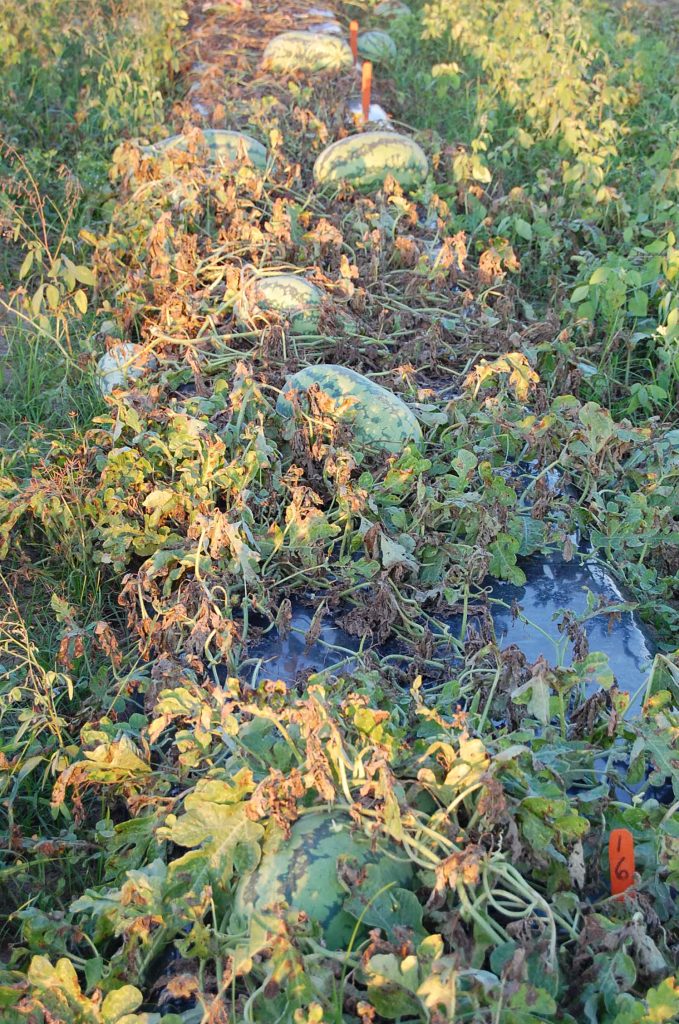
    File photo/Wilting is common in a heavy gummy stem blight outbreak.

    Rainfall over the weekend in north Florida has watermelon producers wary of potential diseases that could potentially occur. Bob Hochmuth, UF/IFAS Regional Specialized Extension agent in Live Oak, Florida, cautions farmers to look for any new symptoms that could occur.

    “Most of our fungicides are in fact preventative. Trying to play catch-up with a preventative fungicide after a disease has gotten started is not the best plan,” Hochmuth said. “There are some systemic fungicides that have good activity once we see the disease start. But for sure, we want to try to stay on a really good, early-season preventative maintenance program. What we try to do as we move into these next few weeks is to keep a close eye on new diseases and then begin to target the fungicide application to the best-case scenario for the diseases that show up.

    “We don’t have a lot of silver bullets to correct a problem once it occurs.”

    Farmers Prefer Dry Conditions

    Florida watermelon producers prefer a dry production season since the crop is vulnerable to various diseases. Farmers utilize drip irrigation to supply ample amount of water. But any extra moisture leaves the crop susceptible to potentially devastating diseases.

    “The drier conditions typically help reduce the disease pressure. The only exception to that is powdery mildew. It can still be a problem, even in dry weather,” Hochmuth said. “But the other diseases, the primary ones being downy mildew, gummy stem blight and bacterial diseases, those are all encouraged by, especially, multi-day rain events.”

    He added that watermelon fields were disease-free heading into the weekend. But chances are that could change this week.

    “There was pretty significant rainfall throughout the watermelon growing region. A little bit on Friday but pretty significant on/off showers over the weekend,” Hochmuth said. “We were clean going into the weekend I feel like. We haven’t really seen anything other than the fusarium wilt, which has nothing to do with rain.

  • Rainy Forecast: Florida to Receive Heavy Rains This Weekend

    National Weather Service/WPC forecast map

    Florida is on track to receive heavy rainfall thunderstorm activity through this weekend, says Gary England, UF/IFAS Extension Agent Emeritus.

    In his email, England alerted producers that the main precipitation accumulation is expected Saturday through early next week, mainly Monday and Tuesday. Most of north and north central Florida could receive at least two inches of rainfall with some locations receiving between four and five inches during the period. 

    According to the most recent update from the U.S. Drought Monitor, much of central and south Florida is abnormally dry.

  • Drought Monitor: South Florida Remains Abnormally Dry

    South Florida received a substantial amount of rainfall last weekend, but it still remains dry across the region. According to the Thursday’s release of the US Drought Monitor the majority of south Florida and parts of central Florida are abnormally dry. Even counties like Monroe, Collier and Palm Beach are classified ‘D1’ or in a moderate drought.

    The abnormally dry conditions extend as far north as Citrus County, Marion County, Putnam County and Flagler County.

    South Georgia still has enough moisture from the excessive rains it received in February. There are about 20 counties in north Georgia that are abnormally dry. They start in Henry County and Clayton County and extend as far east as Elbert County and Hart County.

    There is also a few counties that abnormally dry along the Georgia-Alabama line. They include Haralson County, Carroll County and Heard County.

    In Alabama, the abnormally dry counties are Cleburne County, Randolph County and Chambers County along the Georgia-Alabama state line. There is a small portion that is abnormally dry in Monrore County and Wilcox County.

  • UF/IFAS Extension Agent: Cold Damage Was Close on Watermelons

    Almost two weeks after a cold Easter weekend, North Florida watermelon producers are still counting their blessings. They understand the minimal damage their crop sustained during a chilly Easter weekend could have been a whole lot worse.

    Bob Hochmuth

    “It was really, really close,” said Bob Hochmuth, UF/IFAS Regional Specialized Extension agent in Live Oak, Florida. “Because a lot of those plants were very well established; in other words, they had a big root system and the dark plastic gives you an opportunity for a lot of warming in that root system, so they have the capacity, physiologically, to come back in a hurry. That’s basically what happened. The younger plants that were more recently transplanted are probably in a little different situation.

    “Because a lot of our crop had been planted for basically a month, the rebound was a result of the fact that we had large, well-established root systems that were able to push the crop back.”

    How Cold Was it?

    Hochmuth estimated that temperatures in the Suwanee Valley area – Levy County, Gilchrist County, Alachua County – on up to the Georgia line, the temperature range was 32 degrees Fahrenheit to 37 degrees. Most temperatures centered around 33 degrees or 34 degrees. Heavy frost was also constant throughout most throughout the area.

    Hochmuth also believes farmers will continue to see damage from the frost that didn’t show up in the first day or two. But don’t be alarmed.

    “As the crop gets older and older, we’re going to continue to see probably the remnants of damage tissue that dries out over the course of the season. We just need to have the anticipation that’s going to be the case,” he added. “It doesn’t mean that some new disease necessarily has moved in on the crop or anything like that.”

  • Timely Rainfall Just ‘What the Doctor Ordered’ for South Florida Region

    South Florida was thirsting for rainfall prior to last weekend. The abnormally dry conditions were alleviated a little bit with steady moisture that soaked the region, says Gene McAvoy, University of Florida/IFAS Regional Vegetable Extension Agent IV Emeritus.

    US Drought Monitor graphic shows how dry Florida was last week prior to the rainfall last weekend.

    “We got about an inch and a half down around Immokalee (Florida). Some places were a little better,” McAvoy said. “It was a nice soaking rain, exactly what the doctor ordered.”

    The dry weather created dire conditions for vegetable and specialty crop producers in the middle of their production season. According to the US Drought Monitor, most of the South Florida and Central Florida regions were abnormally dry last week. Some counties, like Collier County where McAvoy is located, and Monroe County, Palm Beach County and small parts of Broward County and Hendry County were classified in a moderate drought.

    “We were starting to get awful dry around here. I’ve been hearing problems with things like blossom end rot and some of those issues that you see when it does get dry and it’s hard to keep the soil moisture constant,” McAvoy said.

    The next US Drought Monitor update will be released on Thursday.

  • Georgia Fruit Crops Impacted by Cold Temperatures

    South Georgia vegetables were not the only crops vulnerable to last weekend’s chilly temperatures. Fruit in middle and north Georgia were subjected to even colder temperatures. University of Georgia Cooperative Extension Fruit Disease Specialist Phil Brannen is concerned about the state’s grape, apple and peach crops.

    Phillip Brannen

    “I think there will be some significant damage on grapes, anything that was advanced. I think most of the grapes are still not that advanced, so I’m hopeful that’s going to help. But it’s pretty cold temperatures,” Brannen said.

    Brannen said Chardonnay grapes are often the variety that comes out the earliest. It was definitely the most vulnerable to any frost damage.

    “Most of the time Chardonnay by this time would have some shoot development. Those shoots would be fried, as far as those young shoots,” Brannen said. “You can have secondary fruit production on buds. There are secondary buds that will produce fruit, but you’re going to have a much reduced crop from those secondary buds. As long as the secondary buds were not damaged, we can still have a crop of grapes even in things that were pretty far advanced.”

    Apple and Peach Crops

    The outcome may be just as significant for Georgia’s apple and peach crops.

    “When you’re looking at north Georgia, a lot of the apple trees were in full bloom. Depending on what stage they were in, they could be damaged pretty severely again this year. We had a lot of damage last year, but I think we’re going to have a good bit this year. We had two nights with really cold temperatures,” Brannen said. “I’m concerned about apples, peaches in north Georgia, same thing. A lot of them were in full bloom or just post bloom, and that kind of temperatures for as long of a period as we had is going to be pretty significant as far as damage.”

    Brannen estimated that temperatures in the north Georgia mountains dipped as low as 25 degrees or 26 degrees Fahrenheit. In Athens, Georgia where Brannen’s located, the temperature dropped to about 30 degrees. He’s concerned about middle Georgia peaches as well, where he heard temperatures dropped below 30 degrees in one orchard.

    “I’m hopeful on peaches in middle Georgia it’s just going to kind of thin them as opposed to causing major issues. But it remains to be seen,” Brannen said.

  • South Florida Producers Dealing with Abnormally Dry Conditions

    South Florida is abnormally dry. While it is not uncommon this time of year, vegetable and specialty crop producers are having to adjust with their irrigation management, says Gene McAvoy, University of Florida Regional Vegetable Extension Agent IV Emeritus.

    “It’s pretty characteristic of this time of year in South Florida. We’re in the height of our dry season now. We had a little rain with the last front that went through; anywhere from a few tenths to a half inch, but yeah, it’s dry out there,” McAvoy said.

    According to the U.S. Drought Monitor, the majority of middle Florida to South Florida is classified as ‘D0’ or abnormally dry. With hot and dry conditions being the case for most of this region, it can lead to additional concerns for farmers beyond just water needs.

    “Seasonally, we’re seeing an increase in insect pressure, particularly, things like whiteflies, worms, pepper weevils. Again, it kind of goes with this time of year. We’ve been planting since August, so populations build up,” McAvoy said.

  • Chilly Outcome: Cold Temperatures Damage Some South Georgia Crops

    watermelon
    File photo shows a young watermelon field.

    Cold temperatures and a late-season frost could lead some South Georgia vegetable producers to replant some of their crops, namely watermelons and cantaloupes.

    Bill Brim, part owner of Lewis Taylor Farms in Tifton, Georgia, said his plants survived most of last weekend’s temperature drop, other than some cantaloupe plants in Worth County.

    “Cantaloupes got burnt a little bit in some low areas as well. We’re probably going to have to reset some of those. It was over in Worth County at that real sandy farm that we’ve got. It got a little colder over there I believe than it did over here,” Brim said. “We’re going to have to reset some of those. We’re probably going to go in there and put a little extra fertilizer on them to see if we can get them going.”

    Squash was also not immune to frost damage.

    “Anybody that had any squash planted, it burnt it too. Tender vegetation just can’t take it,” Brim said.

    How Cold was it?

    According to the University of Georgia Weather Network, temperatures dropped as low as 35 degrees Fahrenheit in Tifton, Georgia on Saturday morning; 34 degrees in Valdosta, Georgia on Saturday; and 33 degrees in Moultrie, Georgia on Saturday.

    It was just as bad in other areas.

    “We’ve already had some calls. East Georgia, I think, and north Florida got hurt worse than we did. We had calls from north Florida to save all the plants that we had,” said Brim, whose farming operation also includes LTF Greenhouses that has over 900,000 square feet of production space with the capability of producing more than 350 million transplants every year. “East Georgia was the same way over around Jesup, over that way. They got hurt pretty bad, too, with the plants that they had already set out. It’s mostly watermelons.”

    Especially since South Georgia vegetable plants are still in their infancy stage at this time of year, they are vulnerable to cold temperatures.

    “If it burns that bud out, you might as well go ahead and pull it up. It just won’t ever come back, it doesn’t seem like. It splits off, and it just doesn’t work,” Brim said.

  • Weather Alert: N.C. Strawberry Farmers Encouraged to Protect Crop

    N.C. State Extension

    N.C. State Extension cautions strawberry producers to apply row covers to their plants in anticipation of freezing temperatures that will linger into the weekend.

    A freeze warning started Thursday night and will continue Friday night. But conditions will improve on Saturday, though there still is a chance for a frost from Saturday night to Sunday.

    According to N.C. State Extension, the morning of highest concern is Saturday morning. A high pressure system will allow winds to decrease and ground temperatures to cool. It is likely to be several degrees below freezing in many areas. This frost and ground freeze will extend into Georgia as well.

    Farmers are encouraged to apply double covers in areas where temperatures are forecast to be below 20 degrees. It’s also important to have sprinklers set up and in place in case they’re needed.