Category: Watermelon

  • Watermelon Board Announces First Female Board President

    Jordan Carter

    Winter Springs, FL – March 10, 2021 – The National Watermelon Promotion Board (NWPB) held its bi-annual board meeting virtually on Saturday, March 6. Board member Jordan Carter was elected President by her peers, becoming the first woman to serve in this position. Prior to this nomination, Carter (District 3, Cordele, GA) served as Secretary/Treasurer as well as interim President since January 2021. 

    “I am overjoyed and beyond honored to serve as president and want to make my time in service meaningful,” said Jordan Carter, NWPB Board President. “I am so grateful to be a part of an amazing board of directors who work hard every day to promote watermelon and all of its goodness. I am looking forward to supporting initiatives that inspire each other and to developing relationships for continued growth. Together, we can bring fresh insights and energy to carry out our shared goals of increasing demand for watermelon.”

    In addition to Carter’s nomination, Christian Murillo (District, 6 Nogales, AZ) was elected Vice President and Kelly Partch (District 5, Brawley, CA) elected Secretary/Treasurer. For more information or a full list of the Board of Directors and Committee Assignments, visit the industry section of watermelon.org or contact Summer Walker, Marketing & Communications Manager at swalker@watermelon.org.  

  • Sweet Success: Syngenta Watermelon Excursion Excels in Diverse Climates

    Watermelon research remains a key focus for scientists at Syngenta. Watermelon varieties need to withstand any type of diverse climate, especially for growers in Florida, Georgia, Indiana and California.

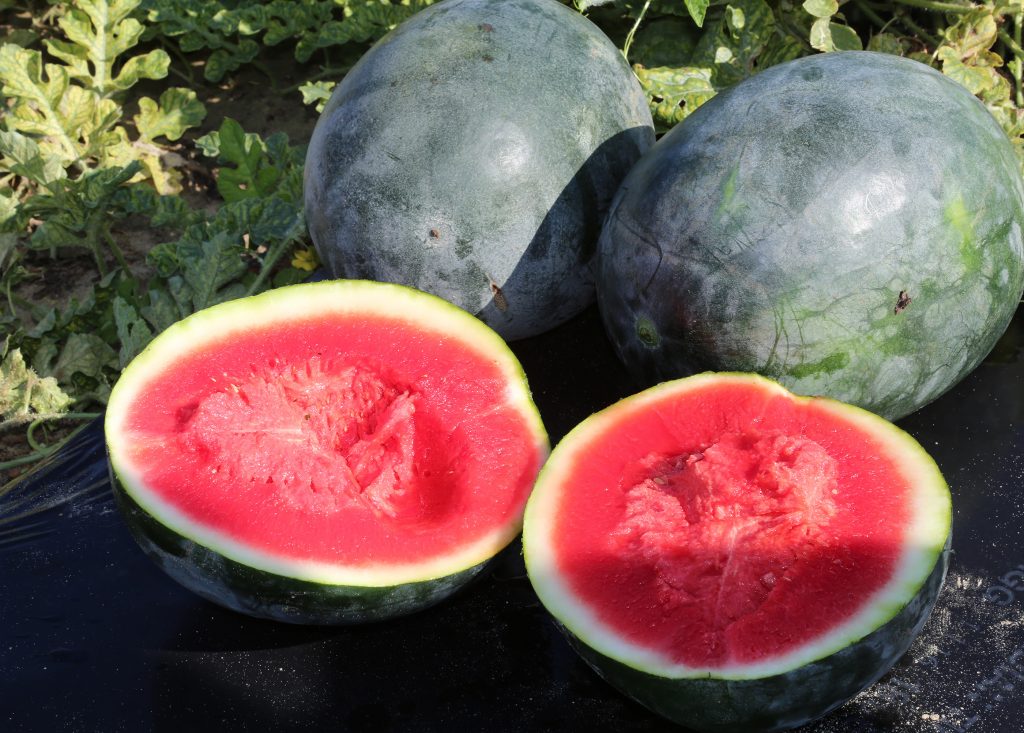
    Syngenta photo shows Excursion watermelon variety.

    Rebecca Wente-Naylor, breeding trial specialist at Syngenta, discussed the challenges of finding new varieties amid climate change during an American Seed Trade Association webinar.

    “With climate change, we’re already seeing a lot of fluctuations in temperature and weather patterns as well as some increases in extreme weather events. To combat this variability, we’re really trying to select the most resilient new varieties that are widely adapted and can withstand adverse weather conditions better than their predecessors,” said Rebecca Wente-Naylor, breeding trial specialist at Syngenta. “We do this by testing our new experimental hybrids with our current commercial growers throughout the United States.

    “A good example of this would be our watermelon variety called Excursion. I’ve seen this produce fruit in some of the worst environmental conditions from South Florida to Indiana to California. It’s really widely adapted, and honestly, seems to flourish, especially when it takes a beating.”

    According to Syngenta, Excursion is a large fruit size with 50% or more 36-count fruit. It excels in early to main season plantings and matures up to seven days earlier than the current “standard” to hit early markets.

    Maybe most importantly, it has improved disease resistance with intermediate resistance to Fusarium wilt race 1 and Anthracnose race 1. It has shown stronger Fusarium tolerance than comparable varieties.

    Watermelon Plantings

    All of South Florida’s crop has been planted for about a month. Central Florida producers normally plant in mid-February. North Florida, Alabama and Georgia are slated to start around mid-March.

  • Rapid Response: New UGA Test for Fusarium Wilt a Major Help for Watermelon Producers

    UGA CAES photo: UGA plant pathology graduate student Owen Hudson (left) and research scientist Emran Ali (right) helped develop a faster protocol for detecting Fusarium wilt disease through a PCR assay.

    University of Georgia scientists have developed a rapid test to determine the presence of fusarium wilt in watermelons.

    This test produces much faster and more efficient results and will facilitate research for breeders who are researching new varieties. They can produce options that have resistance to the disease.

    Emran Ali, head of the Plant Molecular Diagnostic Laboratory at the University of Georgia Tifton campus, said in the UGA CAES Newswire that the process takes about three hours to diagnose races, which is a major upgrade since traditional bioassays can take more than a month.

    “At the microscopic level, you can diagnose Fusarium, but you can’t differentiate the races,” said Ali in the UGA CAES Newswire. “Traditional bioassay methods have been used for this, but it takes weeks to grow watermelon plants and evaluate the disease, and watermelon cultivars used for the bioassay can be difficult to source. This method is not only inefficient, it is also sometimes inaccurate.”

    Huge Help for Farmers

    Fusarium wilt symptoms can appear at any growth stage.

    Georgia is a consistent national leader in watermelon production. The crop’s farm gate value was $180 million in 2019. If farmers know the specific race of fusarium wilt that’s in their field, they can make the right management decisions. So far, four races of Fusarium oxysporum f. sp. niveum (FON) have been identified. Some commercial watermelon varieties are resistant to races zero and one, but not races two and three.

    “Resistant watermelon varieties are effective against some races but not others,” said Ali in the UGA CAES Newswire. “If you quickly diagnose, growers can have more time in advance to know what’s going on in their fields. It’s good to know what’s going on. Watermelon varieties resistant to races zero and one are available, so you may grow resistant varieties to control disease caused by these races. Other races are more destructive and more difficult to control.”

    The new molecular detection method allows differentiation of the different races of the pathogen.

    Disease Symptoms

    Fusarium wilt symptoms can appear at any growth stage. If they appear at the seedling stage, the plants will not make it to vines. Plants infected with the fusarium wilt pathogen will eventually die if the infection is severe. The plant can produce fruit if the infection is weak, but when it begins using the energy necessary to produce fruit, the plant will likely decline and slowly die.

    Click here for more information from the UGA CAES Newswire story.

  • Georgia Watermelon Producer: We’re Not Panicking Yet

    Watermelons being researched on the UGA Tifton Campus. 6–6-17

    Georgia watermelon producers are not concerned about how excessive rains in February will impact their plantings in March – not yet anyway.

    Dick Minor, with Minor Produce Inc. in Andersonville, Georgia, says Georgia watermelon farmers are still weeks away from needing to get in the field to plant this year’s crop.

    “We’re still a couple of weeks at the earliest and really three weeks from impacting us. If it keeps like this for three or four more weeks, then it’s an issue,” Minor said. “Normally, watermelons in South Georgia are not planted, maybe a few before March 10, but most of them are started around the 15th or 20th of March. I don’t think it’s an impact yet.”

    According to the University of Georgia Weather Network, Moultrie, Georgia received 15.99 inches of rain from Jan. 1 to Feb. 23, compared to just 6.96 in 2020 and 6.61 in 2019. It is similar in Tifton, Georgia where it recorded 15.77 inches during that same timeframe, compared to 7.57 in 2020 and 5.85 in 2019.

     “We would be doing stuff to get fields ready, but it’s not to the point it’s really critical right this minute. Now, if it stays like this for a couple of weeks, it will be. But we’ve got a lot of equipment, we can get things ready in a hurry,” Minor said. “We’re not behind planting. All the plants are in the greenhouse so they’re doing fine. We’re not panicking yet. But if it stays like this a couple more weeks we will be.”

    What Does 2021 Look Like?

    According to Samantha Kilgore, executive director of the Georgia Watermelon Association, acreage was projected to decrease to about 19,000 acres last year. But most of those who produced a crop enjoyed a bountiful harvest and strong prices throughout the season. Farmers are hoping for a repeat in 2021.  

    “We think it’s going to be like normal acres. It’s all going to depend on what else is going on in the world, especially COVID,” Minor said. “If all these restaurants and food service start opening back up, it’ll be good. If a lot of the places up north stay shut down, it probably won’t be as good. We didn’t expect it to be a great market year last year and it was. There’s just no telling. There’s really no way to predict.”

  • National Watermelon Association to Hold Annual Membership Meeting

    Watermelons on display at a farm on the UGA Tifton campus. 6-14-19

    The annual membership meeting of the National Watermelon Association is scheduled to be held via conference call on Thursday, March 25, 2021 at 11 a.m. (eastern).

    The agenda will focus solely on the election of officers and executive committee members for 2021.

    Stay tuned to future updates, including the conference call information.

  • Tasty Treats: BASF Emphasizing Flavor with Melon Varieties

    BASF remains committed to improving melon varieties with an emphasis on flavor. Matthew DeCeault, produce chain specialist at BASF Vegetable Seeds, talked about the challenges that lie ahead with regards to melon research during an American Seed Trade Association webinar.

    “We’re working on a lot of things. Where we’re really focused is on improvements to flavor. Based off research that we’ve done, and I don’t think it’s come to any surprise that flavor is No. 1 in preference, flavor improvements. We continue to work on flavor to improve it, both learning from the consumer and taking those learnings back to make those incremental improvements,” DeCeault said. “Whether that’s sweeter melons or more consistent, I think those are two separate things we continue to tackle those problems with our team.”

    Melon consumption has decreased steadily since 2011, equating to a 1.7% decline per year. Cantaloupes have experienced the steepest decline at 2.5% every year. Honeydews are increasing, however, at 2.3% annually.

    Consumer Research

    BASF has conducted research to gauge people’s preferences with respect to all aspects of the consumer experience – sight, smell, flavor. The feedback led to the development of the Sweet Spark cantaloupe that should generate renewed interest in the cantaloupe market.

    “This variety, named Sweet Spark is a variety with consistent sugar, firmness, but most importantly consistent flavor. The flavor profile allows it to eat well, even in adverse conditions affecting its sugar content. Identifying these attributes and this response from consumers during tasting allowed the retailer to deliver the variety in their own label and feel confident offering the variety to consumers in the winter months,” DeCeault added.

  • Back-to-Back Bountiful Watermelon Seasons?

    Watermelons being researched on the UGA Tifton Campus. By Clint Thompson 6–6-17

    It is never too early to start thinking about watermelon season in the Southeast. After all, south Florida’s crop has been in the ground for about a month. Central Florida producers will plant in mid-February. North Florida, Alabama and Georgia are slated to start around mid-March.

    It is never too early to start thinking about another dream season to follow last year’s bountiful season.

    “I’ve been at this 40-some odd years. Could you have two bountiful years back to back? Yes, indeed. Is it likely? Probably not,” said Carr Hussey, a watermelon farmer in Florida and Alabama, chairman of the board of the Florida Watermelon Association and co-founder of Sweet Mama Produce. “That’s a very difficult question because weather is such a big deterrent. I think it’s going to be an okay year, but I don’t know if it’ll be as bountiful as last year.”

    Short Supply, High Demand in 2020

    Watermelons were in short supply last year that contributed to higher prices for Southeast farmers. Hussey predicted in May there could be a watermelon shortage by Memorial Day. Prices in mid-May were around 20 cents per pound. Florida’s watermelon supply diminished due to three straight weekends of rain events. Heavy rains on mature vines lead to a quick harvest season.

    But those farmers that had a crop were able to sell and sell at high prices for most of the season.

    “In my 40-something years I’ve seen about three of those. I hate to say it, but I think COVID had a little bit to do with it last year. People were staying home, doing more Bar-B-Quing. I really think it helped the pricing. The bountifulness was already there, but the demand was higher which kept the price good,” Hussey said. “Will that happen again this year? I hope so. I don’t hope for COVID, of course.”

    Prices also could be impacted by an increase in acres. Georgia’s acreage dropped to around 19,000 last year. It was a significant decline from the 23,000-acre average from it had from 2016 to 2018. But with word of higher prices in 2020, it should entice farmers to plant more acres this year.

    “Anytime there’s a really good year, everybody and their brother want to get on it next year. That’s what will probably deter the price from being as good,” Hussey said. “But that being said, if they don’t increase it dramatically, it’ll still be a good year; if they don’t increase acreage dramatically.”

  • Wind’s Blowing: South Florida Melons Progressing Amid Adverse Conditions

    watermelon
    File photo shows watermelon plants in a field.

    South Florida watermelons have been in the ground almost a month. Plants are progressing, but today’s cooler temperatures and strong wind has one farmer concerned potential gummy stem damage.

    “Right now, (plants are) looking pretty good. I’m just hoping that this wind doesn’t do a lot of damage. When your line is just starting to run a little bit and you get a lot of wind, that’s when you start to get some problems,” said Carr Hussey, a watermelon farmer in Florida and Alabama, chairman of the board of the Florida Watermelon Association and co-founder of Sweet Mama Produce. “Gummy stem starts to show up and stuff like that.”

    Weather Factor

    A La Nina weather pattern was expected to bring warmer and drier winter conditions across the Southeast. But that has been opposite of what some producers in Florida, Georgia and Alabama have felt so far. In South Florida, though, temperatures can increase dramatically and quickly, which could bring added stress to the plants already in the ground.

    “We’ll have days here where it’ll be a high and today’s going to be one of them, like 58 (degrees). And two days from now, but it won’t be this week, but last week was where we had a week like that; two days later we were 80, which is 10 degrees above our normal temperature. On average it was a couple of degrees higher than normal,” Hussey said.

    “The wicked witch of the north has always said when you get temperature changes like that, that’s when you have a hollow heart situation. But I don’t think anything’s been planted long enough for that to happen. Should the weather straighten out I think we’ll be okay. I don’t think anybody actually knows where hollow heart really comes from.”

    Hussey plans to plant again around Feb. 15 in Wauchula, Florida and then again in Malone, Florida and Cottonwood, Alabama on March 15. That is also about the time when most of South Georgia producers will plant their crop.

  • Whitefly Management: Sanitation Key Especially for Watermelon Producers

    Stormy Sparks’ message regarding whitefly management remains the same: If you’re done with the crop, get rid of that crop.

    Sanitation remains the best defense against whitefly buildup in Southeast vegetable and cotton crops. Even watermelon producers, who don’t have to contend with whiteflies as much as cantaloupe and cucumber farmers, are encouraged to do their part in preventing potential infestations in other fields.

    “Watermelons present a unique challenge because we’re dealing with so many more growers,” said Sparks, a University of Georgia Cooperative Extension vegetable specialist.

    “If you look at it from strictly a financial standpoint this season, in many cases there’s no emphasis on whitefly management in watermelons. But if we don’t get rid of the crop, we can distribute them on watermelons and then they can build up in those crops that are left standing and move into cotton. That’s basically what happens.”

    Sanitation is a key management strategy all farmers can implement when managing whiteflies. Once farmers are done harvesting their spring vegetables, they need to get rid of them.

    Watermelons Left in the Field

    But in many watermelon fields, watermelons are sometimes left in the field long after the final harvest. This can be largely attributed to “pinhookers” or people who buy the remaining watermelons in a field with the purpose of reselling them. However, this leaves a watermelon field susceptible to whitefly infestations since so much of the crop is left in a field for weeks, if not months.

    “You can find fields in the fall that were planted in the spring,” Sparks said.

    Whitefly Impact

    Whiteflies migrate from winter vegetables to spring vegetables to agronomic crops, like cotton, to fall vegetables and back to winter vegetables. Whiteflies cause feeding injury issues in vegetables and transmit two viruses: cucurbit leaf crumple virus and cucurbit yellow stunting disorder virus.

  • USDA Announces National Watermelon Promotion Board Appointments

    UGA CAES photo/Watermelons being researched on the UGA Tifton Campus. 6–6-17

    The U.S. Department of Agriculture announced the appointment of nine members to serve on the National Watermelon Promotion Board this week. The appointees will serve three-year terms from Jan. 1, 2021, to Dec. 31, 2023. 

    Members newly appointed or reappointed are:

    • District 1 Producer: Kyler Bishop, Punta Gorda, Florida
    • District 1 Producer: Chad Chastain, Punta Gorda, Florida
    • District 1 Handler: Stephen R. Nichols, Lakeland, Florida
    • District 1 Handler: Rob Gibson, Vero Beach, Florida
    • Importer: Matthew N. Tanner, Pompano Beach, Florida
    • Importer: Christopher M. Dyer, Mission, Texas
    • Importer: Christian Murillo, Nogales, Arizona
    • Importer: Jeff Fawcett, Edinburg, Texas
    • Public Member: Craig A. Stokes, San Antonio, Texas

    The National Watermelon Promotion Board now has 30 members composed of 10 producers, 10 handlers, nine importers and one public member. Approximately one-third of the board members are appointed each year. Members can serve up to two consecutive three-year terms.

    More information about the National Watermelon Promotion Board, including a roster of members, is available on the Agricultural Marketing Service (AMS) National Watermelon Promotion Board webpage and on the board’s website at www.watermelon.org.

    Since 1966, Congress has authorized industry-funded research and promotion boards to provide a framework for agricultural industries to pool their resources and combine efforts to develop new markets, strengthen existing markets and conduct important research and promotion activities. AMS provides oversight to 21 boards. The oversight ensures fiscal accountability and program integrity, and is paid for by industry assessments.