Category: Watermelon

  • North Florida to Feature More Late-Season Watermelons

    North Florida watermelons will be in supply later than normal, says Branford, Florida producer Laura Land. Land, who is also a member of the Florida Watermelon Association, says there will be more late-season watermelons this year in North Florida.

    “The increase in acreage that I’m seeing here in the North Florida area is pretty much that later crop,” Land said. “They’ve got their early crop like they’ve been having them, about the same acreage. Then they’ve put in 40 to 80 more acres for some later crops.”

    Additional acreage in North Florida could challenge South Georgia for the market in mid-summer. Both regions are hoping to duplicate last season’s success, where there were high yields and high prices for farmers.

    “Normally we try to be through before (Georgia) ever gets started. Georgia acreage doesn’t seem to have increased a lot. It’s staying pretty level. This (North Florida) area seems to be dropping their time back so that they’re coming in a little later,” Land said. “There seems to be a pretty good acreage. Crops all look very good. It’s acreage that’s scattered in all different ages.

    “Looks like from the 15th of May through the 15th of July, they’ll have watermelons here in North Florida.”

    Land said farmers in her region normally want to be done before the end of July, but some were still planting as of last week. That followed a freeze during Easter weekend that killed some watermelon plants. Farmers were forced to replant.

    “I think maybe acreage in the north Florida area has gone up a little bit but considerably little. It’s pretty much the same people that’s been growing watermelons, may have added 40 more acres,” Land said. “It could just be how their land worked out. Everybody in the watermelon business knows that no two years are ever the same. There’s a new challenge every year.”

    Current Market

    Land said prices are around 30 cents per pound right now with not a lot of availability. Watermelons are available mainly just in the South Florida area, around Immokalee. Land said producers in the Lake Placid, Arcadia regions should start harvesting this week or at least by the first of May.
  • Alert: Florida Watermelon Producers Wary of Increased Disease Pressure

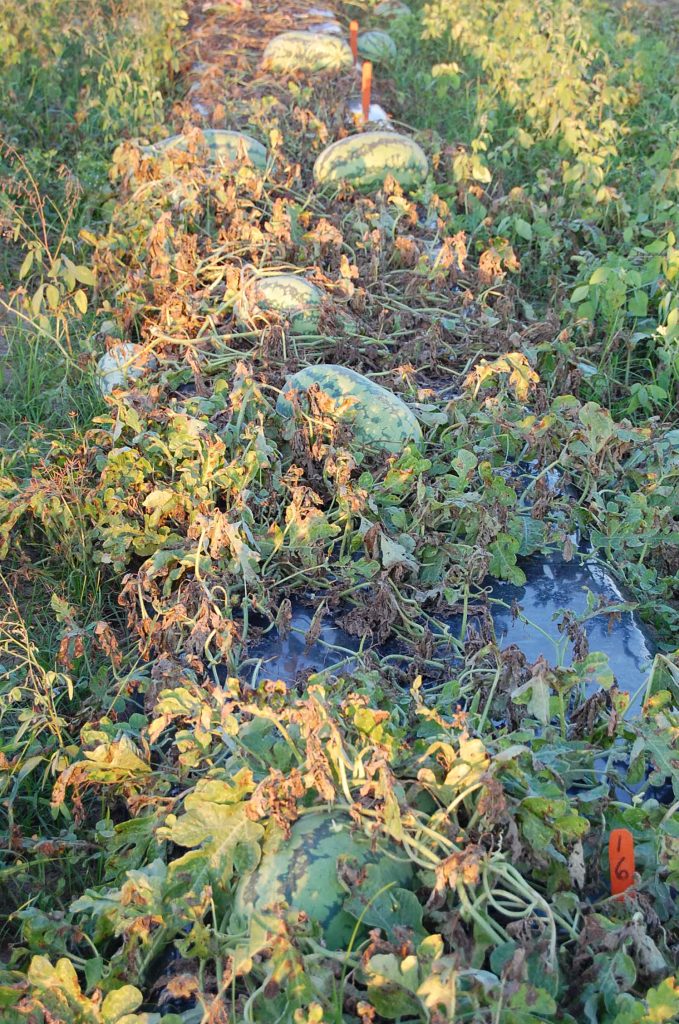
    File photo/Wilting is common in a heavy gummy stem blight outbreak.

    Rainfall over the weekend in north Florida has watermelon producers wary of potential diseases that could potentially occur. Bob Hochmuth, UF/IFAS Regional Specialized Extension agent in Live Oak, Florida, cautions farmers to look for any new symptoms that could occur.

    “Most of our fungicides are in fact preventative. Trying to play catch-up with a preventative fungicide after a disease has gotten started is not the best plan,” Hochmuth said. “There are some systemic fungicides that have good activity once we see the disease start. But for sure, we want to try to stay on a really good, early-season preventative maintenance program. What we try to do as we move into these next few weeks is to keep a close eye on new diseases and then begin to target the fungicide application to the best-case scenario for the diseases that show up.

    “We don’t have a lot of silver bullets to correct a problem once it occurs.”

    Farmers Prefer Dry Conditions

    Florida watermelon producers prefer a dry production season since the crop is vulnerable to various diseases. Farmers utilize drip irrigation to supply ample amount of water. But any extra moisture leaves the crop susceptible to potentially devastating diseases.

    “The drier conditions typically help reduce the disease pressure. The only exception to that is powdery mildew. It can still be a problem, even in dry weather,” Hochmuth said. “But the other diseases, the primary ones being downy mildew, gummy stem blight and bacterial diseases, those are all encouraged by, especially, multi-day rain events.”

    He added that watermelon fields were disease-free heading into the weekend. But chances are that could change this week.

    “There was pretty significant rainfall throughout the watermelon growing region. A little bit on Friday but pretty significant on/off showers over the weekend,” Hochmuth said. “We were clean going into the weekend I feel like. We haven’t really seen anything other than the fusarium wilt, which has nothing to do with rain.

  • UF/IFAS Extension Agent: Cold Damage Was Close on Watermelons

    Almost two weeks after a cold Easter weekend, North Florida watermelon producers are still counting their blessings. They understand the minimal damage their crop sustained during a chilly Easter weekend could have been a whole lot worse.

    Bob Hochmuth

    “It was really, really close,” said Bob Hochmuth, UF/IFAS Regional Specialized Extension agent in Live Oak, Florida. “Because a lot of those plants were very well established; in other words, they had a big root system and the dark plastic gives you an opportunity for a lot of warming in that root system, so they have the capacity, physiologically, to come back in a hurry. That’s basically what happened. The younger plants that were more recently transplanted are probably in a little different situation.

    “Because a lot of our crop had been planted for basically a month, the rebound was a result of the fact that we had large, well-established root systems that were able to push the crop back.”

    How Cold Was it?

    Hochmuth estimated that temperatures in the Suwanee Valley area – Levy County, Gilchrist County, Alachua County – on up to the Georgia line, the temperature range was 32 degrees Fahrenheit to 37 degrees. Most temperatures centered around 33 degrees or 34 degrees. Heavy frost was also constant throughout most throughout the area.

    Hochmuth also believes farmers will continue to see damage from the frost that didn’t show up in the first day or two. But don’t be alarmed.

    “As the crop gets older and older, we’re going to continue to see probably the remnants of damage tissue that dries out over the course of the season. We just need to have the anticipation that’s going to be the case,” he added. “It doesn’t mean that some new disease necessarily has moved in on the crop or anything like that.”

  • Narrow Escape: North Florida Watermelons Dodge Significant Frost Damage

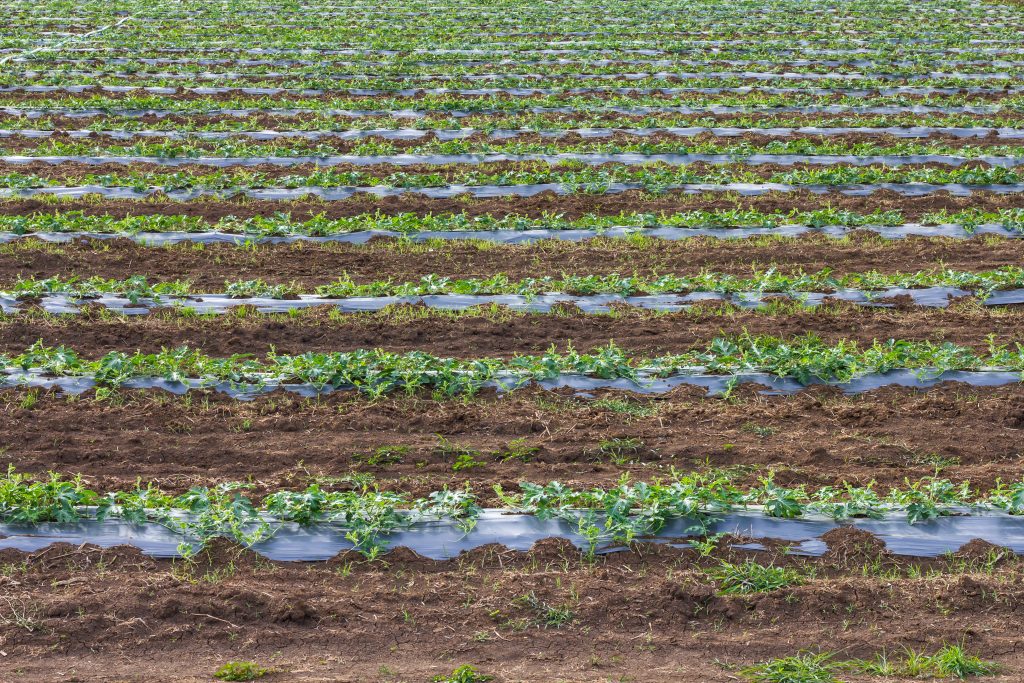
    File photo shows watermelon field.

    Watermelon farmers in Northeast Florida escaped significant damage this weekend during frost and prolonged cold temperatures, believes Bob Hochmuth, UF/IFAS Regional Specialized Extension agent in Live Oak, Florida.

    “The way that I characterize it is we escaped narrowly. I think if we had another degree or two colder or if the event had been a couple of hours longer, any one of those, I think we would have had a big mess on our hands in the case of watermelons and other vegetables,” Hochmuth said.

    He believes that though watermelons incurred some frost damage in the Suwanee Valley area, they should make a full recovery.

    “We feel like going into this cold, the root systems were well established and advanced. I think the plant is going to push back pretty rapidly. I think the recovery on those fields is going to be pretty rapid because of the warm soils, big root systems. It’ll already start to push new growth,” Hochmuth said. “In fact, from 8 o’clock to 5 o’clock on Saturday, you could actually see that growth. Maybe two or three inches of new growth just on Saturday at the beginning of that recovery.”

    Just How Cold Was it?

    Hochmuth estimates that temperatures in the Suwanee Valley area – Levy County, Gilchrist County, Alachua County – on up to the Georgia line, the temperature range was 32 degrees Fahrenheit to 37 degrees. Most of the temperatures centered around 33 degrees or 34 degrees. Heavy frost was also constant throughout most of the area.

    Hochmuth

    “We were 95% to 98% planted. A lot of those were 3- or 4-foot-long vines, with the earliest ones planted in late February, those watermelons were setting fruit. It’s a very unusual scenario,” Hochmuth said. “It’s not crazy unusual to get a freeze event in the first few days in April. But I think the thing that made it especially precarious this year is that it was so warm in February, there was a lot of acreage that was planted that normally wouldn’t be planted that early. That put the crop at an advanced state in comparison to normal for the first week in April.”

    He rode around to fields on Saturday and observed that 50% of the fields appeared untouched, while 50% ranged from slight frost damage to pretty severe damage.

    “The temperature over a plastic mulch field of vegetables is much warmer than a bare ground/pasture type of a field. As the air mass moves into the watermelon field, it’s pushing against the warm air mass over top of that field. That means where the cold air wins, you get damage on that first 50, 100, 200 feet,” he added. “That was very commonplace to what we saw around the perimeter of the fields. That’s where we saw the most damage. Where the fields are relatively protected, we didn’t see a whole lot of damage.”

    Protect Against Disease

    Hochmuth cautions watermelon producers that frost damage predisposes the crop to additional disease pressure. Producers need to return to their usual fungicide program and protect the plant from leaf tissue that’s been damaged.

  • Chilly Outcome: Cold Temperatures Damage Some South Georgia Crops

    watermelon
    File photo shows a young watermelon field.

    Cold temperatures and a late-season frost could lead some South Georgia vegetable producers to replant some of their crops, namely watermelons and cantaloupes.

    Bill Brim, part owner of Lewis Taylor Farms in Tifton, Georgia, said his plants survived most of last weekend’s temperature drop, other than some cantaloupe plants in Worth County.

    “Cantaloupes got burnt a little bit in some low areas as well. We’re probably going to have to reset some of those. It was over in Worth County at that real sandy farm that we’ve got. It got a little colder over there I believe than it did over here,” Brim said. “We’re going to have to reset some of those. We’re probably going to go in there and put a little extra fertilizer on them to see if we can get them going.”

    Squash was also not immune to frost damage.

    “Anybody that had any squash planted, it burnt it too. Tender vegetation just can’t take it,” Brim said.

    How Cold was it?

    According to the University of Georgia Weather Network, temperatures dropped as low as 35 degrees Fahrenheit in Tifton, Georgia on Saturday morning; 34 degrees in Valdosta, Georgia on Saturday; and 33 degrees in Moultrie, Georgia on Saturday.

    It was just as bad in other areas.

    “We’ve already had some calls. East Georgia, I think, and north Florida got hurt worse than we did. We had calls from north Florida to save all the plants that we had,” said Brim, whose farming operation also includes LTF Greenhouses that has over 900,000 square feet of production space with the capability of producing more than 350 million transplants every year. “East Georgia was the same way over around Jesup, over that way. They got hurt pretty bad, too, with the plants that they had already set out. It’s mostly watermelons.”

    Especially since South Georgia vegetable plants are still in their infancy stage at this time of year, they are vulnerable to cold temperatures.

    “If it burns that bud out, you might as well go ahead and pull it up. It just won’t ever come back, it doesn’t seem like. It splits off, and it just doesn’t work,” Brim said.

  • Watermelon Production Decreased in 2020

    Prices were High

    Watermelon production in the United States decreased in 2020, while prices remained strong. According to the USDA Fruit and Tree Nuts Outlook, domestic fresh-market watermelon production totaled 3,419.9 million pounds in 2020, which is a decrease of 4.4% from the previous season.

    The USDA National Agricultural Statistics Service (NASS) reported that production in 2019 was 3,579.2 million pounds, and in 2018, it was 3.914.9 million pounds.

    Production in Florida and Georgia decreased, while North Carolina increased. The USDA NASS also reported that the average price per pound was 17 cents in 2020, up 10% from the previous year.

    Watermelon imports decreased 4.1% in 2020. Mexico is once again a huge exporter of watermelons, supplying 85% of the imports into the U.S. in 2020.

    Imports were down 6.9% in January 2021, compared to 2020. Mexican shipments of watermelons in January were also 8.4% lower.

    Watermelon exports increased 11.5% in 2020.

    It was one of the few commodities not impacted by the COVID-19 pandemic. After the initial shock that did impact South Florida producers in March 2020, retail demand picked up.

    The February 2021 freeze in Texas may impact domestic watermelon supplies in future months.

  • Storage Options for Watermelons

    Watermelons being researched on the UGA Tifton Campus. By Clint Thompson 6–6-17

    From production to harvest, the battle is not yet over for watermelon farmers. There is the subject of post-harvest care, specifically, with storage options. Joe Kemble, Alabama Extension vegetable specialist, cautions growers that watermelons are not adapted to long-term storage.

    “They will last two to three weeks at most in storage,” Kemble said. “If you’re looking at long-term storage, say I’m harvesting today, tomorrow or the next day and I’m not going to market until Friday, short-term storage at 50 to 60 degrees and around 90% relative humidity is ideal,” Kemble said. “Can you store watermelons and cantaloupes together? Ideally, no. They have two different regimes of temperatures they require to really maintain their quality.”

    If watermelons are stored at low temperatures, they can be subject to chilling injury. This can cause pitting and off-flavors. They can also lose sweetness if they are stored outside in the environment, even in the shade.

    “For you as the seller or grower, you may not see the problem. It’s the end user, the person who gets it at the end and opens it. They’re the ones that’s going to see the problems if they have chilling injury or if they developed off flavors,” Kemble said.

    He also warns producers to never drop, throw or walk on watermelons. It can cause internal bruising and breakdown of the flesh.

  • How Sweet it is: Refractometers Help Melon Producers Determine Maturity

    Watermelons on display at a farm on the UGA Tifton campus. Clint Thompson 6-14-19

    Watermelon plantings are under way across the Southeast, but it’s never too early to start thinking about harvest. While maturity levels in seeded melons can be determined by thumping the melon or observing its appearance, seedless melons are not as simple.

    Joe Kemble, Alabama Extension vegetable specialist, recommends producers to utilize a refractometer to determine the brix or sweetness levels of watermelons. The sweeter the watermelons, the closer they are to reaching full maturity or being fully ripe.

    “If I’m a commercial watermelon grower, I want to have a brix meter in my back pocket. These brix meters are used to measure sweetness. If you happen to raise honeybees, there’s brix meters associated for measuring the sweetness of honey, the sugar content. They also sell them for wines and other beverages. You want one that can be used for agricultural purposes for fruit,” Kemble said.

    Sweeter the Better

    The sweeter the watermelons when they’re harvested, the better off the producer will be. Kemble said large grocery store chains desire watermelons at 10% brix or higher. A refractometer will help growers accurately determine if a watermelon is fully ripe instead of them just guessing.

    “What this requires is to sacrifice a melon or two. You go out there and do your best guessing in terms of figuring out, how close are we to harvest? You harvest one or two that look likely candidates, cut them open, take some of the tissue from the center of the fruit and squeeze it on that plate on the refractometer. You’ll close the plate and hold it out towards the sun and look through it. There’s a gauge in it, and it will show the percent brix,” Kemble said.

    Kemble recommends these seedless watermelons: Affirmed, Bottle Rocket, Crunchy Red, Fascination, Orange Crisp (orange), Superseedless series, Sweet Gem, Tri-X 313 and Troubadour.

  • What to Expect? How Watermelons Fare This Year is Anyone’s Guess

    South Florida’s watermelon crop is a couple of weeks away from harvest. Producers in that region are looking to rebound after COVID-19 decimated last year’s season.

    How will producers fare in 2021? Bob Stewart, owner of GID Farms in Immokalee, Florida, says, “You never know.”

    “You go plant them, grow them and make the best crop you can and let the market do what the market’s going to do, because you just don’t ever know,” Stewart said. “Like last year, when we started loading watermelons last year, it was about the time they shut the country down. That was a big issue with getting loaded and getting gone. The movement was just slow, slow, slow, trying to get them moved.”

    While it was a bountiful harvest and profitable market for producers in north Florida and Georgia, producers in south Florida suffered. Just as harvests ramped up across the south Florida region, the pandemic hit. Everybody stayed home and didn’t venture out to grocery stores like they used to.

    Stewart believes acreage this year will be about average.

    “I don’t think there’s going to be anybody that jumps into it real big and plant a whole lot more than just normal,” Stewart said.

    Stewart’s first plantings, which was around Dec. 20, are nearing harvest time.

    “Hopefully, we’ll be loading some by April 1. That’s the gameplan to get it kicked off in the United States,” Stewart said. “You’re trying to let the imports get done and roll into our window as that April market.”

  • Sweet Rebound? South Florida Melon Producers Hope to Bounce Back

    South Florida watermelon production could use a productive season following last year’s impact from COVID-19. Unfortunately, wind damage may derail farmers’ hopes.

    “Everything’s beat up from the wind and the cold. The crops that were planted super early more so than the ones that were planted late. I think if the weather stays like it is, the quality will be exceptionally good. But I think yields will be low,” said Greg Collier, Florida watermelon producer.

    Collier said sustained wind speeds reached 30mph with gusts of 45mph.

    “Wind is one of the hardest things there is on a watermelon, and it’s pretty democratic, everybody gets it. We might get a four-inch rain and the guy two miles down the road might miss it altogether,” Collier said. “I might frost or freeze, and you might not. But the wind is the same everywhere. Everybody gets 35mph wind and it beats them up.”

    COVID Impact

    The potential lack of yields is disheartening considering how COVID impacted the market last season. Just as harvests were beginning to start across the South Florida region, the pandemic shut the country down.

    “We experienced no business. When we were rolling into harvest last year, the market was (more than) 40 cents (per pound) on the off-shore Mexican stuff. A couple of guys in Immokalee (Florida) started a few loads and then the COVID deal hit. They sent everybody home. They went to the stores, bought up a bunch of groceries to take home with them and never came back to the stores. Then they started closing the stores down, especially in the northeast,” Collier said.

    “New York got hit real bad, which, that’s one of the prime sales areas for Florida is the New York area; Philly, Baltimore, Boston, New York City. That’s where a ton of our stuff goes to.”

    Collier plans to start harvesting fruit in South Florida in the second week in April. There is fruit on the vine now that is a little bigger than a softball.

    Collier is part of Global Produce Sales, a marketer of watermelons. They’ll have fields in Moore Haven, Florida; Plant City, Florida; North Florida, South Georgia, Indiana, North Carolina and Delaware.

    “We had a phenomenal year in north Florida and Georgia. Indiana was really good. But South Florida was not so much,” Collier said.