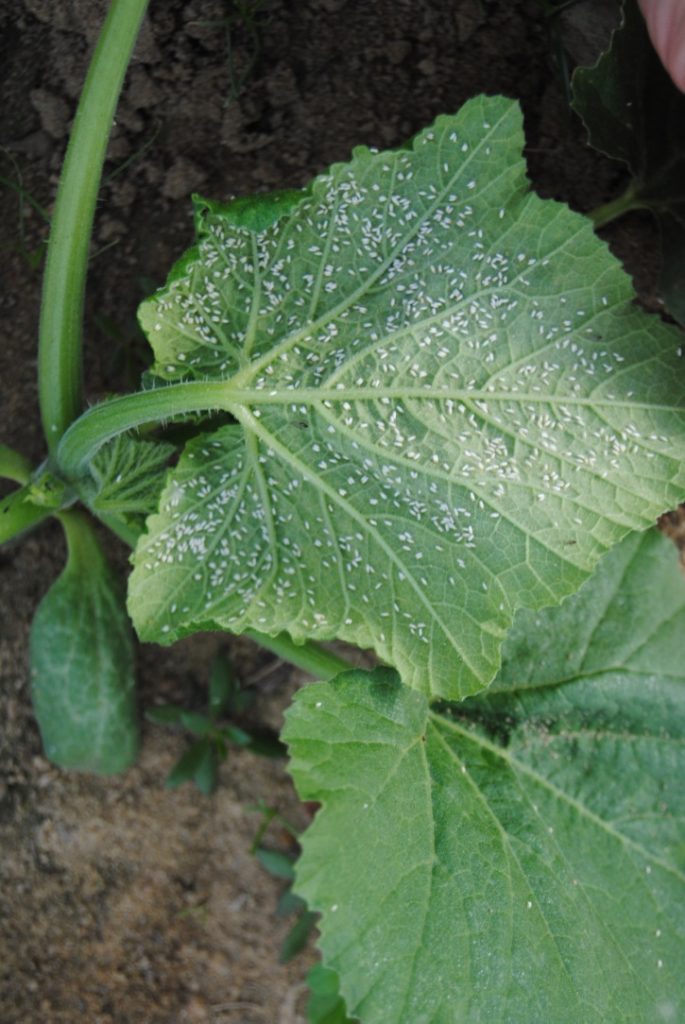
Whiteflies are not the only insect wreaking havoc on vegetable crops this fall. According to Stormy Sparks, University of Georgia Cooperative Extension vegetable entomologist, broad mites are a problem for vegetable producers.
Sparks
“I’ve had several calls on broad mites, which are a problem primarily in peppers and eggplant,” Sparks said. “Unlike spider mites, spider mites like the middle of the summer because they like hot and dry weather, broad mites don’t like cold weather but they like it a little bit cooler and humid, which is what we have now. They tend to be a fall pest. Ten years ago, you never heard about them. But I’d say in the last three to five years, it’s almost an annual event.”
Large Host Range
According to UGA Extension, broad mites have a large host range, consisting of 60 families of plants. Along with peppers and eggplants, broad mites’ vegetable hosts include beets, beans, cucumbers, potatoes and tomatoes.
Damage is especially severe in bell peppers. The damage is caused by secretion of a plant growth regulator or toxin as the mite feeds, and extensive damage can happen at very low pest density.
“They make it look like the plant has a virus, same thing with eggplant. You get distorted growth. You get distorted fruit. It makes it unmarketable,” Sparks said.
Some acaricides provide excellent control of broad mites. Examination of plant terminals is necessary to evaluate control success. Damage can continue for two weeks after successful control.
File photo shows whitefly adults feeding on a yellow squash seedling.
According to the South Florida Vegetable Pest and Disease Hotline, whiteflies are flaring up in tomatoes and watermelons in Southwest Florida. In the Central Florida area, growers indicate that whiteflies are present in tomatoes low numbers, although some of the early plantings were hit hard by whiteflies.
Tomato Yellow Leaf Curl Virus pressure remains less than 1% but it is present in nearly every planting.
Growers in Homestead, Florida indicate that whitefly numbers are present in oriental vegetables.
Management of whiteflies later in the season depends on early suppression of whitefly populations. Growers need to be aggressive with systemic materials like Venom, Sivanto Prime and Verimark, early in the season.
Proper scouting remains a viable management tactic for controlling silverleaf whitefly. University of Florida entomologists have established thresholds that have been successful for tomato producers.
For more whitefly management tips, see click here.
The Southeast Regional Fruit and Vegetable Conference includes a trade show of hundreds of exhibitors. Photo courtesy of the Georgia Fruit and Vegetable Growers Association.
It has proven almost impossible to hold in-person conferences and trade shows amid the coronavirus pandemic. The Southeast Regional Fruit and Vegetable Conference is the latest to announce its intention to transition to a virtual event in 2021.
Charles Hall, executive director of the Georgia Fruit and Vegetable Growers Association confirmed in an announcement on Monday that the event scheduled for Jan. 5-7, 2021 will be held virtually.
“The Savannah conference is a unique conference, and everybody enjoys that conference because of the networking and the opportunities to see folks and the education quality and tradeshow and industry folks there. It became quite obvious that as we worked through how we do the conference in this Corona-19 guideline, it just became an impossibility,” Hall said. “If you look at one of our classrooms where we expect to have 100 people in there, if you social distance, you can get 19 people in that room. What happens is if we work to go forward with that, you’ve got 19 people getting an education and 80 people not getting an education.
“The effectiveness and ability with the conference to function is just not possible to have it.”
Normal Attendance
A normal attendance for the conference is between 3,200 and 3,500 people. The event targets fruit and vegetable crops like watermelons, peaches, blueberries and hemp with educational sessions led by University of Georgia Extension specialists.
Over the next two weeks, the organization will provide more information on exhibiting, sponsoring and attending the virtual event in January.
One benefit of this virtual format is that educational sessions will stay online for four months.
“There’s a lot of positives to the change but the networking and atmosphere of the Savannah conference is going to be missed this year,” Hall said.
Agricultural producers who continue to face market disruptions and associated costs due to the coronavirus pandemic can sign up for the Coronavirus Food Assistance Program (CFAP 2) beginning today. Applications will be accepted through Dec. 11, 2020.
Rabinowitz
Auburn University Assistant Professor and Extension economist Adam Rabinowitz discusses the impact of this new program and how it is much different than the original.
“It is much, much broader in terms of commodities; pretty much all of the row crops are there, including cotton and peanuts for this area. The fruits and vegetables have been vastly expanded. I think there’s over 230 fruits and vegetables and tree nuts,” Rabinowitz said. “This is going to have very far-reaching effects in terms of what agricultural producers are eligible for payments through this program through the FSA (Farm Service Agency).”
Additional $14 Billion
An additional $14 billion is being made available for agricultural producers. The U.S. Department of Agriculture (USDA) will use funds being made available from the Commodity Credit Corporation (CCC) Charter Act and CARES Act to support row crops, livestock, specialty crops, dairy, aquaculture and many additional commodities.
Specialty crops eligible for CFAP 2 exclude crops with an intended use of grazing, green manure, or left standing.
Wide-Ranging Impact
The fact that this program encompasses a wider range of commodities speaks to the fact the USDA was able to really gauge the impact COVID-19 had across all agricultural spectrums.
“There were two things that were happening. For starters, the CFAP 1 program was really based on thinking about the 2019 crop and what was held in terms of inventories and what the immediate market responses were. The 2020 crop was something that was just starting to move through the system; just starting to be planted, and so there really wasn’t an opportunity to see what those market impacts would be right away,” Rabinowitz said.
“I think nobody really knew how long this pandemic was going to go and what the true impacts were. I think this speaks volumes to the fact that we know that there have been wider impacts than what was first anticipated. The fact that there are still market disruptions that are occurring. It’s creating some challenges for agricultural producers. This is a means that the USDA and president are using to try to help mitigate those effects.”
University of Georgia Cooperative Extension vegetable entomologist Stormy Sparks paints an ominous picture of the potential devastation whiteflies will have on this year’s fall vegetable crop.
“We’re probably a month ahead of the last two years. This is going to be challenging fall for whiteflies,” Sparks said.
Vegetable producers across the Southeast have either planted or are currently planting their fall crop. Sparks insists that farmers use resistant varieties when possible to protect against whiteflies and the diseases they spread. Unfortunately, there is not many that are commercially available, except in tomatoes.
“Really, when you’re dealing with viruses, particularly the whitefly-transmitted viruses, the solution to the problem is resistant varieties. The problem is in many cases we don’t have that. The one where we do have it is Tomato Yellow Leaf Curl (virus),” Sparks said. “Fortunately, we have resistant varieties in tomatoes that are commercially available. In the fall you’ve got to have a resistant variety.”
In most cases, whitefly-transmitted viruses are just as devastating as the whiteflies themselves. There is no resistance in yellow squash. In snap beans, there are severe problems with Cucurbit Leaf Crumple Virus and Sida Golden Mosaic Virus.
“With leaf crumple virus right now, in squash; I’ve been planting squash for two months, the most recent planting I’ve probably got about 20% virus right now. If you look at it historically, you go from very low to about 20%. Once you get about 20%, give it about another week or two weeks, you’re typically looking at close to 100%,” Sparks said. “As far as viruses are concerned, at this point, it’s not as bad as I thought it would already be, but I still suspect it’s going to get very ugly in the near future. We did have virus detected in the spring crops late in the season; more than normal. Dr. (Josh) Freeman down in Quincy (Fla.), said in some of his tomato trials in the spring, at the end of the season he had as much as 30% Yellow Leaf Curl Virus. Normally, it’s going to be 5% or less.”
Proper Sanitation
Sparks insists growers practice proper sanitation to protect against future whitefly infestations. Once farmers are through harvesting their crop, they need to get rid of it. If plants are left in the field, they could potentially serve as hosts for whiteflies.
Problem This Year
This is the worst year for whiteflies since 2017. They are a greater problem this year due in large part to the mild winter. While colder temperatures do not eliminate whiteflies, they do kill off many of their wild hosts and slow population development in cultivated hosts. Warmer temperatures allowed for larger whitefly populations to overwinter and become mobile earlier this summer.
Whiteflies migrate from winter vegetables to spring vegetables to agronomic crops, like cotton, to fall vegetables and back to winter vegetables. Whiteflies cause feeding injury issues in vegetables and transmit two new viruses: cucurbit leaf crumple virus and cucurbit yellow stunting disorder virus.
A yellow squash plant is infected with whitefly-transmitted cucurbit leaf crumple virus. Discolored fruits are typical following infection with this virus.
One of the best management tactics for vegetable growers when dealing with whitefly infestations is to get rid of any plants left in the field once harvest season is done. University of Georgia Cooperative Extension vegetable entomologist Stormy Sparks continues to preach proper sanitation to producers amid the worst whitefly outbreak in Georgia since 2017.
“This is really for all pests but definitely for whiteflies, when you get done with a crop and if you’re not managing that crop for whiteflies and it’s a crop that hosts whiteflies, you need to get rid of it as soon as possible,” Sparks said. “It needs to be destroyed so it cannot harbor or produce any more pests. That really should become a priority. In vegetables, getting a crop in on time is just paramount, nothing stops that. We really need to move towards that as far as getting crops out as well.”
Huge Problem This Year
Whiteflies are a greater problem this year due in large part to the mild winter. While colder temperatures do not eliminate whiteflies, they do kill off many of their wild hosts and slow population development in cultivated hosts. Warmer temperatures allowed for larger whitefly populations to overwinter and become mobile earlier this summer.
Whiteflies migrate from winter vegetables to spring vegetables to agronomic crops, like cotton, to fall vegetables and back to winter vegetables. Whiteflies cause feeding injury issues in vegetables and transmit two new viruses: cucurbit leaf crumple virus and cucurbit yellow stunting disorder virus.
By G.E. Vallad, J. Desaeger, J. Noling and N. Boyd
Vegetable and strawberry growers have long relied on soil fumigants to contend with various soilborne pathogen and pest complexes, as part of an integrated management strategy that includes crop resistance, cultural control and pesticides. However, with the loss of methyl bromide (MBr), many growers have struggled to maintain consistent soilborne pathogen and pest control with the available fumigants.
Much of this relates to the inability of available fumigants to disperse throughout the soil in the same manner as MBr. This is due to the physical differences in volatility, as revealed by comparing the vapor pressure and boiling points (see Table 1) of currently available fumigants to MBr and water. Volatility is the tendency of any substance to convert to a gas at a given temperature and is directly related to the substance’s specific vapor pressure, which is inversely related to boiling point.
Figure 1. The Yetter Avenger Coulter system has a pair of coulters straddling the raised bed. Final application depth is greater than 8 inches below the soil.
By comparing vapor pressure and boiling point values of fumigants to water, it is easier to understand why the current fumigants are referred to as volatile liquids. Vapor pressure values for Pic and 1,3-D are on average 70-fold less than MBr at 20° C (68° F), and the ITC generators are even less volatile with physical characteristics more similar to water. MBr, as a true gas, would rapidly volatilize from a liquid once applied to the soil and quickly fill available airspace within the soil profile. In comparison, all the current alternatives remain liquid following application and then slowly volatilize. These physical characteristics limit fumigant movement within the soil of the prepared, raised bed.
Figure 2. Roots are emerging below the plastic tuck from the side of the bed.
Unfortunately, threats from soilborne pathogens and pests are not always limited to the immediate raised bed. For example, research previously demonstrated that supplemental applications of chloropicrin along bed edges below the tuck (Figure 1) protected tomato roots emerging from the fumigated bed into non-fumigated soils (Figure 2), which subsequently reduced the incidence of fusarium wilt (Figure 3). Similarly, research demonstrated that deep-shank soil applications of 1,3-dichloropropene (Telone) (Figure 4) were necessary to manage nematode populations deeper in the soil, below raised beds, that were beyond standard in-bed fumigant applications (Figure 5).
Figure 3. A field trial demonstrates the supplemental application of Pic 100 to bed edges compared to the grower standard of Pic-Clor 60 alone.
FIELD TRIALS Many operations have problematic fields with a complex of soilborne pests and pathogens. Large replicated field trials were recently conducted to address such situations, combining both supplemental approaches in tomato fields affected by root-knot nematodes and fusarium wilt. Combinations of deep-shank Telone II, with in-bed fumigation, supplemental chloropicrin and plastic mulch [virtually impermeable film (VIF) vs. totally impermeable film (TIF)] were evaluated.
Figure 4. A broadcast, deep-shank application of Telone II (inset shows applicator). The tractor at top is making a 16 to 18-inch application at 12 gallons per acre, followed by a disk to disrupt chisel traces (center pass) and then packed with a roller to seal the fumigant (bottom pass).
Two fields received deep-shank applications of Telone II (12 gallons per acre) in 600-foot by 50-foot strips alternated with 50-foot non-fumigated strips across the entire field. A month later, raised beds prepared over the Telone II strips received in-bed applications of either Pic-Clor 60 (300 pounds per acre), Pic-Clor 80 (225 pounds per acre) and Pic 100 (180 pounds per acre) with supplemental application of Pic 100 along the bed edge (150 pounds per acre).
Raised beds prepared over the non-Telone II strips received Pic-Clor 60 (300 pounds per acre) either with or without the supplemental Pic 100 along the bed edge as additional controls. Each of the described combinations were covered with both TIF and VIF plastic mulch (for a total of 10 treatments) and then planted accordingly. Each treatment plot consisted of three beds (approximately ¼ acre) and was replicated five times in each field.
RESEARCH RESULTS Two weeks after deep-shank applications of Telone II, deep soil cores pulled across fumigated and non-fumigated portions of the field found total nematode levels (including parasitic Meloidogyne species) were reduced by 82 percent, from an average of 8.3 nematodes per 100 cubic centimeters of soil to 1.1 nematodes. The reduced nematode counts were further reflected at the end of the season with a 97 percent reduction in root-knot galling between deep-shank Telone II and non-deep-shank fumigated plots.
Figure 5. A demonstration of deep-shank applied Telone II on root-knot nematodes in cucumber. Telone was applied perpendicular to raised-bed preparation. The image shows a strip where the deep-shank applicator was turned off.
Supplemental Pic applications reduced average root gall ratings 24 percent and reduced average fusarium wilt incidence by 47 percent. Unexpectedly, deep-shank Telone II applications had the greatest statistical effect on fusarium wilt, reducing disease incidence by 66 percent, from 19.4 to 7.5 percent average incidence across all treatments. In-bed fumigants also had a significant but minor effect on average root gall ratings and fusarium wilt, with in-bed Pic-Clor 60 and Pic-Clor 80 performing better than Pic 100.
Statistically, mulch had no effect on nematode gall ratings, fusarium wilt or yields. In-bed fumigation had numerical but no statistical effect on tomato yields. A replicated lab study further demonstrated the fungicidal activity of 1,3 dichloropropene (Telone II) against Fusarium oxysporum f. sp. lycopersici. Several other studies have reported similar findings for 1,3 dichloropropene against soilborne pathogens and for chloropicrin against nematodes.
CONCLUSION These findings further support the notion of developing supplemental fumigation strategies that target soilborne pests and pathogens at their source. These supplementary approaches are meant to be prescriptive in nature, based on the specific soilborne pest or pathogen problems observed in fields.
Current and future research will address the frequency of supplemental fumigation and the use of other fumigants, as well as reducing in-bed application rates to help offset the cost of supplemental fumigation. Improvements in available post-plant fungicides and nematicides may also change fumigation strategies, as well as the availability of crop varieties with improved tolerance to soilborne pathogens and pests. Parties interested in participating in such studies are welcome to contact Gary Vallad at gvallad@ufl.edu or 813-419-6577.
While the normal time to plant turnip and mustard greens is now, Joe Kemble, Alabama Extension vegetable specialist, advises farmers and homeowners to wait a few weeks so temperatures can cool off.
During a webinar on Aug. 19 that can be accessed on the Alabama Extension Commercial Horticulture Facebook page, Kemble said growers typically plant both greens in August through October, but high temperatures can impact stand establishment if planted too early.
“I will say with the temperatures where they are right now, I’m going to want to hold off probably until mid-September before I start actually sewing these. Unfortunately, one of the issues you run into with cole crops is there can be an inhibition of the seed to germinate well when the soil temperatures are very hot. When the soil temperatures are above 85 or so they can really affect your stand establishment,” Kemble said. “My tendency is to wait for things to cool off a little bit. It doesn’t mean you can’t do it but what normally happens is you just don’t get a very good stand compared to what you would normally get under cooler soil conditions.”
Kemble reminds growers that when they begin planting their fall crop, yields are better if planted in rows. The greens attract fewer disease issues and it produces a more uniform crop.
Top mustard green varieties include Florida Broadleaf, Green Way, Savannah, Southern Giant and Red Giant (red-leaf type). Top turnip greens include Alamo, All Top, Just Right, Purple Top White Globe, Seven Top, Shogoin, Southern Green, Top Star, Topper and Tokyo Cross.
The 2020 Citrus Expo and Vegetable & Specialty Crop (VSC) Expo will be held Wednesday and Thursday, August 19-20. Due to COVID-19, this year’s event has transitioned to a virtual format, but growers can still get the same great Expo experience they are accustomed to.
Both the citrus and VSC seminar programs will debut online at CitrusExpo.net at 9:30 a.m. Eastern both mornings. Attendees will be able to view videos of the research presentations from their computers or cell phones. Those who attend the seminars as they debut online will be eligible to win one of four $200 gift cards from Bass Pro Shops.
One of the most anticipated features of the event will also be held virtually, as the trade show will take place. You can connect online with vendors to find every imaginable product or service your operation could ever need. Growers will be able to visit the online exhibitor corner to view videos from suppliers and obtain information about their latest products. There will be 15 premier exhibitors in the lineup with links to forms that growers can fill out. Growers who visit at least five premier booths and fill out the forms will be entered to win a $100 Bass Pro Shops gift card.
The exhibitor corner will also debut online at 9:30 a.m. EDT at CitrusExpo.net on Aug. 19–20 along with both the citrus and VSC seminar programs. But while the seminar programs will be available throughout the end of the year, the exhibitor corner will only be offered Wednesday and Thursday, so don’t miss out. AgNet Media would like to extend a special thanks to the exhibiting vendors and sponsoring companies who are investing in the event and the Expo attendees.
Bell pepper roots (left) show severe galling caused by the southern root-knot nematode compared with healthy roots (right) treated with Pic-Clor 60.
By Abolfazl Hajihassani and Chinaza Nnamdi
The majority of vegetable production in Georgia is located in multiple counties in the southern region of the state. Vegetables are grown year-round on both raised beds covered with polyethylene plastic mulch and on bare ground.
Using a comprehensive survey conducted in 2018, we have documented that root-knot nematodes, Meloidogyne spp., are the No. 1 nematode pest in vegetable crops in Georgia, infecting 67 percent of the fields surveyed. Therefore, proper management practices need to be developed or optimized for successful control.
CONTROL OPTIONS
Chemical control is currently the best option for managing nematodes in vegetable-producing systems. Optimizing chemical control methods is a must for vegetable growers in the Southeast. Growers often fumigate the soil prior to planting the first crop in the spring or in the fall, but the issue with root-knot nematodes is particularly important in the second, third or fourth crop grown on the same plastic mulch. Reusing mulch favors nematode buildup in coarse-textured soils.
In Georgia, 1,3-dichloropropene (Telone II), chloropicrin, mixtures of 1,3-dichloropropene and chloropicrin (e.g. Pic-Clor 60), metam sodium (Vapam) and dimethyl disulfide (Paladin) have been the common fumigants for the control of soilborne pathogens, weeds and nematodes in vegetable-production systems.
In a field study conducted at the University of Georgia Tifton campus in 2019, we evaluated the effects of different soil fumigants on the southern root-knot nematode and yield of bell pepper. Treatments included Telone II (125 pounds per acre), Dominus (250 pounds per acre), Pic-Clor 60 (175 pounds per acre), Paladin (167 pounds per acre) and an M. incognita-resistant pepper cultivar (Carolina Wonder).
RESEARCH RESULTS
Results showed that all soil fumigants and the resistant cultivar reduced root galling compared to the untreated check at harvest. Pic-Clor 60 had numerically better control of root galling compared to the other fumigants. At the end of the season, second-stage juveniles of the nematode in the soil were only lower than the untreated check in the resistant pepper treatment. Among the fumigant treatments, Paladin had numerically lower nematode numbers in comparison with the other fumigants. We also found that Pic-Clor 60 and the resistant cultivar had the highest and lowest pepper fruit yield, respectively.
Based on our data, treatments with Dominus and the resistant variety had the highest weed density. Plots treated with Pic-Clor 60 had the lowest weed density. There was no difference in weed density among Paladin, Telone II and the untreated check. The weed population in the Dominus treatment was higher than the check plot. Soil fumigation with Pic-Clor 60 reduced southern blight disease, caused by the fungus Athelia rolfsii, as compared to other treatments.
Paladin, though effective in suppressing nematode juveniles in the soil, was withdrawn from the market in 2019, further restricting the already limited number of tools for managing nematodes. Pic-Clor 60 is likely an ideal fumigantfor control of root-knot nematodes and other soilborne pathogens in multi-cropping systems of vegetables. However, root-knot nematode population densities in plots treated with Pic-Clor 60 were increased by the end of the growing season. This may suggest that combined use of fumigants and post-plant nematicides through drip irrigation could provide enough root protection against high densities of root-knot nematodes in the first and subsequent crops grown on the same plastic mulch.
In collaboration with county Extension agents, two on-farm trials are currently being conducted in Brooks and Lowndes counties in Georgia. The objective is to examine whether the combined application of both fumigant and non-fumigant nematicides in the first crop can result in a more effective control of root-knot nematodes and higher crop yield, compared to the use of only fumigants in the first crop and only non-fumigant nematicides in the second crop grown on the same plastic mulch.