Georgia vegetable growers will vote Feb. 1 through March 2, 2021 to determine the continuation of the Georgia Vegetable Commission marketing order which allows assessment of one cent per marketing unit of vegetables as described in the current marketing order.
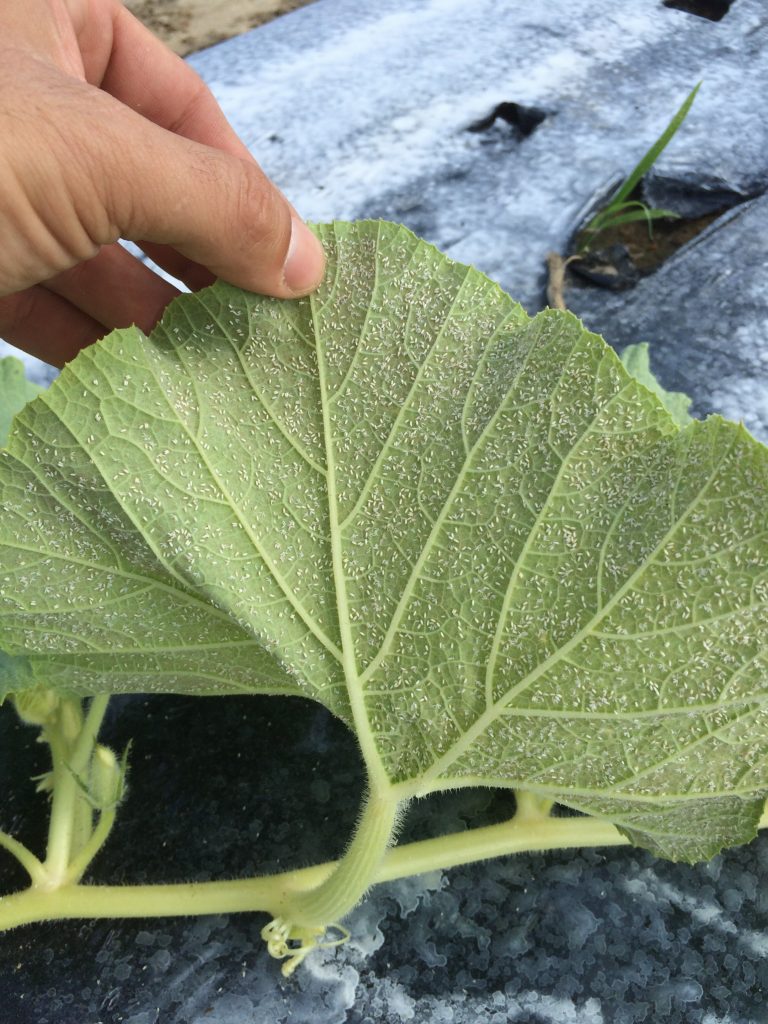
Photo submitted by UGA’s Stormy Sparks/Shows whiteflies on a vegetable plant.
The marketing order applies to growers with 50 acres or more of total annual production of the following crops – beans, bell pepper, specialty pepper, broccoli, beets, cabbage, cantaloupe, carrots, cucumbers, eggplant, greens (including collards, turnip greens, mustard and kale), squash (including yellow, zucchini and winter squash), sweet potato and tomato.
Funds collected by the Georgia Vegetable Commission are used for research, education and promotion of the crops mentioned above. It is the policy that the commission allocates at least 75% of money collected toward research projects by the University of Georgia and other research institutions that best serve Georgia growers. Some of the areas previously funded have focused on whiteflies, fungal disease diagnoses and control, viral diseases, variety development, fumigation, and weed control.
The Georgia Vegetable Commission was established by the Georgia General Assembly in 2006 at the request of the Georgia vegetable growers. The marketing order must be reapproved by vote of the eligible vegetable growers every three years by a two-thirds affirmative vote.
If you are a qualified grower and have not received a ballot in the mail by Feb. 10, please contact Andy Harrison:
According to N.C. State Extension, the new Southeastern Vegetable Crop Handbook is now available online. Extension vegetable specialists across the Southeast come together annually to update this handbook.
In addition to vegetables, garlic, some culinary herbs and hops are also included. There will be a limited number of hard copies available. Due to the lack of in-person vegetable grower meetings this season, they will probably be distributed through your local North Carolina Cooperative Extension offices. More information will be posted on that when it is available. And a big thank you to Vegetable Growers News for partnering with us on this project!
Photo by Clint Thompson/Shows Madeline Dowling, a Clemson student, makes a presentation about the MyIPM App.
This year’s virtual Southeast Regional Fruit and Vegetable Conference ends today with hopes of returning to an in-person format in 2022.
Charles Hall, Executive Director of the Georgia Fruit and Vegetable Growers Association, believes the educational sessions that were offered over the course of the three-day event are invaluable for producers this year and moving forward in upcoming growing seasons. More importantly, those educational sessions will be available for viewing even after the conference concludes.
“One of the keys of the Southeast Regional Conference is education. We still had over 100 hours of education that is being offered. The good thing about it is that education continues until April 30. If people missed a class, they want to go back and listen to that instruction again, it’s going to be there on the (virtual) platform,” Hall said.
“People can go back if they’ve registered for the conference, or if they wanted to register after the conference. Somebody that didn’t get to be on the conference this week, they can still register and go back and have the livestreaming of those sessions.”
This week’s conference was changed to a virtual format amid COVID-19 concerns.
Syngenta had a chance on Tuesday during the Southeast Regional Fruit and Vegetable Conference to showcase several new vegetable products that are sure to benefit vegetable and specialty crop growers in the Southeast.
Prevail
Prevail is a popular new beans variety that’s adaptable to a wide range of growing conditions. It produces slim, very dark green pods. In trial data, it reached maturity in 54 days and has an average pod length of 5.5 inches.
Payout
Payout is a spineless squash that matures in 45 days. The open plant produces cylindrical fruit that reaches 6.7 inches in length.
Grandprize
Grandprize is a straightneck squash that produces high quality fruit with a glossy deep yellow appearance. It boasts an enhanced disease package. The vigorous plant delivers solid yield performance over other yellow straightneck varieties.
Powerhouse
It won’t be long before watermelons are planted for the upcoming season. Powerhouse is a variety that should be considered for planting. It reaches maturity in 86 days and weighs between 13 and 16 pounds. It can develop sugars early, allowing for potential early harvest. It has a thick rind for improved shipping. It has high yield potential and full flavor.
Will Gay
“In our watermelon portfolio, we’re really excited about adding Powerhouse,” said Will Gay, a PDS in Georgia with Syngenta. “This variety is three days earlier in maturity than Captivation. With it being 86 days, it’s right between Fascination and Captivation in maturity. It is a main 45-count watermelon and it is improved on size than some other varieties that we’re competing with that may have more 60 counts. This is a good 45-count melon.”
The 2021 Southeast Regional Fruit and Vegetable Conference is normally held in January in Savannah, is being held virtually this year due to COVID-19 concerns. The three-day event will be held through Thursday, Jan. 7.
For more information, or to register for the event, click here.
The 2021 Southeast Regional Fruit and Vegetable Conference is underway. The conference, which is normally held in January in Savannah, is being held virtually this year due to COVID-19 concerns. The three-day event will be held through Thursday, Jan. 7.
For more information, or to register for the event, click here.
With an interest in wildlife while possessing an expertise in food safety, Kristin Woods is concerned about risks bird populations have on fruit and vegetable production in the Southeast.
“It is possible to do both, have safe produce and maintain habitat for birds and other wildlife. But it really is an area we need more research in to know how to do that safely,” said Woods, Alabama Regional Extension agent, who specializes in food safety.
Does clearing habitat around produce fields put vegetable and specialty crops more at risks of birds potentially carrying deadly pathogens? On the other hand, if the natural habitat is left alone, are crops less at risk to be impacted? Those are questions Woods hopes to answer and will talk about further during the Southeast Regional Fruit and Vegetable Conference on Thursday at 4 p.m.
“I’m interested in ways that our commercial produce growers can maintain habitat for wildlife, as well as pollinators that they need for their produce without increasing food safety risks. There has been some line of thinking that clearing habitat is safer. Some of the emerging research is indicating that is not the case. When you clear habitat … you shift the species of birds into species that are more likely to carry pathogens,” Woods said.
“If we can maintain woody areas and habitats around our growing areas, then we attract native species of birds that have lower pathogen prevalence. They’re also species that are less likely to be visiting areas that have livestock. They’re less likely to be carrying things like E. coli and salmonella.”
IPM Strategy
Organic producers can also potentially incorporate birds into their integrated pest management (IPM) strategy if a natural habitat is maintained. It’s similar to how insects are used in an IPM system.
Chard and cauliflower crops show signs of freeze injury.
By Pam Knox and Tim Coolong
Untimely freezes can cause tremendous problems for fruit and vegetable crops.
Fall freezes quickly put an end to the growing season for most fruits and vegetables. If freezes come earlier than expected or before the crops are ready for harvest, they can provide a devastating blow to yields and reduce the value of the crops. Spring freezes may destroy blossoms on plants that have recently broken dormancy, reducing yield by eliminating potential fruit or destroying young plants.
Growers are sometimes able to reduce the impact of freezes by using frost- and freeze-protection measures to increase temperatures near the crops and prevent damage due to freezing temperatures.
TYPES OF FREEZES
There are two main types of freeze that can occur in fields, and freeze-protection methods depend in part on what type of freeze is expected to occur.
Mustard greens that were cultivated prior to a freeze resulted in some plant damage.
An advection freeze is caused by cold and dry air moving (“advecting”) into the production area, replacing the warmer, moister air that was already in place. An advection freeze is commonly associated with moderate to strong winds, a well-mixed air mass that does not have a temperature inversion, and low humidity. Temperatures will drop below freezing and may stay that way for an extended period.
It is difficult to protect against an advection freeze because the wind blows added heat away from the crops and makes formation of protective ice from sprinklers difficult. The lack of a temperature inversion means that wind-moving devices like tall fans or helicopters do not have access to a warmer layer of air to mix with surface air. The dry conditions also mean that irrigation is often not effective at keeping temperatures above freezing, which can lead to ice loading on the plants as the sprinklers try to keep up.
Radiation freezes occur when the sky is clear and winds are calm to light. Temperatures drop because with clear skies, radiation from the earth’s surface can quickly allow energy to escape to space. The coldest air tends to flow downhill because it is denser than the air around it, pooling in the lowest-lying areas (sometimes known as “frost pockets”). Radiation freezes are often accompanied by a temperature inversion aloft. This is a layer of air above the surface that is warmer than the air near the ground.
One freeze-protection method is to mix warmer air down to the ground using fans or helicopters, keeping the surface air warmer. Frost-protection methods are generally more effective in radiation freezes than in advection freezes, especially when strong inversions with plenty of warm air are present. Sometimes a night with cold air blowing into an area results in an advection freeze occurring the first night followed by a radiation freeze the second night when the winds die down. Therefore, growers may need to be prepared for both types of freezes.
FREEZE-PROTECTION METHODS
If temperatures are not expected to be much below freezing, heating at ground level can be employed to keep temperatures higher. This can be done using orchard heaters or even burning debris or bales of hay in open areas of the field to be protected. This method can be helpful when a radiation freeze is occurring, especially when a strong inversion is present to trap the heat near the surface, but it loses effectiveness with strong winds. It also puts out a lot of pollution and can be expensive to maintain because of the fuel and labor needed to keep the heaters burning.
If a strong inversion is present, methods for mixing the warmer air down to the surface can be used. This can include both wind machines such as large fans or helicopters. Helicopters have the advantage of being portable but are expensive to operate. Wind machines can be permanent installations or can be mobile, but only cover a limited area. If the inversion is weak, a wind machine could make matters worse by increasing evaporative cooling through the movement of the air.
Irrigation can be an effective tool for freeze protection if it is able to be applied at a rate that “keeps up” with the freezing conditions. The irrigation is applied continuously to the crops, forming ice on the crops which releases heat to the air around those crops by the latent heat released by changing liquid water into solid ice. The plant material under the ice is kept near freezing by the ice cover and transfer of energy into the plant.
Row covers can provide plants with some protection from frost, wind and insects.
If the air conditions are windy, air will mix with the ice, forming cloudy ice that is less effective at protecting the plants, which reduces their ability to survive the frost. Clear ice is a sign that the freeze protection is likely working. If the air is low in humidity, irrigation is not very successful because most irrigation systems cannot put out water at a high enough rate to keep up with the effects of the cold air. If the dew point temperature of the incoming air is below about 22° F, then irrigation is unlikely to be effective. Even higher dew point temperatures are no guarantee that irrigation will work, especially in an advection freeze where wind is a factor.
Sometimes growers will use center pivots to irrigate prior to a freeze event. Center pivots move far too slowly to directly protect a crop as described above. However, in some cases when the soil is dry, adding moisture to the soil can help it retain heat from the day, which can provide some protection in the evening. When the soil is already wet, further irrigating it will not help.
Covering plants with plastic tarps or row covers has been used with varying success. A plant can be covered by mulch or a cover overnight to keep the cold air from hitting the plant. The cover (particularly clear plastic) must be removed the next day or sunlight will heat the cover, causing potential damage to the plant from excessive heat. Floating row covers that allow 2 to 4° F of freeze protection and have various degrees of light transmission can be purchased and easily moved around fields. Row covers also provide some protection from wind and insects. Mulch or plastic covers will be most effective when the ground has been warmed by the sun during the day. They are also aided by moist soil conditions, which help hold heat in the ground.
Other methods such as cultivating ahead of a frost or spraying chemicals to prevent frost formation on the leaves have been tried by some growers. However, they have not proven to be effective in field trials and could cause additional damage to the plants, so should be undertaken with caution. In some cases, cultivation can expose roots to freezing temperatures and cause further damage.
See secure.caes.uga.edu/extension/publications/files/pdf/B%201479_1.PDF for more information about freeze-protection methods and how to run a frost protection irrigation system.
Root-knot nematodes (Meloidogyne spp.) are one of the most rapidly spreading of all pests and pathogens. The southeastern United States (Florida, in particular) is a paradise for these parasites. Nematodes cause damage to vegetables all over the world, and anyone who has had to deal with root-knot nematodes knows how difficult they are to control.
Root-knot nematode damage is often not recognized and is frequently confused with other biotic or abiotic problems, such as disease, nutritional and watering issues. When nematode populations are high and weather and soil conditions are favorable, root-knot nematode damage can become so bad that total crop loss occurs. This is especially the case when soils are already warm at planting or when a double crop is planted on the same bed.
Soil fumigants like Telone-chloropicrin mixtures and metam-based products like K-Pam are the most effective products when nematode pressure is high. Deep-shank (18-inch) injections of Telone can provide additional control in problematic fields by targeting nematodes that hide in the subsoil. Fumigants must be applied at least three weeks before planting to avoid phytotoxicity to the crop.
NEW NEMATICIDES
In the past, when beds were not fumigated, nematicide options for vegetable growers were limited to Vydate (oxamyl) and a few biological products. Over the past years, two new nematicides, Nimitz and Velum, have become available for vegetable growers in the Southeast. The new nematicides are less toxic and have a safer label (caution instead of danger) than previous products. They can easily be applied through drip irrigation systems. These nematicides should not be considered fumigant replacements, as they will target only nematodes. Additional measures need to be taken to manage soil diseases and weeds.
Nimitz should be applied seven days before planting to reduce the risk of phytotoxicity to the crop, while Velum can be applied before and after planting. Fluopyram, the active ingredient in Velum, is the same as in the fungicide Luna, although no clear evidence of soil disease control was observed for Velum in University of Florida Institute of Food and Agricultural Sciences (UF/IFAS) experiments. Care should be taken not to exceed the maximum annual use rate of fluopyram when using both Luna and Velum.
Both Nimitz and Velum have been extensively tested at the UF/IFAS Gulf Coast Research and Education (GCREC) farm and are currently being evaluated in commercial fields. Their performance against root-knot nematodes on a variety of vegetables such as tomato, cucumber, squash, cantaloupe and watermelon was generally good and comparable to Vydate. Unless nematode pressure is too high, these products are a good alternative for growers that cannot or do not fumigate, or they may provide additional nematode control after fumigation when nematode pressure is high or long-season control is required.
ORGANIC OPTIONS
For organic growers, several biological products are available. They can be toxins derived from plants, bacteria or fungi while others are biocontrol organisms such as several species of bacteria and fungi. Some product names are ProMax, Kyte Gold, Ecozin, Dazitol, Majestene, DiTera and MeloCon. Typically, organic nematicides require multiple applications. In conventional production, they can be used as part of a program with chemical nematicides. Research into organic nematicides’ potential is ongoing at the GCREC and will be reported in future updates.
Root-knot nematode damage on tomato
Cover crops can also be good options to include in a nematode management plan. Summer cover crops like sunn hemp and sorghum-sudan grass can help reduce populations of most species of root-knot nematodes. The most common species in the Southeast are the southern (M. incognita), Javanese (M. javanica) and peanut (M. arenaria) root-knot nematodes. Often, vegetable fields will harbor more than one of these species. However, many more species exist.
In Florida, more than 15 root-knot nematode species have been found, including seven in vegetables. One particularly virulent and aggressive species is the guava root-knot nematode (M. enterolobii). This nematode has become a serious concern for the sweet potato industry in the Southeast and can cause severe damage to almost all vegetables grown in the region.
RESISTANT CULTIVARS
Vegetable growers that fumigate may not care much what species of root-knot nematode they have in their field as fumigants probably kill all species equally. However, knowing your root-knot species does matter when cover crops or nematode-resistant tomatoes are part of the nematode management plan. Research at the GCREC has shown that while some cover crops, like cowpeas, may be poor hosts to certain species of root-knot nematodes, they may be good hosts to other species.
Also, when root-knot nematode-resistant tomato cultivars are used, it is important to realize that while these cultivars are resistant to the three most common species mentioned above, they are not resistant to other root-knot species (including guava root-knot). Nematode-resistant tomato cultivars performed very well in root-knot nematode infested fields in recent trials in Florida. Root gall damage was negligible, and yields were increased compared to a susceptible cultivar. Fears, based on earlier reports that the nematode resistance gene in these cultivars might break down in the warm soils of Florida, were unjustified in GCREC trials.
The resistant cultivars also greatly reduced nematode reproduction and root-knot soil numbers by the end of the crop. This is often not the case when only a fumigant is used, as the fumigant will protect the crop from early nematode damage and yield loss, but nematode populations often increase by the end of the crop. Nematode-resistant cultivars are the easiest and cheapest method to manage root-knot nematodes, but unfortunately nematode resistance is rarely a priority in tomato and vegetable breeding programs.
Florida Fruit and Vegetable Association (FFVA) Chair Aaron Troyer, on behalf of FFVA members, sent a letter to Gov. DeSantis this week urging for priority distribution of a COVID-19 vaccine for Florida’s agricultural workforce.
While FFVA strongly supports that healthcare workers and long-term care facilities receive first priority, Troyer urged for prioritizing Florida agriculture after those groups to ensure a continued safe and abundant food supply.
“The pandemic has shone a spotlight on the essential nature of agricultural workers, who are on the front lines putting healthy, nutritious food on consumers’ tables,” the letter stated. “As you well know, Florida is the ‘winter bread basket’ for the entire country and a key economic driver for the state. The health and well-being of the agriculture workforce is the top priority for Florida growers.”
Florida growers have already taken extraordinary measures, completed extensive training and made substantial investments in workforce protection against COVID-19 since the start. However, there is still concern for COVID-19 impacts on the workforce without access to a vaccine in the coming months.
See attached letter:
December 2, 2020
The Honorable Ron DeSantis
Governor, State of Florida
The Capitol400 S. Monroe St.Tallahassee, FL 32399-0001
Dear Governor DeSantis:
On behalf of the members of the Florida Fruit & Vegetable Association, I am writing to strongly urge that the state include agricultural workers among its top priorities for the COVID-19 vaccine allocation. We understand the state has begun preparations for the rollout of the initial vaccine and strongly support priority allocation to healthcare workers and long-term care facilities. Respectfully, prioritizing vaccinations for Florida’s agricultural workforce (after the aforementioned groups) is vital for a safe and abundant food supply.
The pandemic has shone a spotlight on the essential nature of agricultural workers, who are on the front lines putting healthy, nutritious food on consumers’ tables. As you well know, Florida is the “winter bread basket” for the entire country and a key economic driver for the state. The health and well-being of the agriculture workforce is the top priority for Florida growers, who have taken extraordinary measures, completed extensive training and made substantial investments in workforce protection against COVID-19 since the start. However, our growing season has only just begun, generating concern of anticipated impacts on our workforce heading in to the winter months if there is still no vaccine available.
Now more than ever, Florida agriculture plays an important role in our communities, and its workforce plays an even greater one in helping to feed the state and country. Despite best efforts, this virus has proven unstoppable, and no industry is immune to its impacts. But, this industry is resilient, and we will continue to do all we can to protect our workers. That said, priority distribution of a vaccine to agricultural workers ensures a healthy workforce and that food will continue to flow from the farm to consumers.
Thank you for your leadership and consideration of this request. We stand ready to partner to ensure all of Florida’s essential workers have access to vaccines when available.
Valent U.S.A. continues to tout Senstar Insecticide as another effective tool in the toolbox for vegetable growers trying to manage whiteflies.
It offers fast and long-lasting control of soft-bodied insects of vegetable and citrus crops. These pests include whiteflies, aphids, thrips and pysillids.
Whiteflies were widespread this year and led to the worst outbreak for Southeast growers since 2017. They continue to pose risks for fall producers, according to Craig Campbell, regional Valent Field Market Development Specialist.
“With these fall crops and brassicas coming in and tomatoes and peppers, (whiteflies are) bad again and getting worse,” Campbell said. “Growers are talking about it and using sprays to try to manage them. They’re bringing in viruses again as well. They’re a real problem again this year.”
Why is Senstar so Effective?
Senstar has two modes of action and provides both translaminar and systemic activity in the plant. This allows Senstar Insecticide to control all stages of the insect’s life cycle.
It is very effective at reaching pests on the underside of the leaves, which are hard to reach with a spray. Its translaminar action means it can move up and down the leaves and manage those pests that feed on the underside.
Craig Campbell talks about how Senstar is another option for growers.
“Growers need options and they can’t make mistakes. They’ve got to be on their management program, they’ve got to be spot on,” Campbell said. “When Valent released Senstar for Southeast growers this year, vegetable growers and citrus growers, we gave them a new option.
Craig Campbell talks about why Senstar is so effective.
“What we’ve done is we’ve taken two state-of-the-art products and used a very special formulation technology that allows them to be put in the bottle together. When a grower uses them with a good adjuvant for penetration, the products get in the plant; they move up and down the plant through the leaves. They provide consistent control. That’s super important and long lasting control, what a grower really needs.”
Availability Important in 2021
Senstar’s availability all of next season is crucial since whiteflies’ impact in 2021 could be sooner and even more widespread. According to Pam Knox, University of Georgia Extension Agricultural Climatologist, a La Nina weather pattern is expected to last through the winter and early spring. The lack of colder temperatures this winter could allow whiteflies to overwinter on host plants.
Whiteflies can also transmit cucurbit leaf crumple virus and cucurbit yellow stunting disorder virus. According to UGA crop loss estimates for fall 2017, these viruses caused between 30% and 50% of crop loss in squash and cucumbers and nearly 80% of crop loss in snap beans.
Campbell talked about why Senstar is a great tool to use in a rotation.