South Carolina is the country’s No. 2 producer of peaches.
The current coronavirus pandemic has impacted fruit and vegetable farmers across the Southeast. South Carolina producers may be better equipped to deal with the current crisis based off who their normal clientele is.
“I think everyone here is looking at Florida and is not liking what we see down there but hoping that our situation is a little bit different,” said Eva Moore, communications director at the South Carolina Department of Agriculture. “A lot of our market for our produce is in-state or neighboring states. Whereas I think Florida took a big hit with the tourism industry going away and that sort of thing. We’re in constant communication with our growers, just keeping an eye on things.”
South Carolina thrives heavily on agriculture as a source of revenue for the state. Moore said there are 4.7 million acres farmed and 25,000 farms. Peaches are the state’s No. 1 fruit. Moore said there were approximately 17,500 acres of peaches in 2017, amounting to $18 million in production.
Andy Rollins, Clemson Extension agent says the state’s peach crop appears ripe for a productive season this year, pending how the market spirals over the next few months.
Also, in 2017, there were about 2,800 acres of tomatoes, earning $34 million in production. Watermelon acreage totaled 4,900 with a value of $26 million.
Tallahassee, Fla. – Today, Agriculture Commissioner Nicole “Nikki” Fried and the Florida Department of Agriculture and Consumer Services (FDACS) released the Florida Seasonal Crop COVID-19 Impact Assessment, a new report providing data on crop losses facing Florida farmers. Based on figures reported by growers, total crop losses across the state through mid-April 2020 may exceed $522.5 million. Florida is the nation’s second-largest producer of seasonal specialty crops such as blueberries, strawberries, tomatoes, peppers, cucumbers, and more.
“As COVID-19 continues to upend our economy, access to a safe, healthy, secure domestic food supply is critical. That depends on our farmers, who are facing significant crop losses and unprecedented market challenges,” said Commissioner Nikki Fried. “With high-volume buyers like theme parks and cruise lines closed, as well as continued unfair foreign trade practices, Florida’s growers are facing over half a billion dollars in losses. These crop loss figures reported by growers are the tip of the iceberg – without quick access to meaningful federal assistance, many of Florida’s multi-generation agriculture businesses could be sunk.”
Causes: The Florida foodservice industry’s demand for fresh produce has plummeted as large-scale buyers including restaurants, school districts, food processing facilities, and others have closed due to COVID-19. Farmers who depend significantly on these high-volume purchases are experiencing losses. In addition to these COVID-19 market issues, high volumes of unfairly-priced Mexican imported produce continue to over-saturate the U.S. market and driving prices below the economical point to harvest, pack, cool and ship the domestic product. As Florida and Mexico share nearly-identical growing seasons, COVID-19 has intensified the problem for Florida farmers.
Solutions: Commissioner Fried and FDACS have been working tirelessly to help mitigate these losses. Commissioner Fried has worked closely with agricultural producers, the U.S. Department of Agriculture (USDA) and other partners to support Florida growers through these challenging circumstances. Commissioner Fried has been in communication with Congress, USDA Secretary Perdue, and other federal agencies to advocate for fast economic relief, and with major retailers and state agencies to seek additional purchases of Florida-grown products, including produce and dairy. She has also advocated for increased focus on Florida’s food supply, and communicated and directly with farmers and ranchers to provide resources, support, and connections directly to buyers, consumers, and food banks. On Friday, the USDA announced $19 billion in aid for agriculture, but concerns remain about the aid’s timeliness and effectiveness due to payment limitations. Commissioner Fried will continue working with USDA, Florida’s Congressional delegation, and industry partners to push for the solutions and support Florida’s farmers need and deserve.
Florida Seasonal Crop COVID-19 Impact Assessment:
The Florida Seasonal Crop COVID-19 Impact Assessment was assembled utilizing phone interviews with growers on April 15, 2020. It should be noted that markets, as well as selling and purchase strategies, change rapidly for most crop sectors with the current conditions of the market. Fluctuations for these projected figures should be expected. Below is information on six of the eleven seasonal crops surveyed to collect value loss data for the Florida Seasonal Crop COVID-19 Impact Assessment. For the full list, find the full report here.
Selected Crop Loss Data:
Lettuce: Circumstances have driven sales down by at least 60% for the season, with estimates of 75% or more of the crop being plowed under. A conservative value loss estimate for the Florida lettuce industry is $5-7million. Some growers in this industry still have one month of harvest left to complete, and report that a more precise estimate will be available once the season ends in mid-May.
Green Beans: Estimated crop losses of green beans in Florida ranges from 50-75% and prices have fallen from $16-18 per box to $6-8 per box in one week. This crop loss cumulatively could range from 75-100% in Central and North Florida, where harvest season has just begun. Industry estimates may approach $40-50 million in overall losses. This crop is approaching heavy scheduled volumes and peak production in coming weeks.
Cabbage: Overall demand for Florida cabbage has decreased by almost 100% following the closure of processed product markets for food service. Estimates of crop losses approach $24 million for the Florida cabbage industry.
Zucchini/Squash: Growers of zucchini and squash are harvesting the crop only where pre-existing contracts are in place or for the purpose of preserving plants. With 25% of the product still remaining in fields, prices have dropped from $28 per box to as low as $3 per box. Estimated losses on Florida zucchini and squash are $17 million for each crop. These crops are approaching heavy scheduled volumes and peak production in coming weeks.
Peppers: It is estimated that up to at least 25% of the overall Florida pepper crop has yet to be picked, as growers are harvesting only to cover pre-existing contracts, and then are shutting down production quickly to minimize further losses. Each crop is typically only seeing one to two picks, resulting in approximately 20% of the total pepper business being plowed under this season. Estimated losses are at least $10 million on Florida peppers.
Cucumbers: Many South Florida companies grow cucumbers for the spring market, and 100% of that spring market crop may now be plowed under. Industry estimates approach up to $38 million in overall losses. This crop is approaching heavy scheduled volumes and peak production in coming weeks.
The Alabama Department of Agriculture and Industries (ADAI) is accepting grant applications for projects that enhance the competitiveness of U.S. specialty crops in foreign and domestic markets. The application deadline for these specialty crop block grants through the U.S. Department of Agriculture (USDA) is Monday, April 27, 5 p.m. CST. Specialty crops are defined by the USDA as fruits and vegetables, dried fruit, tree nuts, horticulture (including maple syrup and honey) and nursery crops (including floriculture).
Commodity groups, agricultural organizations, colleges and universities, municipalities, state agencies and agricultural nonprofits are all eligible for this grant program. However, their proposals must meet all of the program specifications. ADAI and a review committee of industry representatives will make application evaluation reviews and award recommendations to the USDA. USDA has final approval for projects submitted.
The specialty crop block grant is a competitive grant process, with the minimum amount awarded being $5,000. The maximum award to commodity groups, agriculture organizations, municipalities and agriculture nonprofits applicants is $25,000. The maximum amount for colleges and universities is $40,000.
Projects cannot begin until official agreements are signed, which is expected in October, 2020. For more information, visit http://www.agi.alabama.gov/scbgp or contact Johnny Blackmon at 334/240-7257.
Effective July 1, the University of Georgia (UGA) College of Agricultural and Environmental Sciences (CAES) will have a familiar face to serve as interim dean.
Joe West
Joe West, who recently retired as assistant dean from the UGA Tifton campus, just hopes he can be a stabilizing influence during a time of uncertainty in the Ag industry in Georgia.
“People know me. I’m fortunate enough over my career that I’ve been in several different jobs and worked in Athens, so I know a lot of the key folks at the University of Georgia,” West said. “Already having that network of University of Georgia leadership and having their support is important. Talking with the leadership in Ag. We’ve got so much uncertainty in our industry. It’s really, really suffering right now. We as a college need to figure out what’s our role, what we can do to try to help this industry and help our farmers.”
West will take over for Sam Pardue, who will retire June 30. West has also agreed to work half time in May and June in preparing for his new role.
Georgia’s state colleges and universities have been impacted by the ongoing coronavirus pandemic. All have moved to online instruction for the rest of the semester. But West said research remains a priority and will continue to be under stricter guidelines.
“Social distancing and things like that, we’re certainly observing,” West said. “As I understand it, our vice president for research, David Lee, has been, to the extent he can in keeping our people safe, he’s been very helpful in letting our field people get their research plots in. He’s come to understand how important timing is and that if we don’t get a crop in by a certain time, it’s a loss for us from a research standpoint. We’re not totally shut down. We’re getting some research in the fields, and again, ensuring that our people are safe. You can be in a tractor by yourself and be socially isolated.”
UGA CAES coordinates research on three experiment stations and eight research and education centers throughout the state on various crops, including fruit and vegetables.
While all industries have been seriously affected by the COVID-19 pandemic, food and agriculture have been among the hardest hit segments of the U.S. economy. The primary reason lies in the composition of household food expenditures.
The impacts of the pandemic appear to vary by commodity based on two critical issues: perishability and labor use. Perishables like fruits, vegetables and milk are among the hardest hit. Many of these industries also depend on labor for growing and harvesting.
There is no immediate shortage of food in the U.S., according to the U.S. Department of Agriculture (USDA). However, the current demand for items such as grocery-size products and on-demand delivery is greater than what is in abundant supply – bulk, large-sized products and processed shipments to restaurants that remain open.
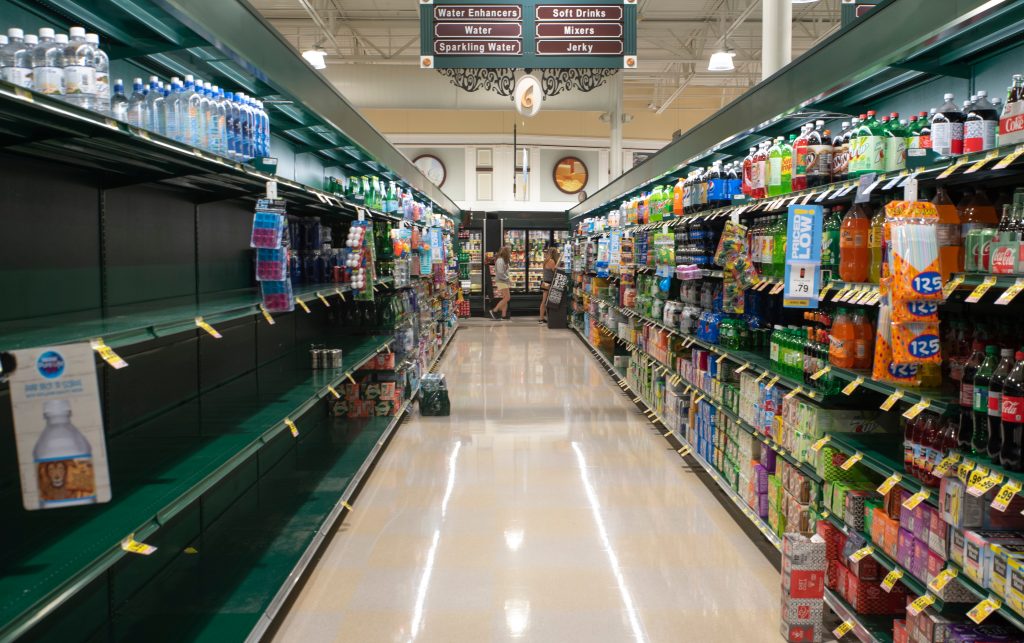
This demand-supply mismatch appears to mimic anecdotal evidence of price spikes and empty store shelves on the consumer side and the collapse of demand and dumping of food on the farm side, with a range of linked effects in the middle.
Households spent $1.7 trillion on food in 2018, 54% of which was spent on food away from the home at restaurants, bars, sports venues and other establishments, according to the USDA Economic Research Service. A dramatic drop in foot traffic at all types of restaurants began in the second week of March.
Supermarkets and grocery outlets have also experienced a significant reduction in foot traffic. But delivery and on-demand services have been strained by the sudden surge in demand from people under stay-at-home orders and social distancing guidelines, which includes nearly 90% of the U.S. population.
With the drastic fall in food demand away from home, multiple forces were unleashed rapidly, causing ripples that stretched farther into every food and agricultural commodity.
First, the supply chain serving food service industries did not have many buyers. A case in point is cheese, where the major supplier, Wisconsin, found two-thirds of its demand fall to near zero within a week or two.
Second, social distancing guidelines and shuttered non-essential businesses affected supply chains serving both food services and retail grocers.
The results include a significant slowdown in the operations of processing and distribution, shortage of workers at farm, processing and distribution (trucking) facilities, and a shortage of cleaning and sanitizing supplies. Compounding these effects are the resources spent in contact tracing and quarantine if and when a worker tested positive for COVID-19.
Third, is the urgent need to transition products run through food services into those that consumers need at the grocery store. For example, restaurants usually buy diced vegetables, like onions, in 60-pound bags, but consumers at grocery stores usually buy 3- to 5-pound bags of unpeeled onions. Also, large cheese blocks sold to food services, which generally have sizable storage space, cannot be chopped overnight into packs of ounces and pounds to sell at grocery stores.
(The author is a professor of agricultural and applied economics in the University of Georgia’s College of Agricultural and Environmental Sciences. Chen Zhen, associate professor in the department of agricultural and applied economics, contributed to this story.)
With the COVID-19 shutdowns increasing people’s need for food, some consumers rely on nonprofits for a bite to eat. To help, farmers in Florida and elsewhere are donating excess produce to food banks, said a UF/IFAS expert.
In fact, some food banks are helping farmers by offsetting some of their costs, thus incentivizing growers to harvest food they can’t sell, said Gene McAvoy, a UF/IFAS Extension agent emeritus.
“There is no shortage of food, but the majority of vegetables grown in Florida are targeted at the food service industry — hotels, restaurants, schools, cruise ships, etc.,” said McAvoy.
Food service represents 60% to 80% of normal demand for Florida-grown vegetables.
“When this source of customers dried up, growers were faced with a huge oversupply for the remaining retail demand,” said McAvoy. “With no market, it makes little business sense to harvest because that adds expenses like picking, packing and storing, on top of what farmers have already invested in the crop.
“Growers feel bad when the crops they have worked so hard to grow go to waste, and they’re interested in helping feed hungry Americans,” McAvoy added. “But they also need help to be able to do so.”
McAvoy, UF/IFAS Extension agent emeritus for Hendry County and a regional vegetable Extension specialist for Southwest Florida, said he has received multiple calls and emails from farmers wishing to donate and from food banks and facilities, who are looking for food.
He gives several examples of farms that are giving to food banks. Here are four:
Over the past few weeks, Wish Farms in Hillsborough County has donated 220,000 pounds of fresh strawberries — equivalent to 241 pallets/nine semi-trailer loads — to Feeding Tampa Bay and the United Food Bank in Plant City.
Nearly two weeks ago, growers in Immokalee donated more than 3 million pounds of vegetables to the Harry Chapin Food Bank of Southwest Florida, “overwhelming their ability to store, transport and distribute the produce. They had to call a halt,” said McAvoy.
Farm Share, a food-distribution nonprofit, works with more than 2,000 food pantries, churches, schools and other nonprofits throughout Florida. The agency is running at maximum capacity, despite having 25 refrigerated trucks, six warehouses between 10,000 and 35,000 square feet and nearly 50 drop sites from Jacksonville to Florida City.
U.S. Sugar provided more than 120,000 servings of fresh, locally grown green beans to South Florida churches, healthcare providers and food banks.
“Farmers work hard to grow this food, putting in a lot of time, money and sweat equity, and nothing breaks their hearts more than to see their efforts go to waste,” McAvoy said. “Unfortunately, it costs money to pick, pack and transport produce for which there is currently no market. People can help in the recovery effort by donating to food banks so that they can finance efforts to recover this food before is spoils.”
This file picture shows whiteflies on a squash leaf.
By Clint Thompson
Between the coronavirus pandemic and decreased demand for their product, Florida’s vegetable farmers have had their share of challenges this past month. Add whiteflies to the list.
According to the South Florida Vegetable Pest and Disease Hotline, the Immokalee, Florida area in South Florida has seen hundreds of acres abandoned. This is due to irregular ripening and high incidences of tomato yellow leaf curl virus disease (TLCVD).
There’s been some reports of 50% to 80% of the disease being seen in several vegetable fields. According to Gene McAvoy, University of Florida/IFAS Regional Vegetable Extension Agent IV Emeritus and President of the National Association of County Agricultural Agents, whiteflies have been problematic in tomatoes, watermelons and other cucurbits.
“We’ve had a number of growers destroy substantial amount of acreage, even before this whole COVID-19 thing blew up. We’ve had a lot of irregular ripening because of high levels of whiteflies. Most of our growers are using a resistant (tomato) variety so that’s not an issue in the round tomatoes. But especially with the Romas that have no resistance, they’re getting tore up,” McAvoy said.
The whiteflies’ impact on tomatoes is felt across Central Florida and on the East Coast where pressure is higher in older tomatoes. Whiteflies are also problematic in cucumber and pepper and are increasing in melons.
High incidences of whiteflies may be attributed to the mild winter. While colder temperatures don’t eliminate whiteflies, they do kill many of their wild hosts and slow population development in cultivated hosts. Warmer temperatures allow for larger whitefly populations to overwinter and become mobile earlier.
“Down here our strategy is to try to have clean fallow in the summer and not have anything for them. We usually start off pretty low but if we have a warm, mild winter like we’ve had the past couple of years where they start building in the fall, they just continue going this time of year. They basically become unmanageable,” McAvoy said.
Count Daren Hanshaw in as one of the numerous Florida fruit and vegetable growers impacted by the coronavirus pandemic and the continued imports of produce from other countries.
Hanshaw Farms: Pictured are cucumbers left in the field.
Hanshaw who owns Hanshaw Farms in Immokalee, Florida, grows cucumbers, tomatoes, watermelons and cantaloupes on about 500 acres. He’s experienced the negative impact of the past month with all his crops.
“We’ve had a variety of ways that this thing has hit us. Obviously, we’re still waiting on about a $1.5 million of receivables of tomato money from the fall that these food service companies are not paying their bills,” Hanshaw said. “That hiccup started at the beginning of this before we really knew what it was going to do to our current crop. Our first problem was cash flow. The first problem was noticing that people were slowing down on paying their bills. That money is trickling in but obviously that money is what keeps this watermelon crop and this cantaloupe crop going and pays the labor every week for that.”
Hanshaw had about a 10-day period where he was harvesting cucumbers at $35 or $40 per box. That price dropped to $10 in the span of three days.
“It went from, everybody needing whatever you can harvest to well we better not harvest because we’re not even getting our labor and box back. The decision we had to make was to pull the plug rather than delivering them to the packing house basically just to trade money or to lose,” Hanshaw said.
“You had off-shore stuff still coming in to Pompano. You had Mexican stuff that was surging. It just seemed like the volume picked up just exactly at the least perfect time for us. On top of the fact, our customers were telling us they couldn’t take the product,” Hanshaw said.
Hanshaw said he has a fresh cut contract with two major companies, but just Monday did he receive the first three POs (purchase orders), where normally he should have had 15 loads per week. The demand for watermelons has dropped significantly and it shows in the market price. Hanshaw said the prices are 45% off of what they have been the past three years.
“I can’t disagree that there are more important things to get on somebody’s shopping list than watermelons. Obviously for us, in our world, they’re the most important thing going right now,” Hanshaw said. “I don’t believe that there is a surplus of fruit. It’s not like everybody down there has got a stellar crop. It’s demand and it’s competition with foreign product that’s beating us up.”
U.S. Drought Monitor: The latest map of Alabama abnormally dry and modertately dry areas in yellow and light brown.
Farmers in South Alabama are in desperate need of rain. Producers in North Alabama need field conditions to dry so they can plant their crop. It’s been an unpredictable winter and early part of spring for the state’s vegetable growers.
“It’s been wet in the central and northern part of the state and it has been impressively dry on the Gulf Coast. (Even) with this last storm we had (Sunday), things are very dry,” said Joe Kemble, Auburn University Extension vegetable specialist. “Most of the plantings, I think things have been going okay. We’re still pretty early right now. There’s still a lot of brassicas, collards, cabbage, broccoli and other cole crops out there in the field and look good.”
Alabama farmers produce a substantial amount of tomatoes, melons, cantaloupes, sweet corn, southern peas, greens, squash, zucchini and sweet potatoes every year. The state’s vegetable production is located as far south as Mobile on the Gulf Coast, all the way to Huntsville, which is located near the Tennessee border. But as vegetable crops try to grow, they continue to experience vastly different weather conditions throughout the state.
“Last night, I think in the Huntsville area, they got over 5 inches of rain. Where down on the coast, they got less than an inch and a half to two inches. Unfortunately, that wasn’t even enough to do a lot in the Gulf Coast area,” Kemble said. “It’s something with how dry it is in the southern part of the state. Most of our vegetable crops are irrigated. In the long term, it is a concern. Wells can only get you so far. It’s also a bigger expense associated with having to provide well water.”
Kemble said growers are still trying to plant crops in the central and northern parts of the state amid the wettest winter on record.
“I think things are pretty well on schedule. There was a lot of concern in March just with the incredible amount of rain we received. That was more of a problem for crops that were already in the field. The weather’s been sort of decent the past couple of weeks,” Kemble said. “I think a lot of people have been able to get out there and prep their fields and get plastic laid and things like that. I think they’re sort of right on schedule, maybe a little bit behind in planting. From the folks I’ve spoken to, I don’t think they’re weeks behind, I think they’re a week behind, in some cases.”
Nutsedge can puncture the plastic and fight for the same resources as the pepper plants.
By Clint Thompson
The University of Florida (UF)/IFAS vegetable growers meeting scheduled for April 23 will meet via online beginning at 10 a.m. Those interested in learning about weed management can join via https://ufl.zoom.us/j/831234086. The Meeting ID is 831 234 086.
Those interested can also join via mobile: +16465588656, 831234086# US (New York); +16699006833, 831234086# US (San Jose).
Due to the ongoing coronavirus pandemic, the UF/IFAS Administration determined that all group research and Extension meetings through the end of April must be postponed.
The meeting’s contents will include a presentation from UF/IFAS weed scientist Ramdas Kanissery. He will discuss the aspects of effective, long-term and crop-safe weed suppression in vegetable production, specific to tomatoes and peppers. Initial results from an ongoing experiment for nutsedge suppression in vegetable plasticulture beds will also be highlighted.
Nathan Boyd, UF/IFAS weed scientist, will talk about the effects of soil fumigants in managing weeds. His talk will highlight the efficacy of different fumigants on weeds, fumigant movement in the soil, broadleaf and grass management with fumigants and techniques to enhance fumigant efficacy.
Peter Dittmar, UF/IFAS weed scientist, will talk about fallow weed management selection to improve nutsedge control in vegetable crops. Nutsedge is the most problematic weed in vegetable crop production. The summer months are ideal for its control because they provide growers a chance to use broad-spectrum herbicides, mechanical methods and cover crops. The key for better weed control is to reduce underground tubers.
These fallow management practices are most important during the summer fallow when nutsedge is actively growing. It is not effective to wait until the fall.
The zoom meeting will wrap up with a question-and-answer session with the presenters, beginning at 11:30 a.m.