Category: Top Posts

  • Picking Varieties With Profit Potential

    citrus expo

    By Gene McAvoy

    Choosing which variety to plant is one of the most critical decisions that a commercial grower must make each season.

    Variety selection is a dynamic process. In the past, some varieties retained favor for many years. More recently, with advances in plant breeding and the incorporation of new and improved traits for disease resistance and other horticultural characteristics, there is a trend for older varieties to be supplanted by newer cultivars after only a few seasons.

    “Profit” may be the only word needed to describe the importance of variety selection. Profit potential depends on selecting varieties suited to the farm and your target market.

    Selecting the proper variety may be an opportunity to expand a market or overcome certain production obstacles.

    Growers would be wise to heed the old saying: “There is nothing more optimistic than a seed catalog.”

    DO YOUR HOMEWORK

    Study and use reliable results from local performance tests, including on-farm trials, other growers’ experience, vegetable and seed trade literature and university studies. Discuss results of university and seed trade variety trials with the people who performed them.

    On-farm trials will help identify varieties that may be potential candidates for production.

    START SMALL

    When trying new varieties, do so on a small-scale basis but make it a fair test by growing them under the same conditions likely to be encountered in the field. Whether the new varieties work or not, the process of testing them will provide valuable information.

    RECORD RESULTS

    “Mental notes” on yield or overall performance are usually not as accurate as actual measurements. Keeping accurate records of yield and other data is important but often overlooked. To gain the most benefit from on-farm trials, results should be recorded and documented.

    With good records, growers can identify which varieties will perform best in which fields in which season (early, mid or late) and other production conditions (e.g., climate, disease and insect pressure).

    TRY SOMETHING NEW

    Following the maxim “if it ain’t broke, don’t fix it,” growers sometimes identify and stick with favorite varieties. This approach is understandable, but it shouldn’t prevent a producer from trying new varieties.

    Production and market forces increasingly demand that growers establish identities in the marketplace, partly through supplying unique, high-quality products. For growers, changes in consumer preferences can dictate adoption of new and unique varieties to distinguish themselves in the market.

    KNOW YOUR MARKET

    Research the market to clarify what is valued and accepted. Growers should know their target market and be prepared to grow what the market dictates. Keep in mind that most markets tend to see yield as the grower’s concern and quality as theirs.

    In evaluating a new cultivar, these important selection factors should be considered:

    • Marketability: The harvested plant product must have characteristics desired by the packer, shipper, wholesaler, retailer and consumer.
    • Maturity needed to match the cropping season, supply the market and reduce the risk of weather-related crop failure
    • High marketable yield potential
    • Dependable resistance to diseases, insects, stress and physiological disorders (e.g., blossom-end rot)

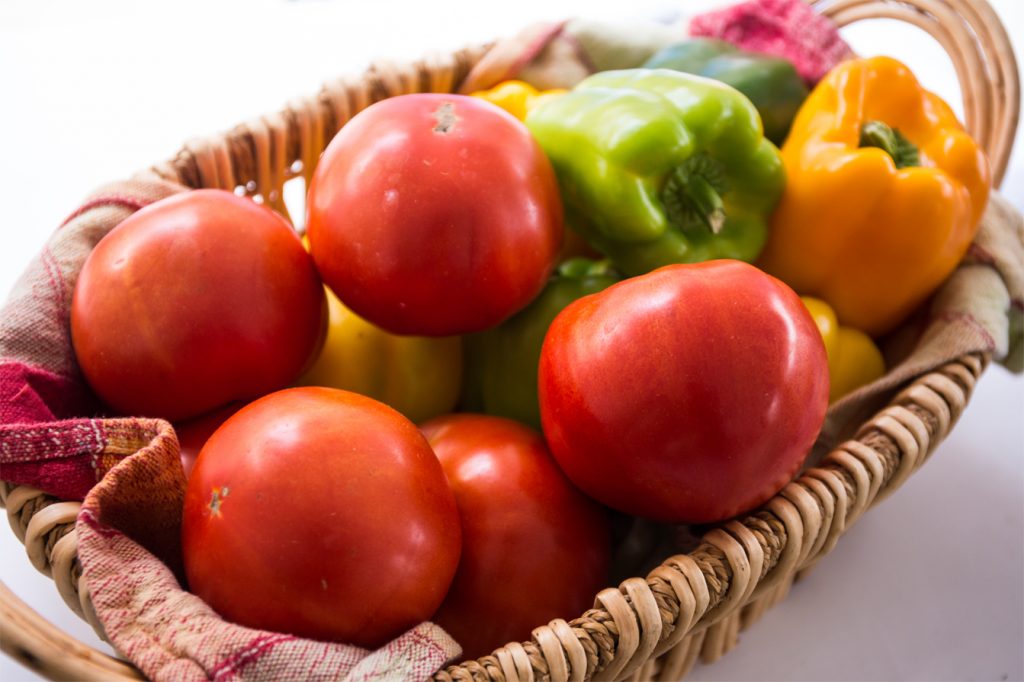
    In pepper, these qualities include pack-out, shelf life, shape (blockiness), number of lobes, color (both mature color and shade of green for immature fruit), size, firmness and pod wall thickness. More recently, some markets are interested in nutritional quality and taste.

    The tomato market seeks many of these same qualities, including color, shape, flavor, firmness, pack-out, shelf life and shipping and ripening characteristics.

    Variety evaluation should be an ongoing process for growers who wish to remain profitable and competitive.

  • Clemson Extension Agents Provide Updates on Various Crops

    Clemson Extension agents provided updates in The South Carolina Grower this week about the status of various crops being produced throughout the state.

    Coastal

    Spider mites have been reported on beans, tomato and melon in the Coastal Region.

    Zack Snipes reports, “It was a warm week with some sprinkled in showers along the coast. All crops are coming in right now with heavy watermelon volume. What’s left of the tomato crop is ripening fast. As far as pests go, I have seen a good amount of bacterial leaf spot in pepper, squash bugs and cucumber beetles in squash, and spider mites on beans, tomato, and melon.”

    Midlands

    Justin Ballew reports, “We got a little more rain last week and the temperatures were a little warmer than previous weeks. We’re still harvesting tomatoes, sweet corn, peppers, eggplant, peaches, squash, zucchini, beans, etc. Since the environment has been warm and wet, we’re starting to see diseases pick up. Seeing lots of powdery mildew and anthracnose on cucurbits and bacterial spot on tomatoes. Stay on your fungicide programs and rotate modes of action as much as possible. I’ve also been getting some reports of heavy spider mite activity on tomatoes.”

    Sarah Scott reports, “We’ve had hot and, for the most part, somewhat dry conditions in the past week. Some areas received an inch of rain, but it was very spotty. Tomatoes, peppers, squash, corn, cucumbers, and melons are all being harvested now.  Plums, peaches, and nectarines are also still being picked. The peach crop is about 10 days ahead of schedule.”

    Pee Dee

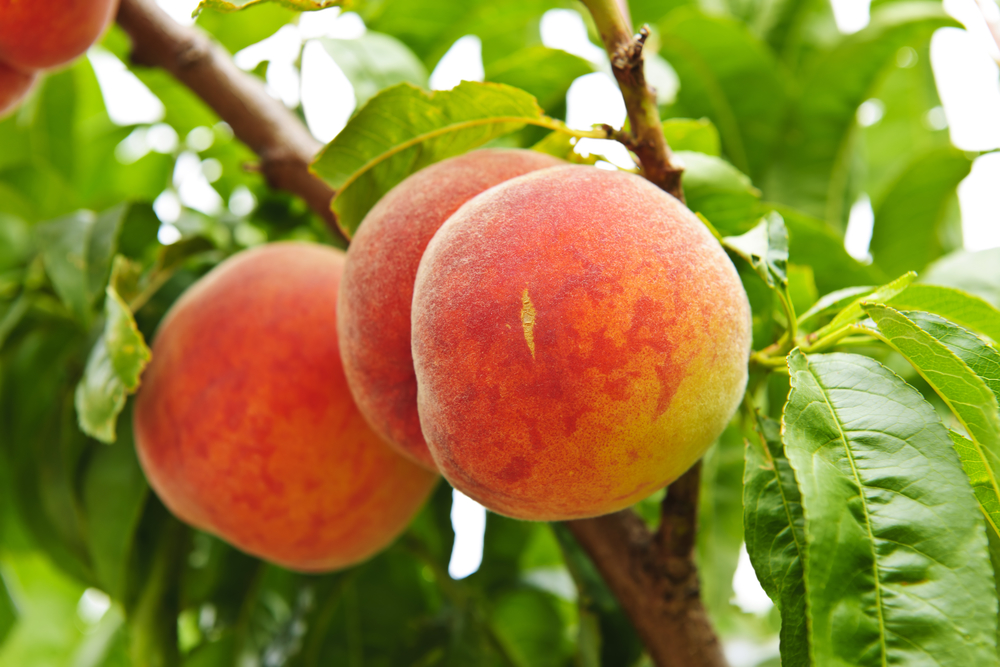
    File photo shows ripe peaches ready to pick on tree branches.

    Bruce McLean reports, “Vegetable crops are maturing nicely, even though some are exhibiting heat stress from the recent hot weather. Cucurbit Downy Mildew (on cucumbers) has been reported throughout the Pee Dee Region. Powdery Mildew is widespread on zucchini and yellow squash. Sweet corn is looking good, with good volumes being produced. Tomatoes, other than being stressed from the heat and the humidity, look pretty good and are bearing well. Sweet potatoes are still being planted. Muscadines are beginning to size and look to be a very good crop. Blueberries are winding down, with only the latest varieties being harvested now.”

    Tony Melton reports, “Processing peppers and tomatoes are beginning to be harvested and they look good.  With all the early winds and excessive rain, it was difficult but as my daddy would say ‘we made a silk purse out of a sow’s ear.’ Second and third crop pickles are yielding much better than the weather-beaten first crop. Processing peas will begin harvest this next week, so we badly need some dry weather, but the forecast is not favorable.  Also, the amount of cowpea curculio is increasing rapidly, and an intense/timely spray program is needed to prevent what most call “stings (maggots) in the peas.” One grower got slack on his spray program and this week had to discard $6,000 worth of peas. Spray with a pyrethroid at or before the first flower, then every week until flowering is finished. The first spray is the most important because if you wait too late, the curculios are already in the field. Curculios are very hard to kill. When disturbed they ball up inside their protective coat, and your spray is repelled. My program repels them and attempts to keep them out of the field. Also, rotation is very important to keep down the population of curculios surrounding your fields.”

    File photo shows a muscadine vineyard. Muscadines are beginning to size in the Pee Dee Region.

    Upstate

    Kerrie Roach reports, “Upstate peaches are beginning to ripen! While exciting, we have seen some physiological issues with sizing and softening that we attribute back to a late-season cold spell. While the peaches originally appeared to pull through without damage, we are now seeing peaches that are not sizing and those that do size up, only ripen on the very outer portion. It is a waiting game to see how each variety ends the season. In the meantime, market vegetable production is in full swing and the apple crop is looking fabulous.”

  • UGA Entomologist: Whiteflies Not as Bad as 2017 But Still Bad

    File photo shows whiteflies infesting fall cucurbits.

    By Clint Thompson

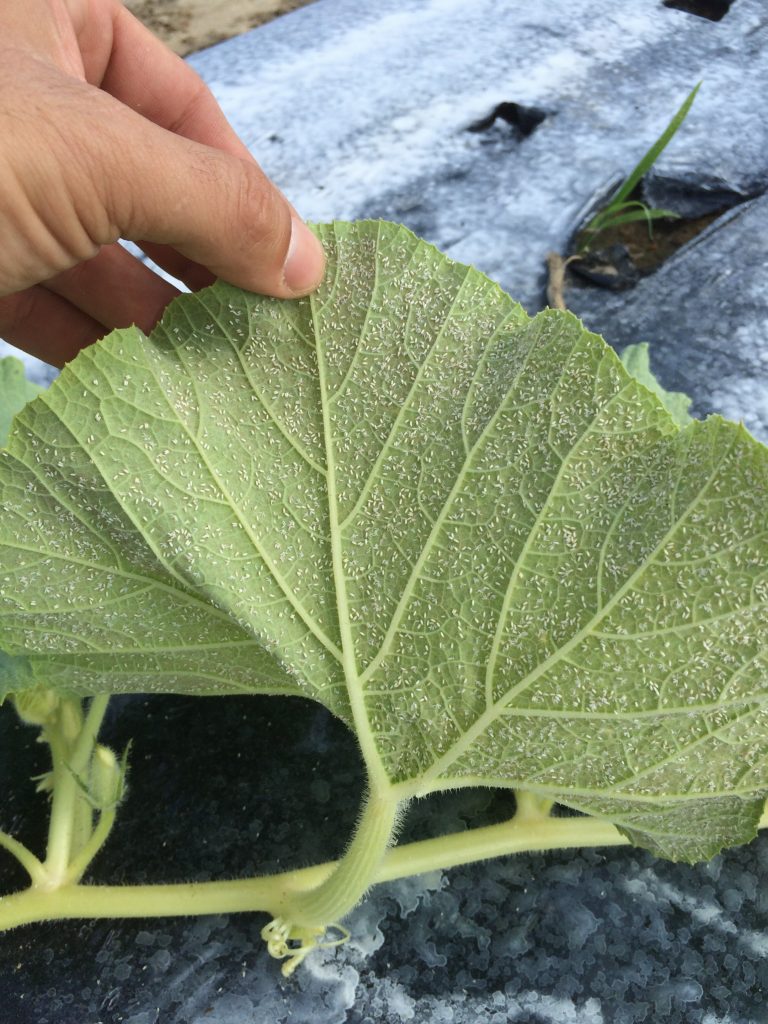
    University of Georgia Cooperative Extension vegetable entomologist Stormy Sparks confirmed this week that whiteflies are back with a vengeance on susceptible vegetable crops and Georgia’s cotton, which is still just a few weeks old.

    “I’ve been holding off a long time on saying it looks bad. But about a week ago, it’s just hard to say it doesn’t look bad,” Sparks said. “There’s still some things that could happen, but I saw some populations in some cantaloupe that you don’t usually see for another month or two. They’re already treating some cotton, apparently.

    “We’re probably a month behind 2017, but we’re at least a month ahead of our normal year.”

    Sparks said in May that whiteflies were already present in Georgia vegetables.

    Why So Early?

    While colder temperatures do not eliminate whiteflies, they do kill many of their wild hosts. They also slow population development in cultivated hosts. Warmer temperatures this winter allowed for larger whitefly populations to overwinter and become mobile earlier.

    “We already had the populations, there’s no doubt about that, earlier than normal in some areas, particularly coming out of kale. There’s a lot of things that can happen as far as weather and everything else that can impact it. There’s still some things that could happen to keep it from getting as bad as it did in 2017,” Sparks said. “If they get to a certain level, those rain events don’t have the same impact than they would at lower populations. I think we’re probably far enough long now that they’ll rebound fairly rapidly. That’s what I’m afraid of.”

    Rain is expected all week in South Georgia, but Sparks believes a tropical storm-type system is what is needed to suppress whitefly populations.

    UGA cotton entomologist Phillip Roberts said farmers are already treating for whiteflies in cotton which is month to a month and a half earlier than normal.

    What Can Be Done?

    Sparks, Roberts and other specialists continue to preach sanitation with whitefly management. Farmers have done better in recent years in getting rid of their vegetables once they are done harvesting. That needs to continue this summer.

    “If the vegetable growers get rid of those crops that are infested, if you’re done with them; if you get done with watermelon fields and cantaloupe fields … get rid of them. Don’t let them keep reproducing. The cotton guys just need to be keeping an eye on infestations and don’t let them build up there,” Sparks said.

    Whiteflies migrate from winter vegetables to spring vegetables to agronomic crops, like cotton, to fall vegetables and back to winter vegetables. Whiteflies cause feeding injury issues in vegetables and transmit two new viruses: cucurbit leaf crumple virus and cucurbit yellow stunting disorder virus. Vegetables like squash, zucchini, cucumber, cantaloupe and snap beans are highly susceptible to these viruses.

  • Nikki Fried: Consumer Conscience Awakening Result of COVID-19

    By Clint Thompson

    A biproduct of the ongoing coronavirus pandemic was the positive response consumers had to supporting American farmers. Nikki Fried, Florida Ag Commissioner, calls it a “consumer conscience awakening.”

    File photo shows Florida Agriculture Commissioner Nikki Fried visits with farmer Paul Allen, Palm Beach County Commissioner Melissa McKinlay and Tom MacVicar of MacVicar Consulting.

    “When people go to the food stores, they were seeing on one point, you’ve got Mexican strawberries inside of our food stores and then you’re seeing all of the reports of our crops in Florida being plowed under and milk being poured out. They couldn’t understand what was happening,” Fried said. “People started to wake up. People are going to their local farmers, to the farmers markets and to the U-picks. We also kicked off our online marketplace, Farm To You, which allowed about 380 different commodities; we had about 500,000 hits on the webpage. You’re hearing these success stories across the state of Florida and really across the entire country where more and more consumers are going directly to the farmer and building that personal relationship, wanting more domestic grown.”

    It is a sentiment that was shared by Paul Allen, president of R.C. Hatton Farms in Belle Glade, Florida and chairman of the Florida Fruit and Vegetable Association. He said in May that the point of supporting American farmers was received loud and clear amid the pandemic and the constant influx of imports from Mexico.

    “The American people have heard everything that’s been on the national media all about Mexico. They’ve stopped buying Mexican produce. They’re buying American produce,” Allen said.

    Tough Start to Season

    Unfortunately, it was not always this way this season. In a previous interview in early April, Allen said he left about 2 million pounds of green beans in the field and about 5 million pounds of cabbage. All because of the coronavirus pandemic that shut restaurants down and closed off a major supply chain to foodservice industries.

  • Bob Hall Named Swisher Sweets Farmer of the Year for South Carolina

    According to the The South Carolina Grower, Bob Hall of  Bush-N-Vine Farm in York, South Carolina is this year’s Swisher Sweets Farmer of the Year for South Carolina. He was nominated by Upstate Clemson Extension Agent, Andy Rollins.

    Rollins said of Hall, “I am so proud of him and all his family for all they have done to make their farm and community great.”  Hall will compete against farmers from other states in the Southeast for the overall 2020 Swisher Sweets Farmer of the Year. The winner will be announced at the Sunbelt Ag Expo in Moultrie, Georgia, which will be held October 20-22, 2020.

  • Three Georgia Farmers Market Locations Could Be Spared

    UGA picture/Watermelons being researched on the UGA Tifton Campus. 6–6-17

    By Clint Thompson

    The revised budget cut requirements from the Georgia Governor’s Office of Planning and Budget and the State Legislature may have spared the state farmers market locations in Cordele, Thomasville and Savannah.

    Julie McPeake, Georgia Department of Agriculture Chief Communications officer, confirmed that as a result of the budget cut requirement from 14% to 10%, the State Legislature provided funds to support the transition of ownership of the Cordele, Thomasville and Savannah farmers markets to their respective local governments.

    “In May, the Governor’s Office of Planning and Budget (OPB) requested that state agencies present a plan to cut 14% of their budgets for fiscal year 2021. The Georgia Department of Agriculture (GDA) operates with a very efficient budget, forcing very difficult decisions to reach the requested budget cuts, including a proposal to close multiple state farmers markets,” McPeake said. “However, following a revision of revenue estimates, OPB and the State Legislature reduced budget cut requirements from 14% to 10%. As a result, the Legislature provided funds to support the transition of ownership of the Cordele, Thomasville, and Savannah farmers markets to local governments effective April 1, 2021.” 

    Impact From Coronavirus Pandemic

    Locations in Augusta, Cordele, Macon, Savannah and Thomasville were on an initial list to be cut. McPeake said the locations in August and Macon are still scheduled to be off the GDA’s books for 2021, but she didn’t have a timeline for any transition.

    It is unfortunately a necessary evil that had to be considered during this recession which is a result of the coronavirus pandemic.

    “With the 14% budget cuts that were requested, you’ve got to make some decisions. Unfortunately, some of those tough decisions require looking at hard numbers. When you have some markets that are having trouble to turn a profit, that’s one of the first places you’ve got to turn to, to save that money,” said Paul Thompson, marketing director for the Georgia Department of Ag, in early June.

    The different farmers market locations vary in what commodities are sold there. In Cordele, the self-proclaimed “Watermelon Capital of the World,” it is known for watermelons and cantaloupes being bought and sold this time of year.

    July 1 began the new fiscal year.

  • UF’s Angle: We need to have a more resilient marketing system

    By Clint Thompson

    A second wave of the coronavirus pandemic is inevitable. Perhaps we are already in it, just a few months ahead of the fall forecasts that most projected would coincide with flu season.

    J. Scott Angle, NIFA portrait, Oct. 31, 2019. USDA Photo by Preston Keres

    But you can pencil in COVID-19 as another challenge farmers will have to face this fall, especially as preparations are already underway for the fall crop which will be planted in a few months.

    Scott Angle, the newly-named vice president for agriculture and natural resources at the University of Florida/IFAS, believes growers can learn a lot from their first bout with this pandemic, which occurred in the midst of fruit and vegetable harvests in March and April.

    “Whether this fall in the next phase or the next pandemic, we better make sure we’re ready. We certainly have learned a lot of lessons. We learned a lot of lessons about how to social distance. I still think we need more research in that area because we don’t have all the answers, but we understand that’s where disease transmission can occur,” Angle said. “We have some ways of protecting workers. Whether or not those are the best methods, I don’t know if anyone knows at this point. Most of our social distancing and protective methods at least on some level are just common sense. We certainly need some research for that.

    “I think we all understand that our economies have to keep running and mostly we just have to keep producing food. We don’t really have a choice, to say we’re going to shut down the farm for a year or two years or until we get a vaccine. We’re going to have find smarter ways to do the things we did last year.”

    One Adjustment

    Angle admits a big adjustment must be how farmers can adjust their marketing strategies when the demand for produce is disrupted. For example, when the coronavirus pandemic struck in mid-March, it forced restaurants to shut down across the country. These are major buyers for farmers in Florida and Georgia. When restaurants were not buying produce, farmers in Florida struggled to find a home for their fruits and vegetables.

    In early April, Paul Allen, president of R.C. Hatton Farms, said he left about 2 million pounds of green beans and about 5 million pounds of cabbage in the field. Florida farmer Kim Jamerson said in late March that her produce business would lose 100% of their production costs, along with packing and shipping costs if things did not improve.  

    “I was on a conference call with some food manufacturers and they were joined by farmers who were saying the exact same thing, when the markets dried up, they had to pivot very quickly and sometimes would be in a matter of days. In fact, some of them said, ‘I just want to donate my food to a food bank or pantry,’ and even that they weren’t able to do very easily,” Angle said. “We need to have a more resilient marketing system that can pivot a lot more quickly.

    “One good example would be, these food pantries need it and need it now more than ever because their needs have gone way up. Could there be an intermediary to step in and pay the farmers and get that food over to the food pantries for these charities?”

    Similar Idea

    Jamerson had a similar idea right after the pandemic became problematic for Florida growers. She reached out to the office of U.S. Senator Marco Rubio (Fla.) and spoke to one of his aides about the government helping its farmers by purchasing their crops and distributing the food to its citizens since many are unemployed. Back in March, she had not heard back from Rubio’s office.

  • Florida Vegetable Farmer: Future of American Farming Dismal

    By Clint Thompson

    Florida vegetable farmer Sam Accursio paints a gloomy picture for the future of farming and the availability of food in the United States.

    Farmers in America have to overcome multiple obstacles every year to be successful.

    “It’s dismal, unless the American consumer says we’ve had enough. We are going to support these American growers or we’re going to be hungry some day. It may not be in my lifetime. It may not be in my kids’ lifetime. But my grandkids, some day, they’re going to wonder where their food is coming from,” Accursio said. “That’s from everything; beef, pork, chicken, vegetables and fruits.

    “Look at the USDA, I read an article very quickly, it’s going to allow chickens to be imported from China. Do we need them in this country? I wouldn’t think so. I think our chicken price is very reasonable in the store. I think you can still buy an uncooked chicken between $5 and $7. I don’t think we need a Chinese alternative chicken in our nation.”

    Farmers have to overcome obstacles every year, whether it’s due to insects, diseases, shockingly low commodity prices, natural disasters and global pandemics, like COVID-19 this year. They also have to deal with foreign competition, which was a major problem this year. Amid the coronavirus pandemic, market prices continued to spiral downward with Mexican imports.

    “Look at what they’ve done to the asparagus growers in the United States, between Peru and Mexico. They have put most of them out of business,” Accursio said. “The consumer has no idea of what they’re eating; what the regulations are that the U.S. growers are under, and you go to these other countries and the regulations are different. The human rights are different. The environmental concerns are different. Which they should all be the same, that was the idea of the free trade agreement, to bring their standards up to our standards, but it never happened.

    “It made the regulations tighter on me but not south of the border. How would you like to have competition where you’re paying the employee $7 a day and I’m paying $130 a day. That’s a big impact, huge.”

    There also doesn’t appear to be any relief in sight in the way of new farms. It’s such a costly occupation that most don’t have the capital necessary to get into the business.

    “If you put a financial plan together, you bring it to somebody, they’ll laugh at you. You mean you’re going to spend $2.5 million before you pick anything and then you don’t know what you’re going to get back? Who’s going to loan you money to do that?” Accursio said. “I am 57. I have two sons that are in the business with me. We know the importance of food for the American people, for the world.

    “Unfortunately, there’s nobody coming in behind us except for these family farms that are producing now. There’s no new farms popping up.”

  • San Jose Scale Problem for Peach Producers

    Photo from Brett Blaauw/University of Georgia/Shows San Jose scale crawlers.

    By Clint Thompson

    Brett Blaauw, University of Georgia assistant professor in the Department of Entomology, says the time is now to treat San Jose scale crawlers which are peaking in peach orchards.

    “Right around late June, early July and then again in August, we see these real high populations of their larvae, the crawlers. Crawlers are also susceptible to insecticides. They do not have that waxy coating yet. They’re the mobile stage of the scale. They’re leaving their mothers and searching for another part of the plant to settle down and start to feed. These crawlers have a few days of vulnerability so we can also try to time our insect sprays to target those scale crawlers,” Blaauw said.

    He said in his blog that he expected this week to see a peak in crawler activity. South Carolina producers should expect to see crawler activity in the next week or two.

    What is San Jose Scale?

    San Jose scale is a tiny insect that has a waxy coating. It covers and protects the whole body of the insect. It protects them from the environment. It protects them from other insects that would eat them. And unfortunately, it protects them from insecticides. Once these insects create their waxy covering, they are hard to kill, according to Blaauw.

    They also reproduce at an extremely high rate. It does not take long for a minimal problem to balloon to a major concern for peach producers.

    “Females can produce hundreds of offspring. Just from one female, she can produce almost 300 offspring. Of those 300 offspring, if they’re female, can go on to have 300 more offspring. The population can get quickly out of hand,” Blaauw said. “When you have thousands of these little insects feeding on the branch of a peach tree, it can quickly kill or reduce the vigor of that branch. If the problem goes untreated, you lose branches, and then you lose limbs and eventually you lose whole trees.”

    Another Management Option?

    Blaauw said another management option is to apply two dormant sprays of horticultural oil. It is best to spray once the trees are dormant and then before bloom next growing season. The high-volume sprays will suffocate the San Jose scale.

    “That usually works pretty well and significantly reduces the scale population. But even when the growers are doing that, we’re seeing the numbers skyrocket about now. I can go out there and monitor almost any time of the season and find San Jose scale in the trees,” Blaauw said.

    The San Jose scale can be traced back to the 1800s. With modern insecticides, the scale was not a problem in the 1900s. But it has come back with a vengeance in the 2000. It thrives in Georgia’s warm summers and winters and can be active all year long.

    Another issue is that complicates farmers’ management options is that the scale may not impact the whole orchard. It could be clustered in one area or part of the orchard. It can be hard to manage if a grower has many acres of peach trees.

  • Nikki Fried: Our Growers Cannot Compete

    Florida Ag Commissioner Makes Comments on USMCA

    commissioner

    By Clint Thompson

    Not every leader in the agricultural community believes the United States-Mexico-Canada Agreement (USMCA) was the right move for American farmers.

    Even after the USMCA entered into force on Wednesday, Nikki Fried, Florida Ag Commissioner, remained vocal to her opposition to the agreement, mainly due to its impact on specialty crop producers.

    commissioner
    Nikki Fried
    Florida Agriculture Commissioner

    “Florida’s farmers, who have always faced challenges like hurricanes, droughts and so much more, have always been able to be adaptable in the face of all of that adversity. Now, as they face COVID-19 with disruptive supply and market chain which caused major crop losses of over half a billion dollars, they’re also facing increased and unfair foreign competition,” said Fried during a virtual press conference on Thursday. “I’ve been outspoken on this, spoke out against NAFTA and fought against USMCA, which could cost Florida another 8,000 jobs and almost $400 million. For years NAFTA allowed Mexico to tilt the playing field with unfair advantages. Our growers cannot compete like that.”

    New Study

    Fried said the Florida Department of Agriculture and Consumer Services (FDACS) sent a new research study to the U.S. Trade Representatives to show how negatively seasonal producers have suffered from unfair trade.

    1. Mexico has expanded its share of US domestic markets by 217% since 2000, while Florida lost market share by 40%.
    2. There has been a 551% increase for seasonal crop imports from Mexico from 2000-2019. An $11 billion gap exists between Mexican Ag exports and Florida’s total Ag value.
    3. Florida producers lost sales of up to 20% due to Mexican Ag export expansion since 2000. This resulted in $3.7 billion in total economic losses in Florida’s economy along with 37,180 lost jobs.

    Florida farmers voiced their displeasure with Mexican imports this year, amid the coronavirus pandemic that already impacted a huge chunk of the market. Blueberry farmer Ryan Atwood said, “he is a fan of having his own domestic supply of food.”

    Florida vegetable farmer Sam Accursio believes the only solution is for “people to vote and get people that are like-minded and want to support our nation in office.”

    Lack of Support

    Fried also expressed her displeasure with fellow Florida leaders for lack of support in opposition to USMCA.

    “Of course, I’m disappointed that we couldn’t get some of the other members of the leadership in the Senate or the House as well as the governor to speak up united on this issue. The agriculture commissioners across the country meet on a pretty normal basis. We had a meeting probably about six months ago where USMCA was brought up. I was the only one who voted no. Because everyone has their own benefits that they’re seeing, the problem is these specialty crops are the ones who have been hit the most,” Fried said. “You’re starting to see it trickle it down (though). Bud (Chiles of Demand American Grown) hosted a meeting, felt like forever ago, last year with growers from Georgia, who are starting to experience it.

    “It’s been hit heaviest by Florida. But now you’re starting to see expanding into Alabama, Georgia and the Southeast and a little bit in California. We were really kind of hopeful that we were going to get some more support on the opposition to USMCA and certainly would have loved some assistance from other statewide leaders. But unfortunately, we did not get them.”

    According to the USMCA press release, the agreement marks the beginning of a historic new chapter for North American trade by supporting more balanced, reciprocal trade, leading to freer markets, fairer trade, and robust economic growth in North America. However, Southeast farmers still will compete against imports of Mexican produce.