According to the Alabama Extension Commercial Horticulture Facebook page, insect pressure has increased significantly over the past two months. This was reported in 20 locations across Alabama, where moth counts from pheromone traps were collected.
For example, the beet armyworm moth numbers were 823 as of Aug. 15, a 1.2X increase from the 682 reported on July 31. Host plants include corn, cowpea, eggplant, pepper, tomato, cotton, peanut and soybean. The fall armyworm saw a 1.6X increase from 88 to 149 over that same timeframe. It prefers to feed on grasses then move to crops.
The southern armyworm also saw a 1.6X increase from 197 to 307. Moths are active throughout the year in Florida. Larvae have reddish brown head with white line on the body.
The moth most widespread right now is the lesser cornstalk borer. It increased from 4,000 on July 31 to 5,060 on Aug. 15. The squash vine borer, corn earworm, soybean looper and yellow striped armyworm experienced the largest increase of 2X each.
The squash vine borer increased from 152 to 311. It is worse on organic farms. The corn earworm feeds on corn, tomato and cotton.
The cabbage looper increased from 192 on July 31 to 286 on Aug. 15. Its host plants include sweet potatoes, beans, peas, squash, tomato and watermelons.
Clemson Extension agents provided updates in The South Carolina Grower this week about the status of various crops being produced throughout the state.
Statewide
Dr. Tony Keinath with a word on crop rotation. “To keep the soil on your farm productive over the long term, do not replant the same vegetable, or a related crop, in the same field “too often.” How often is “too” often depends on the crop and the pathogens present in the soil. Almost always, “too often” is less than 12 months between disking the old crop and planting the new crop.
The main risk in replanting “too often” is building up root pathogens that survive in the soil for years. Even in the heat, diseased roots and stems take several months to decay enough so they are not a source of pathogens.
Another risk is foliar diseases that start on volunteers from the previous crop. The pathogens may be in or on some of the seed that sprouts; for example, black rot on leafy brassica greens or gummy stem blight on cantaloupe and watermelon. A small number of infected volunteers means the disease has a head start right at the beginning of the crop.
Controls for soilborne pathogens (fungi, water molds, and nematodes) are limited.
Many vegetable crops have no resistance to these pathogens.
Fungicides do not penetrate soil well, or they are quickly inactivated.
Fumigants have many restrictions that require time-consuming record keeping and air monitoring.
Root-knot nematodes are a special problem, because they form galls on many vegetables and some field crops (cotton, for example) grown in rotation with vegetables. Summer cover crops of sunn hemp can lower nematode numbers.
Without crop rotation, more fungicide sprays will be needed, which raises the risk of fungicide resistance. Fungicides and fumigants are not a substitute for good crop rotation.”
Midlands
Justin Ballew reports, “Many areas got a little more rain last week, and we had a break from the heat over the weekend. We have a lot of the fall crop planted now, including squash, zucchini, tomatoes and brassicas. So far everything is mostly growing well. We are seeing bacterial wilt develop in some of the fall-planted tomato fields. Bacterial wilt loves hot soil temperatures, which is typical this time of year. Be sure to follow a proper crop rotation plan (at least 3 years) to help manage bacterial wilt buildup in fields. Since the heavy rain we got a few weeks ago, we’ve also seen plenty of bacterial spot in what’s left of the spring tomatoes.”
To test for bacterial wilt in tomatoes, place the cut stem in a jar of clean water. If the plant is infected, within about 30 seconds you will see milky, white bacterial ooze begin to stream from the stem. Photo from Justin Ballew.Bacterial wilt commonly causes discoloration of the vascular tissue within the stem. Photo from Justin Ballew.
Pee Dee
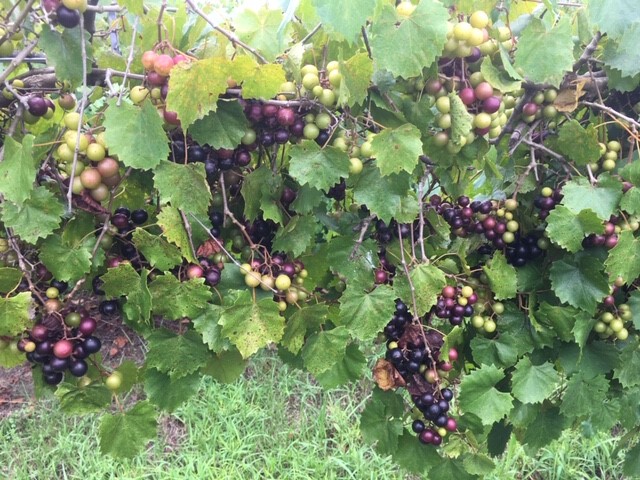
Bruce McLean reports, “Most summer vegetable crops are starting to wind down. Peas, okra, watermelon and cantaloupe are still being harvested at some volume. Late summer/fall squash, cucumbers and tomato harvest are a couple of weeks away. Fresh market muscadines are being harvested now. Juice and wine muscadines are getting close – maybe 7 to 14 days away, depending upon location. In most juice and wine muscadine vineyards, Carlos is around 40% colored (ripe); Noble is around 60%; and Doreen is around 25%. Grape root borer (GRB) flight is still occurring, with moderately high moth counts in traps.”
Eumorpha pandorus, a.k.a Pandorus Sphinx Moth caterpillar, found in the muscadine vineyard at Pee Dee REC. Photo from Bruce McLean.‘Noble’ muscadines getting close to harvest. Photo from Bruce McLean.
Tony Melton reports, “‘Another Crop Bites the Dust’ from spreader/stickers. I have seen too many farmers sing this sad song. Be careful and know what you are doing when adding a sticker/spreader when spraying vegetables. Short season, tender vegetable crops will burn very easy in our heat and do not have time to come back like long season row-crops. Our state’s second major watermelon/cantaloupe season is in full season in Chesterfield County. Harvest is in full swing and will continue until frost. Curculio sprays are beginning to be applied to the fall pea crop. Looks like pickle harvest will continue until frost.”
Senate Minority Leader Chuck Schumer rarely gets involved in agricultural issues. However, the Hagstrom Report says he asked Ag Secretary Sonny Perdue to delay issuing a U.S. Domestic Hemp Production final rule until 2022. That move would allow hemp growers and producers in his home state of New York and across the country to continue to operate under the 2014 Farm Bill Pilot Program until that time.
Schumer notes that COVID-19 is a solid reason for the delay. He also knows about some criticism for the interim final rule and says a delay “will allow USDA to address some of the more pressing regulatory critiques while giving states and producers additional time to come into compliance.”
Allan Gandleman is President of the New York Cannabis Growers and Processors Association. He says the more than 700 registered hemp farmers in Schumer’s home state of New York would be negatively affected by USDA’s interim final rule on hemp.
(From the National Association of Farm Broadcasters)
UGA photo shows a pecan tree suffering through the heat with scorched leaves.
Recent rainfall is a sight for sore eyes for pecan farmers on the verge of harvesting this year’s crop, according to University of Georgia Extension pecan specialist Lenny Wells.
“We’ve had years where August and September we didn’t get a drop of rain. Even with the best irrigation the percent kernel didn’t fill out as good as you would expect,” Wells said. “A little bit of rain goes a long way during this time as far as that goes.”
Weeks of dry conditions and extreme temperatures led to multiple counties in Alabama and Georgia being classified as ‘abnormally dry’ by the US Drought Monitor. This led to tough conditions for pecan trees producing a crop.
“We were seeing a lot of that leaf scorch, especially on the young trees where the roots were getting a little burned from the heat. It’ll be 105 degrees down 5 or 6 inches, and that’ll burn and kill off some of those feeder roots. You get some scorching and that kind of thing,” Wells said. “This (recent rain) will give some relief from that for sure.”
Harvest Season About to Begin
With harvest season just a month or two away – Wells believes the Pawnee varieties will be harvested in mid-September – this is an important time in the production season for the nuts to receive water.
“We’re into the kernel fill stage and that’s such a high energy demand process and especially when they have a heavy crop on them like we see out there this year, it just takes a lot of water to fill those nuts out as the kernel forms,” Wells said. “The crop is probably two weeks ahead of schedule. But a lot of our main varieties are right in the middle of filling those kernels. Some of the early stuff has already got kernels already in place. But the water’s still going to be beneficial to helping them go on and mature properly and open up properly.”
According to many farmers, fair trade is more of a fantasy than reality.
Charles Hall, executive director of the Georgia Fruit and Vegetable Growers Association, understands changes to the unfair trade practices that are being experienced by seasonal growers in Georgia and Florida with regards to Mexican imports are not going to happen overnight.
But he is hopeful the virtual hearings on Thursday, Aug. 13 and the one next week on Thursday, Aug. 20, will make a difference.
Hearing Next Week
Hall is one of numerous farmers and industry leaders in Georgia who will testify in a virtual hearing on Thursday with the U.S. Trade Representative’s Office. The hearings provide the U.S. Department of Commerce and Trump Administration an opportunity to hear from growers in both states about the urgent need for federal action regarding unfair trade.
“I think it is big that we have this opportunity to talk with some of the decision makers in Washington. I know that our Congressmen and Congressional delegations have been fighting for us. I think it could very well be of some remedy, but I say that cautiously because there’s an awful lot that has to happen for this to be any remedy for us,” Hall said. “I don’t think after these hearings, they’re going to say we believe you and we’re going to do what we need to. I think the hearings are one step in the process. Hopefully, we can continue to keep the administration on our side and continue to work towards some remedy to this.”
Trade Distorting Policies
Hall hopes the discussion over the two days of hearing will center on trade distorting policies and how to address the competitive disadvantage American farmers are facing.
“All of the testimony that was presented on Thursday (13th) or next week on the 20th is to show the U.S. Trade Representative’s Office what we consider to be trade distorting policies. Over the last 15 years, since NAFTA was created, particularly over the last five years you can look at the increase of Mexican imports into the U.S. and how much the Mexico imports have taken over the U.S. domestic market for produce. You can really see what those imports are doing,” Hall said.
Heat and dry weather conditions make this a peak time for insect pressure. Ayanava Majumdar, an Auburn Extension Professor in Entomology and Plant Pathology, cautions fall vegetable growers about insect pests and to scout regularly.
Pictured is a fall armyworm.
“Insects love the heat because they grow through their life cycle faster because of the extra heat. They grow faster. They mate and reproduce faster plus the plants are stressed. It’s like a perfect storm and it leads to massive crop losses for farmers,” Majumdar said.
Armyworms
There are various insect pests the growers need to be mindful of this time of year. Majumdar is concerned with caterpillars, in particular, the armyworm sisters: beet armyworm, fall armyworm, yellow striped armyworm and southern armyworm.
“These four, often times there’s mixed populations in the field. They can be very difficult to identify when they’re small. As they grow bigger it’s easier to identify. Those armyworms have very distinct patterns and head structures,” Majumdar said. “Those armyworms, along with horned worms, loopers; everything is just exploding right now. This is the peak of insect activity now.; August and then into September, to some extent. We are constantly telling farmers to watch; caterpillars on tomatoes and then you will see sucking insect pests, which cause quality loss like stink bugs, leaf footed bugs.
“Often, it’s hard to tell the yield loss from just the weight of the produce, but they will destroy the appearance or the taste of the produce. There’s a huge quality loss with the sucking insect pests. Those are increasing as well.”
Squash Bugs
He also warns of squash bugs on squash. They feed on the crop and can transmit yellow vine disease. This can shut down plants during harvest and is exacerbated by the current drought-like conditions.
While scouting is important, knowing when to apply insecticides can be just as key to pest management. Majumdar implores farmers to always consider the current weather conditions.
“We can not do calendar-based spraying anymore, at least not in Alabama. We go from drought to extreme wet weather in a week. That has a huge effect on insects,” Majumdar said. “Have some flexibility in the IPM plan. That’s very important to check the weather patterns. I’ve described flash drought versus prolonged drought. There’s different kinds of drought we’re experiencing now. That affects our pest management.”
Miami, FL — U.S. Senator Marco Rubio (R-FL) delivered testimony during a virtual hearing on seasonal and perishable produce organized by U.S. Trade Representative Robert Lighthizer, U.S. Secretary of Agriculture Sonny Perdue, and U.S. Secretary of Commerce Wilbur Ross.
The virtual hearing is the first of two to discuss foreign trade practices that are harming American growers, especially Florida farmers, of seasonal and perishable produce. These hearings are being convened after Rubio led the Florida delegation in securing a promise from the administration to further examine this issue and formulate a plan that addresses the severe harm that Florida growers continue to experience at the hands of Mexico. You can read Rubio’s testimony as prepared here.
“[P]rimarily you are here because of a promise made to me and to the entire Florida congressional delegation, and to this industry in Florida – made both privately, and publicly in Ambassador Lighthizer’s letter of January 9, 2020, that these unreasonable trade practices would be thoroughly examined, and an appropriate remedy announced,” Rubio said in his testimony. “The USMCA was a victory for our economy in many ways… However, as I said at the time, Florida growers were not protected by this agreement, and in fact, they were left out. Your promise to us was that this omission would not be the final word, that the livelihood of Florida growers would not be the price tag of the USMCA. We need you to make good on that promise.”
Background:
Rubio has been leading the effort on behalf of Florida’s growers who are harmed by unfair trade practices from Mexico. When the Senate approved the United States-Mexico-Canada Agreement Implementation Act (USMCA), Rubio highlighted the shortcomings of the agreement as it relates to Florida’s seasonal growers.
“However, no trade deal is perfect, and while many American farmers and ranchers are celebrating, Florida’s fruit and vegetable growers were once again left to fend for themselves,” Rubio said. “Florida growers deserve an effective, enforceable, and durable solution to the problems NAFTA helped impose. While the USMCA will not improve their situation, I remain confident that this administration will continue to look for ways to address significant price distortions in the domestic seasonal and perishable produce market caused by a rising tide of unfair import competition.”
Florida Agriculture Commissioner Nikki Fried testified on Thursday about unfair trade in a virtual hearing with the U.S. Trade Representative’s Office.
The hearing, which will continue throughout the day, provides the U.S. Department of Commerce and Trump Administration an opportunity to hear from seasonal produce growers in Florida on the urgent need for federal action regarding unfair trade.
U.S. Representative Darren Soto of Florida’s 9th District testified on Thursday during a virtual hearing with the U.S. Trade Representative’s Office.
Soto focused much of his talk on blueberries and how Mexican imports have impacted Florida farmers.
The hearing, which will continue throughout the day, provides the U.S. Department of Commerce and Trump Administration an opportunity to hear from seasonal produce growers in Florida on the urgent need for federal action regarding unfair trade.
Blueberries are one commodity at stake with competition with Mexico.
Gene McAvoy, associate director for stakeholder relations at the University of Florida/IFAS, is speaking up about unfair trade practices.
He’s one of numerous farmers and industry leaders in Florida who will testify in a virtual hearing today with the U.S. Trade Representative’s Office. The hearings, scheduled for today and next Thursday, Aug. 20, will provide the U.S. Department of Commerce and Trump Administration an opportunity to hear from seasonal produce growers in Georgia and Florida about the urgent need for federal action regarding unfair trade.
Today’s hearing is scheduled for 9 a.m. To view the live recording of the hearing, visit USTR’s website here. The livestream will be made available on August 13.
Fair Trade More Fantasy Than Reality
McAvoy has substantial statistical data to support his belief that the idea of fair trade is more fantasy than reality.
“When I first came to Immokalee (Fla.) 25 years ago, we had 300 mostly medium-sized vegetable growers. I don’t think we have 80 (now). Some of them have gotten bigger, but the majority have had to get out because they just couldn’t compete,” McAvoy said.
McAvoy echoes what other farmers have been complaining about as they try to compete against Mexican imports.
“They’re paying their labor less per day than we’re paying per hour. We see produce coming in a $5 a box on tomatoes, and it’s impossible to fathom how that can be done when you think about the cost of production,” McAvoy said. “A tractor in Mexico’s going to cost just as much and more than it does here. Chemicals cost just as much and more than here. The cardboard box itself costs $1.50. When they’re putting stuff on the market at $4 or $5, I don’t care if labor is cheaper, there’s something else going on there.”
Multiple Commodities Impacted
Multiple commodity groups are vulnerable to unfair trade practices with Mexico.
“It started with tomato and then it progressed over the years. Tomatoes in 2000, we were about equal in Mexico, above Mexico in terms of total production of tomato on an annual basis. Now, they’re sending in three times what Florida produces into the United States on an annual basis. It moved to peppers. It moved to blueberries, strawberries; I’m hearing from growers now that have switched to organic production to carve out a niche and they’re starting to encroach on that market now,” McAvoy said.
Click here to view the hearing schedule and list of participants on August 13. Additional information regarding the August 20 hearing will be released closer to the date. The Federal Register notice regarding the hearings can be viewed here.
NOTE: Full transcripts of the hearings will be posted online after the hearings.