Alabama hemp producers looking ahead to the 2021 season are invited to participate in roundtable discussions with Alabama Cooperative Extension agents and specialists.
Alabama Extension is hosting three discussion events with producers over the next three weeks, beginning this Thursday at Camp Meadowbrook in Cullman, Ala. One will be held on Nov. 13 at the Richard Beard Building in Montgomery, Ala. The other will be held at the Wiregrass Research Center in East Headland, Ala.
They will be held from 9 a.m. through 11 a.m.
The sessions are designed for hemp farmers to discuss the challenges and potential opportunities in the industry. Anyone with an interest in hemp is welcome to come and share their experiences from this year’s growing season and ask questions.
A representative from the Department of Agriculture and Industries will also be available to answer any specific questions regarding Alabama rules and regulations.
A maximum of 30 people will be allowed at each event, though everyone else is welcome to attend via zoom.
Click here to register for this week’s hemp discussion.
Southeast peach producers have new tools in the fungicide toolbox for the 2021 season. According to the UGA Peach Blog, Cevya, Miravis and Miravis Duo and Chairman are new products that growers need to implement in a way that will allow for efficient and protect against resistance development.
University of Georgia Extension fruit disease specialist Phil Brannen said Cevya is a DMI (DeMethylation Inhibitors) fungicide that was registered for use last year by BASF.
However, because it is a DMI, growers need to treat it like any other DMI since there has been DMI resistance in previous years. Brannen prefers that Cevya be used only in late-season sprays for brown rot disease.
Miravis and Miravis Duo
Miravis and Miravis Duo are Syngenta products. They are extremely active against peach scab, a fungal disease that thrives in a wet environment. Scab is the second most impactful disease that peach farmers deal with ranking just behind brown rot. Miravis and Miravis Duo also provide brown rot control that is comparable to Merivon or Luna Sensation.
If growers are not having any issues with peach scab, then they are encouraged to still use chlorothalonil (e.g. Bravo and generics).
Chairman
Chairman, another product from Syngenta, is a post-harvest packing line that is similar to Scholar. Brannen said it is basically a combination of Scholar and propiconazole, which is a DMI. The addition of the DMI provides potential sour rot management. This is the last opportunity to manage sour rot as the fruit goes to market, so growers are to consider Chairman if it is a concern. It may also broaden brown rot efficacy.
Resistance management remains a top priority for peach producers, especially when incorporating new chemical applications.
“With brown rot being the kind of fungus it is, we know it can develop resistance; thankfully, we’ve been able to develop some good programs that even where we’ve had some DMI resistance, we can still get good control and incorporate some DMIs. But we try to use only one class of chemistry if possible once or twice per year,” Brannen said. “We try to utilize the old chemicals like chlorothalonil, like captan, like Sulfur and save all of the other classes of chemistries where there can be resistance until the very end where we have such a problem with brown rot. Then we try to utilize them only once or twice per class.”
Figure 1. A: The University of Georgia Smart Sensor Array (UGA SSA) node is installed in blueberries. The electronics are housed in the white PVC container. The spring allows the antenna to bend when farm vehicles pass overhead. B: The UGA SSA sensor probe integrates three Watermark sensors and can be customized to any length.
By Vasileios Liakos
One of the goals of the University of Georgia College of Agricultural and Environmental Sciences (UGA CAES) is to develop new irrigation methods and tools for crops. Researchers, including myself, Erick Smith, George Vellidis and Wes Porter, have been developing smart irrigation scheduling tools for blueberry growers in Georgia since 2015. Smart irrigation is a new method of irrigation that uses technology and information to make more accurate and faster decisions.
UGA has developed two smart irrigation tools for blueberries — the UGA Smart Sensor Array (SSA) and the Blueberry App.
SYSTEM RECORDS SOIL MOISTURE
The UGA SSA is a system that records soil moisture within fields. It consists of a monitoring system, a commercial server that receives soil moisture data wirelessly, and a website that presents soil moisture data and recommends irrigation rates. The monitoring system consists of smart sensor nodes and a gateway. Each node has a circuit board, a radio frequency transmitter, soil moisture sensors, thermocouple wires and an antenna (Figure 1a). Each node accommodates two thermocouples for measuring temperature and a probe that consists of up to three Watermark® soil moisture sensors (Figure 1b).
“Soil moisture sensors record soil water tension, and we realized very soon that farmers could not make irrigation decisions based on the sensor readings. It was necessary to convert sensor readings into amount of irrigation,” said UGA precision agriculture specialist George Vellidis.
To overcome this problem, we utilized soil properties and a model to convert soil water tension numbers into inches of irrigation that is needed to saturate the soil profile. Additionally, farmers can see in real time their soil moisture data to make irrigation decisions for each location in fields using a web-based interface that was developed by UGA.
IRRIGATION SCHEDULING APP
Figure 2. Left: The main screen of the Blueberry App tells growers how many hours they need to run their irrigation systems and how many gallons they are going to use. It also allows them to check accumulated rainfall from the past seven days and the expected crop evapotranspiration for the next seven days. Right: Blueberry growers do not have to check the app daily since it notifies users if there is rain at the field and how much irrigation they need to apply.
Blueberry growers can also use the Blueberry App on their smartphones to schedule irrigation (Figure 2). The app runs a model that uses reference evapotranspiration (ETo) data and the Penman-Monteith equation to calculate the irrigation needs of blueberries.
The innovation of the Blueberry App is that it is programmed to receive forecasted ETo data for the next seven days for every location in the United States from the Forecast Reference Evapotranspiration service of the National Oceanic and Atmospheric Administration. Precipitation data are received from the Georgia Automated Environmental Monitoring Network and the Florida Automated Weather Network (FAWN).
UGA has developed a crop coefficient curve that shows the water needs of blueberries in Georgia every year. The goal is to include more coefficient curves from other states. This will be capable if more blueberry growers use the app.
By knowing the total ETo for the next seven days and the crop coefficient values of the blueberries, the crop evapotranspiration of blueberries can be calculated, and irrigation events adjusted accordingly.
EVALUATION OF SOIL MOISTURE SENSORS
Another interesting project, involving soil moisture sensors and blueberries, began a few months ago. The objectives of the project are to 1) compare different commercially available soil moisture sensors in blueberry soil, 2) determine the accuracy of each type of soil moisture sensor in blueberries and 3) determine which soil moisture sensor type is best for use in blueberries.
Figure 3. Field trials are testing four different soil sensor types in blueberry fields.
The soil moisture sensors used in this project are Watermarks, Irrometer tensiometers, Aquachecks and Decagons (ECHO EC-5). The selection of these sensors was made based on their popularity in the United States. Table 1 shows advantages and disadvantages of different types of soil moisture sensors.
This study takes place at a UGA blueberry farm in Alapaha and at two commercial blueberry farms in Alma and Manor. At each site, the four different soil moisture sensor types have been installed close to each other along the beds to collect data to meet the objectives of the project (Figure 3).
Source: Practical use of soil moisture sensors and their data for irrigation scheduling by R. Troy Peters, Kefyalew G. Desta and Leigh Nelson, 2013, Washington State University.
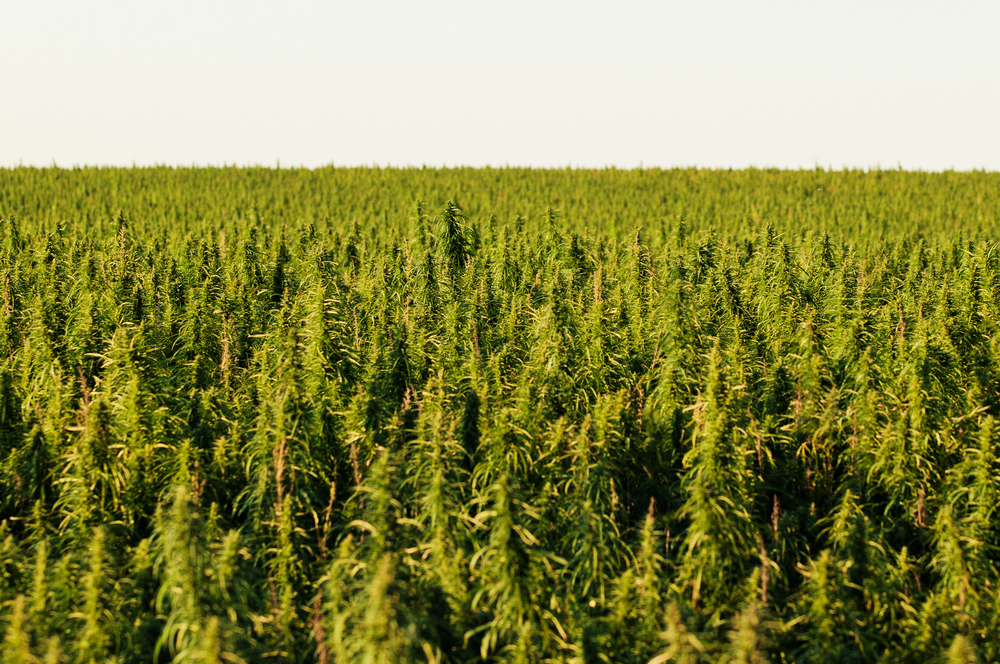
File photo shows industrial hemp. Photo taken 06-12-19.
Many Alabama hemp farmers are either sitting on their crop following harvest or have decided to plow their crop under, due to low quality and decreased prices, according to Katelyn Kesheimer, Auburn University Assistant Professor and Extension Specialist.
“I spoke to a grower on Friday and he said he couldn’t find a processor that had the right price to make it worthwhile for his crop. So he’s going to sit on it a little bit, which I think a lot of people are going to do just because they’re not sure of the actual process of finding a buyer and what to do with it. They really didn’t think it through before they grew the crop,” Kesheimer said. “Honestly, I think a lot of people are going to be sitting on it or destroying their crop because it’s not even worth it to harvest.”
Kesheimer reported on Oct. 21 that Alabama hemp was expected to be low quality due to disease, insects, rain and late plantings. She received calls from buyers looking for smokable flower grade hemp and couldn’t find enough. Not much has changed two weeks later.
“There’s not a lot of great quality flower out there for smokable hemp, so I think a lot of it will get extracted into oil. But the cost associated with it might be prohibitive for some growers. They’re trying to work through that right now,” Kesheimer said. “I imagine we’ll be sitting on a little bit of hemp for the next few months, if not longer.”
2019 Hemp Still Being Held
Producers holding on to their hemp crop is not uncommon in Alabama. Kesheimer believes farmers still have hemp from 2019 because the market price never rebounded.
“It never got back up to where everyone thought it was to make it worthwhile to grow,” Kesheimer said.
Kesheimer and Regional Extension agent Jessica Kelton plan to host listening sessions with hemp producers over the next three weeks to gauge opinions and hear about the potential challenges of the industry moving forward. The first one will be this week on Thursday in Cullman.
“People tried to go big. We had a lot of new growers. There was a lack of information. There’s a lack of buyers, processors, markets. It was wet, so disease just ramped up. I don’t think people realized how quickly, whether it was southern blight or caterpillars, could take out a crop,” Kesheimer said.
Clemson Extension agents provided updates in The South Carolina Grower this week about the status of various crops being produced throughout the state.
Coastal
Rob Last reports, “Strawberry planting is mostly complete in the area. Plants received from nurseries have been very good this year, and establishment is progressing well. In fall vegetable crops, Southern army worms continue to be present and numerous. Whiteflies in fall vegetables are beginning to reduce. Disease pressure remains relatively low.”
Zack Snipes reports, “Strawberry planting continued last week. Bare root plants look good going into the ground. Stay on top of workers to plant them correctly. I saw some patches with “J” roots or long roots that went to the bottom of the hole and back out. Those plants will die or produce considerably less yield than properly planted plants. Also, I have seen and heard reports of spider mites on plug transplants. Check your fields and get out miticide this week if you need it. Fall growth is very important as well as knocking out the existing spider mite populations. Remember that the threshold for spider mites is 4% to 5% of the leaves with a population. And lastly, I have seen AWFUL disease on purchased transplants. If you purchase transplants and they have disease on them, DO NOT plant them. The plants will never produce like they should and you are inoculating the rest of your crops and land with that disease.
Clean bareroot cutoff plants. Notice how white or cream colored the crown is and how clean the roots are. Photo from Zack Snipes.
Midlands
Justin Ballew reports, “Young strawberries are growing well so far in the midlands. We’ve had good weather for getting the plants established. We are starting to see some spider mites already, so don’t forget that we need to be scouting regularly as soon as the plants are in the ground. If you plan to cover your strawberries for a couple weeks in the fall, getting rid of mites should be priority #1. Other crops are doing well also, though we are seeing high numbers of caterpillars and diseases like black rot, and Alternaria on brassicas have really been ramping up.”
Discoloration on young plants from spider mite feeding damage. Once populations reach the threshold of 4% infestation, treatments need to be made in a timely manner to keep spider mites from hanging around throughout the winter and into the spring. Photo from Justin Ballew.
Pee Dee
Tony Melton reports, “First time I have seen large numbers of yellow-margined beetle in Orangeburg County – we had to treat 1 out of 10 fields for them. If possible do not use a pyrethroid on young greens; it will encourage worm and aphid problems. Still seeing a lot of boron and magnesium deficiency in greens, mostly because farmers are not liming properly, using sul-pho-mag, or using premium fertilizers with minor elements. Spray with boron and many applications of Epsom salts, and the greens will eventually grow out of the problem. Like always, swine cress and corn spurry are awful weeds in greens – to control, I recommend using a stale-bed culture technique before planting. We still have butterbeans, peas and cucurbits in the ground – hope frost stays away until after Thanksgiving.
Upstate
Kerrie Roach reports, “High winds, heavy rains and now cold overnight temperatures have laid down a gauntlet for growers in the Upstate over the last week. Many growers in Oconee County lost power from the remnants of Hurricane Zeta for anywhere from 1 to 4 days. Apples are just about finished with mainly Yates and Arkansas Blacks left to pick. Apple growers concerned with fungicide resistance should contact Kerrie to pull Bitter Rot samples now to be sent to the shared lab at N.C. State.”
Andy Rollins reports, “Finishing up strawberry planting in the upstate. I’ve been inspecting farms and assisting some growers with planting different types of plants they weren’t used to planting. Unlike the pictured transplants some are a little smaller than normal but appear to be healthy at this point. Colder weather is a slight concern as we need decent growing conditions to get them rooted in well. Some may need to use row covers to keep strawberry plants growing during the first 30 days in the ground if temperatures stay low. Peach growers are putting down fall herbicides, and some are preparing to do delay blooming. This involves waiting till at least 50% of the leaves are off of the trees before applying a liquid form of ethylene. Other stipulations are also important regarding temperatures after application. If it is your first time trying this, speak with your county agent to get the correct method.
Healthy strawberry plug ready to be planted. Photo from Andy Rollins.
Hemp harvest is nearing an end in Georgia. According to Tim Coolong, associate professor in the UGA College of Agricultural and Environmental Sciences, the state’s hemp producers appeared to have stayed within the legal parameters of hemp production.
What distinguishes hemp from marijuana is the amount of THC or tetrahydrocannabinol present in the plant. It is the main compound in cannabis that produces the “high” sensation.
Legal hemp must contain no more than 0.3 percent of THC. Otherwise, the THC is at an unacceptable level, and the crop must be destroyed. That doesn’t appear to have been the case this year, though.
“I haven’t heard many reports of people going above the limit. For the most part, at least for the growers I’ve interacted with, they were testing regularly. When they had gotten their test back for harvest they were completely legal and ready to go,” Coolong said.
THC levels must be officially tested within 15 days of anticipated harvest.
If growers regularly tested their hemp samples, it prevented a disastrous scenario of if the officials tested the crop before harvest, and it exceeded legal limits, catching the farmers off guard. All of the work done to produce that crop would be for naught.
“We stressed that a lot last year at our county meetings. Terry Hollifield, with Georgia Crop Improvement, they were doing the sampling for the growers, and he made a specific effort to do orientations with them. During the summer, he would go out and visit the growers and explain to them the process and everything,” Coolong said.
“Almost every grower I had spoken to this summer was doing some testing on their own before the state would come in. I would be surprised if there were very many growers who were just like, ‘Oh, I didn’t know about this.’”
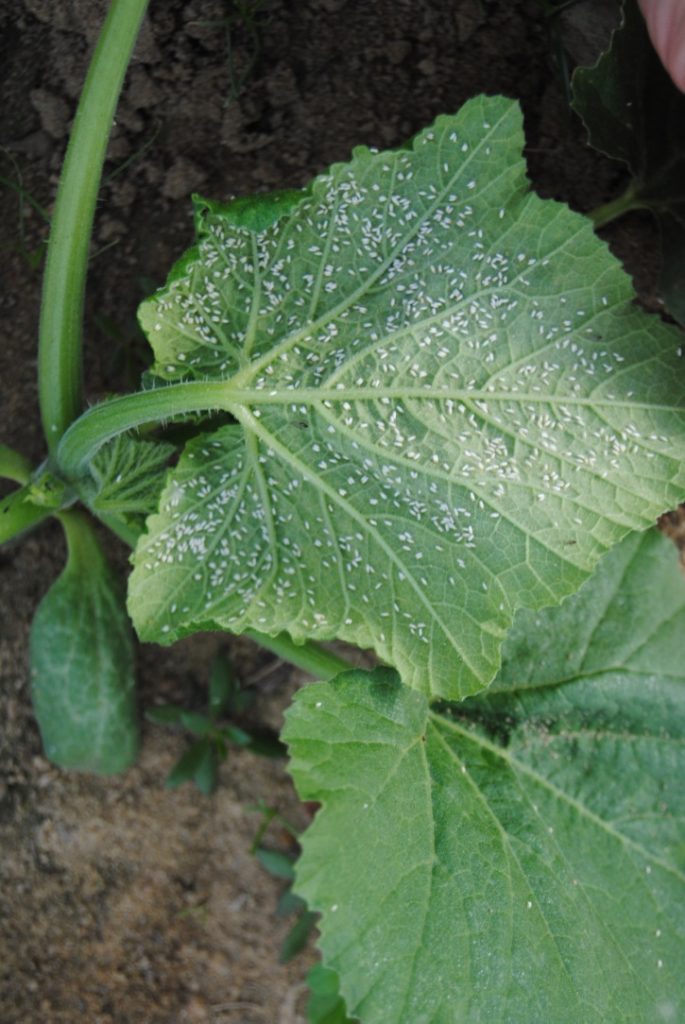
File photo shows whitefly adults feed on a yellow squash seedling.
This has been the year of the whitefly for vegetable producers in the Southeast. Even as they have been a problem for Georgia vegetable producers, they have also been a nuisance for Alabama farmers.
Ed Sikora, an Alabama Extension Specialist Professor in Entomology and Plant Pathology at Auburn University, said he’s seen quite a few whiteflies on some of the cucurbit crops like zucchini, yellow squash and pumpkin. The whitefly pressure has increased this year and is impacting locations not used to whitefly damage.
“I don’t work with insects typically, but they seem more common on the cucurbit crops in some of our monitoring plots this year than in past years. Every so often I’ll see the silverleaf damage on squash and so forth,” Sikora said. “This year they seem to be more common than I’ve seen in the last five years on that crop. I saw some last year in the Brewton area. This year I’m seeing them up around, even Auburn. It was heavy down in the Dothan area and in Brewton again.”
What’s most concerning for Alabama vegetable growers are the viruses whiteflies can transmit. They are responsible for transmitting multiple viruses, including cucurbit leaf crumple virus and cucurbit yellow stunting disorder virus. They’re also concerning for vegetable producers in Georgia where whiteflies are before coming to Alabama.
According to the University of Georgia crop loss estimates for fall 2017, the last major infestation period prior to this year, these viruses caused between 30% and 50% crop loss in squash and cucumbers and nearly 80% crop loss in snap beans that year. Vegetables like squash, zucchini, cucumber, cantaloupe and snap beans are highly susceptible to these viruses.
“We’re a little bit concerned because we know that they can transmit some plant viruses. These are occurring in Florida and we assume they are occurring in Alabama as well. We think with more whiteflies in the southern tier of the state that we’re probably seeing more whitefly-transmitted virus problems. That’s something we’re looking into, currently,” Sikora said.
UGA CAES photo/Erica Head, a student in the Organic Horticulture Entrepreneurship class and student assistant herb manager at UGArden, sells teas from herbs she’s grown and processed at a weekly student farmers market.
By Austin Clark for UGA CAES News
Balancing academic coursework with a job is a challenge many University of Georgia students face. But for students in the new Organic Horticulture Entrepreneurship class, their classwork is both academic and economic.
This semester is also harvest season for the four horticulture students in the class, who are gaining experience planning, planting and marketing their crops through a weekly student farmers market.
Taught by Associate Professor David Berle and Professor Tim Coolong in the Department of Horticulture, the new course in the College of Agricultural and Environmental Sciences (CAES) empowers students to learn the process of growing their own produce and build the interpersonal communication skills necessary to sell their crops.
Every Thursday
Every Thursday from 4:30 to 6 p.m., the students load up tables at UGArden with the crops they’ve grown during the semester — leafy mounds of lettuce, kale, turnip greens and bok choy, as well as radishes, turnips and teas made from herbs they’ve grown — and sell their wares to the public. Customers are able to buy field-fresh produce and the students practice educating members of the Athens community about the process of organic farming.
The class, which is being taught for the second time this semester, was created after Berle, who focuses on organic horticulture, and Coolong, a vegetable specialist, were approached by a donor interested in supporting the development of an immersive course addressing both sustainability and entrepreneurship.
Part of the donor funding goes to compensate Sarah Rucker, assistant farm manager for the UGArden.
“(Rucker) is the one who helps coach the students and manage the farmer’s market,” Berle said. Through her role in the course, Rucker essentially serves as a teaching assistant for the course by answering any questions the students may have about their crops, best practices and marketing techniques.
Course Adjustments
As the course progresses, Berle continually makes adjustments to give students the best opportunities to gain experience in both growing and selling organic produce.
One tweak is the way students sell their produce. During the first semester the course was offered, students were selling primarily to university vendors such as UGA Dining Services and the University of Georgia Center for Continuing Education & Hotel. But after realizing that students were missing out on face-to-face interaction with customers, Berle and Coolong combined their class with the weekly UGArden farmers market so that students could interact directly with consumers rather than just delivering to vendors.
Students Appreciative for Opportunity
Students in the course are grateful for the opportunity to give back to the Athens community by providing fresh produce while learning what it takes to be an entrepreneur in the organic horticulture industry.
“I am probably out here (in the garden) for four or five hours every day,” stated Sarah Kate Duncan, a senior horticulture major who is taking the course. “But it is totally worth it … Some of my favorite things to grow are turnip greens, different types of lettuces, fresh cut flowers and herbs.”
Another student in the course, Erica Head, works as the student assistant herb manager for UGArden.
“I see the whole process from beginning to end: I seed the plants, I put them in the field, I dry and process them into teas. I like seeing people enjoy the teas and telling them about their medicinal effects,” Head said. “It’s also really good to see the other students selling the crops they have worked hard on all semester.”
Chris Rhodes, director of industry partnerships at CAES, explains that industry leaders are looking for graduates with the creativity, communication and problem-solving skills that students in this course are gaining.
“There is no substitute for running a business to learn how to run a business,” Rhodes stated. Through his role in the college, Rhodes wants to ensure that every student has the confidence to recognize a path they want to achieve and then to be connected to resources to ensure success after their time at UGA.
Produce Availability
Student-grown produce from the course will be available through the weekly farmers market until Thanksgiving. For more information on this course and other experiential learning opportunities available at CAES, visit caes.uga.edu/students/experiential-learning.
Doug Chapman, Alabama Extension agent for Commercial Horticulture in North Alabama, says the ramifications of having scab disease in your pecan orchards can’t be understated.
“It’s the difference between having pecans and not having them,” Chapman said.
Even as pecan harvest is under way across Alabama, soon it will be time to plant new pecan trees. Pecan planting is usually done during December and January when the trees are dormant.
However, before commercial growers and homeowners begin putting trees in the ground, they must consider their fungicide spray options to manage scab disease. If they don’t have a management strategy, they shouldn’t expect pecans to start falling in 8 to 10 years.
“Scab is My First Suspect”
“Scab can wipe you out. I’ve seen it to where, even if you were to make a few nuts, if there was a scab problem, they tend not to fill out,” Chapman said. “We get a lot of questions like, okay I’ve got pecans and they’re not filling. Here again, scab is my first suspect and until you can eliminate that, there’s not much point in talking about the rest of it.”
Unpredictable Weather
Weather was unpredictable this year for pecan growers. Chapman said it was really wet in the spring, but then it turned off dry. He doesn’t think scab was nearly as bad as it has been in other years. But the dry weather has also affected the nut size. If you didn’t have irrigation, the nuts didn’t size up when they should have.
Scab Disease
Scab disease does not usually kill trees, but it can greatly reduce yields. The fungal pathogen that causes scab overwinters in the tree as lesions on stems and old nut shucks that remain in the tree after harvest. When temperatures begin to warm in the spring, the fungus becomes active and starts to produce new spores that are spread by rain and wind.
All South Georgia vegetable farmer Sam Watson wants when competing against Mexican imports is a level playing field. Right now, that does not exist and has the Moultrie, Georgia farmer concerned about the future of the American farmer.
Watson
“When you look at what we have to do from our cost of production standpoint and you look at our labor costs mainly, where we have to pay (hourly) H-2A wages that are in the $12 range and yet you can go to Mexico and have the same labor down there and pay $8 a day on the high end; and then there’s no regulatory environment,” Watson said.
“You don’t have EPD and Department of Agriculture and FDA and OSHA. The food safety requirements exist on this side, but do we know how much of that is being regulated on their side? The whole regulatory environment is different.”
Virtual Hearings
Watson was one of many Georgia farmers and Florida farmers who testified in virtual hearings with the U.S. Trade Representative’s Office about unfair trade practices with Mexico. All who testified voiced similar concerns that they are unable to compete now and in the future.
Not a Level Playing Field
“It’s a totally different playing field. If I didn’t have to pay but $8 a day, I could do a whole lot better job probably when it comes to quality and harvesting and that kind of stuff,” Watson said. “They’ve got state of the art facilities down there that we can’t compete with. The government is subsidizing those guys down there. Their government is pumping a ton of money into economic development and growing that sector of their economy down there.
“You’ve got cost of production, you’ve got regulatory environment and you’ve got subsidies. When you put all of that together; the cost of production continues to go up. Our regulatory environment continues to get worse. Our labor costs continue to go up.
“You reach a point where it’s just not worth it anymore.”
Federal Response
Federal agencies responded to the hearings with a plan to help farmers of seasonal and perishable fruits and vegetables, including those from Georgia and Florida. Click here to view details of the plan.
“We’re not saying we want to stop the production. We just want there to be a level playing field. They shouldn’t be sending product into the United States of America open on a $16 squash market. That’s called dumping. I’ve got evidence of it,” Watson said. “That happens all the time.”