South Florida was thirsting for rainfall prior to last weekend. The abnormally dry conditions were alleviated a little bit with steady moisture that soaked the region, says Gene McAvoy, University of Florida/IFAS Regional Vegetable Extension Agent IV Emeritus.
US Drought Monitor graphic shows how dry Florida was last week prior to the rainfall last weekend.
“We got about an inch and a half down around Immokalee (Florida). Some places were a little better,” McAvoy said. “It was a nice soaking rain, exactly what the doctor ordered.”
The dry weather created dire conditions for vegetable and specialty crop producers in the middle of their production season. According to the US Drought Monitor, most of the South Florida and Central Florida regions were abnormally dry last week. Some counties, like Collier County where McAvoy is located, and Monroe County, Palm Beach County and small parts of Broward County and Hendry County were classified in a moderate drought.
“We were starting to get awful dry around here. I’ve been hearing problems with things like blossom end rot and some of those issues that you see when it does get dry and it’s hard to keep the soil moisture constant,” McAvoy said.
Imports of fresh fruits and vegetables continue to flood the U.S. markets and it is only increasing. According to the USDA Economic Research Service, Mexico was the top importer of fresh or frozen fruits as well as fresh or frozen vegetables.
Its fruit imports tallied $3.21 billion from October 2020 to February 2021. Its an increase from the $3.03 billion it recorded the prior year. February’s data indicates $746 million compared to $693 million in February 2020.
In fresh or frozen vegetables, Mexico’s three-month output from October 2020 to February 2020 was $3.8 billion, compared to $3.58 billion the prior year.
The top 10 importers of fresh and frozen fruits include: Mexico, Peru, Chile, Guatemala, Costa Rica, Ecuador, Canada, Honduras, Colombia and Brazil. The world total for the October to February timeframe was $6.82 billion, an increase from the $6.5 billion the prior year.
The top 10 importers of fresh and frozen vegetables include: Mexico, Canada, European Union-27, Peru, Guatemala, China, Costa Rica, Ecuador, Honduras and the Dominican Republic. The world total for the October to February timeframe was $5.73 billion, compared to $5.44 billion.
What does the technological future look like for vegetable and specialty crop producers? In an era where they compete in a global marketplace against rising imports, producers can no longer rely on cheap land or labor; they must compete on the basis of technology and innovation.
What does that future look like? Come find out at the Ag Tech Expo, hosted by the UF/IFAS Southwest Florida Research and Education Center on May 10-11. It is a virtual event, but farmers can click here to register.
Conference Registration is $100. Student Registration is $25. The price for trade show vendors is $250.
Agenda
DAY 1 – Monday, May 10, 2021
Opening Remarks – J. SCOTT ANGLE, PH.D. , Vice President for Agriculture and Natural Resources , University of Florida Institute of Food and Agricultural Sciences (UF/IFAS)
Keynote Speaker – DR. RANVEER CHANDRA , Microsoft – Data-driven agriculture: How the Cloud and AI can help reimagine food from seed to plate.
10:00 am Scott Berden /Miquel Clavijo, US Sugar – Leveraging IoT and Remote Sensing Technology at US Sugar.
10:30 am Louis DeMaso, Lipman Family Farms – Sustainability Case Study: Precision Agriculture for Maximum Resource-Use Efficiency.
11:00 am Dr. Sanjay Shukla, UF IFAS SWFREC – Streamlining growing environment for fresh produce with compact bed geometry system.
11:30 am Tony Mucciardi, Tree Radar – TRU GPR and IR imagery for root morphology maps.
UAV Session (Monday a.m.)
10:00 am Nathan Stein, pix4d – A good map is the first step in digitizing your field.
10:30 am Dr. Spyros Fountas, AUA, Greece – The role of UAVs for crop yield estimation.
11:00 am Dr. Yiannis Ampatzidis, UF IFAS SWFREC – Agroview: AI-based technology for precision agriculture.
11:30 am Drew Baustian, Micasense – Image Classification, Irrigation Monitoring & More Using Multispectral & Thermal Imaging.
Genomics Session (Monday a.m.)
10:00 am Dr. Tong Geon Lee, UF IFAS GCREC – CRISPR: A technical breakthrough for crop research.
10:30 am Dr. Samuel Hutton, UF IFAS GCREC – Applications of Marker Assisted Selection in the UF/IFAS Tomato Breeding Program.
11:00 am Dr. Vance Whitaker, UF IFAS GCREC -Genomic Prediction in Strawberry Breeding.
11:30 am Dr. Marcio Resende, UF IFAS Department of Horticulture – Genomics and phenomics applied to sweet corn breeding.
12:00 PM – 2:00 PM – Break and Technology Show – Virtual Trade Show
2:00 PM – 4:00 pm – Afternoon Sessions
Robotics Session (Monday p.m.)
2:00 pm Dr. Pal Johan From, Saga Robotics – Thorvald – and autonomous multipurpose platform for agriculture.
2:30 pm Bob Pitzer, HCR – Robotic strawberry harvesting.
3:00 pm Dr. Stavros Vougioukas, UCDavis – Human and ag-robot collaboration for fruit harvesting.
3:30 pm Dr. Manoj Karkee, WSU – Tree fruit harvesting: Accomplishments and challenges.
Protected Ag Session (Monday p.m.)
2:00 pm Dr. Kevin Folta, UF IFAS Department of Horticulture – Closed Controlled Environment.
2:30 pm Jennifer Waxman, Executive Director, The Villages Grown™ – Bridging Agriculture and Wellness — How CEA may be the next movement towards the Food-as Medicine approach.
3:00 pm Bob Hochmuth – Protected Ag- Technology Under Cover
3:30 pm Federico Boscolo, Cultiva Farms – TBA
Jonathan Way, Colusa Farms – TBA
Innovations in Water and Nutrient Management (Monday p.m.)
2:00 pm Doug Crawford, BMP Logic – Real-time irrigation management with wireless soil moisture sensor – adoptions in North America and lessons learned.
2:30 pm Grower’s perspective on technology adoption in managing water and nutrient over three decades, Lipman Family Farms.
3:00 pm Dr. Sanjay Shukla and TBA – Circular nitrogen and phosphorus economy.
3:30 pm Dr. Sandra Guzman, UF IFAS IRREC – New technologies for efficient irrigation.
4:00 PM – 5:00 PM – Technology Show – Virtual Trade Show
5:00 PM – 6:00 PM – Virtual Party (Happy Hour)
DAY 2 – Tuesday, May 11, 2021
Keynote Speaker TBA
10:00 AM – 12:00 PM Morning Sessions
Automation Artificial Intelligence, and Precision Spraying (Tuesday a.m.)
10:00 am Dr. Lynn M Sosnoskie, Cornell University, – Review of weed management technology.
10:30 am Dr. Nathan Boyd, UF IFAS GCREC – Weed Management for the Future.
11:00 am Dr. Thanos Balafoutis, IBO, Greece – Variable rate technologies for precision spraying.
11:30 am Keith Hollingsworth, CC and/or Dr. Yiannis Ampatzidis, UF IFAS SWFREC – Smart tree crop sprayer utilizing sensor fusion and AI.
Environmental Services (Tuesday a.m.)
10:00 am Benita Whelan, Florida Cattlemen’s Association – Dispersed Water Management System.
10:20 am Dr. Sanjay Shukla, UF IFAS, SWFREC, and Linda McCarthy, Lykes Bros Inc. Payment for water storage and treatment services program in the Everglades Basin– From pilot to large-scale implementation.
11:00 am Ernie Shea, Solutions from the Land – Florida Climate Smart Agriculture Working Group Overview.
11:30 am David M. (Max) Williamson, Williamson Law + Policy PLLC – High-level Overview of Carbon Markets.
12:00 PM – 2:00 PM – Break and Technology Show – Virtual Trade Show
2:00 PM – 4:00 pm – Afternoon Sessions
Automation and Pest/Disease Management (Tuesday p.m.)
2:00 pm Dr. Natalia Peres, UF IFAS GCREC – Ultraviolet Robot for control of Powdery mildew in Strawberry.
2:30 pm Dr. Ozgur Batuman, UF IFAS SWFREC – Development of a novel automated delivery system for citrus trees.
3:00 pm Michael Otte, Rantizo – Drone Spraying, the Future Present of Agriculture.
3:30 pm Liron Brish, Farm Dog – Easily digitizing your in-field workforce – the foundation for efficiency and effectiveness.
Water Management I Mixed session I (Tuesday p.m.)
2:00 pm Dr. George Vellidis, UGA – SmartIrrigation – a Pathway to Sustainable Intensification.
2:30 pm Dan Urban, Analytics Lead, CERESIMAGING – Managing the variability in transpiration and vigor with aerial imagery.
3:00 pm Grant Allen, C&M North America (Checchi & Magli) – Vegetable/Melon Transplanting – Speed, Precision, Automation, etc.
3:30 pm TBA
Traceability/Blockchain (Tuesday p.m.)
2:00 pm TBA, AgTools – Using data to improve market access and profit margins.
2:30 pm Bristol Wells, Highlands Agriculture – Virtualizing the Business of Ag with Highland Ag Solutions.
3:00 pm Creg Fielding, Fusionware – Vertically Integrated Supply Chain – Get out of spreadsheet hell!
Population is expanding around the world. Farmers will need to produce more food in the next 50 years but with fewer resources and less environmental impact.
The developments in agricultural robotics, machine vision, ultra-precision farming; autonomous farming; artificial intelligence (AI); and genomics will transform the way farming is conducted. These technologies coupled with AI are enabling a revolution which will eventually upend the familiar way of conducting daily farming practices.
The vegetable and specialty crop sector is vulnerable to market manipulation. That makes what Mexico is accomplishing through its increased imports of cucumbers and squash dangerous for the future of the American farmer, claims Georgia farmer Dick Minor.
“In 2018, the combined acres planted into fresh market cucumbers of the top five producing states was less than 30,000 acres,” Minor said. “A simple 10% increase in production is enough to totally devastate the marketing window and eliminate any chance of profitability.
“Mexico, over the last 10 years has dramatically increased production of cucumbers and squash. They have expanded production with no regard for other production areas or without regard for probability of making a profit.”
Competitive Disadvantage
Minor produces eight different vegetable crops, which include cucumbers and zucchini squash. It is very common to produce both crops. But it’s also becoming increasing challenging to produce both crops when compared to unfair competition against Mexico.
“The last 34 years have presented many challenges to our vegetable farming operations. However, none has presented a threat near the scale of the dramatic increase in low-cost Mexican vegetable imports,” Minor said.
Many factors led to this unfair competitive advantage, as claimed by Minor and other Florida and Georgia farmers during Thursday’s U.S. International Trade Commission hearing. Labor tops the list. Mexico can pay its workers a small fraction of what farmers like Minor pay theirs.
“Mexico is able to offset its disadvantage in location with some of the most abundant and cheapest labor costs anywhere in the world,” Minor said.
Government subsidies also contribute to Mexico’s workforce growing more and more produce under protected acreage. Mexico can import its produce 12 months out of the year, which directly impacts marketing windows for Southeastern farmers.
“Florida growers understand that when Georgia starts they need to be finished harvesting and they plant accordingly. Georgia growers understand that North Carolina will start harvesting in late June, and when we plant, we also plant accordingly. Each growing area understands its window,” Minor said.. The factors that influence when and how much product they can produce and still maintain the probablilty of still maintaining a profit.”
Supply is the main factor that affects daily prices. Fresh produce needs to be sold and sent to markets as soon as it is harvested. Markets are volatile. They can surge quickly or drop instantly, as they are sensitive to change and planted acres.
“Today, low costs Mexican production is threatening every grower in the United States,” Minor said.
Clemson Extension agents provide updates in the The South Carolina Grower this week about the status of various crops being produced throughout the state.
Weekly Field Update-4/12/21
Statewide
Dr. Matt Cutulle reports, “I am starting to see some goosegrass popping due to soil temperatures being 65 degrees Fahrenheit. Goosegrass will typically be problematic in more compacted areas of the field. In most broadleaf crops, a Select or Poast post-emergent application will control emerged goosegrass. PRE-herbicide options include Curbit and Dual Magnum (If crop is labeled). In rice, it is important to remember that Quinclorac products will kill crabgrass but not goosegrass. The best rice product that will control goosegrass effectively in SC is Clincher.”
Coastal
Rob Last reports, “Crops are generally doing well in the area, with strawberries coming off with good volumes. On the whole, row covers or icing protected 97% of the susceptible flowers leading to 1% to 2% losses of flowers. The damaged flowers can increase grey mold pressure in the crops so maintaining both sanitation and fungicide applications to strawberries will be crucial. As berries ripen, sanitation also becomes essential for reducing pest pressure from sap beetles. In some crops, where row covers were utilized, we see spider mite populations increasing and a few active thrips feeding on both flowers and berries. Other fruit crops in the area, such as blackberries and blueberries, look very good with low levels of damage from the freeze event last weekend. Peaches in the area are being thinned, with scouting being maintained for scale and plum curculio. Early planted watermelons did suffer from the frost in places, leading to 10% to 15% plant loss and hence the need to replant in a few areas. Other crops are moving slowly away from the injuries. Luckily, a lot of crops were not beginning to vine and survived the worst of the damage. These plants are stressed, so care will be needed with any applications as well as scouting for pest and disease issues. Conversely, cantaloupes in the area were direct seeded and have survived unscathed.”
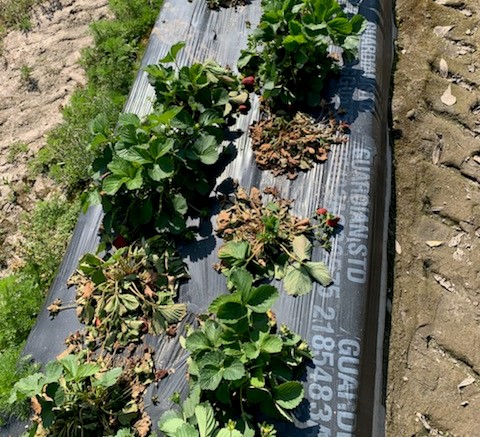
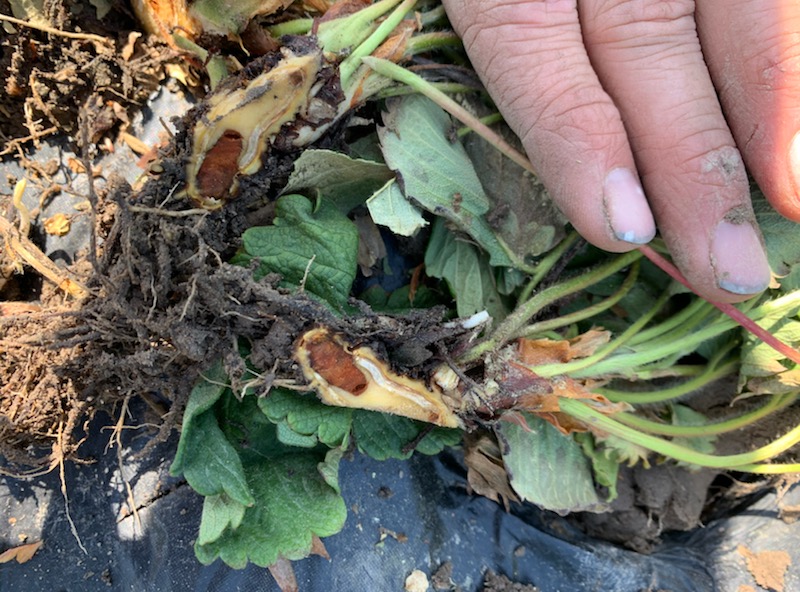
Zack Snipes reports, “I was out and about last week as things are moving rather quickly in the fields. Spider mites are alive and active in every strawberry patch that I was in last week. You will see the translucent mite with two distinct spots as well as a reddish colored mite. The reddish colored mite is actually a two-spotted spider mite. We see this red form early in the season. Get out and scout, as the weather is perfect for them. I am also seeing strawberry plants wilting down and dying. If you cut the crown you will see a brown/red rot in the center of the crown. Send these plants off for diagnosis. Most of what I have seen has been Phytophthora. We lost some cucurbit crops to the frost last weekend, but some areas had no damage at all or slight damage. For some positive news, we are cutting some beautiful broccoli right now.”
Lower lying areas of fields or areas where the drip tape was nicked is where I am seeing some root rot issues. Photo from Zack Snipes.Cutting the crown of wilting strawberry plants can help detect the pathogen responsible. Sending off to the lab is the only way to get a 100% diagnosis of the problem. Photo from Zack Snipes.
Midlands
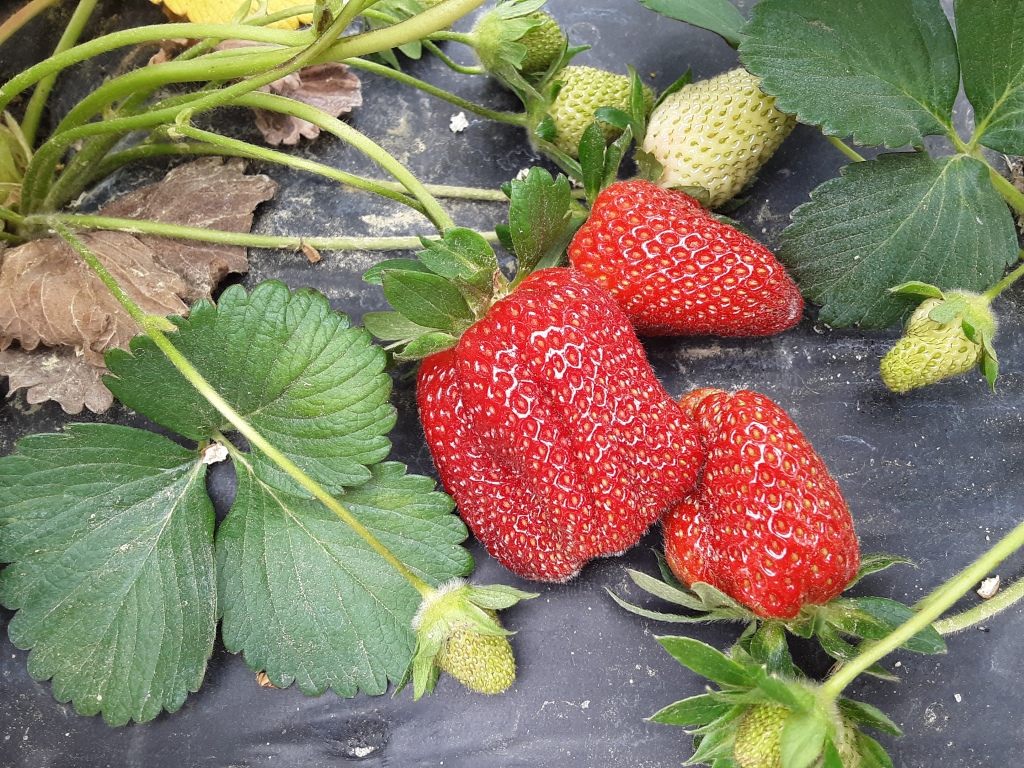
Justin Ballew reports, “Strawberry picking started on a wider scale this past week. This conveniently coincided with spring break for a lot of the public schools in our area, so U-pick operations have been busy. The weather was very mild last week, so everything is looking great. Spider mite and grey mold activity seems to be very low. There are a few thrips in certain places, so that’s something we need to keep an eye on. Brassicas are growing well. Caterpillar populations are still pretty low in most spring planted crops. There was a little injury to sweet corn from the recent frosts, but we expect the plants to grow out of it. Sweet corn’s growing point is underground until the 6 leaf stage. Since pretty much all the sweet corn was at the 3 leaf stage or younger, the growing points were protected and the damage is just superficial.”
Strawberry season has finally arrived in the Midlands. Photo from Justin Ballew.
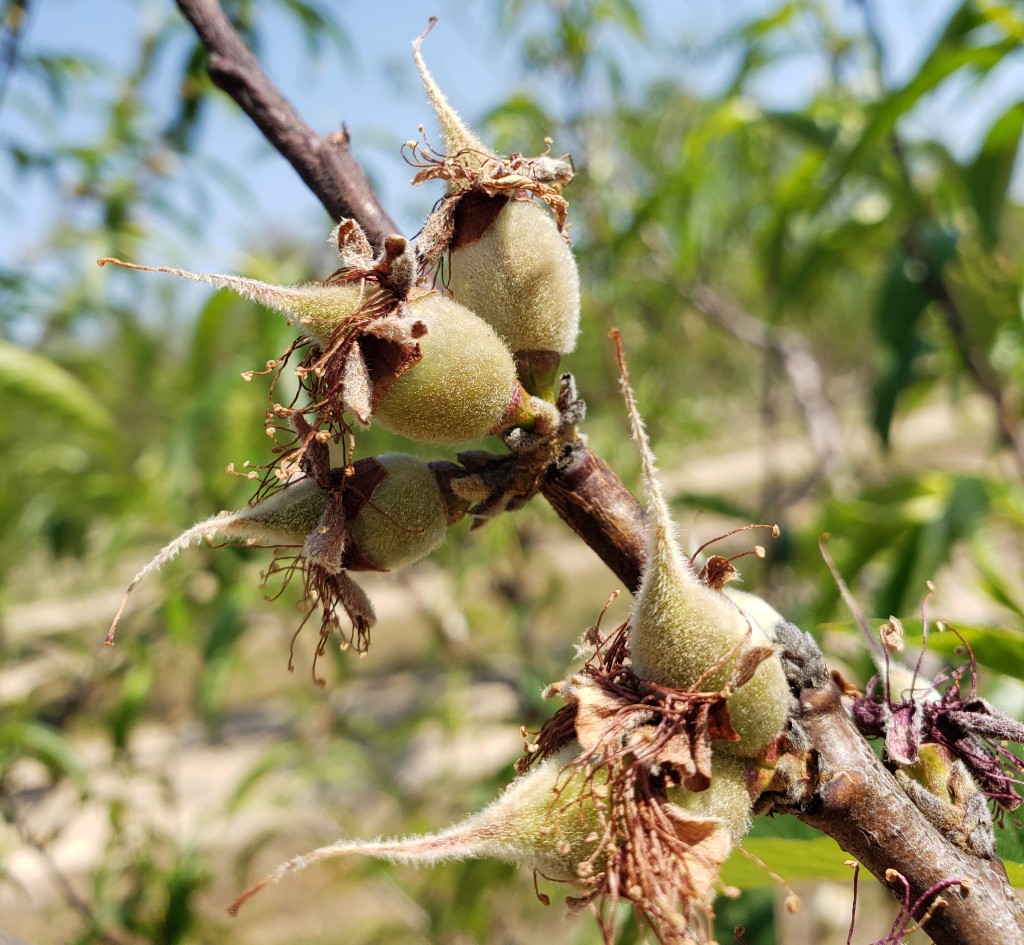
Sarah Scott reports, “We are still assessing peach crop damage from freeze events happening between April 1 and April 3. It looks like anywhere from 1/4 to 1/3 of fruitlets were damaged by the cold event, but with no additional damage we should still be on track for a good crop this year. Strawberries were delayed a bit from the cold but are recovering nicely. Planting continues for crops like kale and other spring greens.”
Peach fruitlets at shuck off. Photo from Sarah Scott.
Pee Dee
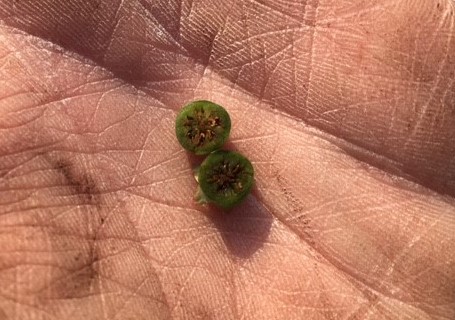
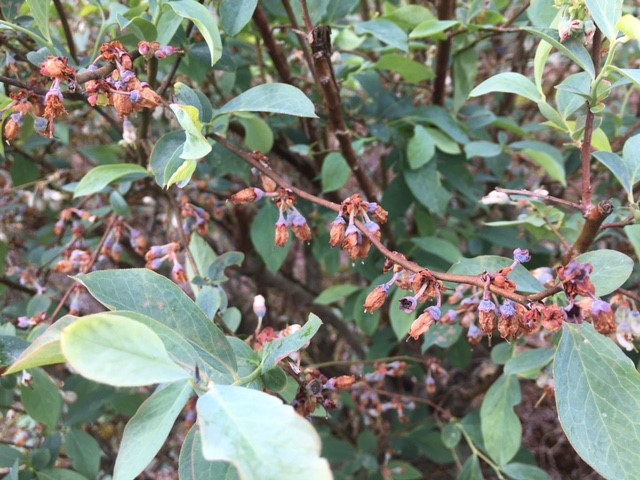
Bruce McLean reports, “Strawberries are really starting to come off. The quality is very good, and the plants are in good health. Disease is relatively low, and spider mite activity is moderate. Damage was minimal from the freeze before Easter. We did see some damage on blueberries, though. Blueberries without frost protection (in especially cold locations) did see some significant injury to both early southern highbush and early rabbiteye cultivars. Injury of 80% was observed in Star and O’Neal (southern highbush) and Premier (rabbiteye). Blueberries with frost protection fared much better. This shows the importance of having well-designed frost protection if you are going to grow early-blooming cultivars. Muscadines, being at budbreak, did not show any significant injury. Farmers are taking advantage of this absolutely beautiful weather to plant vegetables. Sweet corn, peas, butterbeans, cucumbers, squash, melons, tomatoes, etc. are going in the ground as fast as they can. Blueberries are being planted now, too.
Black and brown seed and tissue within the berry shows that the fruit was injured from the freeze and will not develop. Photo from Bruce McLean.Damage to early fruitlets on rabbiteye blueberry. Photo from Bruce McLean.
Tony Melton reports, “Most strawberries are doing well and really starting to produce a lot of fruit. Cabbage is starting to head and is growing well. Brassica growers are applying products for diamondback moth and Sclerotinia. Some pickles are emerging and many acres will be planted this week. Some butterbeans are up, and more are being planted. We will start to plant peas this week. Cool temperatures slowed sweet potato slip growth a little, but most beds are covered with slips. Collards, turnips and kale are growing fast. Hundreds of acres of tomatoes and peppers are already planted. A few acres of watermelons and cantaloupes are planted, but our main market is after the 4th of July.”
The economics of farming in Florida is not adding up for some vegetable and specialty crop producers. With land prices continuing to increase across the Sunshine State and imports continuing to flood the U.S. markets, it has created a crossroads for some growers, explains Florida Ag Commissioner Nikki Fried.
Nikki Fried Florida Agriculture Commissioner
“When our growers can’t compete and they are seeing job losses, they’re seeing economic losses and the demand for land here in the state of Florida continue to increase. We have 1,000 people moving to the state of Florida every single day. With those types of increases, we need to build infrastructure and urban development in our state,” Fried said. “It’s become a crossroads for a lot of our farmers; whether to stay with their generational farms and continue trying to make ends meet while they’re seeing imports coming into Florida really devastate the marketplace.”
Fried testified on Thursday during the U.S. International Trade Commission hearing about the impact squash and cucumbers are having on the Southeast domestic industry. Some producers have already hinted that they see the end of their agricultural careers. Not because of choice but due to an inability to compete. It only continues to worsen.
“We are losing a lot of farms, just because they can’t compete, can’t keep their farms going and the price of land continues to increase. It’s a really hard crossroads,” Fried said. “I’ve spoken to hundreds of thousands of farmers across our state who have to make these tough decisions because agriculture and farming is just not making ends meet.”
A farmer may have a certain Integrated Pest Management (IPM) plan to utilize during this year’s growing season. Mother Nature may have other ideas, however.
Ayanava Majumdar
Ayanava Majumdar, Extension Professor in Entomology and Plant Pathology at Auburn University, stresses that weather can challenge IPM plans.
“The local weather patterns are really challenging agriculture. Not just now, it’s been happening for a long time,” Majumdar said. “What I want to show you is how we’ve cycled between drought, a prolonged drought and then we had a very wet year and then we had a flash drought. These weather patterns are really impacting how insect populations are growing, how they’re behaving and then our effectiveness with insecticides, whether it be organic or conventional.”
Insect Impact
In the summer of 2016, a prolonged drought led to an increase in moth activity for fall armyworms, beet armyworms, squash vine borers and cabbage loopers. The following summer was a wet year, which led to major decreases for moth activity.
In the summer, 2019, a flash drought occurred. It led to a sudden increase in moth activity for soybean loopers, corn earworms, fall armyworms, lesser cornstalk borers, cabbage loopers, tobacco budworms, beet armyworms and squash vine borers.
“To me, I think that flash drought is very dangerous. In 2019, I saw two acres of tomato plots for research, that flash drought increased insect pressure so suddenly that we were just unaware of the high population that suddenly the crop was looking really bad with insect outbreaks. I think we are better situated for handling a prolonged drought. We have drip irrigation systems most of the time. But if you have a flash drought, you just don’t know, it comes suddenly, affects the crop and increases the insects,” Majumdar said.
He added that a flash drought can cause more than 70% crop loss in late-season tomatoes.
Samantha McLeod photo/Georgia Governor Brian Kemp designated pecans as the official state nut for Georgia.
Brian Kemp is nuts about pecans. So is the rest of Georgia for that matter. Just call Georgia the “Pecan State.”
Georgia’s Governor designated the pecan as Georgia’s official state nut on Friday at an event at Ellis Brothers Pecans in Vienna.
According to the USDA Fruit and Tree Nuts Outlook, Georgia reclaimed the status as the largest pecan producer in the country after last season’s output, after being bested by New Mexico the previous two years.
Last year’s harvest rose 95% to 142 million pounds. Statewide bearing acreage remained steady at 129,000 acres, with yields per acre estimated at 1,100 pounds per acre.
According to the UGA Extension, pecans were ranked as the top state for pecan production by the 1950s. It’s a status that’s still true today.
Two issues at the forefront of vegetable and specialty crop producers in the Southeast is H-2A and imports from countries like Mexico. Secretary of Agriculture Tom Vilsack discussed both issues and sympathizes with growers in the Southeast.
“We’re looking at ways in which we’re able to provide some help and assistance to them under the COVID relief packages that were not specifically targeted to them. No. 2, in terms of labor, no question, serious issues, serious challenges that agriculture faces,” Vilsack said. “That’s why I’m certainly happy to see the House of Representatives pass the Farmer Worker Modernization Act, which essentially creates an avenue for a stable, mature and predictable workforce that makes improvements to the H-2A program that makes it easier for farmers to have that stable workforce, dependable workforce. At the same time, it allows those workers the opportunity to basically come out from the shadows.”
Vilsack said he hopes the Senate will take the legislation up, noting it is a bi-partisan issue.
“These are the workers that folks in the Southeast are depending upon. These are folks that are essentially responsible for picking a lot of our fruits and vegetables in a number of different areas across the country. It just makes sense that farmers have that stable and secure workforce,” Vilsack added.
Increasing Imports
As for imports, it’s an issue that seems to worsen daily. Southeast farmers accuse Mexico of dumping produce and creating a competitive disadvantage that growers can’t compete with.
“On the issue of imports, look, it’s always a delicate balance. We want to make sure that we are able to ensure that our producers have market opportunities. But at the same time, part of what we do, obviously, is to export. We want to make sure that there’s a balance relationship there,” Vilsack said.
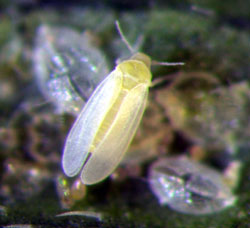
According to the most recent South Florida Pest and Disease Hotline, whitefly pressure continues to build across the region, with populations reaching high numbers. This is especially true in older cucurbit and fruiting vegetables at or close to harvest.
Whiteflies feed on various hosts but the crop that’s proven to be most vulnerable is older tomato fields that should have been terminated by now.
Growers and scouts on the east coach report that pressure is building in older eggplant and tomato. Whiteflies are migrating out of these crops and putting pressure on nearby fields. Whiteflies are also causing problems in some pepper.
In Homestead, whitefly numbers are high in tomato and other crops. Tomato yellow leaf curl virus, which is vectored by whiteflies, is also high in most tomato fields. Some hotspots are also present in beans.
A few hotspots of adults and nymphs have been reported in snap benas in Pahokee and Clewiston, Florida.