Weed management remains a vital strategy all vegetable producers need to implement in order to have a successful season.
University of Georgia Cooperative Extension weed scientist Stanley Culpepper implores farmers to stay vigilant in keeping weeds out of their fields.
“What you want to do is you want to remove weeds from the field because they compete with the crop. They compete for water. They compete for sunlight. They compete for your nutrients,” Culpepper said. “In most situations when you talk about a vegetable crop, not all, in most situations the weed is a better competitor than the crop. If you’re in corn, corn’s a really good competitor. A lot of weeds can’t compete with corn.
“But in most of our produce crops, because we start off very small and it takes a long time to get going, those weeds will basically take advantage of the lower competitiveness of the crop and then win out.”
Weeds are problematic no matter what time of the year and no matter what crop is being produced. Whether you are talking about wild radish or primrose this time of year or nutsedge in a fumigated plasticulture production system during the spring, weeds are a top priority that need to be considered before planting ever begins.
“Before you ever start a conversation, you say look vegetable weed control is really challenging. There can’t be any weed emerge at planting. It’s very likely that if we’re going to implement a herbicide program we’ve got to start it before we ever plant,” Culpepper said.
“It’s not like cotton. It’s not like corn. It’s not like soybeans where okay I made a little mistake, I’ll catch up. That does not exist in the world of weed control in southeastern vegetable production.”
The long-awaited hearing with the International Trade Commission (ITC) for blueberry farmers has come and gone. The case against blueberry imports from foreign competitors has been made.
Now what happens?
Bob Redding, who works for the Redding Firm and serves as a lobbyist for agricultural groups in Washington, D.C., outlines the potential outcomes that will occur following Tuesday’s hearing. It all depends on the recommendations the ITC makes to President-Elect Joe Biden and what path he chooses to take after assumes office.
Potential Outcomes
“The president can ignore it, change it or accept it. This will be quickly, after the ITC action, a political issue again with the administration. Having said that, we do not know the position of the president yet, on this issue. It’s too early,” Redding said.
“We need to get a U.S. Trade Rep in place first and we will start working with them, our congressional delegations start working with them to hopefully get a good position on that issue.”
The case was made tougher considering the American Blueberry Growers Alliance’s opposition.
“We have a lot of groups against us. A lot of the countries that are pushing product at a bad time of the year have hired up lawyers, economists, lobbyists and consultants to fight the American Blueberry Growers Alliance position in trying to get relief from seasonal imports at the ITC,” Redding said.
The U.S. Department of Agriculture’s (USDA) National Agricultural Statistics Service (NASS) dropped another 2 million boxes from the January forecast for Florida’s orange crop but added 200,000 boxes to the state’s grapefruit projection.
ORANGES Florida’s total orange crop is now forecast at 54 million boxes, down 4 percent from 56 million boxes in December. The orange reduction was in the non-Valencia crop, down from 22 million boxes to 20 million boxes. NASS reported that final droppage of non-Valencia oranges (excluding navels) at 43 percent is above the maximum and the highest in a series dating back to the 1960-61 season. The Valencia projection was unchanged at 34 million boxes.
The projection of California’s orange crop increased 500,000 boxes to 51 million boxes. The Texas orange projection was unchanged at 1.5 million boxes.
GRAPEFRUIT Florida’s total grapefruit crop is now expected to be 4.6 million boxes, up 5 percent from December. The additional 200,000 boxes in January were in red grapefruit, now at 3.9 million boxes. White grapefruit is unchanged at 700,000 boxes. Projected fruit size at harvest and droppage of both reds and whites are projected to be above average.
California’s grapefruit crop forecast climbed 400,000 boxes to 4.2 million boxes. The Texas grapefruit projection rose 100,000 boxes to 5 million boxes.
TANGERINES AND TANGELOS The Florida tangerine and tangelo forecast was unchanged at 1.1 million boxes. California’s tangerine and tangelo projection was also unchanged at 23 million boxes.
LEMONS Lemon forecasts rose for both Arizona and California. The Arizona projection climbed 600,000 boxes to 1.9 million boxes. The California forecast jumped 2 million boxes to 24 million boxes.
RALEIGH – Agriculture Commissioner Steve Troxler announced on Monday the promotion of Kaleb Rathbone of Waynesville to assistant commissioner for Western NC Agricultural Programs and Small Farms and Teresa Lambert of Laurel Springs as the director of the Research Stations Division.
Troxler
Lambert fills the role created by Rathbone’s promotion. Rathbone replaces Bill Yarborough who retired as special assistant to the Commissioner, and he will also assume additional duties and oversight as an assistant commissioner.
“I am always pleased to have well-qualified and dedicated staff members step into new leadership roles at the department,” Troxler said.
“Both Kaleb and Teresa started working with the department in temporary positions at research stations during college, eventually returning to full-time positions and rising through the ranks. Their long-term commitment to agricultural advancement and innovation speaks to their drive to move North Carolina agriculture forward, help improve the bottom line for farmers and ensure we meet growing global food demands. I know Kaleb and Teresa will continue to serve our farmers well in these new roles.”
Rathbone graduated from the University of Tennessee with a bachelor’s degree in soil science and a master’s degree in Agriculture and Natural Resources management.
He most recently served as the director of the Research Stations Division, providing leadership, direction and oversight for the state’s 18 research stations from the mountains to the coast. Prior to that, he was the superintendent of the Mountain Research Station in Waynesville for nearly eight years and was also a research specialist there for over five years.
Rathbone is active in the community, serving in advisory and leadership roles with Carolina Farm Credit, Haywood Community College and state and local Farm Bureaus and Cattleman’s Associations.
Lambert graduated from N.C. State University with both a bachelor’s degree in animal science and a master’s degree in poultry science.
She brings over 26 years of state service to her new role, having most recently served as the superintendent of the Piedmont Research Station in Salisbury for nearly five years. Prior to that she worked for over six years with the N.C. Cooperative Extension Service in Statesville and Sparta as an extension agent specializing in row crops and livestock. Lambert was a meat and poultry relief inspector for nearly five years covering processing facilities in 16 northwestern counties. In that role, she also provided on-site training to new employees.
She has also worked as a research technician at the Upper Mountain Research Station in Laurel Springs and a livestock extension agent in Winston-Salem.
Brad Graham, the crop unit supervisor and long-time employee of the Piedmont Research Station, will serve as the interim station superintendent.
Rathbone and Lambert have already assumed their duties.
Blueberry growers and industry leaders in the Southeast had their say on Tuesday about unfair trade practices regarding imports from foreign countries, including Mexico.
They testified during a virtual hearing with the U.S. International Trade Commission (ITC) regarding a global safeguard investigation into fresh, chilled or frozen blueberries.
Jerome Crosby, Georgia blueberry grower and chairman of the American Blueberry Growers Alliance, testified about the importance of the Alliance’s formation and its role in protecting its domestic crop.
“We officially launched our Alliance in December for the same reasons we are before you today. The U.S. blueberry growers needed a new approach to protect and secure the future of their farms and to respond to the assault on the U.S. market by blueberry imports,” Crosby said. “We require a strong and unified voice for the U.S. blueberry grower without the influence of domestic or foreign marketer or retailers seeking lower and lower prices.”
Increased Imports
Crosby said imports of fresh blueberries have increased 75% over the past five years. It is only expected to worsen as prices and profits continue to plummet for U.S. producers.
“We fully expect a variable tidal wave of imported blueberries in the next several years,” Crosby said. “Substantial portions of the industry report losses on an operating and net income basis. Packing and freezing facilities have been shuttered. Blueberry acreage has declined.
“The injury to the domestic industry is serious, clear and wide spread. It’s caused by the flood of imports into the U.S. market.”
Blueberry farmers from across the United States are asking the ITC for temporary relief from a surge in imports that are harming the domestic industry
WASHINGTON, January 12, 2021 – Members of the American Blueberry Growers Alliance (ABGA), a group representing U.S. domestic blueberry farmers, today provided information to the U.S. International Trade Commission (ITC) during a hearing on the impact of rising imports during the U.S. growing and harvest seasons. American blueberry growers across the country – mostly small, family-run farms – have been devastated by an influx in blueberry imports by 75% in the past five years, according to U.S. import data.
“Because of booming domestic demand, we should be enjoying a market in which there is room for both domestic and foreign growers to profit,” said Jerome Crosby, Chairman of the ABGA Board of Directors and owner of Pineneedle Farms in Willacoochee, Georgia. “However, foreign government policies targeting the United States market and large corporate import interests have combined to bring massive volumes of blueberries into our market, increasingly during periods that in the past provided growers with the bulk of their revenues and often all of their profits for the year.”
“The massive increase in Mexican imports during our harvesting season has crippled the Florida blueberry industry and threatens its very existence,” said Brittany Lee, Executive Director of the Florida Blueberry Growers Association and owner of Florida Blue Farms. “Over the period 2009 to 2019, we saw imports from Mexico increase by 2,111%. We have experienced a significant decline in price per pound for fresh blueberries in Florida, and a huge loss of market share.”
Farmers said the U.S. blueberry industry has made extensive marketing efforts over many years to educate purchasers and consumers about blueberries, which has increased demand.
“Foreign producers are taking the benefit of those efforts, in some instances by creating industries out of nothing and exploiting cheap labor and poor environmental regulation overseas,” said Rex Schultz of Heritage Blueberries in Bangor, Michigan and President of the Michigan Blueberry Advisory Committee. “Producers in foreign countries are totally dependent on our market, and they have every incentive to keep shipping more and more product here. This is not a sustainable situation for the American blueberry farmer.”
Imports have also had a devastating effect on blueberry farmers in Western states.
“Ten years ago, imports filled an important role by ensuring supply of fresh berries in the few months is no longer the case,” said Jayson Scarborough, a blueberry farmer in Central California. “Imports from Mexico and Peru, in particular, now enter our market throughout our harvesting period in California. Prices for these imported berries are extremely low, which means that when we begin to sell our harvests, the price point has already deteriorated significantly due to the presence of large volumes of imported fruit in the market.”
Farmers said that massive amounts of fresh blueberries coming in from Mexico and South America often arrive without a buyer.
“Peruvian product can arrive in massive shipments, with hundreds of thousands and even millions of pounds of perishable fresh blueberries on one ocean-going vessel that has been in transit at least two weeks before being unloaded at U.S. ports,” said Shelly Hartmann, owner of True Blue Farms in Grand Junction, Michigan. “When these blueberries are released all at once onto the fresh market, they cause prices to crater. This pushes domestic production of blueberries grown for the fresh market into the frozen market.”
In addition, several members of Congress also testified before the ITC in support of American blueberry growers, including Reps. Austin Scott (R-Ga.), Bill Huizenga (R-Mich.), Earl L. “Buddy” Carter (R-Ga.), Gregory Steube (R-Fla.) and John Rutherford (R-Fla.).
The U.S. International Trade Commission (ITC) is conducting a global safeguard investigation into imported fresh, chilled or frozen blueberries under Section 201 of the Trade Act of 1974. The ITC will determine if the dramatic increase of foreign berries is “a substantial cause of serious injury, or the threat thereof” to American blueberry growers.
###
About American Blueberry Growers Alliance
American Blueberry Growers Alliance (ABGA) is a national association representing blueberry growers and farmers in the United States. ABGA provides a unified voice for blueberry growers in states across the country, including California, Florida, Georgia and Michigan, advocating on behalf of their interests and for the long-term viability of the domestic blueberry industry. For more information, visit: americanblueberrygrowers.com.
Nikki Fried, Florida Ag Commissioner, testified on Tuesday during a virtual hearing with the U.S. International Trade Commission (ITC) regarding a global safeguard investigation into fresh, chilled or frozen blueberries.
The investigation centers on unfair trade practices regarding blueberry imports from foreign countries, including Mexico.
Nikki Fried
Fried stated that Florida has a $62.3 million blueberry industry but its market share has declined by 38% since 2015. It has resulted in $67 million in potential production.
She added that Mexico’s market share has increased by 2,100% since 2009.
U.S. Congressman Austin Scott (GA-08) testified on Tuesday during a virtual hearing with the U.S. International Trade Commission regarding a global safeguard investigation into fresh, chilled or frozen blueberries.
Austin Scott
The investigation centers on unfair trade practices regarding blueberry imports from foreign countries, including Mexico.
The U.S. Department of Agriculture (USDA) announces details of the 97th annual Agricultural Outlook Forum, which will be held virtually on Feb. 18-19, 2021.
The 2021 Forum, themed “Building on Innovation: A Pathway to Resilience,” will focus on the central role science and innovation have played in helping the agricultural sector overcome challenges and build resilience during the COVID-19 pandemic.
The Forum’s program (PDF, 168 KB) will begin with a presentation by USDA’s new Chief Economist, Seth Meyer, on the Department’s outlook for U.S. commodity markets and trade for 2021 and the U.S. farm income situation. A keynote address by the incoming Agriculture Secretary, presentations by Congressional leaders, and a session on genetic literacy are also scheduled for the morning on the first day of the Forum.
In addition, the program will cover five key areas:
Supply Chain Resilience
Commodity Market Outlooks
Food Price and Farm Income Outlooks
U.S. Trade and the Global Market Place
Managing Risk and Ensuring Sustainability
Innovation, Technology, and Productivity
The 2021 Forum is expected to bring together more than 3,000 participants from the U.S. and around the world, including producers, processors, policymakers, government officials, and nongovernmental organizations. The Forum’s program includes more than 30 sessions and 100 expert speakers.
Registration for the Forum is free but required to attend the Forum sessions. To register, visit the 2021 Agricultural Outlook Forum website.
Clemson Extension agents provide updates in the The South Carolina Grower this week about the status of various crops being produced throughout the state.
Weekly Field Update
Coastal
Rob Last reports, “Vegetable crops are growing out of the impacts of frost well. There is active Alternaria in places on brassica crops. Insect activity in vegetable crops in the area remains low. Strawberry crops are moving well with a few spider mites and aphids being observed. Remember if mite treatment is needed, use a specific miticide to target the pest to avoid flaring populations. If you need a second pair of eyes to help scout then please give me a shout.”
Zack Snipes reports, “I’ve been getting a good many calls about strawberries in recent weeks. The warm weather has really pushed our berries, perhaps too far along for this time of year. I know of a couple of farms that are already harvesting which I’m not sure is a great thing this early in the season. Most fields look good with great growth but we only have a few crowns for each plant. Hopefully some cool weather will come in and slow them down. Make sure to sanitize the plants by removing all dead tissue and put out a preventative spray once you are done sanitizing. Good preventative sanitation right now can do wonders for disease management later in the season. Now is a good time to manage weeds before they get too large. And while I am at it…now is the perfect time to get ready for the season by checking sprayers, getting fertigation systems set up and calibrated, and purchasing pesticides you know you will need for the season.”
A sanitized plant and the dead and diseased tissue that came off of it. This needs to be taken out of the field and disposed of. Photo from Zack Snipes.Corn spurry is a weed that needs to be managed now before it is too late. Photo from Zack Snipes.
Midlands
Justin Ballew reports, “The weather has remained cool, so everything is growing pretty slowly. We had another very rainy day last week, and we got a little over 2 inches at my house. That’s over 6 inches for me so far in 2021, and I’ve had some folks tell me they’ve gotten over 8. We are seeing some cold damage to strawberry foliage, but nothing to worry about long term. Just make sure to sanitize any dead leaves and flowers as the temperatures warm in the spring. I’ve already seen some Botrytis develop on dead flowers, so we definitely need to remove these sources of disease inoculum. I’m counting 2 to 3 crowns per plant right now. If you’re behind that, it may be helpful to put row covers on for a couple weeks. Just scout for spider mites carefully first.”
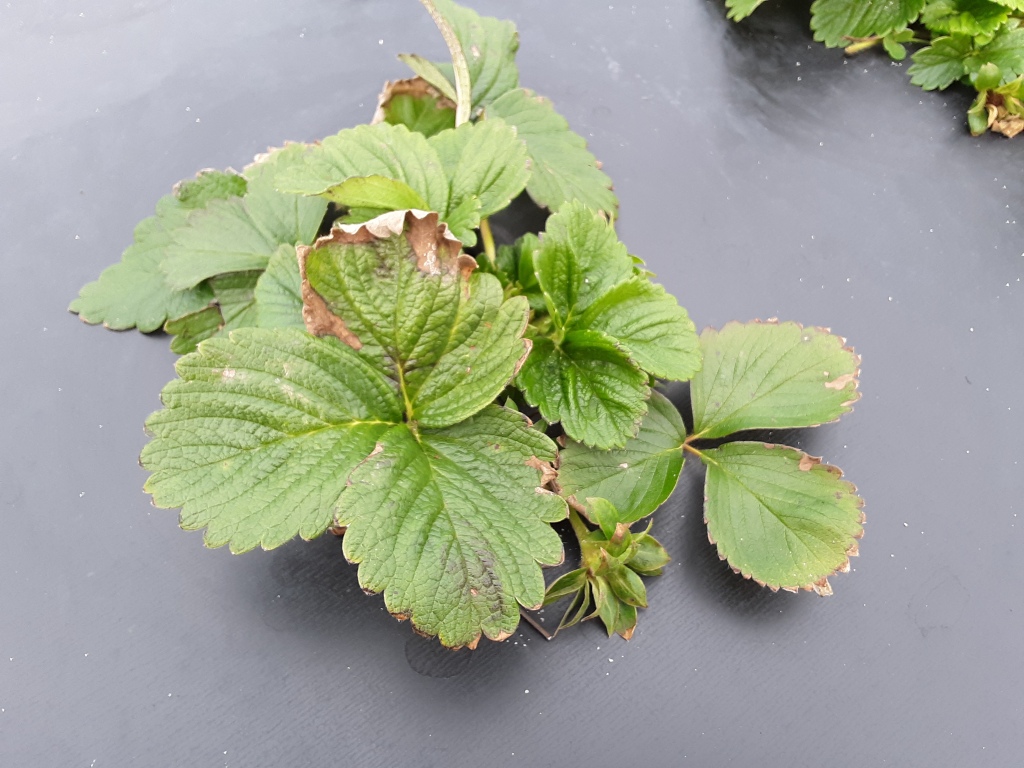
Cold damage around the margins of strawberry leaves from the hard freeze right after Christmas. It didn’t get cold enough to damage the crowns. Photo from Justin BallewThis bloom was killed by cold weather. It’s difficult to see here, but there are already a few botrytis spores developing on the flower. If not sanitized, this could become a significant source of inoculum. Photo from Justin Ballew.
Pee Dee
Tony Melton reports, “Cold hurt green winter strawberries more than ripe ones due to increased sugar in ripe ones. Still got some squash producing in high tunnels if covered inside tunnel with row covers. We’re bedding green fields to allow weeds to germinate so they can be killed using stale-bed culture.”