Hemp industry stakeholders announced this week survey results regarding industry attitudes towards a hemp checkoff program.
The results, announced by the National Industrial Hemp Council and the Hemp Industries Association, show that nearly eight out of every 10 farmers and processors support the checkoff program for research, promotion and consumer education. More than six out of 10 farmers and processors support being assessed to fund a program.
NIHC Chair Patrick Atagi says, “This is exciting news for our industry and exciting that there is such wide consensus in our industry to support such a program.”
Funded through assessments on the produced commodity at the first point of sale, checkoff programs allow producers of commodities to pool resources for research, education and promotion efforts to expand sales and improve production efficiencies.
The survey received 270 responses and was conducted online via Nov. 30, 2020, until Dec. 31, 2020.
(From the National Association of Farm Broadcasters)
The American Blueberry Growers Alliance’s (ABGA) stance on imports has not changed over the years: serious injury has been inflicted on American farmers, especially those in Florida and Georgia.
But where does President Biden stand on this issue? That’s the stance that will ultimately decide the Section 201 investigation regarding blueberry imports. Even if the International Trade Commission (ITC) decides in the ABGA’s favor with its vote on Thursday, the final decision rests with Biden and his administration.
“When people asked me about this from the get-go, I felt like we’re going to win in the ITC, but does the president sign it or not? That’s a 50-50 coin flip maybe, I don’t know. People smarter than me can figure that out,” said Ryan Atwood, who lives in Mount Dora, Florida and farms 56 acres of blueberries, manages another 350 acres and is part-owner of the largest packing house in the Southeast United States.
Virtual Hearing with ITC
The ITC’s decision on Thursday comes a month after ABGA members and industry and congressional leaders testified in a virtual hearing before the ITC about the negative impact blueberry imports from Mexico, Peru, Chile, Argentina and Canada have had on the domestic market.
If serious injury is found, the ITC will formulate a recommendation. But the president will make the final decision.
“The ultimate decision will come from the desk of the president. Regardless of what side of the aisle you sit on, we all like to eat. We all like to eat blueberries,” said Jerome Crosby, Georgia blueberry grower and chairman of the American Blueberry Growers Alliance. “Food is probably the most partisan issue in America when it comes down to it. No matter what walk of life you come from, you like to eat something. That makes the farmer a friend to every human being. I think anyone who fits that category of consuming food is going to have an interest in the American farmer staying in place.”
Chill hours are no longer a concern for one Alabama peach farmer. The biggest worry that Jeremy Calvert has is that his trees will bloom early and be impacted by a late freeze.
“We get a week of 60, 70-degree weather and then go back down in the 20s, that’s just not what you want to see,” said Calvert, whose J Calvert Farms is in Cullman, an hour north of Birmingham, Ala. “Everything we’ve got in north Alabama, we’ve got a good amount of chilling in. Everything looks good. I think we have a good bud set on most everything. They definitely have got all of their chilling in. It’s been good quality chilling. When we do get a warm streak, they’re going to take off like a racehorse. That’s my opinion.”
According to Alabama Extension, chill hours are up across the state. As of Tuesday morning, the Auburn University Turf Unit had received 716 standard chill hours, compared to 617 last year. There was 919 hours recorded at the Chilton County REC in Thorsby, Ala., compared to 778 a year ago. At the EV Smith Research Center HQ in Shorter, Ala., there were 824 chill hours compared to 645 last season.
“Chilling is not going to be an issue for us this year. I think South Alabama could still have a little bit of a deficiency but still probably not going to be a big issue for them,” Calvert said.
Calvert said cold temperatures started around mid-December and have not let up. He is hopeful warm temperatures will hold off as long as possible.
“I would love it if we don’t have any bloom until the first of March, but that doesn’t always happen,” Calvert said.
Photo submitted by Vance Whitaker/Shows Florida Medallion strawberries growing in a field.
The newest University of Florida-bred strawberry could become another option for growers looking to diversify their crop.
Vance Whitaker, strawberry breeder at the University of Florida Gulf Coast Research and Education Center, said the Florida Medallion is performing well and expects a substantial increase acreage next year.
“If it continues to perform well, we’ll see where it finds its niche with the current varieties; whether it’s a third of the industry, what proportion is really hard to say at this point,” Whitaker said. “It’s safe to say it’s performing well. We’ll definitely have a place for a couple of hundred acres of it next year.”
More Varieties the Better
The more strawberry varieties available for Florida producers the better. In just a couple of years, the industry moved from a Radiance-dominant industry to a Brilliance-dominant industry. Growers are quick to switch allegiances, depending on how successful the variety is on a commercial scale. Medallion provides producers another tool in the toolbox.
“It can move very fast. They need the best tools. If they find one that’s better than what they have, they’re going to replace it,” Whitaker said. “Ideally, they’d like to have at least three, hopefully four varieties that complement each other. Right now, we have two good varieties in Sensation and Brilliance that complement each other really well. I think the Medallion will slide in and hopefully become a good third option for them. They really want to diversify and spread their risks.”
Strawberry Traits
Finding the perfect strawberry is not an exact science. But there are qualities that make certain varieties stand out above the rest. Whitaker explains that early yield and flavor are the two most prominent traits farmers are looking to capitalize on.
“Early yield is obvious because of the timing of the market. It’s just critical. Then the flavor, it’s becoming more and more important in a competitive market,” Whitaker said. “Consumer’s expectations are going up for what their berries should taste like. I think that growers recognize that quality is the way that they can compete in a highly competitive international situation. If they can provide fresher, better tasting strawberries than Mexico can, then they can continue to compete well.
“People have to want to eat them, but you also have to have them at the right time.”
Sugarcane production forecasts are up 1% from last month and 13% from last year, according to the USDA National Agricultural Statistics Service. Production is projected at 36.0 million tons. Producers intend to harvest 948,800 acres for sugar and seed during the 2020 crop year, which is a 1% increase from the previous forecast and a 4% jump from last year. Yields for sugar and seed are expected to average 37.9 tons per acre, up 0.2 ton from last month and up 2.9 tons from 2019.
In Florida, expected production of sugarcane for sugar and seed is forecasted at 18.8 million tons, an increase of 3% from last month and a 6% jump from last year.
Root samples of the rootstock Solanum sisymbriifolium (left) and Roadster tomato (right) are from a field infested with southern root-knot nematode M. incognita. Galls produced by the nematode are visible on the tomato root, while the rootstock root is free from nematode damage.
By Abolfazl Hajihassani
Tomato is the most economically important vegetable crop in the United States and has a history of heavy dependence on pesticides.
PATHOGEN PAIR
Root-knot nematodes and southern blight disease are among the most damaging pathogens of tomato. Pre-plant soil fumigation is often, but not always, effective at minimizing yield losses due to soilborne nematode and fungal pathogens. The fumigant 1,3-dichloropropene is only effective against nematodes and is not effective against soilborne fungal diseases. In contrast, the nematicidal efficacy of the fumigant chloropicrin is not the primary reason for its application against nematodes, as it mainly has fungicidal activity.
Fumigants for control of these pathogens are diminishing due to environmental concerns and increasing regulations and restrictions on the use of these chemical treatments. Therefore, alternative control strategies have been extensively investigated over the past decade. Grafting tomato onto rootstocks with resistance to multiple root-knot nematode species combined with application of non-fumigant nematicides could offereffective management strategies that would provide growers with additional tools for managing root-knot nematodes. Moreover, using resistant rootstocks is one of the most effective methods to manage southern blight disease.
Using a three-year award funded in 2019 by the U.S. Department of Agriculture National Institute of Food and Agriculture Methyl Bromide Transitions program, the University of Georgia (UGA) is investigating the effectiveness of a rootstock (Solanum sisymbriifolium) in managing root-knot nematodes and southern blight disease of tomato. Replicated field trials under experimental and commercial production conditions in Georgia are underway.
Root-knot nematodes (Meloidogyne spp.) are tiny parasites that feed inside roots, induce galls (which contain nematode eggs) and disturb water and nutrient uptake from the soil into the plant, thus reducing crop yields. Root-knot nematodes cause approximately $15 million in damage annually to U.S. tomato production.
In Georgia, five species of root-knot nematode are among the most important problems in tomato production. Tomato varieties with resistance to the most common species of root-knot nematodes (M. incognita, M. arenaria and M. javanica) have been released in the past, but these cultivars often lack resistance to other nematode species like M. enterolobii and M. haplanaria and to southern blight disease. Heirloom cultivars are particularly sensitive.
Southern blight, caused by the fungus Athelia rolfsii, is a necrotrophic pathogen commonly found in many areas of the southeastern United States. Tomato plants infected with A. rolfsii wilt permanently in soil with a high level of pathogen inoculum, resulting in significant economic losses to growers.
Roadster tomato grafted onto the rootstock Solanum sisymbriifolium (left) and non-grafted tomato (right) in the field are infested with southern blight. More than 80 percent of the non-grafted plants were dead by the end of the growing season.
ROOTSTOCK TO THE RESCUE
Grafting onto rootstocks resistant to southern blight can reduce the disease incidence and increase yield. Currently, the Maxifort rootstock, which carries resistance to southern blight, is commercially available. It also contains the Mi-1 gene that confers moderate resistance to species of M. incognita, M. arenaria and M. javanica.
In UGA greenhouse studies, S. sisymbriifolium was challenged with M. incognita, M. arenaria, M. haplanaria and M. enterolobii. Results showed that it confers a high level of resistance to all four root-knot species. These results were also confirmed in microplot and field experiments using M. incognita species. The data suggest the importance of using S. sisymbriifolium as a resistant rootstock for effective management of these devastating nematodes in infested tomato fields.
However, since grafted tomatoes are more expensive than non-grafted ones, growers will probably want to use rootstocks with resistance to multiple pathogens to minimize the production costs associated with application of multiple pesticides. Using a field study conducted in the summer of 2020, S. sisymbriifolium rootstock was found to be resistant to A. rolfsii. Field plots grown with tomato grafted on therootstock had significantly fewer dead plants compared to plots transplanted with non-grafted tomatoes.
The next step in the research studies will be to evaluate the combined use of grafting and nematicides and/or fungicides to manage effectively both root-knot nematode and southern blight in tomato. Efforts will also include a cost-return analysis of the control practices developed in this project to compare with growers’ practices for disease management.
Excessive rainfall in January and so far in February has vegetable producers playing catch-up in preparing for the upcoming season.
Field in Tift County, Georgia shows how wet and muddy it is right now.
“We’re way behind as far as laying new plastic for the spring and everything,” said Bill Brim, part owner of Lewis Taylor Farms in Tifton, Georgia on Friday. “We probably still like about 600 acres of plastic to lay. We laid a little bit (Thursday) and a little bit (Friday) and that’s it; about 40 or 50 acres. We really need some dry weather now to try to get some stuff done.”
Brim and other farmers in south Georgia got some sunshine on Sunday and Monday. But according to weather.com, there is a high chance of rain the rest of the week.
According to the University of Georgia Weather Network, Tifton, Georgia has received 8.67 inches from Jan. 1 to Feb. 7, compared to 4.93 in 2020 and 5.18 in 2019. In Moultrie, Georgia where the Sunbelt Ag Expo is located, it has recorded 8.37 inches from Jan. 1 to Feb. 7, compared to 4.86 in 2020 and 5.83 in 2019.
The Lewis Taylor Farms website states it produces more than 6,500 acres of produce every year. Fortunately, it started laying plastic when it did near the end of 2020. If not, it would really be behind in getting row beds ready to plant.
“We started back at the end of November laying (plastic). I’m sure glad we did, because if we hadn’t, we’d be in a real mess. We wouldn’t have gotten anything laid, probably from mid-December to now,” Brim said.
The American Blueberry Growers Alliance’s (ABGA) case has been made. The data supports its stance of serious injury regarding blueberry imports. It’s now up to the International Trade Committee (ITC) which will vote on Thursday to determine whether the domestic industry has been seriously injured.
“We feel like we presented a good case. The numbers do not lie,” said Jerome Crosby, Georgia blueberry grower and chairman of the American Blueberry Growers Alliance. “There’s a lot of people that have different opinions. I’m looking at the numbers and the pricing and the effects of what we see on the blueberry farmers. One of our strongest arguments is you’ve got to look at the net income of a blueberry farming operation. When you see the downward spiral we’ve experienced, then that is the sum total of the effects of the import markets. That is to us the defining factor.”
January Hearing
Thursday’s decision by the ITC will come a month after the ABGA and opposition groups testified during a virtual hearing regarding the impact of blueberry imports.
“Once they reach a decision, then we will move to the next step. If it’s affirmative, we’ll be into the remedy phase, and if it’s not affirmative, then there are other options we will be pursuing. We really won’t know until Thursday. It’s in their hands,” Crosby said.
Data Supports Their Case
Crosby and other blueberry growers who testified in January believe the data supports their claim of serious injury. Blueberry imports from countries like Mexico, Peru, Chile, Argentina and Canada have increased by 62% since 2015, according to the ABGA. The National Farmers Union submitted a letter to the ITC on Friday, Feb. 5, noting that growers’ operating returns fell 32.4% between 2015 and 2019.
Nikki Fried, Florida Ag Commissioner, testified during the January hearing. She stated that Florida has a $62.3 million blueberry industry, but its market share has declined by 38% since 2015. It has resulted in $67 million in lost potential production. She added that Mexico’s market share has increased by 2,100% since 2009.
Letters of Support
A coalition of industry groups, including the Florida Farm Bureau Federation, Georgia Farm Bureau and Georgia Fruit and Vegetable Growers Association, submitted letters to the ITC last week, spotlighting the consequences of blueberry imports.
“Not only do these imports threaten domestic businesses and livelihoods, they also expose U.S. consumers to products from countries with poor or inconsistent product safety records,” John Hoblick, president of the 136,000-member Florida Farm Bureau Federation, said in a ABGA press release.
Elected officials and state agricultural leaders are also in the ABGA’s corner. These include U.S. Sens. Debbie Stabenow (MI) and Gary Peters (MI). Both co-signed a letter of support that was submitted to the ITC on Feb. 3. Representatives and industry leaders also testified during the January hearing.
About the ABGA
According to its website, the American Blueberry Growers Alliance is a national association representing blueberry growers and farmers in the United States. ABGA provides a unified voice for blueberry growers in states across the country, including California, Florida, Georgia and Michigan. It advocates on behalf of their interests and for the long-term viability of the domestic blueberry industry.
Georgia vegetable growers have until March 2 to vote on a Georgia Vegetable Commission marketing order that allows the assessment of one cent per marketing unit of vegetables, which is described in the current marketing order.
Pictured are bell peppers.
The order is applicable only to growers who produce at least 50 acres of the following crops: beans, bell pepper, specialty pepper, broccoli, beets, cabbage, cantaloupe, carrots, cucumbers, eggplant, greens (including collards, turnip greens, mustard and kale), squash (including yellow, zucchini and winter squash), sweet potato and tomato.
If you are a qualified grower and have not received a ballot in the mail by Feb. 10, please contact Andy Harrison: Manager, Commodity Commissions, Georgia Department of Agriculture, Andy.harrison@agr.georgia.gov, (404) 710-1196
The Georgia Vegetable Commission was established by the Georgia General Assembly in 2006. The marketing order must be re-approved by eligible vegetable growers every three years by a two-thirds affirmative vote.
Clemson Extension agents provide updates in the The South Carolina Grower this week about the status of various crops being produced throughout the state.
Weekly Field Update-2/8/21
Statewide
Dr. Matt Cutulle reports, “With the cold temperatures we have been consistently having, it might be good to use Prefar or Dacthal for PRE herbicides instead of Treflan in new collard plantings to avoid injury.”
Midlands
Justin Ballew reports, “Last week was pretty cool and it looks like this week will be about the same. Things are a little slow in the fields, but folks are preparing land for spring plantings and harvesting a little mustard, collards, and herbs. Strawberry growers are still working on sanitizing. Now is also a good time to make sure drip systems are hooked up and ready to go when it’s time to start fertigating. Deer are still wearing out the plants in some fields. Temporary deer fences aren’t that expensive and they can pay for themselves by preventing the degree of damage seen in the photo below.”
This picture was taken last Thursday (2/4). After 3 and a half months in the ground, these plants should be significantly larger, but the deer are wearing them out. A fence should have been used here. Photo from Justin Ballew.Busted feeding on strawberry leaves. Photo from Justin Ballew.
Upstate
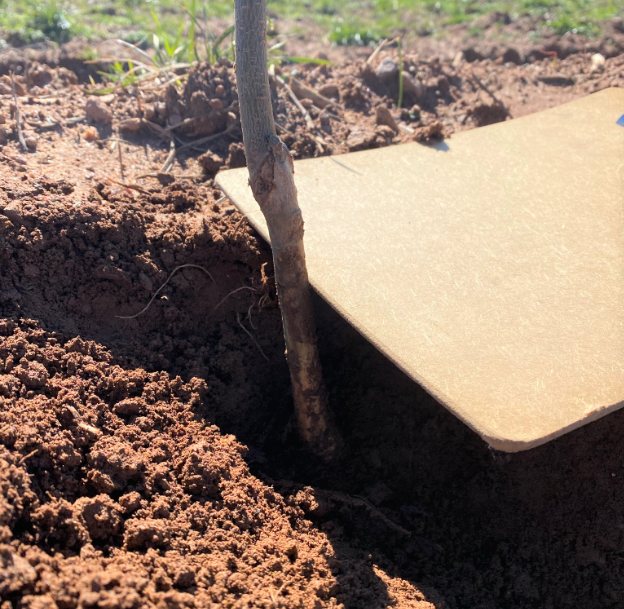
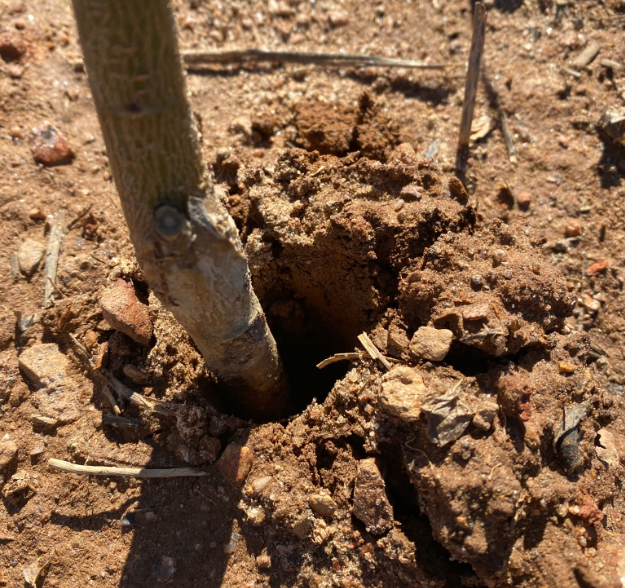
Andy Rollins reports, “We are still in the middle of establishing new peach orchards and inspecting strawberry plantings. I met with new and experienced growers and want to point out most common mistake made. Strawberry wise, I found mites on only one farm growing chandler plugs. Some of the mites were still in diapause (hibernation) and will be orangeish in color, but there were plenty of active adults and eggs out as well on that farm. Expensive miticides are not effective if mites are not present. The most common mistake made in planting peaches is planting them too deep. To look at the picture below, you wouldn’t think anything was wrong, but the first main root is actually about 4 inches too deep. Please make sure when you are finished planting that the first main root is within the top inch of the soil. An easy way to tell they are too deep is if they have created a hole around the stem from wind movement. Anywhere you are growing in heavier clay soil this becomes even more important. We are still spraying oil and copper on peaches and probably will continue till bloom.”
This peach tree was planted about 4 inches too deep. Photo from Andy Rollins.If trees are planted too deep they will create a hole in the soil around them as they move in the wind. Photo from Andy Rollins.