Florida and Georgia remain two of the leading cucumber-producing states in the country. Along with Michigan and North Carolina, they harvest more than 60% of the nation’s fresh market acres, according to USDA Vegetable and Pulses April Outlook.
However, imports continue to challenge the two states for market supremacy, accounting for more than three-fourths of domestic availability, up from less than one-half in 2000.
Imports of fresh cucumbers totaled 2.19 billion pounds in 2020 and are projected to increase in 2021 amid the pandemic. Mexico remains the leading source of imported cucumbers, averaging 80% of the annual volume from 2018-20. Canada provided 16% of import volume during that same timeframe.
Imports accounted for 87% of domestic availability, up from 61% in 2010. From 2015 to 2019, cucumber imports increased by 5% every year.
Greenhouse production accounts for 11% of the domestic cucumber production, up from 10% in 2014 and 3% in 2009. Greenhouse import share, which was 15% during 2010-12, is slowly increasing.
Cucumbers and squash were the source of an investigation by the U.S. International Trade Commission. The hearing centered on the impact that imports are having on the domestic industry.
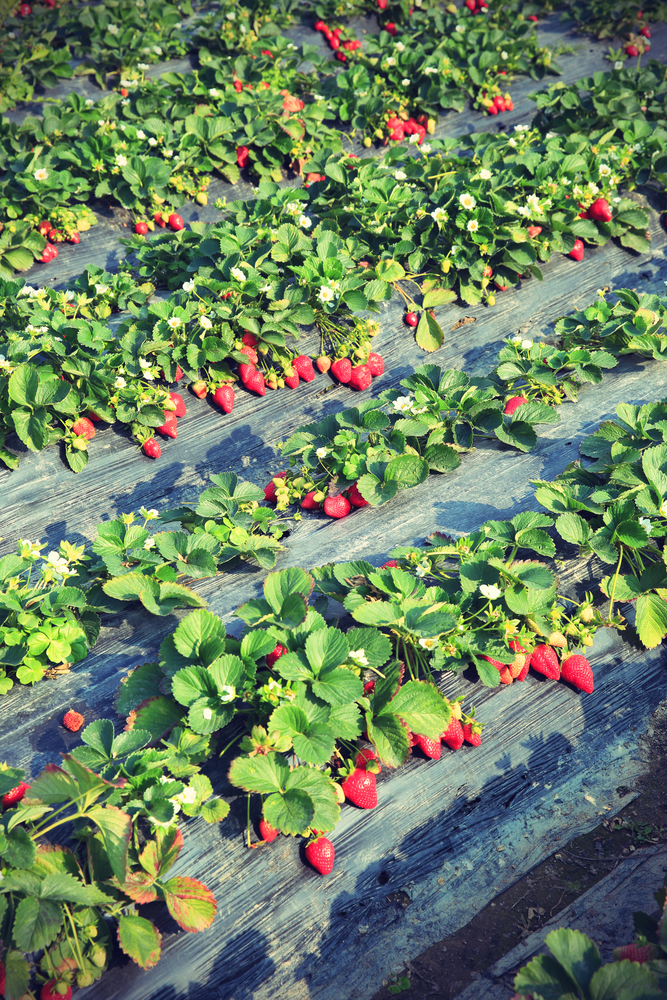
A couple of weeks into Jim Bennett’s first season and the Alabama strawberry producer already regrets not planting more acres than he did.
“We’ve talked about planting strawberries since we opened. This year it kind of worked out and decided we’d go for it,” said Bennett, owner of Bennett Farms in Heflin, Alabama. “It’s right at two acres of strawberries. The first year I didn’t want to bite off more than I can chew. But I wished I had planted five more acres of them. We get picked out pretty quick with the amount of strawberries we’ve got right now.”
Bennett’s strawberry patch is in its second week of production, allowing U-pick the past few days.
“It’s great to see these kids. They love it. We have a lot of other activities, other than the U-pick. They can come out and pick and spend the rest of the day with the food and activities and all that we offer,” Bennett said. “It’s fun to watch the kids and how they react and enjoy the farm. It makes it worthwhile.”
While other producers in the Southeast have experienced diseases with their strawberry crops, namely Neopestalotiopsis Fruit Rot in Florida and Georgia, Bennett hasn’t observed any fungal diseases in his crop.
“The one thing I did learn, I did not build a fence around my crop when we laid the plastic. We were covered with deer, and the deer did some damage to the plastic and ate some crowns off some of the plants. But they’ve recovered and look good now,” Bennett said.
The biggest challenge so far for this Alabama strawberry producer has been the weather. Persistent rains and cold winter temperatures stalled the growth of the strawberry plants.
“I really anticipated picking probably two weeks earlier than we were. The cool weather and cool nights and rain has slowed us down a little bit. They’re coming into full production. They look pretty good right now,” Bennett said.
Hopefully, the cold temperatures on Thursday morning will not impact the crop moving forward the rest of the season.
Dead and dying strawberry plants with Neopestalotiopsis (image from Shane Curry; Appling County Cooperative Extension Service).
The strawberry disease that has ravaged crops in Florida and Georgia has now been attributed to two nursery sources.
According to the University of Georgia Extension strawberry blog, a nursery in Canada received plants from a North Carolina nursery, which is the source of the pathogen related to Neopestalotiopsis Fruit Rot. Phil Brannen, University of Georgia Cooperative Extension Fruit Disease Specialist, said the Canadian nursery has been identified as a source of spread through transplants this year and has had difficulty cleaning up its operation.
“For next year and moving forward, Georgia strawberry producers need to make sure that nursery sources do not have any connection to this pathogen. Once it is in a field, there is no evidence to date that we can get rid of it. It will reside in old residue or weeds in and around the field,” Brannen said in the blog. “The best thing to do is to keep it far away from your strawberry operation.”
How Bad is it?
Just how bad can this disease get? Just ask Tifton, Georgia farmer Bill Brim. His entire strawberry operation of 12 acres was wiped out because of Neopestalotiopsis Fruit Rot. Brim was not alone this year. Brannen said the disease devastated multiple strawberry farms in Georgia.
Thiram and Switch are the only fungicides that have efficacy against this organism, though their activity is not 100%. The pathogen can reside in a field from season to season. It speaks to the importance of growers keeping it out of their fields altogether.
Growers can remove spotted leaves, starting in the fall, and destroy them outside the field. This should be done when plants are dry to prevent further spread of the disease and infection through these activities.
Producers need to rotate to another site for production next year if possible. This is if farmers had a problem with the disease this year.
Industry leaders took exception to the notion that consumers prefer Mexican produce over what’s grown in the United States and that has contributed to the domestic market decline for both commodities. Florida Ag Commissioner Nikki Fried was asked about the quality of her state’s vegetable and specialty crops.
“Of course, I’m going to be a little bit biased here. The state of Florida produces some of the best in the country as far as our agricultural products,” Fried said. “Everything from our cucumbers and squash to our blueberries, strawberries and specialty crops, tomatoes. We are the best in the country.”
What the Opposition Says
Lance Jungmeyer, president of the Fresh Produce Association of the Americas, claimed that “U.S. farmers not having enough labor.” That contributes to a quality disadvantage for American producers.
“Perishable products such as cucumbers and squash are labor intensive crops, particularly for the harvesting and packing. Without adequate labor, southeast growers are at severe disadvantage in how they grow and pack. Their products result in a distinct quality disadvantage that U.S. retail customers clearly recognize,” Jungmeyer said.
Others point to the fact that Mexico is dumping produce or bringing vegetables into the United States and selling it at a fraction of the cost of an American farmer’s load.
Those are the reasons Southeast producers point to as why they can’t compete against Mexico.
The legislative session in Florida provides opportunities for farmers to voice their concerns on what programs need funding. The Florida Fruit and Vegetable Association (FFVA) encouraged its producers to contact senators and representatives about the need to fully fund the Fresh From Florida program at $10.05 million.
“Appropriate funding for the Fresh From Florida program is incredibly important. We understand there are difficult decisions to be made with the state budget this year and deeply appreciate the positive steps the budget conference committee has already taken to appropriate funds. That said, fully funding the program means Fresh From Florida can increase its reach and impact, providing Florida farmers with even more resources to market their products to a national and global audience,” FFVA president Mike Joyner said.
The program helps market products for Florida’s 47,000 agricultural producers.
Mike Joyner
The “Fresh From Florida” logo is displayed on product packaging and signage. Only members of the Florida Agricultural Promotional Campaign are able to utilize the logo. It associates the members’ products with Florida agriculture’s worldwide image of excellence.
“With a $22 return on investment for every $1 invested, the Fresh From Florida program has generated $130 million in additional cash receipts and has reached over 60 million consumers annually through retail partnership programs. The difference is substantial, and our grower members would not be able to establish this level of engagement with national retail buyers or consumers outside of Florida without the program,” Joyner said.
With that said, it is up to the growers to inform their legislators about the difference this program has made.
“When our members engage, policymakers get to hear straight from the men and women who see firsthand how effective the program is in marketing support. After a devastating year for so many amidst the pandemic and with increased pressure from the supply of foreign products – most notably from Mexico, growers need every tool available to remain competitive in the global marketplace and help raise awareness about the importance of supporting local farmers and buying Florida-grown fruits and vegetables. Never has that message been more important,” Joyner said.
Florida’s legislative session will end on April 30.
A crop that already has its annual challenges is struggling to overcome its latest obstacle.
Strawberry with Neopestalotiopsis spot and pepper-like fruiting structures in spot (photo provided by Ansuya Jogi; University of Georgia Plant Pathology Department) .
Florida strawberry farmer Dustin Grooms confirmed that Neopestalotiopsis Fruit Rot has provided uncertainty for the future of the industry in Florida.
“I do feel like this year was amplified a little bit more with that new disease because normally you can come out there with something to spray on it and you can maintain it,” Grooms said. “Overall, we don’t know what’s going to happen next year. It’s on the back of everybody’s minds right now.”
Worse Over Time
The disease has progressively gotten worse since it was first discovered on five farms during the 2018-19 season. It was attributed to one nursery source in North Carolina. The disease is quickly expanding across Florida and has moved northward. It even wiped out one Georgia farmer’s 12 acres this year.
Grooms said he spent more money to hand-prune plants to remove leaves while also applying additional sprays to keep the plants healthy.
“We had a real bad flareup industry wide after a rain. It flared up pretty much on the whole industry there,” Grooms said. “We battled it and battled it. Some blocks were worse. Why? Who knows?”
Grooms’ challenging season also included continued competition against early-season imports that suppressed market prices. Grooms also sprayed the most he’s ever sprayed for chili thrips and spider mites which wasn’t enough in some instances.
“It takes a lot of money right now to be a Florida strawberry farmer. The risks are getting moreso every single day. I’m 39, my dad is 74. That’s a long road ahead to get to 74 where he’s at,” Grooms said. “I’m sure I’m going to see a lot more problems than this disease. But we’re going to put our best foot forward and just try to adapt and overcome, that’s all we can do.
“The price did end up going back up, and it’s actually really high right now for the month of April. We were able to maintain a handful of blocks. It wasn’t enough to offset the low production of the year. The X and Y axis didn’t cross there good. Tough season, a lot of problems. We’ll just have to try it again next year and see what happens. No two years are alike.”
It’s that time of year when Georgia pecan producers need to start protecting their trees against fungal diseases, including scab. According to the University of Georgia Extension pecan blog, sprays vary among the different cultivars and their specific level of resistance.
Low Input Cultivars
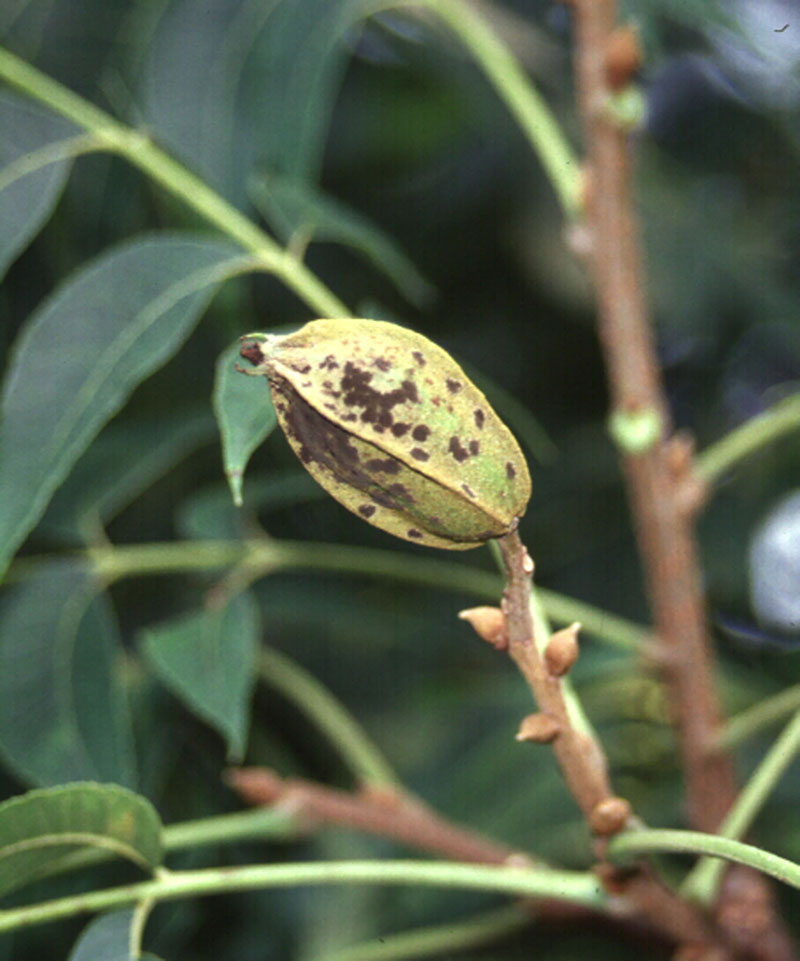
Pictured is what scab disease looks like on pecans.
Those that are considered low input cultivars include Avalon, Elliot, Excel, Kanza, Lakota and McMillan. These require a minimum of three sprays which help manage minor diseases like powdery mildew, anthracnose and downy spot, while also maintaining scab resistance. UGA Extension recommends growers apply a phosphite in mid-to-late April; another in mid-to-late May; and an 11+3 mix in early-to-mid June.
Medium Input Cultivars
Those medium input cultivars include Creek, Kiowa, Oconee, Sumner, Zinner, Ellis and Gloria Grande. These require fungicides to manage scab, which can be controlled without an intensive spray program.
Scab should be controlled with seven sprays. UGA Extension recommends growers apply a phosphite in mid-to-late April; a phosphite or 11+3 in mid-May; Miravis Top in early-to-mid June; Elast+Tin or phosphite in mid-to-late June; Miravis Top in early-to-mid July; Tin or Elast+Tin in mid-to-late July; and Miravis Top in early-to-mid August.
High Input Cultivars
Those high input cultivars include Byrd, Cunard, Desirable, Morrill, Pawnee and Treadwell. These must be sprayed intensively if growers expect to produce a crop. They require at least 10 sprays and likely more in some locations. If you need more than 10, continue rotating Miravis Top and Elast+Tin.
UGA Extension recommends growers apply a phosphite; another phosphite; 11+3 mix; Miravis Top+phosphite; Elast+Tin; Miravis Top; Elast+Tin; Miravis Top; Elast+Tin; and Miravis Top.
Those medium-high cultivars include Caddo, Cape Fear, Huffman, Schley, Stuart, Tanner, Tom and Whiddon. These could fall into either of the other two categories.
Group 3 and Group 11 fungicides contain both a Triazole and Strobilurin fungicide chemistry.
Fungicide sprays should continue through shell hardening.
The Growing Matters Coalition is kicking off its 2021 BeSure campaign that reinforces practical stewardship practices. “(The campaign) is to remind growers and applicators of some simple steps that they can take to ensure pesticides don’t harm pollinators and other wildlife,” Valent USA Sustainability & Stewardship Manager Leslie Garcia said.
One of the ways the industry can achieve this is by remembering to check the labels on their products. “We have a fun little rule here in our industry. The four corners of that label are the law,” Garcia said. Labels also can change year to year. Garcia noted it’s important to check that information before using a newly purchased product. “We like to change up the labels, keep them fresh and updated. As you get new inventory, make sure you are re-reading that label,” she said.
Listen to Garcia’s full interview.
This was a message from the BeSure campaign brought to you by the Growing Matters Coalition, an initiative reminding farmers and applicators to follow stewardship best practices to protect pollinators and other wildlife. Visit growingmatters.org for more information.
What should be an advantage to Southeast producers against Mexico is anything but, believes Georgia vegetable farmer Dick Minor.
Freight prices continue to spike, which has only worsened since gas prices continue to increase. But that doesn’t matter to produce originating out of Mexico, Minor added.
“High freight rates are our friend or should be technically our friend from a business point because Mexico’s got to transport it further than we’ve got to transport it. Every time freight goes up, that should help us, give us a competitive advantage,” Minor said. “The only problem is, they’re still shipping just as much product regardless of freight costs. That tells us, they don’t care. I know for a fact they’ve got boxes into New York for $1 a box net back to them. That doesn’t even pay for the box. They’re just trying to move product.
“If they’re making real business decisions, when freight got really high like it did in ’11, ’12, and ’13 when we had $3.50 gasoline, they should have been shut down. But no, they still shipped product regardless of freight costs.”
Freight was one of several points of contention during the most recent U.S. International Trade Commission hearing that centered on the impact of squash and cucumber imports on the Southeast domestic market.
Increased Freight Costs
Increased input costs are a challenge for Southeast producers. Freight is no exception. It was established during the hearing that between 2015 and 2020, freight costs have at least doubled. There are fewer drivers and more regulations on the road. Drivers must be shut down for eight hours.
“Everything’s going up,” Florida farmer Sam Accursio said during the hearing. “Insurance is going up tremendously for these independent operators. Fuel has been fluctuating back and forth, but their biggest expense is tires and mechanics insurance. Their biggest complaint is insurance and tags.”
Those same input costs are not swaying the intentions of Mexican producers who are focused on the U.S. markets. Whether it is strawberries, blueberries, squash, cucumbers, tomatoes, imports are increasing exponentially. Freight is just another factor that doesn’t seem to matter to Mexican growers.
“The cheaper you can get the freight on a delivered price, then you can make more money,” added Georgia producer Bill Brim during the hearing. “If we take it on an open market and we ship it up there and have $6,000 in freight and they pay you $3 a pack, then you’ve lost your you know what.”
Weather conditions are conducive to certain plant diseases being a problem this year. Joe Kemble, Alabama Extension vegetable specialist, cautions Alabama producers about certain fungal diseases that could become problematic.
“One of the things that’s important this time of the year is there are a lot of foliar fungal diseases. They cause problems in strawberries, but they also cause problems in vegetable crops,” Kemble said. “I’ve seen quite a bit of scattered anthracnose around the state. It’s a common fungal disease. It also goes to strawberries, different species of the disease. Basically, if the weather conditions are favorable for one, they’re favorable for all the different versions of that disease.”
While diagnosing the disease is not an issue, managing it can be a problem if you’re an organic producer. They don’t have the same options to control diseases as a conventional grower would.
“If you’re a conventional grower, there’s herbicides that work quite well to manage these. But if you’re growing organically, you’ve got a bit of a mixed bag in terms of what you need to do. There aren’t any products out there that are curative. It’s really a preventative measure,” Kemble said. “If I’m an organic grower, this time of the year, I think it’s safe to assume that you’re going to have these diseases. It’s a good idea to put on any type of protectant sprays that you’d like to use. If the spray’s not there, you’re not going to get any type of control. It’s very hard after the fact once you see the disease.”