Category: Top Posts

  • Crop Updates From the Palmetto State

    Clemson Extension agents provide updates in the The South Carolina Grower this week about the status of various crops being produced throughout the state.

    Weekly Field Update

    Coastal

    Rob Last reports, “Strawberry crops in the area are developing well with good fruit set. I am seeing a little gray mold around, so sanitation is going to be key as well as fungicide applications. There are also a few thrips in some crops, so scouting for these pests will be very important. Peaches and blueberries are blooming with little evidence of any chill injury from last week’s overnight lows in the upper 20’s. Asparagus crops are beginning to come to market with some chill affected spears early last week. With the dry weather conditions, field work and land prep is going well with plastic being laid for melon crops.”

    Zack Snipes reports, “Great week of weather in the Lowcountry which has really improved the way things are looking. Greens, lettuces, root crops and strawberries are looking good. The strawberries are absolutely loaded up with blossoms right now and are still putting on crowns. Fall planted cover crops are finishing up and being turned under. A bit of sad news this week as Author “Ikee” Freeman passed away. Ikee was a huge supporter of Clemson Extension and the farming traditions in the Lowcountry of South Carolina. His friendship, mentorship, leadership and sense of humor will be missed by many.”
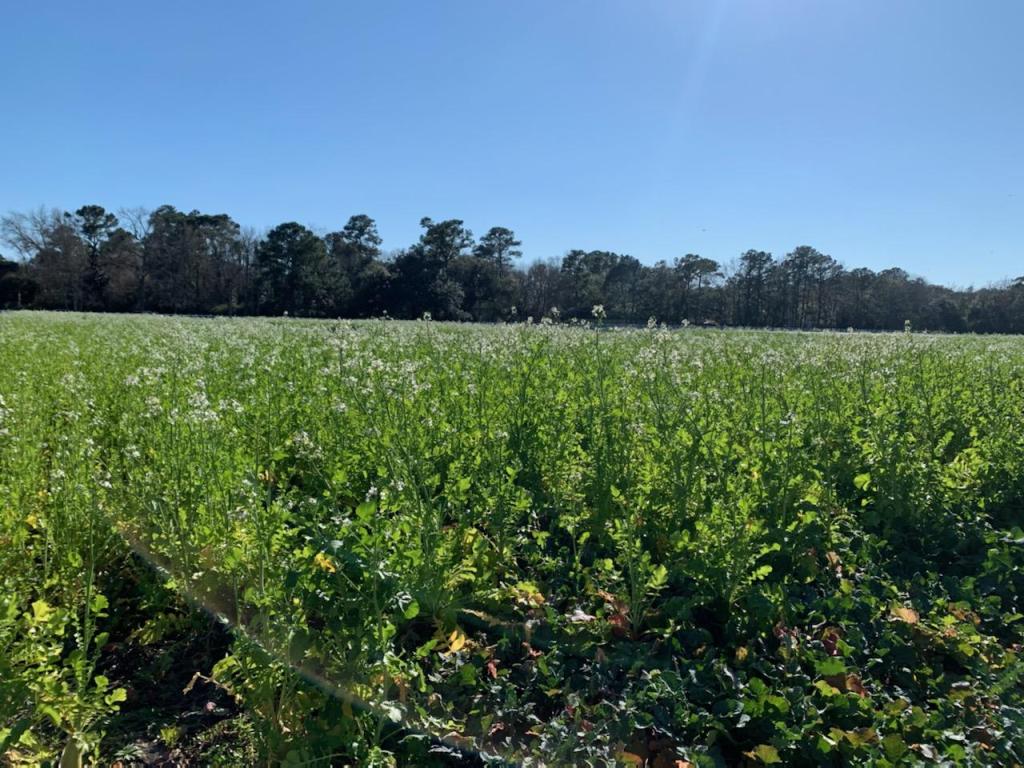
    A fall planted daikon radish cover crop is flowering which provides early season nectar, pollen, and habitat for beneficial insects and bees. Photo from Zack Snipes.

    Midlands

    Justin Ballew reports, “We had another beautiful week of weather last week that really pushed plants along. Strawberries have a ton of blooms on them now. The weather has been pretty dry the last two weeks, but with a few days of rain in the forecast for this week, now would be a good time to throw one of the site specific fungicides into your fungicide rotation. Temperatures are still in the perfect range for Botrytis spore development (60-70 degrees F), and with moisture returning, we could see a lot of Botrytis in the next week or two.
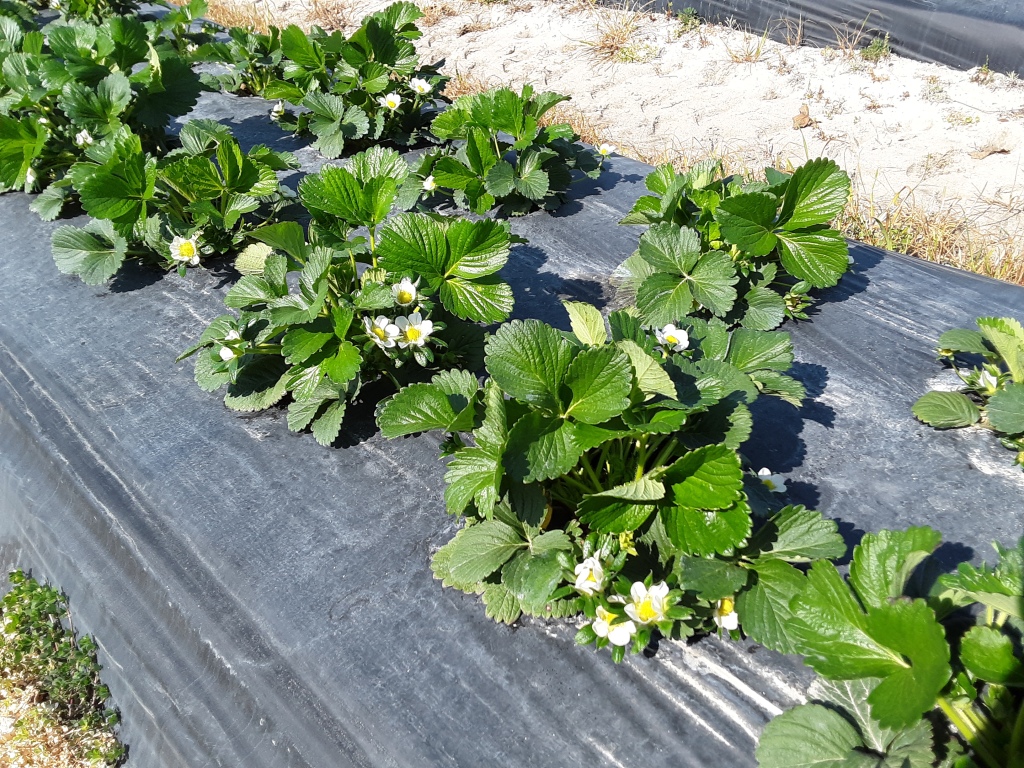
    Lots of blooms present now that we need to protect from Botrytis. Photo from Justin Ballew.
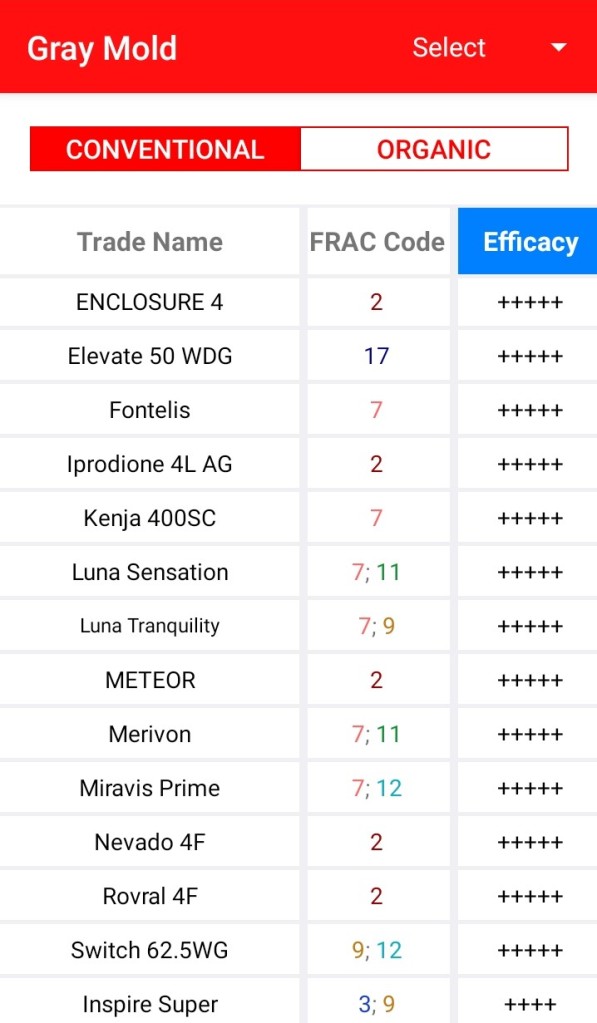
    These are the site specific fungicides listed on the MyIPM app with the best efficacy for Botrytis control on strawberries. It would be a good idea to apply one of these ahead of the rain this week.

    Sarah Scott reports, “Last week’s warm temperatures have pushed peaches into bloom. There was a significant increase in open buds from the beginning to end of the week. Early varieties are near 90% bloom. Temperatures look like they will level out in the next seven days which is good, as temperatures that are way above normal can lead to developmental damage for fruit set. Some pruning is still underway, as well as bloom sprays for blossom blight using products like Captan or chlorothalonil.”

    Upstate

    Andy Rollins reports, “So far peach season is off to a great start. We got all of our chill hours in and are between pink and 5% blooms on all large scale varieties, with a few oddballs further along. Plum growers are even further along and many are preparing for bloom fungicide applications with primarily Bravo (Chlorothalonil). I will be repeating last year’s testing of new biological, Ecoswing, in bloom this week, compared with Bravo. Strawberry production is progressing nicely. This week looks good as far as frost but things change quickly, so all growers will be intimately aware of every weather change at this point. I was very happy to help with a new 10 acre pecan orchard planted last week. It encouraged me because several local growers, a University of Georgia specialist, a retired NRCS conservationist, and myself all worked together to help a widow in need. Her planning and execution was impeccable and diligent.”

    Ten acres of new pecan trees planted last week. Photo from Andy Rollins.
  • Good Read: Vegetable Crop Handbook Important for Alabama Producers

    File photo shows potato plants.

    Alabama Extension encourages its producers to utilize the 2021 Southeastern U.S. Vegetable Crop Handbook during this year’s production season.

    Not only does it provide expertise from specialists from 12 land-grant universities, including Auburn University, it provides information pertaining to various disciplines. These include entomology, agricultural engineering, vegetable production, soil science, plant pathology, postharvest physiology and weed science.

    Four Alabama Extension specialists contributed to this year’s handbook, including: Steve Li, weed scientist; Ayanava Majumdar, entomologist; Ed Sikora, plant pathologist; and Joe Kemble, vegetable specialist.

    For more information on the 2021 Southeastern Vegetable Crop Handbook, visit www.aces.edu or access the handbook online here.

  • Taking its Toll: Strawberry Imports Creating Strain on Farmers

    The International Trade Committee’s (ITC) decision regarding blueberry imports was shocking to Florida’s blueberry producers. It was no less surprising to the state’s strawberry farmers who have their own ITC investigation under way.

    “Our jaws dropped. We know how bad the blueberry deal is and they said they were 5-0 voting against it,” said Matt Parke, farm manager of Parkesdale Farms in Plant City, Florida. “I scratched my head to that and was like, ‘Well, I don’t think strawberries even have a chance.’”

    The ITC deemed in February that imports of fresh, chilled or frozen blueberries are not a serious injury to the domestic industry. It goes against what members of the American Blueberry Growers Alliance testified about during the virtual hearing with the ITC in January.

    “We were in a board meeting when we got the news. If they didn’t get one person to rule in their favor, we ain’t going to get none. To me, blueberries were in a worse position than we were,” Parke said. “The problem is, too, if it was regional; they’re taking a nationwide perspective, but if they would have done a southeast perspective from the Carolinas down to Florida, I don’t see how they could vote against it. It should have been unanimous.”

    In early December, the ITC instituted two monitoring factfinding investigations into U.S. imports of fresh or chilled strawberries. This was made in a request from the U.S. Trade Representative.

    Statistically Speaking

    According to a presentation by UF’s Zhengfei Guan, Florida strawberry production was approximately 220 million pounds in 2000, while strawberry imports from Mexico totaled approximately 70 million pounds. In 2019, Florida production maxed out at 200 million pounds, compared to Mexico’s approximate 400 million.

    How can producers like Parke compete when everything is stacked against them?

    “Mexico has really affected our industry since NAFTA. The first couple of years NAFTA wasn’t so bad. People were still figuring out they could go down there and still invest their money and produce berries a whole lot cheaper,” Parke said. “The third or fourth year of NAFTA, we used to have maybe 200 growers here in Plant City. Between then and now we’re down to probably 50 growers. It’s just because a lot of people went belly up and couldn’t compete.

    “Here in Florida, my guys average $100 a day picking berries. In Mexico, they pay them $5.20 to pick every day. Two-thirds of my cost is harvesting. How can I compete with that?”

    Parke said the market is not great right now. Along with Mexico’s strawberry imports, Florida is picking a pile, and California’s picking a pile. The market is reflecting the increased supply.

    “Mexico has really taken a toll on the American farmer,” Parke said.

  • Insect Report: Pests Currently Light for Georgia Vegetable Producers

    It is planting season for Georgia vegetable producers. They can take solace in knowing that insect pressure appears to be light right now, minus some pepper weevils. This is according to University of Georgia Cooperative Extension vegetable entomologist Stormy Sparks.

    UGA CAES photo/The pepper weevil is one of the most serious pests of peppers.

    “There’s concerns about pepper weevil as we’re getting peppers in the ground. We’re running traps in various counties, got county agents running traps in the major pepper growing regions and we’re still catching significant numbers,” Sparks said. “It’s not anything like it is early in the year. They drop off this time of year, but they’re not going to zero. We know we’re overwintering pepper weevil.”

    Sparks believes insect pressure will increase as Georgia vegetable producers head into April, specifically with thrips.

    “As we get into April, all this pollen that we’re seeing right now is just food for thrips. That’s why we always tend to have thrips populations in April. That’ll be popping fairly soon, probably,” Sparks said.

    Insect infestations increase as temperatures continue to heat up. Growers also need to be mindful of squash bugs.

    “Temperatures control insects so much; reproduction and everything, overwintering. We’ll have squash bugs coming out of overwintering in the next few weeks or month also,” Sparks said. “The cool weather just keeps them slowed down. We do have some whiteflies out there, but I don’t think there’s anything of significance. Again, the temperature keeps them low.”

    The exception to that rule is the diamondback moth.

    “It can explode or disappear anytime of the year. I’ve had a few reports of some diamondback moth activity but nothing of alarming levels,” Sparks said.

  • Another Tool in the Toolbox for Citrus Producers?

    UF Glow variety of citrus. Photo taken 11-17-17

    LAKE ALFRED, FLA — University of Florida researchers continue to study ways to combat Huanglongbing (HLB), or citrus greening disease.

    One discovery brings the potential of another tool for citrus growers to control Asian citrus psyllid, the insect that transmits the disease-causing bacterium, and protect infected trees from further damage.

    Kirsten Pelz-Stelinski, an associate professor of entomology and nematology at the UF Institute of Food and Agricultural Sciences Citrus Research and Education Center, discovered that 2’-deoxy-2’-flouro-d-arabinonucleic acid antisense oligonucleotides (FANA ASO) (small-sized single-stranded nucleic acids) can be used to silence essential genes within the psyllids and in the bacterial pathogen that causes citrus greening.

    Pelz-Stelinski and her team reduced the citrus greening disease pathogen in the psyllid and in citrus. This led to less transmission and a potential reduction in disease severity.   

    “The intent of this research was to find alternative, environmentally-friendly tools for psyllid management as current pest management strategies have led to the development of resistance among Asian citrus psyllid populations,” said Pelz-Stelinski. “Understanding the relationships of essential bacteria needed for insect survival provides potentially important targets for control strategies that use bactericides. By disrupting how the psyllid acquires and processes the pathogen while impacting the nutrition and fitness of the psyllid may provide an alternative management tool in controlling transmission of the HLB pathogen”

    The research was recently published in the online Nature Scientific Reports.

    For more information see UF/IFAS News.

  • Record-Setting Populations: Asian Bean Thrips Spiking in Some Florida Fields

    UF/IFAS photo

    It was a record-setting week on some South Florida farms with respect to Asian bean thrips (ABT) populations.

    According to UF/IFAS, across most farms in southeastern Hendry County, ABT populations averaged 0.2 ABT per bud and ranged from 0.3 to 1.5 per bloom (at full bloom). But in an isolated located, reports were as high as 10.0 ABT per bloom (at full bloom).

    This was the highest population levels reported at this stage in Hendry County. Damage appeared to occur to the blooms.

    Whereas in northeastern Hendry County, populations varied considerably. No ABT populations were reported in some plantings, while others reached as high as 5.0 ABT per bloom at early pod development.

    In the central part of Hendry County, populations stabilized after increasing over the previous few weeks, dropping to 0.3 to 0.6 ABT per bloom (at full bloom).

    Other Counties

    Scouted beans are older in northern Collier County, and populations of 1.8 ABT per bloom were reported.

    In eastern Palm Beach County, reports indicate populations have steadied at 0.1 to 0.5 ABT per bloom or per plant. Aggressive insecticide programs include 1 to 2 spray pre-bloom to keep populations from building early and more aggressive sprays at bloom and later appear to keep ABT at moderate levels. Similar populations are reported in western and north western Palm Beach County.

    Beans were close to harvest, and ABT was not reported in southern Glades County.

  • Florida Grower: Why Even Do This?

    Florida vegetable farmers are tired of voicing their displeasure with imports from Mexico. Some are seeing the writing on the wall; the end is nearing for American farmers.

    Kim Jamerson, whose husband grew up on a family farm and has been farming since age 6, is ready to sell her farm.

    It is not because she doesn’t enjoy the work she’s called a career for 17 years. It is because Mexican imports of vegetables and specialty crops have made it impossible for her to remain competitive.

    “I see an end coming because I’m going to sell the farm. It’s not going to be instant. I’m fortunate that I have a good piece of property that’s going to go into a good real estate sale eventually. Am I going to sell the farm today? No. Am I going to list the farm probably in the next two months? Yes, I am,” Jamerson said.

    Not the Last

    She’s not the first and likely won’t be the last to call it quits due to imports.

    Just a couple of weeks ago, Sam Accursio, a vegetable farmer in Homestead, Florida who produces pickle and cucumber, green beans and yellow and green squash on about 4,400 acres, said he “sees it ending,” in the next couple of years.

    Jamerson farms approximately 1,280 acres of produce in the Fort Myers area. This includes eggplant, zucchini, yellow squash, cucumber and green pepper. It costs her almost $10 per box to break even, whereas Mexico is importing pepper at around $1.95.

    Statistics support Florida farmers’ claims that imports are driving them out of business. Florida produced 1.6 billion pounds of tomatoes in 2000, 20% higher than Mexico. But now Mexico imports (3.6 billion pounds) five times more than what Florida produces (750 million pounds). Mexico’s imports of bell peppers totaled more than a billion pounds in 2019, compared to Florida, which totaled a little more than 300 million.

    It is hard not to empathize with Florida vegetable farmers who have slowly seen their livelihoods being taken away.

    “I can tell you right now, I loved farming. My family liked farming; they love it. It just gets harder and harder every year. It’s getting to the point where it’s like, why even do this?” Jamerson said.

  • Devastating Disease: Bacterial Spot a Problem for Some Florida Producers

    UF/IFAS picture shows bacterial spot on tomato.

    According to the South Florida Pest and Disease Hotline, bacterial spot disease is active in tomato and pepper fields on the east coast and around southwest Florida.

    It is present at moderate levels in older hot pepper plants. Bacterial spot disease flares up after rain events and with fog in tomatoes and non-resistant peppers across the southwest region of Florida.

    Reports from the Manatee Ruskin indicate low levels of bacterial spot in susceptible peppers. Farmers and scouts in Homestead, Florida report the disease is present in tomato and susceptible pepper varieties.

    Bacterial spot is a serious threat to tomato and pepper production in Florida. It spreads quickly during warm periods with wind-driven rains. Fruit symptoms lead to reduced marketability.

    Symptoms on tomatoes include distinct spots with or without yellowing. Fruit spots often begin as dark specks with or without a white halo. As spots increase, they become raised and scab-like.

    Click here for additional information on bacterial spot.

  • Light at the end of the Tunnel: Florida Tomato Producers Longing for Good News

    Bob Spencer, with West Coast Tomato in Palmetto, Florida, believes there is light at the end of a year-long tunnel for the state’s tomato producers.

    As more states continue to reopen combined with the recent passage of the America Rescue Plan, there appears to be good news on the horizon for Florida tomato producers who have struggled from the onset of the coronavirus pandemic.

    “We’re starting to see a little bit of sunlight here over the last two weeks as more and more states are reopening restaurants. You’ve got New Jersey, New York, Michigan, Illinois, Ohio starting to reopen. It’s definitely helped our market,” Spencer said. “During the same period of time that we were experiencing the restaurant shutdowns, Mexico came in with a huge volume. It dumped a lot of cheap product into the country in violation of the agreements that we have them. It’s been a tough three months. But there’s definitely light at the end of the tunnel as these restaurants start to reopen.”

    Pandemic Impact

    Spencer estimated in a story in VSCNews in April 2020 that his company was losing 90% of his business. With food service being shut down for an extended period, this was devastating news for an industry that designates 70% to 75% of its crop for food service. And it could have been a lot worse.

    “We were fortunate last year when it hit that we were still dealing with the after-effects of the new Suspension Agreement with Mexico. As a result, they had planted less acreage in the prior summer. That meant we had less product coming in to compete with us,” Spencer said. “While it was tough for us, it was not as bad as it could have been. Mexico had planted less, not knowing what was going to be the outcome of all the litigation around the suspension agreement.”

    That changed this year, however. Spencer said Mexico overplanted and started dumping in low-cost tomatoes, which adds to tomato producers’ frustration.

    “The reality is it’s the Commerce Department responsible for enforcing the agreement. In reality, it’s the equivalent of having Barney Fife as your security guard. They aren’t set up to enforce agreements,” Spencer said. “It’s just very difficult to get them interested in doing the kind of work to enforce the agreement. We’ve been dealing with it since 1996.”

    But Spencer remains optimistic times are looking brighter for the state’s tomato industry.

    “The springtime looks better (though) with the restaurants reopening,” Spencer said. “You’ve got restaurants reopening and you’ve got Uncle Sam sending everybody a check. Hopefully, people will use part of that check to go out to dinner.”

  • H.E.M.P. Webinars: Alabama Extension Offering Hemp Production Education

    Alabama Extension is ensuring hemp producers have all the relevant data throughout the season in hopes they’ll experience a more profitable season in 2021.

    The Alabama Extension H.E.M.P. (Hemp Education and Management Program) webinar series is a one-hour webinar held twice monthly. It provides information on various topics pertaining to hemp production. The next meeting will be held Wednesday at 11:30 a.m. Click here to register.

    Gail Ellis from the Alabama Department of Agriculture and Industries will provide information on how to submit a grow plan for the upcoming season. Grow plans are due April 30.

    “There’s going to be different topics each time, pretty much based on the most questions we get from growers,” said Katelyn Kesheimer, Auburn University Assistant Professor and Extension Specialist. Hemp webinars will be held on the first and third Wednesdays of each month. “The first one we had, there was a risk management extension specialist talking about the USDA Final Rule for hemp. (This) week, Gail is going to talk about the logistics in submitting a grow plan to the Department of Ag.

    “Then we will have a grower presenting what’s worked for him to create high CBD plants. We have folks from the U.S. hemp co-op talking about fiber. As we move into May and June, we’ll have someone talk about weed control and then insect control.”

    Kesheimer said they are trying to make the webinar meetings regional if possible, so there will be speakers participating from outside of Alabama. Then some are going to be Alabama specific in terms of rules and regulations; how to do the paperwork and how to follow the guidelines and regulations.