Category: Top Posts

  • Weather Impacting Alabama Vegetable Production

    By Clint Thompson

    U.S. Drought Monitor: The latest map of Alabama abnormally dry and modertately dry areas in yellow and light brown.

    Farmers in South Alabama are in desperate need of rain. Producers in North Alabama need field conditions to dry so they can plant their crop. It’s been an unpredictable winter and early part of spring for the state’s vegetable growers.

    “It’s been wet in the central and northern part of the state and it has been impressively dry on the Gulf Coast. (Even) with this last storm we had (Sunday), things are very dry,” said Joe Kemble, Auburn University Extension vegetable specialist. “Most of the plantings, I think things have been going okay. We’re still pretty early right now. There’s still a lot of brassicas, collards, cabbage, broccoli and other cole crops out there in the field and look good.”

    Alabama farmers produce a substantial amount of tomatoes, melons, cantaloupes, sweet corn, southern peas, greens, squash, zucchini and sweet potatoes every year. The state’s vegetable production is located as far south as Mobile on the Gulf Coast, all the way to Huntsville, which is located near the Tennessee border. But as vegetable crops try to grow, they continue to experience vastly different weather conditions throughout the state.

    “Last night, I think in the Huntsville area, they got over 5 inches of rain. Where down on the coast, they got less than an inch and a half to two inches. Unfortunately, that wasn’t even enough to do a lot in the Gulf Coast area,” Kemble said. “It’s something with how dry it is in the southern part of the state. Most of our vegetable crops are irrigated. In the long term, it is a concern. Wells can only get you so far. It’s also a bigger expense associated with having to provide well water.”

    Kemble said growers are still trying to plant crops in the central and northern parts of the state amid the wettest winter on record.

    “I think things are pretty well on schedule. There was a lot of concern in March just with the incredible amount of rain we received. That was more of a problem for crops that were already in the field. The weather’s been sort of decent the past couple of weeks,” Kemble said. “I think a lot of people have been able to get out there and prep their fields and get plastic laid and things like that. I think they’re sort of right on schedule, maybe a little bit behind in planting. From the folks I’ve spoken to, I don’t think they’re weeks behind, I think they’re a week behind, in some cases.”

  • High Rainfall Probabilities Look Promising for Florida Agriculture

    By Ashley Robinson

    There may be light at the end of a dark and dry tunnel for Florida farmers with increased chances of rainfall over the upcoming week.

    According to the U.S. Drought Monitor, the majority of Florida is classified as moderately dry.

    According to Gary England, RSA/Director for the Hastings Ag Extension Center in Hastings, Florida, the same weather system currently ushering severe weather into the Southeast will elevate rainfall chances in the Hastings area beginning today.

    “The one system moving through right now is supposed to go stationary, meaning it will hang around, keeping things mixed up. So, we’ll have a pretty good chance of rain from that through Wednesday.”

    The front is expected to move south down the peninsula Thursday and stall once again, somewhere near the Big Lake, thus keeping a chance of some showers in northeast Florida through Friday. In addition, a second front is expected to pass through the region on Saturday, stalling in central Florida. This will keep rainfall chances moderate to high through the weekend. 

    According to the National Weather Service’s Weather Prediction Center, the Hastings area can expect to see 1.0 to 2.0 inches of rainfall through next Monday.

    “It seems like the regions who are experiencing the worst of the drought are in the areas we’re expecting some rainfall,” England says. “However, that still has to materialize. These stationary fronts may be predicted to be in one place but could remain 50 miles south or north. Rain chances can dramatically change so we’ll have to see how it plays out over the next week.”

    Lack of rainfall for the months of March and April have caused concerns for Florida farmers.

    According to the U.S. Drought Monitor, the state of Florida is experiencing abnormally dry or moderate drought conditions. Most of Wakulla County, Florida and parts of Liberty and Franklin County, Florida are deemed ‘D2’ status which is a severe drought.

    GROWERS CONCERNS

    Florida’s growers are no strangers to dry spells and having to utilize irrigation systems during periods of less than average rainfall. However, applying more irrigation than normal can create additional issues for growers on top of the high costs to operate the irrigation systems. 

    “Generally, we’re pumping water out of the Florida Aquifer. The chemistry of the water in the Hastings area tends to be a little more saline. So, with extended periods of irrigation you could see some harmful effects from that,” England says.

    In addition, increasing temperatures could be troublesome for growers.

    “It’s not always uncommon for March or April to be fairly dry. However, what we’re seeing in this situation is very warm temperatures,” England says. “We’ve had dry March’s and April’s, but the high temperatures were in the 70’s and low 80’s. These warm temperatures that we’re seeing during this dry period can move the crop ahead, possibly maturing a week or so ahead of time.”

  • Vidalia Onion Crop Looks ‘Favorable’ Despite Presence of Downy Mildew Disease in Localized Areas

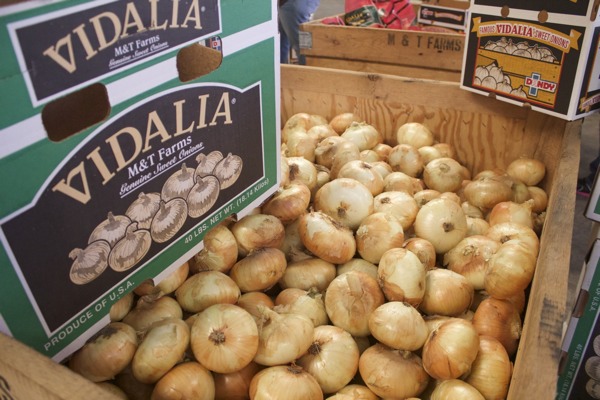
    File photo of Vidalia onions for sale.

    By Clint Thompson

    Vidalia onion producers have begun harvesting the early maturing varieties this year, and Chris Tyson is excited about the potential of this year’s crop.

    “The Vidalia onion crop definitely looks favorable this year. We are anticipating a quality harvest,” said Tyson, University of Georgia Cooperative Extension area onion agent at the Vidalia Onion and Vegetable Research Center in Lyons, Georgia. “Frequent and heavy rains created some adverse conditions earlier in the season, but growers have managed their crop well. They’ve done a great job managing their fertility and fungicide programs despite the weather.”

    Growers started harvesting their earliest varieties in the beginning of April. The peak of harvest will occur near the end of the month.

    There is optimism despite some localized outbreaks of downy mildew disease in the Vidalia Onion zone in Southeast Georgia, according to Bhabesh Dutta, UGA Extension vegetable plant pathologist. Severe and widespread cases have not been reported. He warns, however, things can change quickly with respect to infections in newer areas, as harvests continue to ramp up over the next few weeks.

    “This all depends on how diligently our growers monitor their crops for initial infection and how aggressive they are on their protective fungicide spray schedules,” Dutta said. “Our onion growers have been on top of their game for the most part with respect to timely protective fungicide sprays. This in combination with some warm, clear weather may help reduce the onset or severity of downy mildew.”

    Dutta said the first symptoms of downy mildew occur on older leaves as light green to pale yellow, which turn to tan and brown as the lesion ages. In Georgia, early symptoms can be diamond-shaped lesions that are mottled with pale and green areas interspersed. As colonization progresses, lesions may girdle the entire leaf. This could cause the total collapse of leaf tissues. Infected bulbs are reduced in size and typically don’t store well.  In severe cases, 100% yield losses have been reported. 

    “Although bulb symptoms are rare to none, foliar infection and secondary pathogen colonization result in bulbs that are reduced in size and more often with internal rot,” Dutta said. “Healthy appearing bulbs from a downy mildew-infected crop do not store well and can get often discarded due to the internal rot.”

  • UF/IFAS Vegetable Growers Meeting Rescheduled to Online Format

    Nutsedge can puncture the plastic and fight for the same resources as the pepper plants.

    By Clint Thompson

    The University of Florida (UF)/IFAS vegetable growers meeting scheduled for April 23 will meet via online beginning at 10 a.m. Those interested in learning about weed management can join via https://ufl.zoom.us/j/831234086. The Meeting ID is 831 234 086.

    Those interested can also join via mobile: +16465588656, 831234086# US (New York);
    +16699006833, 831234086# US (San Jose).

    Due to the ongoing coronavirus pandemic, the UF/IFAS Administration determined that all group research and Extension meetings through the end of April must be postponed.

    The meeting’s contents will include a presentation from UF/IFAS weed scientist Ramdas Kanissery. He will discuss the aspects of effective, long-term and crop-safe weed suppression in vegetable production, specific to tomatoes and peppers. Initial results from an ongoing experiment for nutsedge suppression in vegetable plasticulture beds will also be highlighted.

    Nathan Boyd, UF/IFAS weed scientist, will talk about the effects of soil fumigants in managing weeds. His talk will highlight the efficacy of different fumigants on weeds, fumigant movement in the soil, broadleaf and grass management with fumigants and techniques to enhance fumigant efficacy.

    Peter Dittmar, UF/IFAS weed scientist, will talk about fallow weed management selection to improve nutsedge control in vegetable crops. Nutsedge is the most problematic weed in vegetable crop production. The summer months are ideal for its control because they provide growers a chance to use broad-spectrum herbicides, mechanical methods and cover crops. The key for better weed control is to reduce underground tubers.

    These fallow management practices are most important during the summer fallow when nutsedge is actively growing. It is not effective to wait until the fall.

    The zoom meeting will wrap up with a question-and-answer session with the presenters, beginning at 11:30 a.m.

    RUP CEU and CCA credit will be provided.

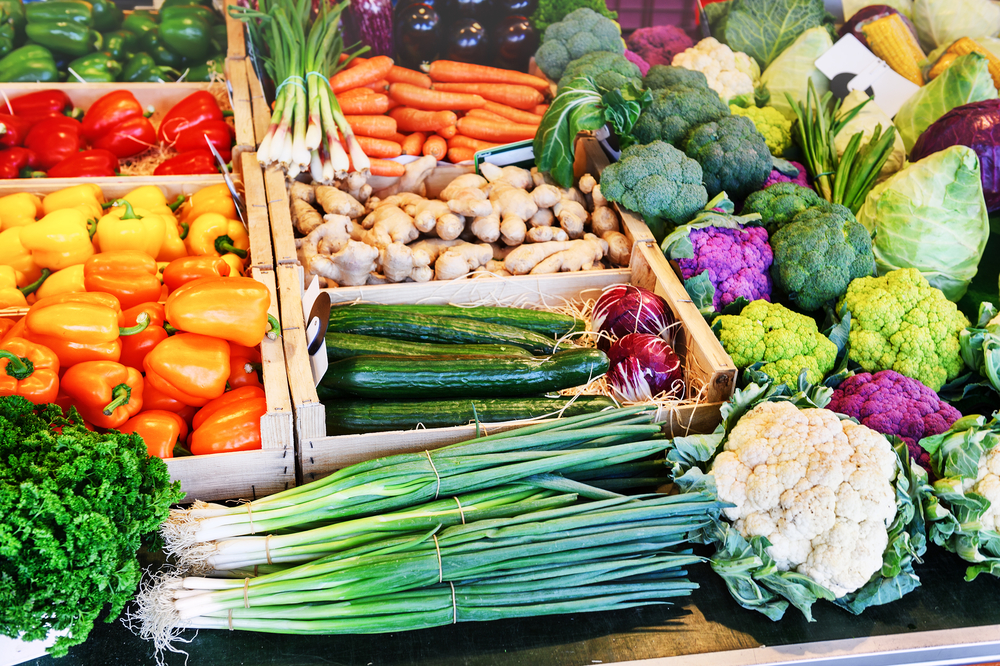
  • Farmers Markets Still Option for Produce Growers

    desantis
    Fresh produce on sale at a farmers market in this file photo.

    By Clint Thompson

    Produce farmers in the Southeast are struggling with markets that have disappeared because of the loss of restaurants and closure of schools amid the ongoing coronavirus pandemic. But Max Runge, Extension specialist in agricultural economics and rural sociology at Auburn University, believes farmers markets remain a viable option for fruit and vegetable growers, especially those who operate on a lower scale.

    “We’ve had pretty good farmers’ markets across Alabama. A number of producers sold through those. I think those are still going to be strong,” Runge said. “I think the market that we have lost is the farm-to-table where the farmers are selling directly to restaurants. We’ve lost that market, at least for now. But I think the smaller production to farmers market that are selling locally, I think those will be okay.”

    Florida fruits and vegetables farmers have struggled over the past month with their food service market drying up, amid restaurants across the U.S. being forced to closed. Many had to leave perfectly good produce in the field just because they didn’t have a buyer to sell to.

    Runge believes, though, that his state’s smaller produce farmers could still reap the benefits at area farmers markets.

    “We don’t nearly have the large commercial operation that there is in Southwest Georgia. We’ve got some. But the majority of them are smaller producers and I think those will hold on,” Runge said. “A lot of those have customers that they’ve sold to for years at these farmers’ markets, and they come back year after year. I think that’ll continue. I think there may be some more interest from people that maybe haven’t purchased from them in the past. And they’re certainly taking advantage of the farmers’ markets.”

  • South Carolina Peaches Ripe for Productive Season

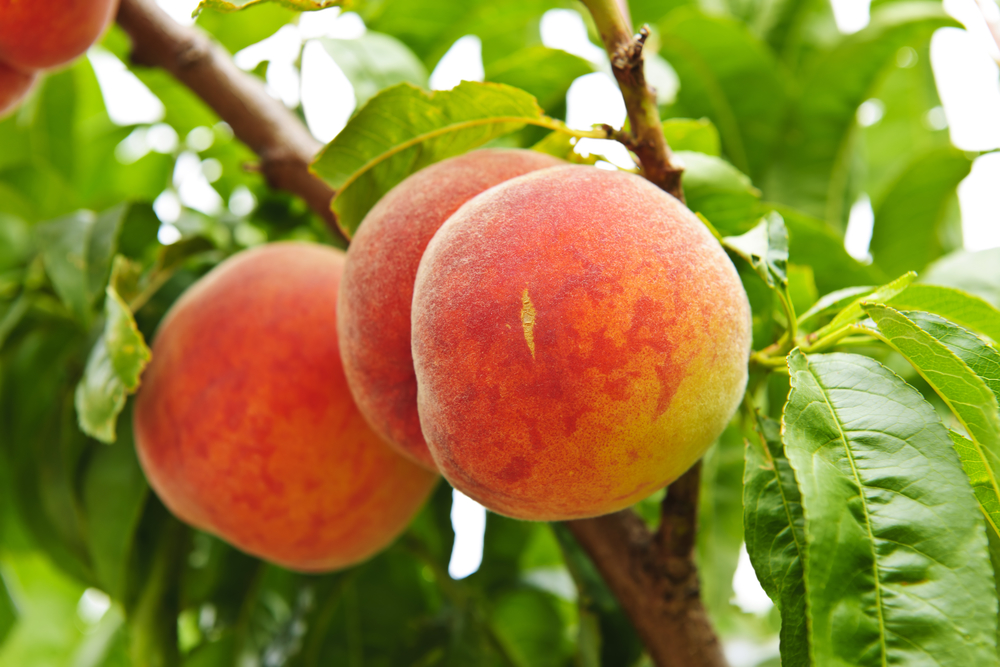
    Ripe peaches ready to pick on tree branches

    By Clint Thompson

    The country’s No. 2 state in peach production appears ripe for a productive season, pending how the market spirals over the next few months, according to Andy Rollins, Clemson Extension agent in Spartanburg, South Carolina.

    “It’s looking really good overall as far as the amount of crop and how clean the crop actually is right now,” Rollins said. “(There’s) a lot of uncertainty, just like everybody, as far as what the market is going to bring. We’re still keeping on. The growers are taking care of everything, spray-wise. It looks to be one of the cleanest crops I’ve ever seen.

    “I’ve spoken with some of the Georgia guys and on the ridge of South Carolina as well, and things look pretty good down there as well.”

    Rollins assists farmers in the upstate or northern part of South Carolina. It amounts to about a third of the state’s crop.

    Farmers across the country are feeling the pinch of an economic downturn amid the ongoing coronavirus pandemic. However, Rollins is encouraged about how early sales are going for his strawberry farmers. He believes a similar fate could await his peach producers when harvests of Flavor Rich varieties begin around May 25.

    “We just started in strawberries and indications are good right now as far as movement of the product with strawberries. Even in this current situation, our wholesale market and several of our U-pick growers are actually doing fairly well,” Rollins said. “But yeah there is still that uncertainty of not sure what’s going to happen later. But really, based on the current situation, things are going pretty well.”

    According to the Agricultural Marketing Resource Center, South Carolina is the country’s No. 2 producer of peaches behind California.

    “It looks like we’re in the clear here at this point in the year. There’s been plenty of years where I’ve said that and that we’ve had events that changed. It seems like I’m saying that every year, but it really is a solid crop. We don’t see any major issues right now with anything,” Rollins said.

  • UF/IFAS Participates in Farm Share Event

    Picture taken by Tyler Jones,UF/IFAS. A UF/IFAS-wrapped vehicle is loaded with several stops’ worth of food deliveries in the Alachua County Farm Share event on April 8, 2020.

    By Clint Thompson

    The University of Florida/IFAS participated in a Farm Share event on Wednesday that led to more than 40,000 pounds of food being distributed to 802 households in Alachua County, Florida.

    Picture taken by Tyler Jones,UF/IFAS. Jeanna Mastrodicasa, UF associate vice president for agriculture and natural resources, unloads a delivery for an Alachua County home during a Farm Share event on April 8, 2020.

    UF Associate Vice President for Agriculture and Natural Resources Jeanna Mastrodicasa said UF deployed 19 vehicles, including Elaine Turner, dean of the UF/IFAS College of Agricultural and Life Sciences.

    “I think for everybody that works at IFAS, every day our work is helping people in some capacity. But in this particular case, what I think it really gave everybody an opportunity to do was formally partner with our local government and our local community on a specific mission and to go out and support this project,” said Mastrodicasa. “For many of the folks who participated, some are typically in the office all day and never really get to interact with citizens. I think for them it was a bit of a treat to get out on the front lines. I also know for pretty much everybody involved, they were just happy to be out doing something that they felt was contributing positively. With all of our folks pretty much working from home right now, I think people were just happy to have a change to do something productive.”

    Mastrodicasa said the Farm Share event encompassed 130 volunteers. They drove to different homes in Alachua County. She said the food, which included potatoes and orange juice, was donated by Farm Share and other entities.

    “What we did was went out to the Alachua County Fairgrounds and picked up food. They put in our car with no contact,” Mastrodicasa said. “We drove to people’s houses, no contact, and left it at their porch. It was very well organized. We helped a lot of people.”

    She added that there are approximately 250,000 people in Alachua County.

  • Florida Interest in Hemp Production is High

    Hemp trial by the University of Florida. Photo by Luis A. Monserrate

    By Clint Thompson

    When the hemp cultivation application process officially becomes available for farmers in Florida around April 25, expect a huge amount of interested applicants, according to Jeff Greene, director of business development at the Florida Hemp Council.

    “The (Florida Department of Agriculture) put out on their website, to put in your name and email address if you are interested in growing it. There were over 1,500 farmers that put their information in. I know that we’ve got in the Florida Hemp Council over 800 that have expressed interest,” Greene said. “The first year of any hemp program is going to be predominantly around low acreage, experimentation. Then as we’ve seen with Kentucky and a lot of the other states, it ramps up. It’s just like any other crop. You’ve got to get used to how to grow it.”

    Greene thinks hemp’s footprint will not be restricted to just one area of the state but expects interest from all producers and sectors from different regions across Florida.

    “I think we’re looking at it from all different levels. We’ve got tomato farmers in Homestead, Florida. The sugar industry is looking at it. The citrus industry is looking at it. The tree farmers up in the Panhandle are looking at it. Everybody’s looking at it,” Greene said.

    However, if there is a concern is that interest in hemp is so great and that it’s open to anybody in Florida, if they have not been convicted of a drug-related crime in the past 10 years, Greene said.

    “My fear is that we’re going to have a supply and demand issue here like we’ve had everywhere else,” Greene said.

    There is also not a licensing fee for producing hemp in Florida.

  • COVID-19 and Food Safety: Fact and Fiction for Food Production

    By: Ruth Borger, University of Florida

    Practice good hygiene by washing your hands with soap and water.

    LAKE ALFRED, Fla. — Consumers are being bombarded with tips for what to do with their groceries during the coronavirus crisis. Leave them in the garage for three days? Wash the produce with soapy water? Wipe all packaging down with disinfectant wipes?

    Listen to the science, say University of Florida Institute of Food and Agricultural Sciences Food Science and Human Nutrition faculty. Food production safety measures secure the food supply.

    “There is consistent agreement among the Centers for Disease Control, the Food and Drug Administration and the U.S. Department of Agriculture that there is no evidence of food or food packaging being associated with transmission of COVID-19,” explained Michelle Danyluk,  UF/IFAS professor of food microbiology. “The FDA has also issued guidance that if an employee tests positive for COVID-19 they do not anticipate that food products would need to be recalled or be withdrawn from the market.”

    Michelle Danyluk and colleague Travis Chapin, a state specialized UF/IFAS Extension agent for food safety, work at the UF/IFAS Citrus Research and Education Center. They advise that produce growers, harvesters, packers, and coolers should continue to follow the good hygiene practices they already have in place (e.g., washing hands and cleaning and sanitizing surface that may contact food or hands, often) as part of their food safety programs when handling produce.
     

    Danyluk and colleague Travis Chapin, a state specialized UF/IFAS Extension agent for food safety, work at the UF/IFAS Citrus Research and Education Center. They advise that produce growers, harvesters, packers, and coolers should continue to follow the good hygiene practices they already have in place (e.g., washing hands and cleaning and sanitizing surface that may contact food or hands, often) as part of their food safety programs when handling produce.

    They acknowledge that there has been some confusion about sanitation practices. FDA and CDC do not recommend any additional “disinfection” in food facilities beyond routine cleaning at this time due to concerns around COVID-19. The primary way to control Coronavirus infection is to prevent spread between people, including workers. Farms, harvesters, and coolers should continue their vigilance around general hygiene and food safety practices.

    “Coronaviruses need a living host (human or animal) to grow in and cannot multiply on produce or on common touch or food contact surfaces,” explained Michelle Danyluk, professor of food microbiology.

  • Florida Producers Still Concerned with Foreign Produce in Stores

    commissioner
    Nikki Fried
    Florida Agriculture Commissioner

    During the Florida Farm Bureau Federation (FFBF) and Florida Department of Agriculture and Consumer Services (FDACS) Town Hall last week concerning COVID-19 and its effects on Florida agriculture, one issued discussed was how fresh produce growers were having difficultly moving their products. But foreign produce continues to be prevalent in stores. Florida Agriculture Commissioner Nikki Fried said this is something they work on every day.

    For more information go to the FDACS website . To hear more comments made during the Town Hall event, click here.