Alabama fruit and vegetable farmers have an outlet to market their produce statewide. Thanks to Sweet Grown Alabama, a non-profit foundation that connects farmers in the state to retailers and consumers, growers can market their produce anywhere in the state.
Thanks to the Sweet Grown Alabama website, vegetables are marketed across the state.
“This database launch is the culmination of many months of work,” said Ellie Watson, Sweet Grown Alabama director. “We have been focused since September on recruiting farmers and just spreading the word about our program to the folks in the agricultural community, so we can build a database of members and a network of folks that have product available.”
Consumers can go to the Sweet Grown Alabama website and find local farms in their area. It also lists a harvest calendar so consumers can know when specific fruits and vegetables are ready to be picked. Anything from satsumas and watermelons on the fruit side to bell peppers and kale on the vegetable side are listed.
Perfect Timing
It is perfect timing for the website’s release. A push to support American farmers has been made during the coronavirus pandemic. Consumers are wanting to purchase fresh, local produce.
“Consumers, now more than ever, desire to know whose hands have been handling the product that they’re eating and where it’s been and where it’s been grown and how it’s been grown. COVID-19 has really given folks a heightened sense of awareness about the supply chain,” Watson said. “Sweet Grown Alabama can really meet a need to connect Alabama farmers and families who are looking for high quality, safe, healthy products. This database launch timing was perfect. It was something we wish could have been launched at the beginning of COVID-19. But we’re thrilled it’s at least up and running now.”
Sweet Grown Alabama is a membership organization. Watson said there are more than 130 completed applications that have been submitted.
North Carolina State small fruits Extension specialist Mark Hoffmann confirmed that grapes in his state experienced frost damage during last weekend’s cooler temperatures. The state’s strawberries appear to have escaped damage.
Hoffmann
“We got lucky for the most part and didn’t see a lot of damage in strawberries. Still a pretty strong strawberry season,” Hoffmann said. “But we had more frost damage in the mountains on grapes. I expect some crop loss this year due to frost damage on grapes.”
Freeze warnings and frost advisories were issued for different parts of North Carolina. Heading into the weekend, Hoffmann expected that strawberry growers would implement row covers on their crop. Row covers help reduce radiation in the field and provide adequate frost protection from temperatures in the 30s. Strawberry production is currently in mid-season. If row covers were not used, the low temperatures could have harmed the open blossoms that are still on plants, which lead to late-season fruit. Temperatures could also harm the actual fruits in popcorn stage and other green fruits.
He also confirmed this was the third frost event for the state’s grape crop. It was especially vulnerable this time since it is late in the season.
Hoffmann estimates that more than 1 million bottles of wine are produced every year in the state and there are 1,500 acres of grape in state.
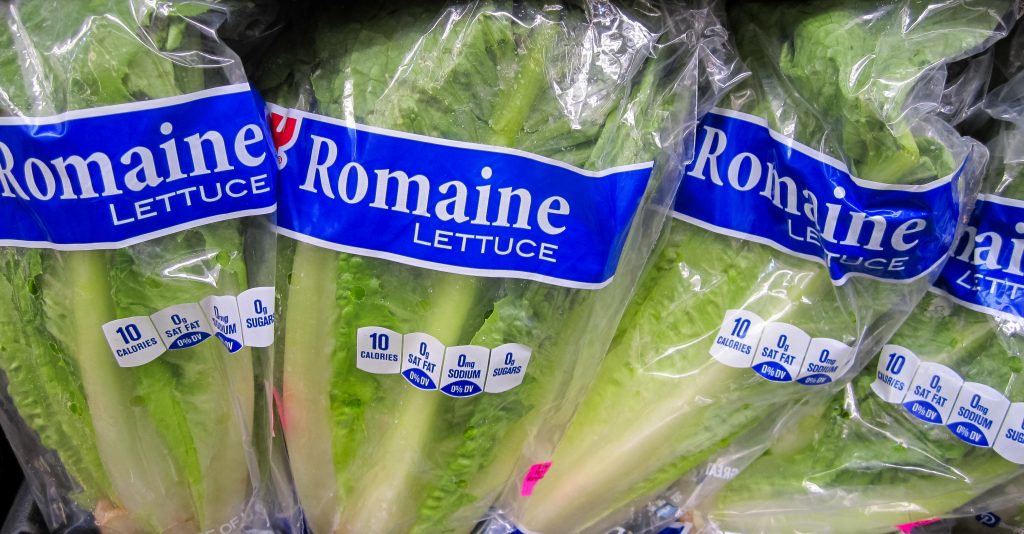
Fresh romaine lettuce on display at local grocery store. Credit: The Toidi / Shutterstock.com
ARS News Service
SALINAS, CALIFORNIA, May 13, 2020—Agricultural Research Service (ARS) scientists have identified five Romaine lettuce varieties that both brown less quickly after fresh-cut processing and are slower to deteriorate postharvest.
They also are determining the genetic basis for deterioration. The researchers have identified the location of genes associated with postharvest deterioration of fresh-cut lettuce, and are in the process of identifying genes associated with browning, two economically important traits. This will speed up development of new Romaine varieties with better shelf-life because now lettuce breeders will be able to check that offspring carry these genes without needing to grow out and destructively test for browning and deterioration resistance.
Lettuces are the most popular, commercially produced, leafy vegetables in the world. They have a farmgate value of more than $2.5 billion in the United States in 2017, making them one of top ten most valuable crops for the country. But fresh-cut lettuce is a highly perishable product.
“The inability to evaluate for deterioration early in the process of developing new varieties has been a real impediment to breeding advances. Now having these molecular markers means that slow deterioration and eventually less browning can be more easily integrated into lettuce breeding, traits that are important economic considerations,” said research geneticist Ivan Simko with the ARS Crop Improvement and Protection Research Unit in Salinas, California, who led the deterioration study.
When you consider browning and deterioration ratings together, the best breeding lines for commercial production, and also for use as parents to develop new varieties are (in alphabetic order): Darkland, Green Towers, Hearts Delight, Parris Island Cos, and SM13-R2, which is a breeding line developed at the ARS lab in Salinas.
In addition, the researchers found the chromosome region that contains the genes for slow deterioration also contains four genes (Dm4, Dm7, Dm11, and Dm44) and one DNA region (qDm4.2) that code for resistance to downy mildew—one of the most-costly lettuce disease.
This colocation indicates a strong linkage between one or more of the four genes and the rate of deterioration. DNA-based markers can be used to develop new breeding lines with slow rate of deterioration and desirable combinations of resistance genes.
Deterioration is the rupture of cells within lettuce leaves, leading to waterlogging and the lettuce turning to mush. Browning is the discoloration of the edges of lettuce after cutting or tearing. Either development can spoil the leafy vegetable’s value by decreasing shelf life.
In an effort to control browning and prolong shelf life, lettuce processors have been turning to modified atmosphere packaging and flushing bags of cut lettuce with nitrogen gas to reduce oxygen levels in the bags.
But these practices are costly. They also can lead to other problems such as off-odors and, when coupled with high storage temperatures that promote anerobic bacteria growth on the bagged lettuce.
“Our study was aimed at finding lettuces that possessed low browning potential without the need for limiting the oxygen supply,” explained research food technologist Yaguang (Sunny) Luo, who led the browning study. Luo is with the ARS Food Quality Laboratory in Beltsville, MD.
Like deterioration, there was significant correlation between high resistance to browning and pedigree, which gives promise that lettuce breeders will be able to improve the trait and incorporate it into new varieties, Luo added.
The Agricultural Research Service is the U.S. Department of Agriculture’s chief scientific in-house research agency. Daily, ARS focuses on solutions to agricultural problems affecting America. Each dollar invested in agricultural research results in $20 of economic impact.
Due to COVID-19, all pesticide license testing in Florida was suspended for more than six weeks. Now that the state has started to reactivate services, testing will resume at select UF/IFAS Extension offices on Monday, May 18.
Not all testing locations will open on May 18. Due to the number of COVID-19 cases in certain regions, some counties are opening services more slowly than others, and this will impact where UF/IFAS Extension can test. If your county Extension office is not yet open for testing, you may be required to travel to a county that is offering these services. Visit the UF/IFAS Pesticide Information Office’s website where the status of testing sites are monitored and updated in real time.
“We know that many of you are in great need of testing services so you can resume professional activities,” said Jason Ferrell, director of the UF/IFAS Pesticide Information Office. “We are working to address these needs while complying with both state and local ordinances. Please be patient with our staff as we reactivate these programs.”
Testing is currently operating by appointment only, and walk-ins will likely be turned away as a health precaution to control crowd size and maintain social distancing. There will also be requirements for your safety and the safety of others, which will be explained when you call to make your appointment. Participant safety is of highest concern, and it is highly recommended that you wear a face covering throughout the exam.
At the onset of COVID-19 closures, UF/IFAS and the Florida Department of Agriculture and Consumer Services (FDACS) explored ways to move testing online, which would allow applicators to take the test without visiting a testing location.
“Online testing is still a priority for UF/IFAS and FDACS, but we could not make it a ‘right now’ solution,” Jay said. “This endeavor will take much longer than six weeks, but we are excited to begin reopening testing locations to keep you working.”
A national coalition of 64 organizations representing specialty crop producers sent a letter to Congressional leadership this week on safety protocols within the industry during COVID-19. They want Congress to know the steps agricultural employers are taking to protect their workers.
“Farmers and ranchers across the country moved quickly to implement new employee safety protocols early in the crisis,” says National Council of Agricultural Employers President Michael Marsh. “While America was being placed on lockdown, agricultural employers were already at work trying to figure out how to best protect their employees and the public.”
The letter details the collaboration between the agriculture industry, public health experts, and regulatory officials to develop the best safety practices in the field and packing. As future rounds of COVID-19 pandemic legislation is debated, the coalition is asking congressional leaders to acknowledge the widespread employee protection protocols that are already in place, as well as provide additional support to help agricultural employers continue to meet the needs of their employees.
The Western Growers Association, a member of the coalition, is asking Congress to “extend current relief efforts for agriculture, and to include additional funding for personal protective equipment and other measures to offset the costs of maintaining an essential workforce during COVID-19.”
(From the NationalAssociation of Farm Broadcasters)
Photo courtesy of UF/IFAS. Shows a Florida finger lime.
LAKE ALFRED, Fla. — Sweet oranges. Ruby red grapefruit. Sugar Belle mandarins. When one thinks of Florida citrus, these fruits immediately come to mind.
But finger limes?
A University of Florida Institute of Food and Agricultural Sciences researcher believes that finger limes maybe the next food trend that will continue to fortify Florida’s role as a citrus producer for the world.
Manjul Dutt, a research scientist with the UF/IFAS Citrus Research and Education Center, has received funding to explore how finger limes could be grown and marketed by Florida citrus growers.
It is a project that brings both opportunity and the potential to diversify the Florida citrus portfolio.
Finger limes are an oblong, finger-shaped fruit about 4 inches long with red, pink or green-yellow pulp filled with tangy juice. They are a culinary delicacy used as garnishes for sushi, vegetables, salads and pasta. Finger limes grow mostly in Australia, California and Hawaii. Dutt believes Florida’s climate, agricultural expertise and soils are perfect to develop an emerging agricultural enterprise.
“An added benefit is that finger limes have the potential to tolerate Huanglongbing (HLB), use less fertilizer and require less pesticide than other forms of citrus,” said Dutt.
What is HLB?
HLB is the cause of the deadly citrus greening disease that has impacted most groves across Florida.
In the project, scientists will plant several finger lime plots across the state at UF/IFAS and stakeholder facilities to measure how successful the plants are in different conditions. Researchers will also assess the best production methods to grow finger lime under Florida conditions.
UF/IFAS citrus breeders will help with the research. They will evaluate the fruit’s tolerance to HLB, which will include sequencing the finger lime’s DNA to identify disease-resistance genes. This in turn may provide insights to enhance existing research underway to breed a citrus-greening resistant tree.
Researchers will also look at market opportunities for finger limes in Florida and potential for distribution both in institutional and consumer markets. Tasting sessions will evaluate if consumers find the finger limes flavorful, appealing to taste and smell, and whether it looks good on a grocery shelf.
Research History
Dutt has been studying finger limes since 2012 and established a finger lime trial in 2017 with funding support from the Florida Department of Agriculture and Consumer Services’ Specialty Crop Block Grant Program. That pilot study attracted the interests of several citrus and specialty crop growers who are enthusiastic about the project.
“We are excited about the possibility that a new citrus variety might be available to Florida growers,” said Anna Jameson of Brite Leaf Citrus Nursery.
“We envision a steady growth of the market and there has been increased demand for this crop in the last few years,” Dutt said. “The UF/IFAS citrus breeding program has some improved cultivars that are potentially superior to currently available varieties.”
The current 18-month project is funded by the UF/IFAS Support for Emerging Enterprise Development Integration Teams (SEEDIT) program. The program is designed to fund integrated research, Extension and economics faculty team science to alleviate barriers in developing emerging enterprises for the state of Florida.
Given the issues Florida agriculture faces, the time is right for us to take a scientific and systematic approach in developing more options for profitable and sustainable industries in the state. Dutt has also received financial support from the UF/IFAS Plant Breeding Graduate Initiative to fully support a doctoral student who will be researching the HLB tolerance characteristics of the finger limes.
Paul Allen’s point of emphasis has been clear recently: Support the American farmer. He believes the message has been received loud and clear.
“We’re thinking all of the local and national attention we’ve gotten about us destroying our crops has brought the American public to the forefront to supporting the American farmer. I really believe that,” said Allen, president of R.C. Hatton Farms in Belle Glade, Florida and chairman of the Florida Fruit and Vegetable Association. “The American people have heard everything that’s been on the national media all about Mexico. They’ve stopped buying Mexican produce. They’re buying American produce. It’s a big part of it.”
He thinks that is a reason watermelons are in short supply and there could be a major shortage by Memorial Day weekend. It also could be attributed to strong demand for tomatoes with prices improving.
“It’s everything. It’s sweet corn, watermelons; people are buying. It’s not that we’re short. People are buying and supporting us,” Allen said. “There’s a lot of product being moved. And in a lot of cases restaurants are starting to open back up. People are starting to get out. It’s a big part of it.
“Thankfully, it looks like the American people are going to have their say in it. They’ve heard our cry because there’s been a hard run on national media, local media about this whole thing.”
Tough Start to Season
Unfortunately, it was not always this way this season. In a previous interview in early April, Allen said he left about 2 million pounds of green beans in the field and about 5 million pounds of cabbage. All because of the coronavirus pandemic that shut restaurants down and closed off a major supply chain to foodservice industries.
“We had a devastating March and April for all crops. When the country was shut down, it was the worst we’ve ever seen it,” Allen said. “When the pandemic hit, there was a buying frenzy for a week to 10 days. Then everybody went lockdown. When we farm, we plant, cultivate, grow, harvest and ship every day for it to be consumed every day. When (the pandemic) hit us, we were the sacrificial lamb.”
Allen believes more financial aid could still be provided by the federal government.
“The biggest thing right now is the government allocated per crop a cap of $125,000, which is nothing. We’re really working trying to get the USDA to see and understand the massive hit that Florida is taken and raise the direct payment caps,” Allen said. “What is fair is not always equal.
“It costs 10 times to grow vegetable crops what it does regular commodity crops.”
More than $30 million investment to create 107 new jobs
Pictured is a field of hemp.
COLUMBIA –Yield Scientific, a subsidiary of GEM Opportunity Zone Fund, today announced plans to establish operations in Hampton County, South Carolina. The company’s $30 million-plus investment is projected to create 107 new jobs.
Founded in 2017, Yield Scientific is a hemp growing and processing operation that specializes in clinical-grade product development for the health care industry. Through its brand Victis CBD, the company offers CBD products developed with high quality standards and advanced science.
Located at Southern Carolina Industrial Campus in Early Branch, Yield Scientific’s new facility will enhance the company’s product development and manufacturing capabilities.
The new operations are expected to be online by the first quarter of 2021. Individuals interested in joining the Yield Scientific team should visit yieldsci.com.
The Coordinating Council for Economic Development has approved job development credits related to this project. Hampton County was also awarded a $50,000 Rural Infrastructure Fund grant to assist with costs related to this project.
QUOTES
“We are very pleased to join the Hampton County community of corporate citizens. Through Yield Scientific and the Victis CBD brand, we will invest over $30 million and create 107 jobs in a pharmaceutical-grade growing and processing complex within the Southern Carolina Industrial Campus in Early Branch. Our project would not have happened without the support and work of the SouthernCarolina Alliance team, the Department of Commerce, the Department of Agriculture and Hampton County.” –GEM Opportunity Zone Fund CEO Zeb Portanova
“We’re thrilled that Yield Scientific has chosen to invest in South Carolina’s growing hemp industry and her people, creating more than 100 good jobs in one of our state’s rural gems.” –Gov. Henry McMaster
“Yield Scientific is a wonderful addition to South Carolina’s burgeoning hemp industry. Their greenhouse operations and processing capacity will create skilled agriculture jobs – and in an Opportunity Zone, no less.” –Commissioner of Agriculture Hugh Weathers
Florida’s peach season has come and gone. David Wheeler, peach farmer in Lake Placid, Florida, said his season started early and finished earlier. From a marketing standpoint, that was as good as he could have hoped for.
Peach season is underway in Georgia and Alabama.
“The marketing window, that was very good this year, yes,” Wheeler said.
Wheeler produces 120 acres of peach trees and had success this year selling retail.
“Walmart was very supportive of the Florida peach program. That really helped us. They took a lot of our volume,” Wheeler said. “They were very good to us.”
In a previous interview, Wheeler confirmed that the high temperatures in March spurred the peaches to ripen earlier than normal. With hot and dry conditions felt throughout the state the past in March and April, peach season closed sooner than normal.
Since Wheeler’s harvesting window closed sooner than normal, he didn’t have to compete against growers in Georgia or Alabama for marketing supremacy. Both states have just now started harvesting their peach crop. Wheeler didn’t have to compete for the market against larger-scale operations. The result was a good year despite a decrease in production.
“I think overall (it went) pretty well. Production was down about 25% but we had a very heavy crop last year so that’s not a big surprise,” Wheeler said. “The fruit quality was outstanding. The best way I have to judge that is when I take peaches to friends; everybody raved about them this year. I know they were a good quality peach. Overall, I would say (it was) a good season, even though production was down and packouts were down.”
Primarily a citrus grower, Wheeler, a peach farmer for nine years, began producing peaches when citrus greening disease became problematic in Florida and has since wiped out a bulk of citrus production in the state. He mainly produces a pair of varieties, UF Best and the UF Sun. Wheeler says he has had the most success producing UF Sun.
Figure 1. Roots of blue lupin (left) and sunn hemp (right) are infected with Meloidgyne arenaria root-knot nematode and stained with acid fuchsin. Nematode galls and egg masses are visible on blue lupin, indicating its susceptibility to the nematode. In contrast, sunn hemp-infected roots are gall-free with a few egg masses, suggesting that it is a poor host for M. arenaria.
By Abolfazl Hajihassani and Josiah Marquez
Multiple cover crops are excellent candidates for vegetable growing systems in the southern United States due to their ability to fix nitrogen, build and maintain soil organic matter, and suppress soilborne pathogens, nematodes and weeds. In addition, cover crops can be a valuable strategy for improving microbial diversity and soil health when properly implemented.
There is plenty of evidence in scientific literature to support positive effects of certain cover crops in management of plant-parasitic nematodes. The key to success is understanding the factors that drive variation. Though suppressive cover crops will not eliminate nematodes from soil, they may reduce their population densities enough to allow proper production of susceptible vegetable crops in infested fields.
In Georgia, multiple root-knot nematodes (Meloidogyne spp.) are widely dispersed in the southern part of the state where they cause severe yield losses particularly in cucurbits, eggplant, tomato and pepper. During a survey in 2018 for nematodes in commercial vegetable-growing regions in southern Georgia, root-knot nematodes were found in approximately 67 percent of fields.
In the Southeast, chemical control is the most predominant approach for managing Meloidogyne spp. in intensive cultivation systems of vegetables.
However, certain summer cover crops, including sunn hemp (Crotalaria juncea), sorghum-sudangrass (Sorghum bicolor x S. sudanense) and velvetbean (Mucuna pruriens) have been implicated in reducing population densities of root-knot nematodes in soil. In Georgia, despite long growing seasons, the practice of growing two to three crops on the same piece of land often leaves a narrow window for the use of cover crops.
COVER CROP CULTIVAR CONSIDERATIONS
Many summer cover crops are susceptible to nematodes, resulting in an undesired population increase in soil during the growth of crops. To avoid this, cover crop species or cultivars that are poor hosts (resistant) to nematodes should be recognized.
In an attempt to find alternatives for control of root-knot nematodes in vegetable production systems, a series of greenhouse experiments was conducted in 2019 at the University of Georgia Tifton campus. The goal was to identify cover crop species/cultivars with potential to prevent the reproduction of M. javanica, M. incognita and M. arenaria. The cover crop susceptibility/resistance was characterized by evaluating root galling and egg-mass index.
Results exhibited that different cover crops respond differently to infection by root-knot nematodes. For example, certain nematode-infected cover crops produce both galls and egg masses on roots, whereas others may only induce either galls or egg masses (Figure 1). M. javanica, M. incognita and M. arenaria aggressively reproduced on blue lupine (Lupinus perennis), hairy vetch (Vicia villosa) and cowpea (Vigna unguiculata). These plants were highly susceptible to these nematode species.
Cover crops that were highly resistant across all three Meloidogyne species include velvetbean, marigold (Tagetes sp.) and sesame (Sesamum indicum). Resistance to parasitic nematodes is characterized as the ability of a plant species to prevent root-knot nematode development or reproduction.
The reproduction of these nematode species on sorghum-sudangrass and sunn hemp varied from susceptible (good host) to highly resistant (nonhost) plants. For example, an unspecified cultivar of sunn hemp was susceptible to M. arenaria and resistant to both M. javanica and M. incognita.
KEY POINTS
In summary, proper selection of a cover crop plays a key role in control of root-knot nematodes. It is important to note that a cover crop species may not provide resistance to all species of root-knot nematodes. In addition, all cultivars of the same cover crop may not create equal levels of nematode control.
Figure 2. University of Georgia researchers are studying the effects of sunn hemp and tillage practices on soilborne diseases, nematodes and weeds. Sunn hemp is harvested and chopped followed by tilling the residue into the soil.
Special attention to the presence of other plant-parasitic nematodes in soil is also necessary when planting a cover crop. Past research has suggested that Meloidogyne-resistant cover crops may support the reproduction of other nematode types in the soil. If vegetable growers think they are having issues with nematodes, soil samples can be analyzed at nematode diagnostic services to determine the types/species of nematodes and their population density for proper selection and management of cover crops to meet goals.
Other key factors to get the optimal benefits of cover crops are planting time, seeding rates and termination (mowing) times. Currently, field research (Figure 2) is being conducted in southern Georgia to determine the effect of spring and summer planting of sunn hemp for optimal biomass production and its influence on nematodes, weeds and soilborne diseases. The goal is to examine the effects of cover crops alone or in combination with tillage practice or chemical control approaches for effective management of plant-parasitic nematodes.