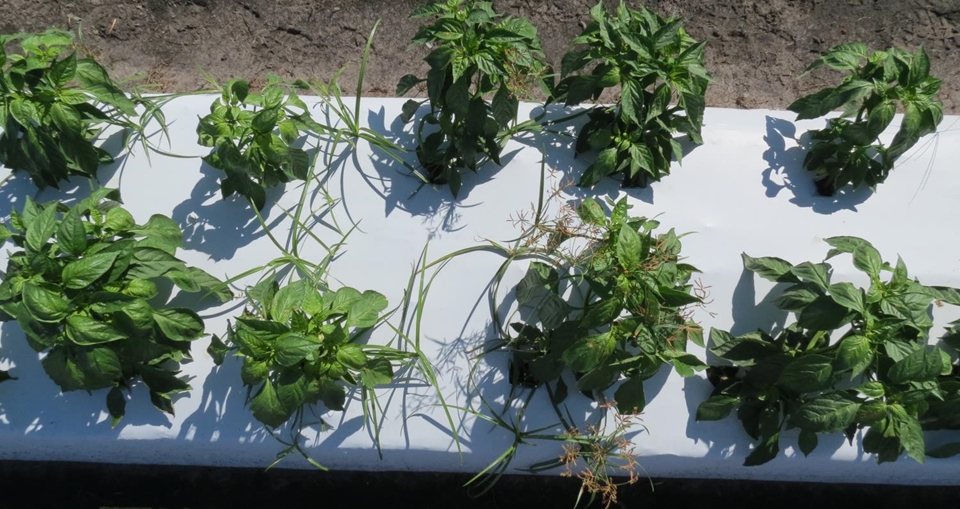
An overhead view of a plasticulture vegetable bed shows nutsedge weeds emerging through the plastic.
By Clint Thompson
University of Georgia Cooperative Extension weed specialist Stanley Culpepper encourages vegetable growers to diversify their management programs against nutsedge. This protects against potential resistance and provides adequate control.
“In general, I would say with our guys, I’m not overly concerned because our fields with our most nutsedge, they get fumigation, they get tillage and they get herbicides,” Culpepper said. “My guys are quite diverse. Will we have resistance one day? Sure, we will, but we are quite diversified in our management approach. We’re not selecting for resistance, say compared to an agronomic guy who goes out and sprays roundup or dicamba three times.”
According to Alabama Cooperative Extension, purple nutsedge and yellow nutsedge are prevalent in most areas where vegetables are grown. Both are perennial weeds that propagate mainly by the production of tubers. While growers maintain control of nutsedge, it comes at a cost, says Culpepper.
“That pest is still the most problematic. Doesn’t necessarily mean we’re not controlling it, but we’re spending a lot of money to control it that we wouldn’t have to spend if it wasn’t so problematic,” Culpepper said. “The one that’s causing us the most money without a doubt in the plasticulture system is nutsedge.”
Why Is It So Problematic?
Farmers who implement plasticulture still struggle with nutsedge because it can penetrate mulch.
“Even if you haven’t poked a hole in the mulch, nutsedge can penetrate it itself. It can damage the mulch and be there before you plant. It can come at any time even if your plant is shading out the plant hole. It’s very unique that way,” Culpepper said. “Is it killing us? Is it hurting our guys? No, I think we’re doing a pretty daggum good job. It’s a repetitive challenge and costing us a lot of money to try to manage.”
Diversification is key since there are very few herbicides that are effective regardless of the vegetable crop being grown. It is not like peanuts where farmers can apply Cadre or cotton where Roundup can be applied. Nutsedge control in vegetables is limited to a couple of products.
“It’s there and probably in every single field but they’re doing a really good job controlling it. It’s not like some disease that jumped on us last week and is going to wipe us out. That’s not it at all,” Culpepper said. “But that’s the one I still say is most challenging for our vegetable growers in plasticulture systems.”
May 27, 2020 — LAGRANGE, GA – Sweet, refreshing Georgia watermelon is coming to a store near you in early June. The 2020 watermelon crop is expected to have the crisp, sweet flavor and high quality unique to Georgia watermelon.
Georgia watermelons will soon be ready for purchase.
While Georgia has had a cool spring, consumers should still start seeing Georgia Grown watermelons in stores the first week of June. The Georgia season typically peaks around June 20.
“We expect excellent quality and even more, we are eager to have a successful growing season,” said Rob Greene, Georgia Watermelon Association (GWA) President and owner of Lime Creek Farms in Arabi, Georgia.
Planting for Georgia’s watermelon crop began in March. From planting to harvest, watermelons typically need 90 days to grow, ripen, and be ready for harvest. With more than 18,000 acres of watermelon harvested on average each year, the state of Georgia ranks in the top 4 in the United States for production among Texas, Florida, and California.
Georgia watermelon is expected to hit stores by June 3. Consumers can pick up watermelon in local stores and markets throughout the southeast. The 2020 GWA Queen Ambassador, Lindsey Westberry, would normally be in stores this summer, but due to COVID-19 restrictions, she is helping consumers through serving in other ways in her local community.
Georgia Watermelon Association Queen Ambassador Lindsey Westberry helped members of the National Guard at Second Harvest of South Georgia to pack food boxes in Valdosta, Georgia.
Just before Memorial Day, Westberry joined with members of the National Guard at Second Harvest of South Georgia (SHSG) to pack food boxes for the local community in Valdosta, Georgia. SHSG provides more than 3 million meals to those with food insecurity.
“Having the opportunity to give back to my community alongside many of our service men and women was truly a blessing,” she said. “I believe in living a life of use to others and I look forward to continuing to bring smiles to people’s faces through watermelon.”
On social media, Westberry will be putting together many recipes, safety and how-to tutorials so consumers can enjoy their local watermelon.
“It’s more important now than ever to support your local economy – and we do that from purchasing in season produce like watermelon when it comes in stores,” said Samantha Kilgore, GWA Executive Director. “Let watermelon help cool you off this summer and rest assured that your local growers do everything they can to provide a safe, sweet, and satisfying product!”
UF/IFAS citrus scientists Tripti Vashisth and Fernando Alferez are trying to reduce the amount of fruit that drops from Hamlin and Valencia trees prior to harvest. If fruit drops, growers can’t harvest it, and that leads to losses for farmers and less fruit at the market for consumers.
Normally, about 10% to 15% of citrus fruit drops from a healthy tree, said Alferez. With citrus greening now prevalent throughout Florida’s citrus growing regions, scientists and growers have seen pre-harvest fruit drop increase in the last decade, he said. In the 2012-2013 season, researchers and citrus farmers noticed about 25% of their crop lost because of greening-associated pre-harvest fruit drop. Now, depending on the citrus variety, growers may see a pre-harvest drop, and it could be up to 50%.
Fruit-Drop Issues
The two UF/IFAS scientists are studying many fruit-drop issues. For example, they’re looking into the effect of removing “fruitlets’’ – fruit that’s less than 2 centimeters in diameter – from so-called “off-blooms.”
“Typically, healthy citrus trees bloom early in spring, and they may have another wave of flowers later in the spring, but it is atypical for the tree to bloom in late summer,” said Alferez. Those would be an example of “off-bloom” fruit.
Preliminary experiments from the two UF/IFAS researchers show that removing “fruitlets” from off-blooms when Hamlin oranges are mature results in more mature fruit hanging onto citrus trees – as opposed to dropping — Alferez said. This may increase yield because the mature fruit drops less.
Valencia oranges are more complex, as several blooms occur during the last part of fruit maturation, he said.
“Also, we have found that fruit drop is associated with fruit development,” said Alferez, an assistant professor at the UF/IFAS Southwest Florida Research and Education Center in Immokalee, Florida. “Small fruit are more likely to drop.”
Another Finding
Another preliminary finding? Insufficient carbohydrates do not cause fruit drop. Therefore, the researchers recommend growers use good irrigation and nutrition practices during the fruit-development period. Vashisth and Alferez also say if growers apply gibberellic acid during the fruit-development period, it can help reduce fruit drop.
“Our preliminary findings are important because they show that the fruit drop related to HLB is not a simple process,” said Vashisth, an assistant professor at the UF/IFAS Citrus Research and Education Center in Lake Alfred, Florida. “There is no single cause for the fruit to drop. There have to be more causes, and that is what we are trying to understand now.”
In healthy trees, competition for resources between mature and “fruitlets” causes some ready-to-harvest fruit to drop.
Citrus Greening Disease
Citrus greening disease – known to scientist as huanglongbing (HLB) — may contribute to fruit dropping from trees. HLB has caused tremendous damage to citrus in Florida.
“In general, trees displaying fewer HLB symptoms or that are relatively healthy tend to have less pre-harvest fruit drop and can hold on to fruit for a longer time,” said Vashisth.
Usually, these “off-blooms” are not abundant; they’re only on a few branches, but it may affect tree performance if it is sick with HLB.
“In Hamlin and Valencia oranges, we have observed several off-blooms resulting in new fruit as the current crop is already developing,” Vashisth said. “This is normal in healthy trees growing in tropical or subtropical regions, such as Florida. However, in an HLB-affected tree, this may compromise the tree’s ability to keep fruit. It may also reduce yield, because the new fruitlets and mature citrus compete for carbohydrates.”
Funding for this research is possible by state legislative funding for the UF/IFAS Citrus Initiative and UF/IFAS new faculty funding.
The Georgia Grown To-Go program generated excitement last weekend for consumers in Marietta and provided a boost in sales for some of the state’s farmers, including Bill Brim.
Pictured by Clint Thompson/Boxes are prepared at Lewis Taylor Farms in Tifton, Georgia to be sold directly to consumers. Similar boxes were sold last Saturday at the Georgia Grown To-Go event in Marietta, Georgia.
As part of the Georgia Department of Agriculture’s (GDA) “Buy Georgia Grown, Now More Than Ever” campaign, Georgia Grown partners with local governments to connect produce farmers directly to consumers in highly populated areas throughout the state. Last Saturday, Lewis Taylor Farms, along with about other semi-loads that included chicken, beef, blueberries, sweet corn, and dairy, were represented in Marietta, Georgia.
Brim, who co-owns Lewis Taylor Farms in Tifton, Georgia, complimented Georgia Ag Commissioner Gary Black in his efforts of connecting Georgia producers with a consumer base yearning to purchase Georgia Grown products.
“I think he was trying to help us as farmers and move some of our product and let people know that with the coronavirus, we’re still in business. We’re still trying to do everything we need to do for Georgia Grown and American Grown,” said Brim. “Of course, Georgia Grown is important to us but we want people to buy American Grown if they’re not from Georgia. Commissioner’s really pushed that really hard.”
Quite the Response
Brim said they prepared 1,540 produce boxes that included beans, blueberries, onions, cabbage and zucchinis. Boxes costs $36 presale and $40 on site. Brim estimated there was about 70% pre-ordered. Brim said there were between 7,000 and 10,000 cars in line to purchase products.
“They’re looking for (Georgia Grown), I think. Gary has done a good job of pushing the media to let them know. Jessica (Kirk) got interviewed and she talked about Georgia Grown and American Grown,” said Brim about his daughter, who helped represent Lewis Taylor Farms last Saturday. “It’s been pushed out there in the media pretty hard.”
What is Georgia Grown To-Go?
Georgia Grown To-Go is a series of pop-up markets, primarily in metro Atlanta, that provides customers an opportunity to purchase fresh produce directly from farmers with limited contact, drive-through service.
In a press release, Black said, “We are excited to offer this great opportunity to help bridge the gap between consumers in metro areas and our farmers in South Georgia. With foodservice channels limited, Georgia Grown To-Go pop-up markets are a great and innovative way to make sure our consumers have access to the Georgia Grown products they crave. We have enjoyed joining forces with our local government and non-profit partners in an effort to best serve our communities during this unprecedented time.”
Lewis Taylor Farms Background
Brim established himself as an industry leader when he, along with Ed Walker, purchased Lewis Taylor Farms in 1985. Over the next five years, Brim helped transform Lewis Taylor Farms into a diversified transplant and vegetable production farm operation.
When Brim became a co-owner of Lewis Taylor Farms, it had only 87,000 square feet of greenhouse production space. The farm now boasts 81 greenhouses with more than 649,000 square feet of production space.
Apurba Barman, a post-doc researcher on the UGA Tifton campus, examines a cotton plant with whiteflies in his lab. By University of Georgia 8-24-18
By Clint Thompson
Whiteflies have already been reported in Georgia vegetables this spring. They are not yet a concern for Alabama producers, however.
Extension Entomologist Ron Smith said as cotton continues to be planted in Alabama, the focus right now is managing grasshoppers and thrips. Their focus will turn to whiteflies in early July.
“I knew they overwintered at some level over there somewhere around Tifton (Georgia). It’s the winter vegetables that are causing them to be able to overwinter over there. We don’t have a lot of vegetables down in the southeastern corner of the state. They have damage and problems at least a month before we do,” Smith said.
University of Georgia Cooperative Extension vegetable entomologist Stormy Sparks said in early May that whiteflies were already present in Georgia vegetables. This is not good since cotton farmers are currently planting their crop in Alabama and Georgia. Whiteflies like to feed on cotton plants as well.
While colder temperatures do not eliminate whiteflies, they do kill many of their wild hosts. They also slow population development in cultivated hosts. Warmer temperatures this winter allowed for larger whitefly populations to overwinter and become mobile earlier.
“We have the potential of having another outbreak like 2017 or 2018 this year because of the mild winter. A lot of things can happen between now and then that can make the problem worse or better. One of the things is planting date, getting our cotton planted on time. Another is how dry it is during the season. Things like that can impact it,” Smith said. “We will really start focusing on what’s happening in Georgia about the first of July.”
Smith said whiteflies’ impact in Alabama is normally felt about a month later than Georgia.
“It is one thing that we’re concerned about because of the mild winter and we will be focused on it a little bit later,” Smith said.
Whiteflies cause feeding injury issues in vegetables and transmit two viruses: cucurbit leaf crumple virus and cucurbit yellow stunting disorder virus. Vegetables like squash, zucchini, cucumber, cantaloupe and snap beans are highly susceptible to these viruses. Commercial cultivars that have resistance or tolerance to these pathogens are not available.
Will They Get Worse?
The weather patterns over the next couple of months will determine if the whiteflies continue to worsen. How much rain will there be? How heavy are the rains and when will they occur? This is especially important as farmers move from winter crops to spring crops and then to cotton. Freezes in the winter and a tropical storm-type of weather system really impact populations.
Sanitation is also key with whitefly management. Farmers need to get rid of spring vegetables once they’re done harvesting.
“If you’ve got crops where you know you’ve got them, if you’re done with the crop, get rid of that crop,” Sparks said. “I think, overall, we’ve been doing a better job with sanitation. That’s something we always need to hammer on and remind them that sanitation is critical.”
AUBURN UNIVERSITY, Ala. — Beginning today, Alabama farmers and ranchers affected by coronavirus will have an opportunity to apply for monetary relief through the Farm Service Agency (FSA). The Coronavirus Food Assistance Program (CFAP) will provide up to $16 billion in direct payments to American agricultural producers who have suffered losses during the COVID-19 pandemic.
The Alabama Cooperative Extension System’s Farm and Agribusiness Management team will be working closely with FSA offices and USDA Service Centers to guide producers through the application process.
Eligibility
Jessica Kelton, the Farm and Agribusiness Management team leader, said the monetary assistance is unique and much needed.
“The COVID-19 pandemic has plunged many of our farmers into more difficult situations,” said Kelton, who is also an agronomic crops regional agent. “So many producers were already struggling after a dry year with an uncertain market. Now, there are a lot of producers with wasted products because of the market declines related to the pandemic.”
The CFAP program specifically targets producers of agricultural products who have suffered a 5% or greater price decline, as well as losses, because of market supply chain disruptions.
Eligible commodities are divided into five groups.
Alabama Extension economist Max Runge said unprecedented was a word used to describe many aspects of the coronavirus pandemic, but the payments to farmers as a result of this virus really are unprecedented.
“In my years as an agricultural economist, we’ve not seen assistance payments as a result of a pandemic,” Runge said. “While we’ve been in uncharted territory for an extended period of time with COVID-19, the farmers in Alabama have continued to operate their farms as usual facing adversity and uncertain markets. I am thankful that the importance of their work is being recognized through these payments.”
Applications
USDA will begin accepting applications today. Producers may submit applications through August 28.
Runge said FSA offices will have an increased volume of applications and phone calls, so patience on the part of the producer will be appreciated. USDA Service Centers will schedule appointments by phone only. USDA will accept applications by email, scan or fax. Extension professionals recommend contacting the local FSA office before sending applications.
Farmers can prepare for appointments by gathering records of recent farm sales and agricultural product inventories. Required application information includes
Ken Kelley, also an Alabama Extension economist, said the financial assistance for producers comes at a time when many livestock and dairy producers find themselves receiving prices well below the 10-year average, even as consumers see higher prices in the grocery stores.
“There were significant supply chain and processing issues earlier in the spring,” Kelley said. “However, the U.S. was and is amid record production of beef, pork and poultry. The issue was not availability of animals, but the logistics of processing and movement.”
While the situation is certainly improving, Kelley said it will be a while before processors catch back up to supply.
“In the meantime, the backlog of supply will continue to hold producer prices at lower levels,” Kelley said. “CFAP will be a welcome assistance as producers work through the effects of COVID-19 on agricultural processors and markets.”
Payment Structure
In order to ensure the availability of funding throughout the application period, producers will receive 80% of the maximum total payment for their operation upon approval of the application. Producers will receive remaining payments as funds are available.
Read more about the Coronavirus Food Assistance Program at www.farmers.gov/cfap. Additional and more detailed information from the USDA is available via their website, www.usda.gov.
Diamondback moth (Plutella xylostella) larvae only feed on plants in the crucifer family, including cabbage, broccoli, kale, mustards, radish, turnips, watercress and Brussels sprouts.
Diamondback moth adult
Diamondback moth larvae are small green caterpillars with a pair of prolegs on their posterior end that form a V shape. This helps distinguish them from other caterpillars commonly found attacking crucifers, including imported cabbage worm and cabbage looper. It takes about four weeks from egg to emergence of adult from the pupa for this pest.
In Florida, diamondback moth is primarily a problem in green cabbage and Napa cabbage. Young diamondback moth larvae feed on the surface of the leaf, producing “windowpane” type damage. There are many weeds in Florida in the crucifer family that serve as hosts for diamondback moth, including yellow rocket, shepherd’s purse, pepperweed and wild radish.
There are at least three types of parasitic wasp in Florida that attack either the larval or pupal stage of diamondback moth. Early-season reliance on Bacillus thuringiensis (Bt) products does not interfere with the activity of these natural enemies and can offset the severity of infestations.
Diamondback moth develops resistance to insecticides easily, particularly pyrethroids. Rotation of insecticide modes of action and avoidance of pyrethroids are important for managing diamondback moth. Resistance develops when successive generations of diamondback moth are treated with the same modes of action. A way to avoid or delay the development of resistance in diamondback moth is to group insecticides by mode of action in time intervals that correspond to the 30-day life cycle of the pest.
EFFICACIOUS INSECTICIDES
Table 1 lists some of the insecticides that demonstrated efficacy against diamondback moth collected from Florida cabbage fields in the spring of 2019. The mode of action number for each group is indicated in the central column. Insecticides with the same mode of action group can be applied more than once within a 30-day treatment interval, which starts when the first application of a given mode of action is made. Distinct modes of action should be used for each 30-day interval once insecticide applications are initiated.
The diamide insecticides (mode of action group 28) are important for management of diamondback moth larvae. If cabbage is being planted when diamondback moth populations are known to be present, the grower should consider a transplant tray treatment of Verimark (cyantraniliprole) or an at-plant treatment of Verimark or Coragen (chlorantraniliprole). At-plant treatments in cabbage would typically be applied with a water cart.
Verimark and Coragen can also be applied near the root zone via shank injection. However, this is not optimal because these two insecticides are not highly mobile in the soil. Application via drip tape is another option, but the use of drip tape in cabbage is not common.
Diamondback moth damage on cabbage
Diamide insecticides that can be applied to the foliage are Coragen, Exirel and Harvanta 50SL (cyclaniliprole). The active ingredient in Exirel is cyantraniliprole, the same as in Verimark, which can only be applied via transplant tray or in the soil. Consult the insecticide labels for specific rates and instructions and remember applications of diamides should be confined to a 30-day interval, after which distinct modes of action should be used.
Bt remains a useful tool for controlling young diamondback moth larvae. It is advised that application of products with the aizawai strain of Bt (Agree WG or XenTari DF) be alternated with products formulated with the kurstaki strain of Bt (Biobit HP, Crymax WDG, DiPel DF or Javelin WG).
Other insecticides that have proven effective against diamondback moth larvae in Florida include Radiant (spinetoram, mode of action group 5), Proclaim (emamectin benzoate, mode of action group 6, a restricted-use insecticide), Torac (tolfenpyrad, mode of action group 21A) and Avaunt (indoxacarb, mode of action group 22A).
Florida diamondback moth populations tested in 2019 were not very susceptible to pyrethroids (mode of action group 3A) or Lannate (methomyl, mode of action group 1A).
MORE INFORMATION
For a fuller list of insecticides registered for management of caterpillars in brassicas, see the 2019–2020 Vegetable Production Handbook of Florida. For additional information on diamondback moth, including images and links to help distinguish it from imported cabbage worm and cabbage looper, visit http://entnemdept.ufl.edu/creatures/veg/leaf/diamondback_moth.htm.
University of Georgia photo/UGA Professor Francisco Diez, director of the UGA Center for Food Safety, and his wife, Claudia Buzo, a ServSafe consultant who trains Hispanic restaurant workers, to translated the video scripts and recorded the video in Spanish.
By Maria M. Lameiras for UGA CAES News
As the spring harvest approached, members of the Georgia Fruit and Vegetable Growers Association knew they needed assistance to provide important information about COVID-19 safety measures and food handling protocols to workers who make up the majority of the seasonal agricultural workforce, many of whom are native Spanish speakers.
University of Georgia College of Agricultural and Environmental Sciences and Cooperative Extension faculty responded quickly by producing a COVID-19 safety video in Spanish that could be incorporated into farm employee trainings
UGA Extension Southwest District Director Andrea Scarrow, Tift County Extension Agent Justin Hand, and Assistant Professor Laurel Dunn in the UGA Department of Food Science and Technology were a part of the group that spearheaded the effort to quickly produce and distribute the video resources to producers throughout the state.
Bill Brim, co-owenr of Lewis Taylor Farms in Tift County, previously worked with UGA Extension to develop financial education materials in Spanish for temporary workers at the farm. He knew who to ask when the need for COVID-19 educational materials arose, Scarrow said.
“Our growers, both small and large, depend on Extension to get immediate answers and help for all kinds of issues. Mr. Brim knew we had that capacity to develop resources in Spanish so he contacted us for that reason,” Scarrow said. “Our producers are in constant communication with our agriculture agents. They depend on us quite a bit. Our agents are very sensitive to the needs of farmworkers and the large Hispanic population we have in the area that supports farming, so we moved on it as fast as we could.”
Working with Beth Oleson, a director of education and food safety for Georgia Fruit and Vegetable Growers Association, UGA Extension recruited the help of UGA Professor Francisco Diez, director of the UGA Center for Food Safety, and his wife, Claudia Buzo, a ServSafe consultant who trains Hispanic restaurant workers, to translate the video scripts and record the video in Spanish.
“Dr. Dunn and I work together frequently on food safety issues. Crafting employee safety language was easy, but making sure we included CDC recommendations that seemed to be changing frequently was a challenge,” said Oleson. “Working with Dr. Diez and Buzo really made the video a success. Buzo’s experience with Hispanic employees helped guide the language and examples to make it approachable to the Spanish-speaking audience.”
During the COVID-19 crisis, UGA Extension has been actively involved in getting research-based materials from faculty out to farms, packing houses, u-pick farms and other agricultural producers.
“We enlisted the help of N.C. State Extension, which shared a lot of materials they had already translated into Spanish,” Dunn said. “This was great, but we felt we needed audio-visual resources to reach a greater number of Spanish-speaking workers.”
Working with Oleson, Dunn developed a general script explaining what the COVID-19 disease is, where it came from, why it is different from other illnesses and why employers would have new safety rules this year.
“It also showed workers how to protect themselves, explained why social distancing is important and outlined what modifications employers can and cannot require,” Dunn said.
Diez and Buzo, who translated the script into Spanish, said they were happy to help communicate this important message to Spanish-speaking agricultural workers through the video, titled “Lo que necesita saber sobre el coronavirus” (“What you need to know about coronavirus”) available at www.youtube.com/watch?v=ugddqd8N0S4.
“My wife and I are originally from Mexico and we are native Spanish speakers. In an urgent situation, such as the one we are in, information like this could make the difference between someone getting sick or not,” Diez said. “We are committed to helping the Hispanic community as much as we can, and many of the migrant workers who come to work on these farms are individuals with only a grade school or middle school education. We wanted to make sure to use simple language and messages so it would be useful and understandable.”
The 24-minute video was distributed through the network of UGA Extension offices around the state and shared directly with producers.
“This is most of what I do really, it is just the subject matter that changed,” said Dunn, a food microbiologist and Extension specialist. “Producers are used to hearing from me about salmonella and E. coli, so we just switched the message to keeping workers healthy.”
The request for the video came in the day before a worker safety production training was to be held at Lewis Taylor Farms, a major agricultural producer in Tift County, so Hand said the UGA team worked throughout the night to get the video ready to show the next morning.
“Jessica Kirk, director of food safety and marketing at Lewis Taylor Farms, talked to several of her crew leaders and some of the workers who said the video really helped the workers to understand the situation a lot better,” Hand said. “These workers came into the U.S. from Mexico and they didn’t know how much this had spread or how important safety is to stop the spread of this virus. They said it was easy to understand the video and they appreciated the message.”
UGA Extension’s COVID-19 resources in English and Spanish are available at extension.uga.edu/emergencies. The Centers for Disease Control and Prevention also has print resources in multiple languages, including posters that describe how to stay healthy during this time, how to protect members of your household, proper hygiene and many other topics, available at www.cdc.gov/coronavirus/2019-ncov/communication/index.html.
Home gardeners who want to expand their edible backyard bounty to include fruits are invited to participate in the University of Georgia Cooperative Extension Backyard Fruits webinar series that runs through June 5.
The series was born out of an idea for a short course on fruit production that was sidelined by the COVID-19 crisis, said Ashley Hoppers, Agriculture and Natural Resources agent for UGA Extension in Fannin and Gilmer counties.
“As the COVID-19 crisis began to stretch out, it sparked a lot of interest among homeowners in using their backyards for food production,” Hoppers said. “We have had many webinars on growing vegetables, but with my background in fruit production, I thought it would be useful to do a series on backyard fruits.”
Unlike growing vegetable crops, most of which are annuals, nearly all fruit crops are perennial and need special attention to establish properly.
“With fruit crops, you’ve got to get off to a good start and it is a bit more complicated,” Hoppers said. “We decided to break the sessions out by commodities based on what could be grown throughout the Southeast to make it a more comprehensive, wide-reaching program for those looking to grow fruit in their backyards.”
Sessions have already been held on blackberries, blueberries and muscadines, with a session on strawberries scheduled for today. Twice-weekly sessions are held at noon on Wednesdays and Fridays through June 5 and will cover apples and pears, peaches and plums, specialty fruits and citrus.
“Specialty fruits will give a snapshot of lesser-grown fruits like figs, Asian persimmons and pomegranates,” Hopper explained.
“All of the sessions will be recorded, as we have had an overwhelming interest, with more than 1,000 people registered to attend and about 300 people attending per session,” Hoppers said. Recorded sessions will be available on the UGA Extension YouTube channel at youtube.com/user/ugaextension.
Mexican imports of blueberries were a big problem for American blueberry farmers as prices dropped.
Mexican imports of produce into the United States continues to be a problem for American farmers. They especially felt the sting this year amid the ongoing coronavirus pandemic.
Southeast growers had to overcome a declining market when restaurants and schools closed in March for fears of COVID-19. They also were overshadowed by the constant influx of Mexican produce.
“It’s insulting to the specialty crop growers who are suffering with COVID-19. It’s taken away markets. Then on top of that, we’ve got Mexican products coming in on top of us to drive the prices even further down,” said Charles Hall, executive director of the Georgia Fruit and Vegetable Association.
Charles Hall comments on Mexican imports into the U.S.
Further Evidence
Florida blueberry farmer Ryan Atwood attributed blueberry’s declining prices to Mexico. In a previous VSCNews story that was published on April 30, Atwood said Mexico had just shipped in 5 million pounds of blueberries the prior week.
Ironically, poor weather conditions in Mexico this year led to a low watermelon supply, which was confirmed by watermelon farmer Carr Hussey. This has led to a current watermelon shortage and higher prices for American watermelon farmers.
Unfair Trade
American farmers have voiced their concerns about unfair trade with Mexico. Blueberry farmer Russ Goodman said hourly pay in Mexico is around $1, much lower than the rate outlined in H-2A that American producers are on the hook for. Hopefully, that will soon be a thing of the past.
USMCA
The USMCA will be implemented July 1. Hopefully, unfair trade practices with Mexico will soon be a thing of the past.
According to a prior AgNet West story, United States Trade Representative Robert Lighthizer announced that the U.S.-Mexico-Canada Agreement (USMCA) will be ready to be put into effect on July 1.
“The crisis and recovery from the COVID-19 pandemic demonstrates that now, more than ever, the United States should strive to increase manufacturing capacity and investment in North America,” Lighthizer said in a press release. “The USMCA’s entry into force is a landmark achievement in that effort.”
However, specialty crops groups have voiced their concern about the lack of support for the sector in the USMCA. Read more here.