Category: Technology

  • Smart Irrigation Tools for Blueberry Growers

    Figure 1. A: The University of Georgia Smart Sensor Array (UGA SSA) node is installed in blueberries. The electronics are housed in the white PVC container. The spring allows the antenna to bend when farm vehicles pass overhead. B: The UGA SSA sensor probe integrates three Watermark sensors and can be customized to any length.

    By Vasileios Liakos

    One of the goals of the University of Georgia College of Agricultural and Environmental Sciences (UGA CAES) is to develop new irrigation methods and tools for crops. Researchers, including myself, Erick Smith, George Vellidis and Wes Porter, have been developing smart irrigation scheduling tools for blueberry growers in Georgia since 2015. Smart irrigation is a new method of irrigation that uses technology and information to make more accurate and faster decisions.

    UGA has developed two smart irrigation tools for blueberries — the UGA Smart Sensor Array (SSA) and the Blueberry App.

    SYSTEM RECORDS SOIL MOISTURE

    The UGA SSA is a system that records soil moisture within fields. It consists of a monitoring system, a commercial server that receives soil moisture data wirelessly, and a website that presents soil moisture data and recommends irrigation rates. The monitoring system consists of smart sensor nodes and a gateway. Each node has a circuit board, a radio frequency transmitter, soil moisture sensors, thermocouple wires and an antenna (Figure 1a). Each node accommodates two thermocouples for measuring temperature and a probe that consists of up to three Watermark® soil moisture sensors (Figure 1b).

    “Soil moisture sensors record soil water tension, and we realized very soon that farmers could not make irrigation decisions based on the sensor readings. It was necessary to convert sensor readings into amount of irrigation,” said UGA precision agriculture specialist George Vellidis.

    To overcome this problem, we utilized soil properties and a model to convert soil water tension numbers into inches of irrigation that is needed to saturate the soil profile. Additionally, farmers can see in real time their soil moisture data to make irrigation decisions for each location in fields using a web-based interface that was developed by UGA.

    IRRIGATION SCHEDULING APP
    Figure 2. Left: The main screen of the Blueberry App tells growers how many hours they need to run their irrigation systems and how many gallons they are going to use. It also allows them to check accumulated rainfall from the past seven days and the expected crop evapotranspiration for the next seven days. Right: Blueberry growers do not have to check the app daily since it notifies users if there is rain at the field and how much irrigation they need to apply.

    Blueberry growers can also use the Blueberry App on their smartphones to schedule irrigation (Figure 2). The app runs a model that uses reference evapotranspiration (ETo) data and the Penman-Monteith equation to calculate the irrigation needs of blueberries.

    The innovation of the Blueberry App is that it is programmed to receive forecasted ETo data for the next seven days for every location in the United States from the Forecast Reference Evapotranspiration service of the National Oceanic and Atmospheric Administration. Precipitation data are received from the Georgia Automated Environmental Monitoring Network and the Florida Automated Weather Network (FAWN).

    UGA has developed a crop coefficient curve that shows the water needs of blueberries in Georgia every year. The goal is to include more coefficient curves from other states. This will be capable if more blueberry growers use the app.

    By knowing the total ETo for the next seven days and the crop coefficient values of the blueberries, the crop evapotranspiration of blueberries can be calculated, and irrigation events adjusted accordingly.

    EVALUATION OF SOIL MOISTURE SENSORS

    Another interesting project, involving soil moisture sensors and blueberries, began a few months ago. The objectives of the project are to 1) compare different commercially available soil moisture sensors in blueberry soil, 2) determine the accuracy of each type of soil moisture sensor in blueberries and 3) determine which soil moisture sensor type is best for use in blueberries.

    Figure 3. Field trials are testing four different soil sensor types in blueberry fields.

    The soil moisture sensors used in this project are Watermarks, Irrometer tensiometers, Aquachecks and Decagons (ECHO EC-5). The selection of these sensors was made based on their popularity in the United States. Table 1 shows advantages and disadvantages of different types of soil moisture sensors.

    This study takes place at a UGA blueberry farm in Alapaha and at two commercial blueberry farms in Alma and Manor. At each site, the four different soil moisture sensor types have been installed close to each other along the beds to collect data to meet the objectives of the project (Figure 3).

    Source: Practical use of soil moisture sensors and their data for irrigation scheduling by R. Troy Peters, Kefyalew G. Desta and Leigh Nelson, 2013, Washington State University.

  • New AI Technology ‘Agroview’ Named UF Invention of the Year

    Yiannis Ampatzidis with agricultural drones in the laboratory. Photo taken 09-23-19.

    September 23, 2020

    By: Brad Buck, 813-757-2224, bradbuck@ufl.edu

    Yiannis Ampatzidis and his research team combined their collective minds to find the artificial intelligence technology to best help farmers save money and better care for their crops.

    Out of that process, they invented a system known as Agroview.

    The system utilizes images from drones and satellites and from the ground – along with artificial intelligence — to assess plant stress, count and categorize plants based on their height and canopy area and estimate plant nutrient content. Agroview can reduce data collection and analysis time and cost by up to 90% compared to the manual data collection, Ampatzidis said.

    “Florida and U.S. growers can use this novel technology to count plants and predict yield, to detect stressed plant zones earlier and to develop maps for precision and variable-rate fertilizer applications,” said Ampatzidis, a UF/IFAS assistant professor of agricultural and biological engineering. “The maps can optimally apply fertilizers, reduce application cost and reduce environmental impact.”

    Agroview captured the eye of UF Innovate | Tech Licensing, which recently recognized the technology as a UF Invention of the Year.

    “I am extremely honored to receive this award,” said Ampatzidis, a young scientist who just entered his fourth year at UF/IFAS. “We truly believe that this AI-based technology could help Florida and U.S. producers improve crop productivity and management.” 

    He thanked his research team at the Southwest Florida Research and Education Center (SWFREC) in Immokalee for helping devise Agroview. He also expressed gratitude to his colleagues from the center and his academic department at the Gainesville campus for their input.

    “I would like to thank UF Innovate | Tech Licensing and especially Dr. John Byatt and Dr. Jackson Streeter for their great help to commercialize this invention,” Ampatzidis said.

    A spinoff company called “Agriculture Intelligence Inc.,” was created, which provides Agroview’s services to growers.

    His bosses are also impressed with the work of Ampatzidis and his team.

    “The Agroview product developed by Dr. Ampatzidis’ program provides the key for connecting UAV imagery to grower decisions. This product bridges a gap that existed between research and on-the-ground, everyday use,” said Kati Migliaccio, chair of the UF/IFAS agricultural and biological engineering department. “Dr. Ampatzidis uses AI in his programs to automate processes that have been traditionally been completed in more resource-expense ways. These efforts will allow for greater efficiency and optimization of the agricultural production process, which is necessary to meet future global food needs.”

    Ampatzidis’ center director, Kelly Morgan, said SWFREC has a long history of supporting vegetable and citrus production.

    “We have typically worked on standard inputs such as fertilizer, water and pesticides,” Morgan said. “Agroview is an example of the new emphasis on precision agriculture by the research center. This program will make growers in Florida much more efficient and result in far less environmental impact. This product of SWFREC should result in lower inputs of fertilizer, water and pesticides.”

  • Coming Soon: White Strawberries From the Wild

    By Seonghee Lee and Vance M. Whitaker

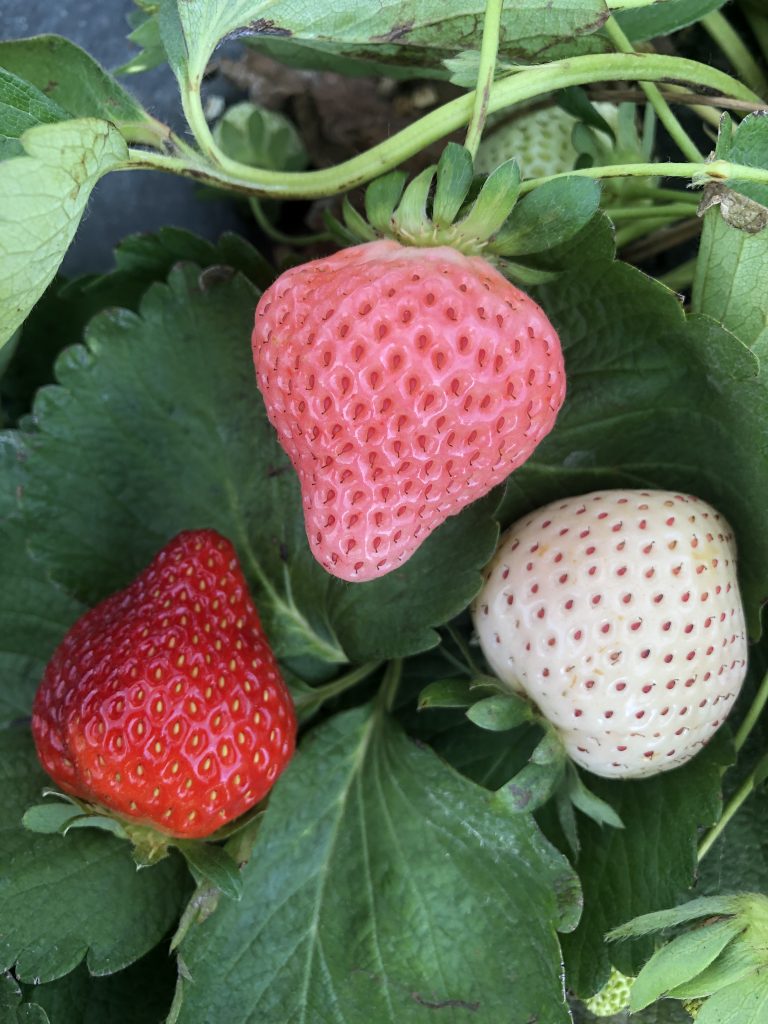
    Figure 1. A new University of Florida strawberry variety is white with a slight pink blush and red seeds when fully ripe. Photo credit: Cristina Carrizosa, UF/IFAS Communications

    The University of Florida will soon commercialize a new strawberry variety. It doesn’t have a name yet, but it is already drawing attention for a very unusual characteristic. When it is ripe and ready to eat, it is white inside and out, with a slight pink blush on the exterior and red seeds. The flavor is very different from a typical strawberry, sweet but with a pineapple-like aroma. White strawberries have been popular for some time in Japan, but this is expected to be the first white strawberry on the market in the United States.

    These unusual strawberries were not made in a lab. White strawberries are actually found in nature. Breeders have harnessed this naturally occurring trait, crossing white strawberries from the wild with modern strawberries to create something different in both appearance and taste.

    WHY IT’S WHITE

    The red color of the typical strawberry comes from pigments called anthocyanins. White strawberries produce much lower amounts of these compounds in their flesh than red strawberries. Recent research has shown that white strawberries of various types all have DNA sequence changes in a single gene called MYB10, which is involved in the synthesis of anthocyanins. These changes keep the gene from carrying out its normal function, essentially halting the chemical process in the fruit that produces red pigments.

    HOW IT WAS DEVELOPED

    In 2012, some strawberry seeds from fruit purchased in Japan were brought to the University of Florida. The seeds were sown, and a few small plants were recovered. The pollen from these plants were crossed with a Florida variety. The seedlings from this cross produced fruit that ranged from white to pink to red.

    Further crosses with Florida varieties were made, ultimately resulting in a strawberry with similar hardiness and fruit characteristics to modern varieties but with white color. Commercial trials have been promising so far. Pickers can tell when the fruit is ripe when a slight pink blush develops on the sun-side of the fruit, and when most of the seeds turn red. By 2022, these new white strawberries should be available in U.S. grocery stores.

    Figure 2. Florida strawberry varieties can be red, pink or white.
    Photo credit: Seonghee Lee
    STRAWBERRY SPECIES

    There are many different species of strawberry throughout the world, and white strawberries are naturally found within several of them.  

    Alpine Strawberry (Fragaria vesca)
    Alpine strawberries are in the species F. vesca, which is an ancient ancestor of the modern strawberry. In Europe, this strawberry is referred to as “fraises des bois” and is prized among food connoisseurs for its aroma. While most members of the species have red fruits about the size of a fingernail, the fruits of some Alpine strawberries are yellow to white in color. More information is available from the University of Florida at edis.ifas.ufl.edu/hs1326 on how to grow Alpine strawberries.

    Beach Strawberry (F. chiloensis)
    The beach strawberry is found in the wild along the Pacific coasts of North and South America. F. chiloensis is one of the most recent ancestors of the modern strawberry. Some of the beach strawberries found in South America are naturally white or pink. The fruit only grow about as large as a thumbnail and are very soft compared to modern strawberries. Some varieties of this species that are crossed between F. chiloensis and the modern strawberry (F. × ananassa) have been called “pineberries.” Some varieties of pineberries are available for home gardeners, but they are not large enough or firm enough to be produced and sold on a large scale.  

    Cultivated Strawberry (F. × ananassa)
    A white beach strawberry from Chile and another wild species from North America called F. virginiana with bright red fruits were collected by explorers and brought to Europe about 300 years ago. There they accidentally hybridized to produce the cultivated strawberry or “modern” strawberry, F. × ananassa, that we know today. Almost all the strawberries currently grown and produced in the United States are F. × ananassa. White cultivated strawberries have been bred for some time in Japan and sold at high prices as novelty items. However, white strawberries have not yet caught on as much in other areas of the world.

    See programs.ifas.ufl.edu/plant-breeding/strawberry for more information on University of Florida strawberry breeding and genetics.

  • Technology to Improve Vegetable Production

    Figure 1. Initial design of the low-cost robotic sprayer for precision weed control in vegetable production: main components of the smart sprayer (A) and self-reconfigured and self-adjustable design for easy field deployment in a variety of vegetable fields (B).

    By Yiannis Ampatzidis

    Vegetable growers face a variety of challenges, including pest and diseases, labor shortages and climate change. How can new advancements in technology help growers address these challenges? Can technology improve crops, reduce production costs and protect the environment? How can technological innovations be incorporated into traditional farming to improve production practices?

    In the last few decades, several “smart” technologies have been developed for vegetable production and processing. However, growers are confronted with a variety of challenges when considering adopting new technology or adjusting existing technology. Growers are being offered solutions that might not work in their specific production system or might not be economically feasible. This article presents examples of state-of-the-art technologies that may be used in vegetable production today or in the near future!

    SIMPLIFY SURVEYING

    Field surveys for disease/pest scouting and to assess plant stress are expensive, labor intensive and time consuming. Since labor shortage is a major issue in vegetable production, small unmanned aerial vehicles (UAVs) equipped with various sensors (remote sensing) can simplify surveying procedures, reduce the labor cost, decrease data collection time and produce critical and practical information.

    For example, recently UAVs and remote sensing have allowed growers to constantly monitor crop health status, estimate plant water needs and even detect diseases. The precision agriculture team (@PrecAgSWFREC) at the University of Florida Institute of Food and Agricultural Sciences (UF/IFAS) Southwest Florida Research and Education Center (SWFREC) developed a cloud-based application called Agroview (http://agroview.farm/login.php).

    Agroview can process, analyze and visualize data collected from UAVs and other aerial platforms (e.g., small planes and satellites). This technology utilizes machine learning (an application of artificial intelligence) to detect single plants and assess plant size and stress. Agroview and UAVs were initially used to create plant inventories in citrus (see a video demonstration at https://twitter.com/i/status/1202671242647490560) and to detect specific diseases in vegetables with high accuracy. Early detection and eradication of infected plants is crucial to controlling disease and pest spread throughout the field.

    SMART SPRAYERS

    Most conventional sprayers apply agrochemicals uniformly, even though distribution of pests and diseases is typically patchy, resulting in waste of valuable compounds, increased costs, crop damage risk, pest resistance to chemicals, environmental pollution and contamination of products. Contamination can be related to run-off after application, discharge from drainage and off-target deposition of spray due to wind (spray drift). This contamination can be significantly reduced through optimization of spraying technology.

    Spray drift of agrochemicals occurs during every application and accounts for a loss of up to 50 percent of the agrochemical used. Minimizing the negative impacts of agrochemicals (and spraying technologies) is a major global challenge.

    More than 90 percent of the acreage of crops in the United States are being sprayed with herbicides. It is estimated that $26 billion is spent on herbicides (more than 3 billion pounds) each year. This overuse of chemicals creates herbicide-tolerant weeds and approximately 250 known species of resistant weeds.

    In recent decades, several smart technologies have been developed for pest detection and for optimizing spraying applications. These new spraying technologies have shown an important improvement in efficiency and safety by adopting the latest advances in electronics, artificial intelligence (AI) and automation.

    One example is the See & Spray machine developed by Blue River Technology (www.bluerivertechnology.com) for weed control in arable crops. See & Spray utilizes computer vision and AI to detect and identify individual plants (such as cotton) and weeds and then applies herbicide only to the weeds. See how this technology works at https://youtu.be/gszOT6NQbF8. This machine can reduce the required quantity of herbicide by more than 90 percent compared to traditional broadcast sprayers. However, this technology was designed for arable crops and might not be a cost-effective solution for specific vegetable production systems.

    Another low-cost smart sprayer has been designed and developed by the UF/IFAS team for precision weed management in vegetables. In the initial evaluation experiments, smart technology was able to accurately detect and distinguish weeds from crops and apply chemicals only on specific weed(s), thus avoiding crops and areas without weeds. See a video demonstration of this technology at https://twitter.com/i/status/1045013127593644032.

    Recently, the precision ag team, in collaboration with Abhisesh Silwal (Carnegie Mellon University) and Panos Pardalos (UF), received funding from the U.S. Department of Agriculture and the National Research Foundation (award #2020-67021-30761) to improve and fully automate this smart sprayer. This novel robotic sprayer (or fleet of sprayers) was designed to be self-reconfigured and self-adjustable for easy field deployment (Figure 1). With this design, the robot can reconfigure itself (Figure 1b) to manage weeds in a variety of vegetable fields (e.g., with different row spacing and raised bed sizes).

    ROBOTIC HARVESTING
    Figure 2. Harvest Croo Robotics harvester for strawberries

    Fresh-market vegetables are quickly perishable and virtually 100 percent are hand-harvested. Vegetable growers face increasing shortages of laborers, which in turn, drive up harvest costs. Mechanical and robotic harvesting systems for vegetable growers could simultaneously decrease their dependence on manual labor, reduce harvesting costs and improve overall competitiveness in the market.

    In one example, Harvest Croo Robotics, a Florida company, is developing a robotic harvester for strawberries that does not require growers to radically change the way they currently grow crops. This technology successfully harvested berries during the 2019–20 season. It could address the labor shortage problem and increase grower profit. 

  • UGA, Georgia Department of Agriculture to Offer Digital Marketing Webinar for Agribusinesses

    With limited to no in-person contact with customers during the COVID-19 pandemic, for many growers, expanding online capabilities is crucial to business continuity. Join Georgia Grown and UGA Extension on June 17 for an e-commerce workshop featuring experts from the UGA Small Business Development Center.

    By Kelly Simmons for UGA CAES News

    The University of Georgia is partnering with the Georgia Department of Agriculture to present a free digital marketing webinar for agribusiness owners looking for alternate ways to sell their products.

    The webinar will be held on Wednesday June 17 at 10 a.m. by the UGA Small Business Development Center (SBDC), the Department of Agriculture’s Georgia Grown division and UGA Cooperative Extension.

    Agriculture-related businesses from across the state have had trouble getting their fresh produce, meat and seafood to market during the COVID-19 pandemic.

    The webinar will introduce participants to e-commerce, best practices for social and email marketing, and suggestions for packaging products for shipping.

    “We’ll provide good takeaways on ways to market their business online,” said Bill Boone, SBDC entrepreneur outreach specialist. “If they need additional help or resources to implement the techniques covered in the class, the SBDC is available to assist.”

    Additional webinars may be scheduled as needed, he said.

    Georgia Grown helps agribusiness thrive by bringing producers, processors, suppliers, distributors, retailers and agritourism together to increase their exposure to customers suppliers and partners through an online searchable database. Find out more at georgiagrown.com/find-georgia-grown.

    UGA Extension assists producers and consumers with information and resources through its network of county agents and specialists throughout the state. Visit the Extension website for more information at extension.uga.edu or call 1-800-ASK-UGA1.

    Registration for the webinar is required and available at georgiasbdc.org/marketing-georgia-grown-ecommerce.

  • UF/IFAS Appoints Interim Director of Fort Lauderdale Research and Education Center

    By: Lourdes Rodriguez, 954-577-6363 office, 954-242-8439 mobile, rodriguezl@ufl.edu

    DAVIE, Fla. – Jack Rechcigl has been appointed as interim Center Director of the UF/IFAS Fort Lauderdale Research and Education Center (UF/IFAS FLREC).  

    Jack Rechcigl. Photo taken 11-07-18.

    On May 12, Rechcigl stepped in to oversee the operations and research at the UF/IFAS Fort Lauderdale Research and Education Center, previously led by retiring center director Robin Giblin-Davis. Giblin-Davis, who first took the helm of the facility in 2009 as acting co-director, transitioned in 2017 to serve as sole acting center director. He is an internationally celebrated scientist, whose area of study has been applied and basic research concerning soil, plant-parasitic and insect-associated nematodes and nematode biodiversity. He retires as an emeritus professor after 35 years at UF/IFAS.

    “My role as Center Director is to support and mentor the award-winning scientists, faculty and graduate students who are dedicated to solving the local and regional agricultural, urban and wildlife issues that comprise southeast Florida’s unique make-up, while continuing the mission of FLREC,” said Rechcigl. “The caliber of research conducted by these dedicated scientists is impressive and addresses the unique needs and issues that growers and community residents face in South Florida’s combined agriculture and urban environment.”

    Areas of research at FLREC include sustainable management for tropical and subtropical landscape systems. Scientists also aim to reduce the impact of invasive animals and plants on natural and highly urbanized habitats. Other areas of research include termite identification and distribution, wildlife ecology and conservation, palm production and maintenance, environmental horticulture, aquatic plant management, turfgrass science and sea level resilience in South Florida.

    As interim Center Director, Rechcigl will serve double duty. As an internationally recognized professor in the soil and water sciences department at UF/IFAS for the past 34 years, Rechcigl served as the lead architect of the programs and is the current Center Director of UF/IFAS Gulf Coast Research and Education Center (GCREC) in Balm, Florida. since 2005. The state-of-the-art center operates from two sites. The 475-acre main facility in Balm, located in southern Hillsborough County, hosts most of the center’s research activities, including laboratories, field and greenhouse studies, a diagnostic lab, faculty offices and graduate student housing. The other site is home to the GCREC teaching program (UF/IFAS CALS), based at Hillsborough Community College’s Plant City campus. He currently oversees 200 employees, which includes faculty, biological scientists, staff, undergraduate and graduate students and international interns.

    Historically, GCREC has been recognized as a premier research site with efforts since the mid-1920s in tomato, strawberry, vegetables, ornamentals and landscape crops. Over the last 20 years, Rechcigl has led the charge with faculty members in making substantial contributions for the continued production and health of these industries, as well as exploring new opportunities and alternative crops for the region that include pomegranate, blackberry, industrial hemp and hops. Rechcigl has established the highly successful Florida Agricultural Expo, which is attended by 1,000 farmers, politicians, government and university officials from around the country each year.

    Research at GREC has also been focused on improving sustainability through the development of precision agricultural technology. Some examples include tractor software that can distinguish crops like tomatoes and strawberries from weeds for precise herbicide application and the use of ultraviolet light to treat and prevent Powdery mildew (Sphaerotheca macularis) on strawberries.