Category: Strawberry

  • Expected Temperature Drop in N.C. Leads to Extra Protection for Strawberries

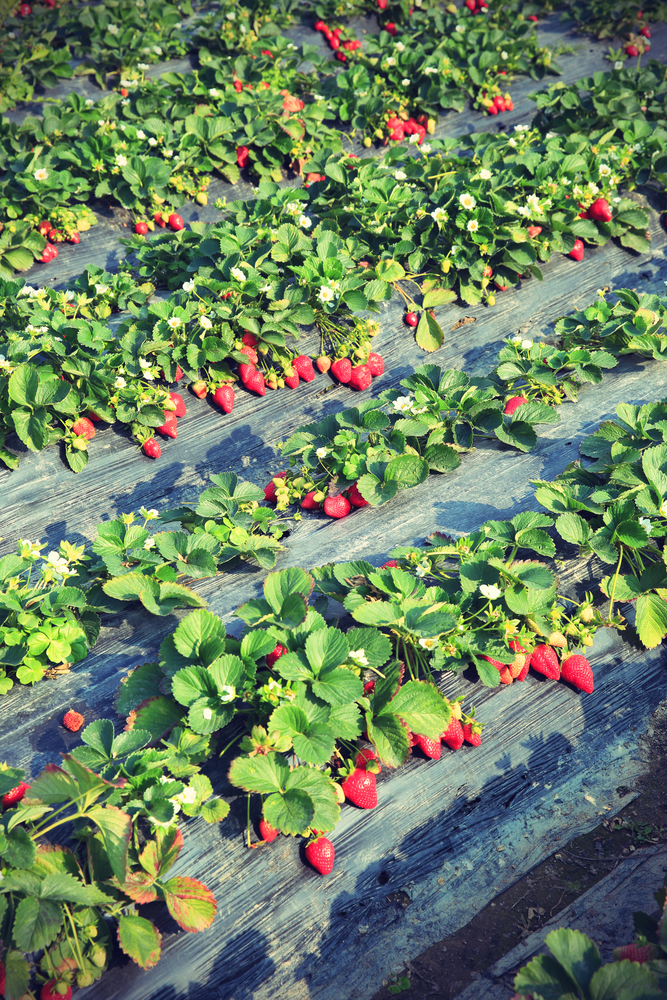
    A file photo shows a strawberry field.

    By Clint Thompson

    Potential freezing temperatures this weekend in North Carolina could impact strawberry production. Unless farmers utilize row covers for protection.

    According to Mark Hoffmann, North Carolina State small fruits Extension specialist, row covers, which help reduce radiation in the field should provide adequate frost protection from temperatures in the 30s on Saturday and Sunday.

    “It looks like in most areas, what’s happening is that if the wind slows down Saturday night to Sunday and we have no cloud cover, that’s probably the most critical time. When it’s Sunday morning and still dark and there’s a lot of radiation, that’s probably the most critical time. With row covers, they will be safe,” Hoffmann said.

    Low Temps

    According to weather.com, temperatures are forecast to drop to as low as 39 degrees on Sunday morning in Raleigh, North Carolina. Temperatures that low are abnormal this late into May for that part of the world.

     “It’s pretty late. I wasn’t expecting it. We were not recommending taking the covers out of the field because we had seen such odd weather patterns this year. It’s very, very late,” Hoffmann said. “Most of the growers had taken their row covers out of the field. They have to put them back in over this weekend.”

    Strawberry production is currently in mid-season. If row covers are not used, the low temperatures could harm the open blossoms that are still on plants, which lead to late-season fruit. Temperatures could also harm the actual fruits in popcorn stage and other green fruits.

    The drop in degrees this weekend could also impact the state’s grape production.

    “This is the third frost event to affect grapes this year already. Usually they grow out of it. This is pretty late in the season again. Unless you have a sprinkler system or wind machine, there’s not a lot you can do, unfortunately,” Hoffmann said.

  • Be Careful How You Store Certain Fruits, Vegetables

    Peaches are sensitive to cold temperatures.

    By Clint Thompson

    University of Florida post-harvest plant physiologist Jeff Brecht cautions consumers about putting some fruit and vegetables in their refrigerators. Quality commodities like tomatoes, melons, avocados and peaches are chilling sensitive. Consumers need to be wary that too much cooling can affect the quality of certain produce.

    “I hear complaints about all of those where people say, ‘They’re tasteless. They’re not like I remember in the garden when I grew up.  They don’t have flavor.’ What it really is, those are all chilling sensitive, and they’ve been exposed to low temperatures for too long. They stop producing the aroma,” Brecht said. “The aroma is a super important component of flavor. That’s what it really is when you hear people complain about tasteless tomatoes is because they’ve been chilled. It’s a big problem that we have.”

    Clearing Up a Misunderstanding

    Brecht said there is a misunderstanding on the part of consumers about how best to handle different fruits and vegetables when they have them in their possession. Many of the vegetables can be injured by exposure to temperatures that are too low. Sensitivity is especially a concern for immature produce.

    “You can keep them too long in your refrigerator because you’ll actually start to compromise the quality,” Brecht said. “Even though I preach cooling, cooling, lower the temperature to maintain the quality, there’s a whole lot of fruits where you can’t go too far with that. That limits what you can do to keep them in good shape after harvest. You can’t cool them right down to 32 degrees or something like that, which you can do with a strawberry.”

    He also encourages consumers to buy local as much as possible. They’re not only providing much-needed business for producers amid tough financial times, they’re also getting fresher fruit.

    “Consumers are getting even better quality that way because they’re going to pick it up at the farm, take it home and probably eat it within a day or two. I would encourage people to patronize the direct sales farming operation to whatever extent they can,” Brecht said.

  • USDA Report Yields Results for 2019 noncitrus/nuts season

    Georgia’s pecan crop accounts for 29% of the nation’s production.

    By Clint Thompson

    The United States Department of Agriculture National Agricultural Statistics Service released its findings for noncitrus fruits and nuts in the Southern Region for the 2019 crop year. These estimates were based on grower surveys.

    Avocados: Florida’s production of avocados was up 88% from 2018. Its value of production was up 54%. Yields rebounded in 2019. Utilized production for the 2019 crop year was 25,540 tons.

    Blueberries: Georgia led the nation with 21,700 harvested acres in 2019. Utilized production was up 76%, and value of production was up 52% from 2018’s hurricane-damaged crop. Georgia produced 95,900 pounds. Utilized production in Florida was up 16%, while value of production was up 3%. Florida produced 24,200 pounds.

    Peaches: In Georgia, utilized production was up 44% and value of production was up 58% from the crop in 2018. Georgia utilized 33,780 tons of production. South Carolina’s utilized production was up 8%, while value of production was up 20%.

    Pecans: Georgia’s pecan crop accounts for 29% of the nation’s production. It had a 4% increase in utilized production and a 21% increase in value of production in 2019. The lingering impact from Hurricane Michael in 2018 and the dry summer in 2019 impacted the crop. Georgia produced 73,000 pounds.

    Strawberries: Florida’s utilized production was down 18% from last year, while its associated value of production was up 9%.

    For more information, see full USDA report.

  • A Berry Good Deed

    Story is from N.C. State College of Agriculture and Life Sciences News website.

    May 6, 2020  |  Dee Shore

    With unemployment rates hitting record levels in the United States and North Carolina, hunger-relief agencies and nonprofit organizations are encouraging donations. At NC State, Extension Small Fruit Specialist Mark Hoffmann is heeding the call.

    For each of the past three weeks, Hoffmann has harvested between 75 and 100 pounds of strawberries from his experimental plots in Clayton and delivered them to the Inter-Faith Food Shuttle Farm along Tryon Road.

    The need is greater than we have ever seen as an organization.

    Farm Manager Kayla Clark says the donation meets an important and timely need in central North Carolina, contributing to the food shuttle’s efforts to end hunger in Wake, Durham, Johnston, Orange, Chatham, Nash and Edgecombe counties.

    The food shuttle provides not only shelf-stable food but also healthy, fresh produce, and the organization has been “low on produce these days,” Clark says.

    “With the unemployment rate rising so quickly, the need is greater than we have ever seen as an organization,” she says.

    The organization is delivering the strawberries through its Mobile Markets and Grocery Bags for Seniors programs.

    Solving problems for growers and others

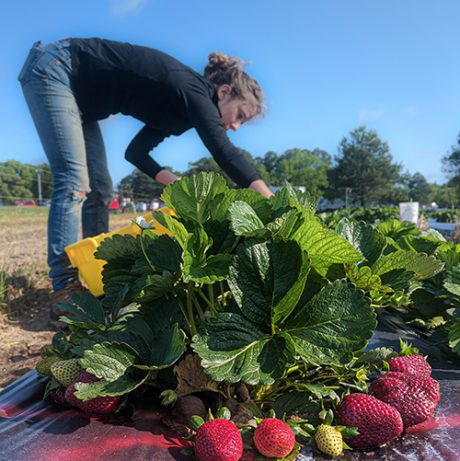
    Woman picking strawberries at a research station
    Technician Emma Volk examines strawberry plants at the Central Crops Research Station in Clayton.

    Hoffmann passes the nonprofit’s farm on his way home from work, where he conducts research and extension education programs aimed at helping growers improve the economic and environmental sustainability of their farms. It occurred to him that donating the berries to the food shuttle would mean that they would benefit not just those growers but also families and individuals hard hit by the economic downturn associated with the COVID-19 pandemic.

    A warm winter set the stage for a strawberry season that’s the best the state has seen in years, Hoffmann says. Production has hit its stride, and the crop has been both beautiful and bountiful.

    In fact, the harvest has been so good that Hoffmann wasn’t sure what he could do with hundreds of pounds of strawberries he’s been harvesting from his research plot at the Central Crops Research Station.

    We have a bumper crop …, and I didn’t want to throw them away.

    Normally, Hoffmann and his associates would distribute the berries to others on campus to acknowledge their support of the university’s small fruits team and their research and Extension work.

    “The strawberries were really good this year, and the season has gone well so we have a bumper crop. It’s a lot of strawberries, and I didn’t want to throw them away and didn’t see any other option,” Hoffmann says.

    “I’m actually eating strawberries every day right now, but they’re way too many strawberries for me to eat by myself,” he adds. “Even if I could distribute them among my students, there’d still be too many left over.”

    Small but important

    Hoffmann expects the crop will amount to 450 to 550 pounds – a small fraction of the 6 million pounds of food that the food shuttle distributes each year to people with low incomes.

    Still, Clark says the donation makes a significant difference – and so does the advice he’s provided the farm on managing and expanding its muscadine grape operation.

    Clark says she’s happy “that our neighbors in need will be able to enjoy the freshest and sweetest strawberries that they possibly could.”

  • N.C. Small Fruit Producers Be Ready for Colder Temps

    File photo shows muscadine grapes. North Carolina producers need to be ready for colder temperatures.

    North Carolina strawberry and grape producers need to be wary of colder temperatures this week, according Mark Hoffmann, North Carolina State Small Fruits Extension Specialist, in his message to producers.

    Temperatures will fall significantly this week, with a slight chance of rain in North Carolina on Friday and Saturday, and clouds coming in from the Northwest. These weather conditions will lead to minimum temperatures below 40 degrees during the night from Saturday to Sunday in the mountains and wide areas of the Piedmont.

    Hoffmann said to check your local weather if you are in an area that can get a lot of frost. If there is a chance of frost, please use row covers to protect your blooms from Saturday to Sunday.

    Please see here on how to manage frost damage.

  • N.C. Strawberry Association President: Overall, the Crop Looks Good

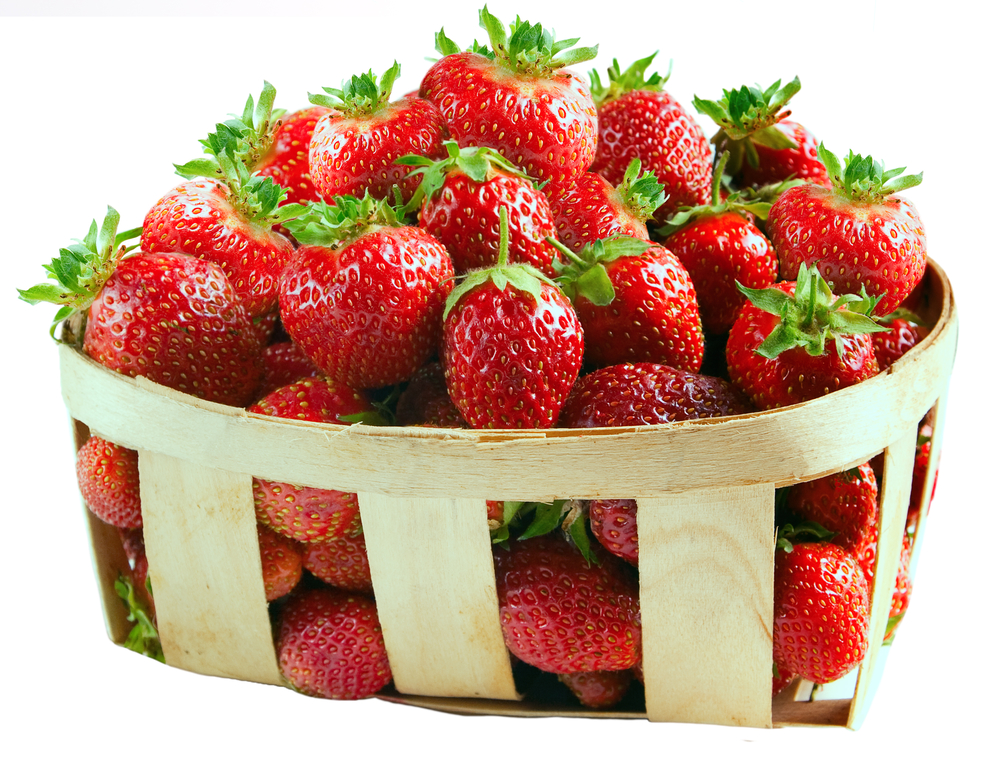
    Basket with fresh strawberries isolated on white background.

    By Clint Thompson

    The president of the North Carolina Strawberry Association is excited about this year’s crop.

    Jim Warenda, who is also the sales representative for Fresh Pick Produce in Kenly, North Carolina, exuded optimism when discussing the prospects of this year’s crop.

    “Everything’s great. We are a hair behind, just due to, it’s been a little bit cooler spring than what we’re normally used to,” Warenda said. “A normal strawberry flower will ripen in about 30 days. They’re ripening at about 37, 38 right now.

    “We’re probably a couple of days behind on some things. Overall, the crop looks good. We really haven’t hit any real big volume yet. We foresee that happening (this) week.”

    He said the normal window for harvesting strawberries is April 20 through June 15.

    Warenda is not alone in having hopes for this year’s strawberry crop in North Carolina. In a previous VSCNews story, Mark Hoffmann, North Carolina State small fruits Extension specialist, said he is expecting a “bumper crop” this year.

    “If the weather holds up, it’s going to be one of the best strawberry years in a long time,” Hoffmann said.

    While the crop appears bountiful, the strawberry market appears in good shape as well. This despite the ongoing coronavirus pandemic.

    “We do some chain store business as well as roadside market stuff in the northeast. There has been a little bit of a decline in market, just because they’ve closed off some of these islands for this month. We haven’t really hit any volume yet, so everything’s been smooth so far. I don’t foresee any hiccups in the next couple of weeks. But this produce business can always change,” Warenda said.

    For more information about strawberry production in North Carolina, see N.C. State strawberry website.

  • Georgia Farmer Thinking Inside the Box

    Workers at Lewis Taylor Farms pack boxes with fresh produce.

    By Clint Thompson

    One South Georgia farmer is thinking inside the box when it comes to moving this year’s fruit and vegetable crop.

    Like his brethren in Florida, Bill Brim’s farming operation has been impacted by the orders of self-quarantine amid the current coronavirus pandemic. The lack of a foodservice market led to a sharp decline in demand for fresh produce including those grown at Lewis Taylor Farms in Tifton, Georgia, where Brim is a co-owner.

    With excess fruit and vegetables, Brim decided to offer boxed fruit to consumers in the South Georgia area. Brim was overwhelmed by the response last week.

    “We just started last week. We did like 350, I think. Next week we’ve already got over 700,” Brim said. “It’s crazy. We could wind up with 1,000 before it’s over with. We’re looking forward to it because we need to move some produce. We’re so far down on greens and stuff like this. Our revenue stream has come to nothing because of the coronavirus.”

    What’s offered?

    Last week, Brim offered collard, kale, zucchini, onion, strawberries and broccoli. People drove to Lewis Taylor Farms on Wednesday and received their produce without getting out of their car.

    Fresh produce in a box ready to be sold in Tifton, Georgia.

    “They lined up out here. We had masks on and gloves on and toted it to the car. They dropped a $20 bill into a box and kept going,” Brim said. “It makes you feel good to know that people in this country are like that. But everybody wants fresh produce, too, and this is a good way for them to get it.

    “We’re just trying to generate some income because we’re so way down.”

    Brim said this marketing outlet is not set up for all farming operations. It is hard to capitalize on unless you are big enough and have got enough product and different kinds of products. This week’s box will feature turnips, broccoli, yellow squash, onion, blueberries and cabbage.

    Brim is not a blueberry farmer, but he is a staunch supporter of other growers like himself. He buys blueberries from another producer in Lakeland, Georgia.

    “We like to use all of our product, but you’ve got to change it up a little bit,” Brim said.

    Watermelon, cantaloupe, eggplant, cucumber and bell pepper could be included as well, once they’re ready for harvest..

    To place an order for this week’s box, fill out an order form. All orders must be placed by Sunday night.

    Lewis Taylor Farms grows more than 6,500 acres of produce each year.

  • Alabama Farmer: If I Had 10 Acres of Strawberries Today, I Wouldn’t Have Enough

    There appears to be not enough strawberries to satisfy local demand in Alabama.

    Strong demand for locally-owned strawberries

    By Clint Thompson

    Strawberry season is in full swing in Alabama. Unfortunately, for farmers, they don’t have enough product to satisfy local demand.

    “If I had 10 acres of strawberries today, I wouldn’t have enough. Saturday morning, about 10 o’clock, I had 82 phone calls and I just unplugged my telephone,” said Bobby Ray Holmes, part-owner of Holmestead Farm in Talladega, Alabama.

    Holmes usually doesn’t have any problem selling strawberries. But this year the demand has been overwhelming. This is due to the coronavirus pandemic. U-pick strawberry operations provide families an outlet to escape the new norm of social isolation.

    “All of the strawberry farmers have run out of product because all of these people are home and can’t go anywhere. So, they go and pick strawberries,” said Holmes. “(Families) say, we can go to the farm. People are pinned in. They want somewhere to go. The kids are all out of school. They want somewhere to take the kids.”

    John Aplin, owner of Aplin Farms in Slocomb, Alabama, echoes Holmes’ sentiments.

    “I’ve never seen anything like it. It’s been crazy. Every year we increase our strawberries to meet demand,” said. “We doubled our strawberries this past year. When I opened the U-pick strawberries, we can’t stay open over four hours. Then we have to close for three days and let them ripen back up.”

    Holmes estimates that he has 1.5 acres of strawberries or approximately 30,000 plants. He said the three or four other farmers are facing the same scenario this year; they don’t have enough strawberries.  “They’ve got the same problem,” Holmes admits.

    “Anytime it’s a problem if you’ve got folks that want to spend money with you, and you don’t have something to sell them. You’ve got a problem,” Holmes said.

  • N.C. State Specialist: Bumper Crop in Strawberries This Year

    By Clint Thompson

    The country’s No. 3 state in strawberry production is expecting a “bumper crop” this year, according to Mark Hoffmann, North Carolina State small fruits Extension specialist.

    Basket with fresh strawberries isolated on white background.

    “If the weather holds up, it’s going to be one of the best strawberry years in a long time,” Hoffmann said. “It’s a bumper crop right now.”

    Hoffmann made the comments before Thursday when a cold front moved through the area. Up until this week, though, the weather had been ideal for strawberry production.

    “We had good weather. We had a relatively mild winter. We didn’t have a lot of frost going on, just a few events where we had to cover. We’ve had a pretty good year so far, for strawberries,” Hoffmann said.

    While the crop appears to be bountiful, there is some uncertainty regarding sale of fruits and vegetables amid the ongoing coronavirus pandemic. Hoffmann appears confident his state’s strawberry producers will not have problems selling their crop.

    “With the whole COVID-19 situation, it’s very different right now. It looks like operations that can sell directly to customers, the direct-to-customer sales is something that’s picking up right now,” Hoffmann said. “Right now, I don’t think there’s a problem getting strawberries a home.”

    Hoffmann estimates that strawberries in North Carolina generates $26 million per year, which makes it the third largest in the country behind California and Florida.

    “It’s a great industry. I would say in the Southeast, it has a very good infrastructure. We have wholesalers and shippers. We have growers that have more than 100 acres. One has 150 acres of strawberries,” Hoffmann said. “I would estimate we have 300 to 400 growers in the state.”

    For more information about strawberry production in North Carolina, see N.C. State strawberry website.

  • Two More Days of Potential Frost in North Carolina

    By Clint Thompson

    Pictured are ripe strawberries.

    Mark Hoffmann, small fruits Extension specialist at N.C. State University cautions strawberry growers about upcoming cooler temperatures that could impact fruit production.

    Hoffmann issued the caution earlier today as potential frost events could occur Thursday and Friday.

    “We are not out of the woods. Conditions are calling for one or two more potential frost nights in North Carolina,” Hoffmann said. “Additionally, rain last night and this morning might have made your row covers wet and heavy. However, tonight and tomorrow call for potential frost damage again and you might require frost protection! If you can, dry your row -covers before using them tonight.”

    According to AWIS Weather Services, temperatures are expected to drop to as low as 36 degrees on Thursday and Friday mornings in Raleigh, North Carolina where N.C. State is located.