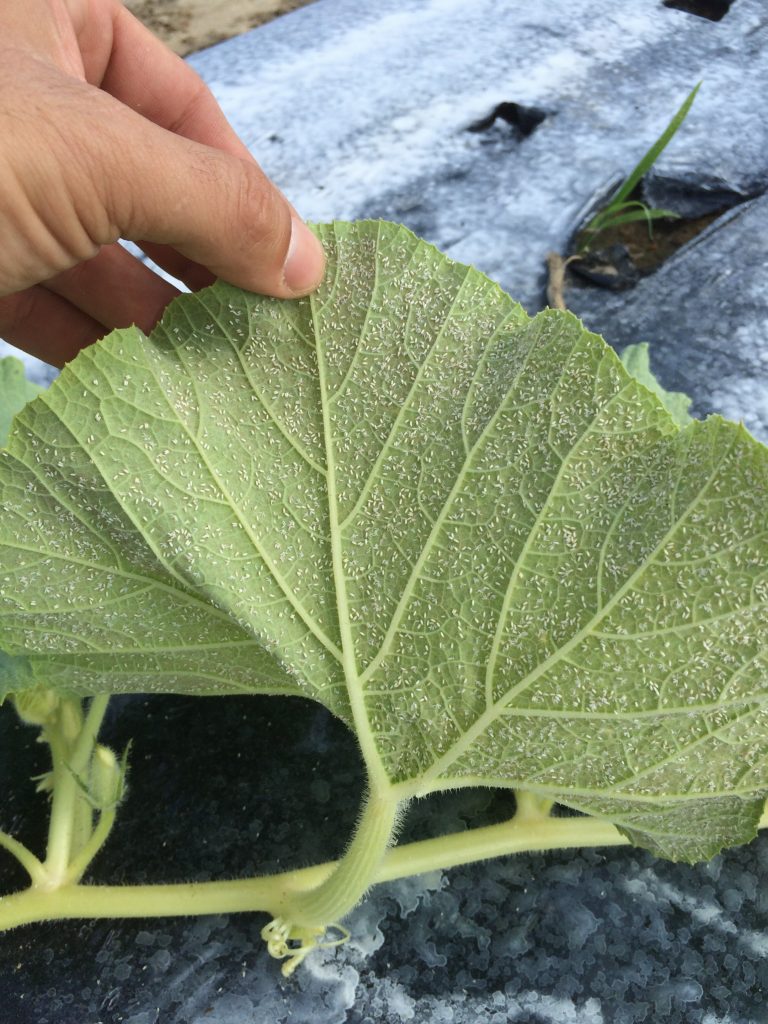
File photo shows downy mildew disease on watermelon.
According to the The South Carolina Grower, downy mildew disease was found Wednesday in one watermelon field in Bamberg County, South Carolina.
Justin Ballew, Clemson Extension commercial horticulture agent, said all growers should immediately spray watermelon with Ranman, Revus, or Gavel to protect their crops from the disease. In addition to direct yield loss, loss of vine cover can expose fruit to sunburn. Growers who find downy mildew in a field should apply Orondis Ultra or Orondis Opti in a weekly rotation with Ranman or Gavel.
According to a previous UGA news release, the downy mildew pathogen thrives in wet, humid conditions and needs moisture on the surface of the plant for successful spore germination and further infection.
Cucurbit crops — like cucumbers, melons, squashes and pumpkins — are susceptible to the disease.
UGA file photo/Shows watermelons being researched on the UGA Tifton Campus. 6–6-17
By Clint Thompson
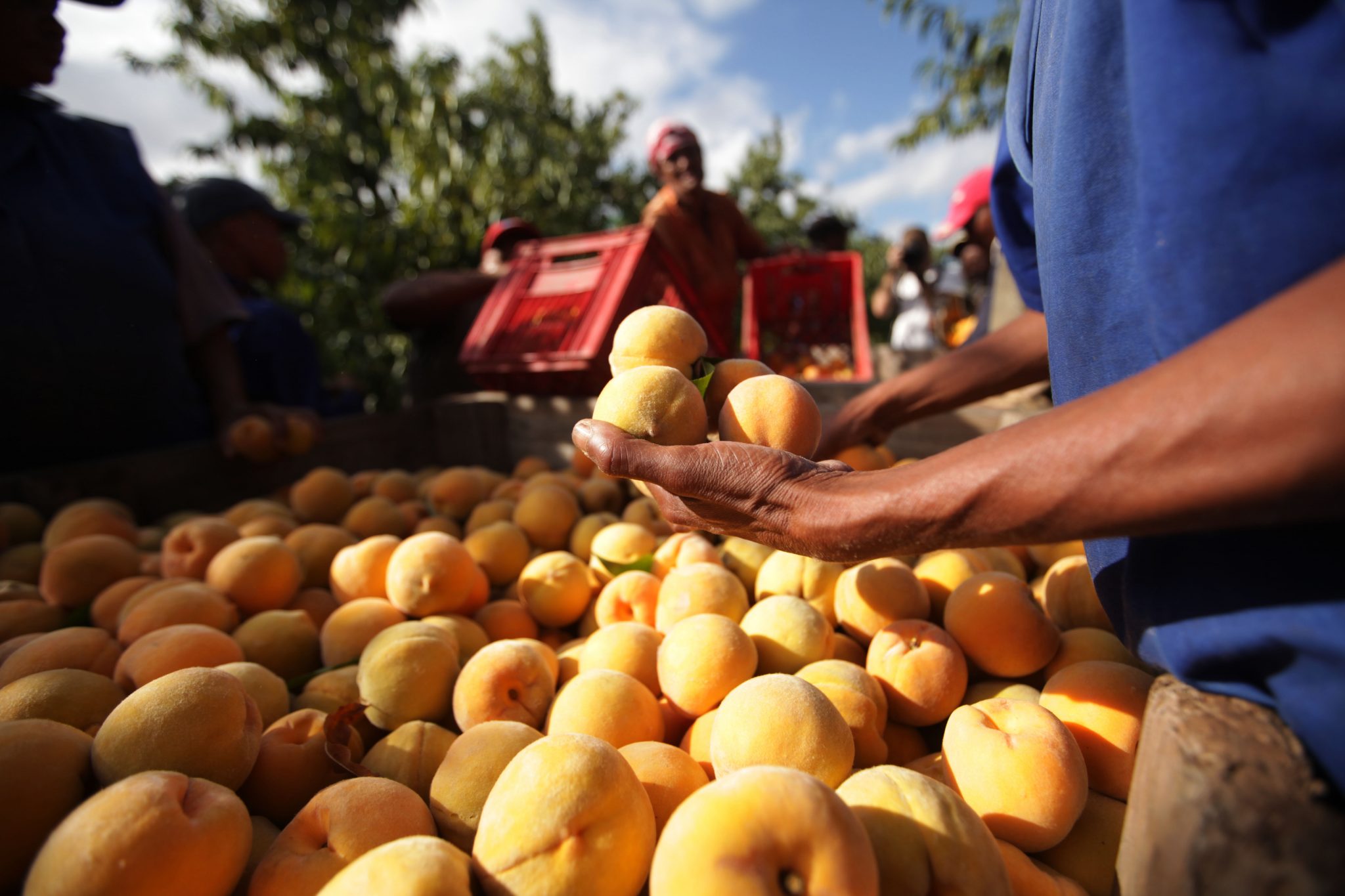
Watermelon prices are holding strong for Southeast farmers, according to one South Georgia producer. Terrell Rutland believes extenuating circumstances could help extend the strong market, currently at 20 cents per pound, for growers an extra few weeks.
“Anything north got frost bit about the first of May. Florida is through so that kind of puts us in the driver’s seat right now,” said Terrell Rutland, who grows 50 acres in Tift County, Georgia and Cook County, Georgia. “Every year, the very first people to pick in Georgia might get 20 cents, but generally, the majority of the crop is sold around 15 cents. It’s good in that respect.”
It’s especially good for Southeast farmers since it appears their melons are the only game in town right now.
“(The Carolinas and the Midwest) always plant three or four weeks behind us but this year they planted, go two or three weeks and the frost killed them, and they planted again. That threw them another three weeks behind. I really wouldn’t be surprised if we don’t get some imported melons to catch some slack up,” said Rutland.
He began harvesting this year on June 4, the earliest he’s ever started.
“When they put on, they grew. They made melons quick. It was kind of shocking, I’ve never had none to grow off that quick. About half of mine, I do put on bare ground and I put about half of them on plastic. The bare ground melons are not ready yet. The cold really affected them a lot worse than it did the ones that were on raised plastic,” Rutland said.
Rutland expects to harvest three days per week through July 4.
Decrease in Acreage
Acreage is down in Georgia this year. According to Samantha Kilgore, executive director of the Georgia Watermelon Association, acreage is projected to decrease this year to 19,000 acres. It would mark a significant drop from previous years’ harvests. According to the National Agricultural Statistics Service, from 2016-2018, Georgia averaged a harvest of just more than 23,000 acres.
Rutland already projects additional acres next year, however.
“It’ll probably be many folks who want to grow watermelons next year where you can’t sell them for a dime a pound. It’s the way that usually works,” Rutland said.
WASHINGTON, D.C. – The U.S. Department of Agriculture (USDA) announced today that it has purchased more than $2.2 billion of meat, fruits, vegetables, specialty crops and dairy products in fiscal years 2019 and 2020 in its ongoing efforts to feed people in need and assist American farmers and ranchers suffering from damage due to unjustified trade retaliation by foreign nations.
Perdue
USDA is on target to reach its fiscal year goal of about $1.4 billion of trade mitigation purchases in the next phase of fiscal year purchasing, which ends Sept. 30. The purchases were made through the Food Purchase and Distribution Program (FDPD), one of USDA’s three programs in its Support Packages for Farmers. Most of the food purchased is provided to states for distribution to nutrition assistance programs such as The Emergency Food Assistance Program and child nutrition programs.
“Over the past two years, USDA has issued more than $2 billion in payments to American farmers, ranchers and producers for U.S.-grown food that is used to help Americans in need,” said U.S. Secretary of Agriculture Sonny Perdue. “Early on, President Trump instructed USDA to make sure our farmers did not bear the brunt of unfair retailiatory tariffs. Our farmers work hard and the most productive in the world, and we crafted the FPDP to help protect them. The FPDP represents just one of the many ways USDA is working hard to fulfill its mission to do right and feed everyone.”
According to this week’s edition of The South Carolina Grower, Clemson Extension agents responded how different crops are progressing this production season.
Coastal
Zack Snipes reports, “It’s the time of year when crops are starting to look ugly. We are in the middle of tomato harvest and it seems to be a pretty good crop this year. Bacterial spot is starting to spread up the plants due to a heavy fruit set, perfect weather, the inability to spray, and constant handling by pickers. Keep up with spray programs as the last few weeks of development are critical to size and taste. Rabbiteye blueberries are coming in strong right now and look really good with the occasional berry having Exobasidum. Stink bug pressure has been very high this year and I’m seeing damage on a multitude of crops.”
Rob Last reports, “In our area, we are seeing some good quality watermelons and cantaloupes coming to harvest. We are seeing some manganese toxicity related to low pH in both crops. Also given the sporadic storms we have seen leaf potassium levels have been lower than ideal. It would be recommended to monitor tissue nutrient levels and adjust fertilizer applications accordingly.”
Midlands
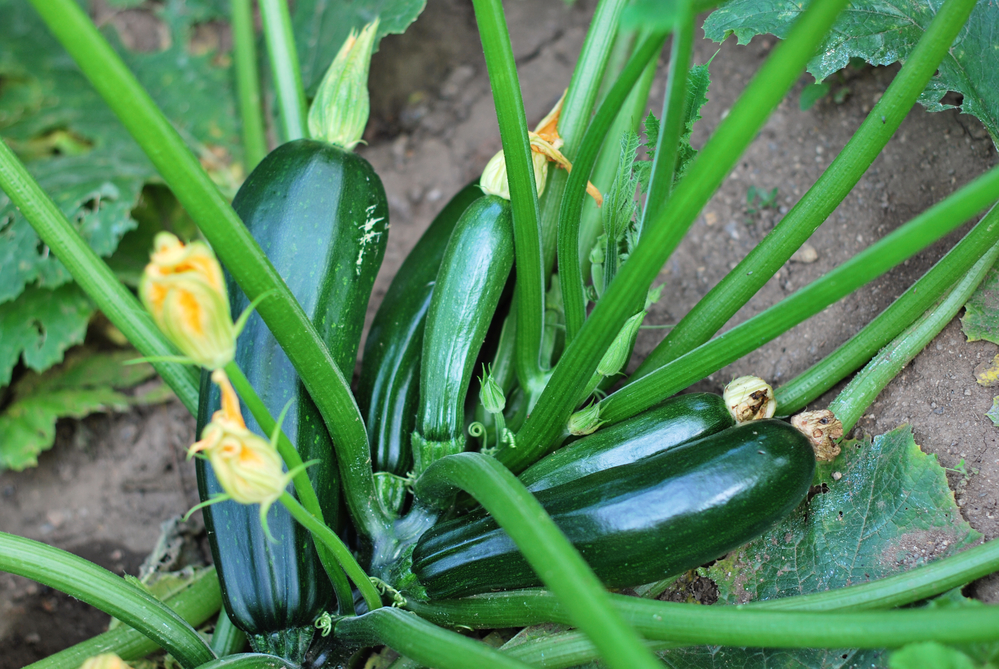
File photo shows zucchini plants.
Justin Ballew reports, “We got a little much-needed rain last week. Crops are developing quickly and growers have started harvesting the oldest planted sweet corn as well as squash, zucchini, cucumbers, beans, and what’s left of spring brassicas. Cucurbit downy mildew has not yet been found in the midlands, but it probably won’t be long. Keep applying preventative fungicides.”
Sarah Scott reports, “Peach season is in full swing. Bacteriosis and brown rot continue to show up in many fields. Warm temperatures during an extended bloom period as well as rain and cold at critical times in the early season are likely the culprits for these issues.”
Pee Dee
Bruce McLean reports, “Cucumbers are being harvested in good numbers. Squash and zucchini yields are increasing. Sweet corn will be ready to begin harvest in a few days. Disease pressure is increasing in cucumbers, primarily Cucurbit Downy Mildew (CDM). CDM has caused significant damage and severely reduced the crop in two locations. Forecasted rains for the next 7-10 days will make it extremely difficult to spray fungicides (as well as applying insecticides, herbicides, and fertilizer). Fruit crops are being negatively impacted by the weather, as well. Reduced fruit quality is caused by increased disease pressure and wet field conditions. And, the forecast over the next 7-10 days is for more rain.”
Tony Melton reports, “Cucurbit downy mildew is increasing rapidly with the rain, glad we started spraying Ranman or Orondis 2 weeks ago. With the rain, ponds have returned to our fields. As one of my vegetable farmers said “Not a good year to be in the Pee Dee vegetable business.” Hundreds of acres of beans, squash, cucurbits, and peas have drowned. Farmers are probably tired of me saying “Potassium Phosphide will help.” Regretfully, on brassicas, the yellowed margined beetle has become established in the Pee Dee, and downy mildew is awful. However, sweet potatoes are growing like a weed (its close kin morning glories).”
Florida Producer Sounds Off on Lack of Category 1 Status in CFAP
By Clint Thompson
Blueberries were left out of Category 1 status in CFAP.
While the blueberry industry was surprised as to how it was not eligible for Category 1 status in the Coronavirus Food Assistance Program (CFAP), one Florida grower remains equally as dumbfounded.
“I was shocked when it came out. I was literally like, jaw on the ground, going how did we get left out of this deal?” said Ryan Atwood, who lives in Mount Dora, Florida and is one of the state’s blueberry leaders. “It wasn’t a great year for us. And then to get left out of Category 1, it was really like salt in the wound.”
Had crops that suffered a five percent-or-greater price decline between mid-January and mid-April as a result of the COVID-19 pandemic,
Had produce shipped but subsequently spoiled due to loss of marketing channel, and
Had shipments that did not leave the farm or mature crops that remained unharvested.
Blueberries Not Included
However, blueberry farmers were not included in Category 1 status, like many other specialty crop commodities, such as almonds, beans, broccoli and cabbage for example. Atwood insists that Category 1 is where most of the farmers were impacted when the coronavirus pandemic hit in mid-March.
“For Florida blueberry growers, we got screwed man. We got left out of Category 1. What that was, they compared the average price of blueberry sales. But the problem is, the government, not knowing what they were doing, compared April 6 to the 10, to January 6 to the 10. Well, January 6 to 10 is the peak of the Chilean imports season. The whole United States is flooded with blueberries at that time. The Florida season, historically, we’re on the fringe edge of when North America starts. We’re in a good spot, usually,” Atwood said. “If you look at historically, we were off as much as 50% on the average price of our sales during a good part of our season. They blew it man, I don’t know how else to say it. We’re hoping that we get put back in it on Category 1.”
Comment Period
When the USDA issued CFAP on May 21, it allowed for a comment period. This could lead to amendments being made to the guidelines set forth for blueberry producers. That is what industry leaders are hoping for.
Atwood farms 56 acres of blueberries, manages another 350 acres and is part-owner of the largest packing house in the Southeast United States. He said the market impact from the pandemic was where he suffered the most.
“For me personally, I can’t speak for everyone in the industry, I picked all of my fruit, it was just that price was not good,” Atwood said. “It all stacked up in the coolers for 7 to 10 days until people started to figure out that life wasn’t ending, and they could go to work. By the time the world went back to normal, there was a surplus of everything out of there. Unfortunately, when that happens, that’s the only way to move that surplus from the marketer side of it, they just lower the price.”
USDA is accepting applications through August 28, 2020. Learn more at farmers.gov/cfap.
Was your crop not eligible for the Coronavirus Food Assistance Program (CFAP), or COVID-19? There is still a chance to try to get that crop on the list of eligible commodities. (Stephanie Ho and Latrice Hill, FSA Director of Outreach)
U.S. Secretary of Ag Sonny Perdue understands the quick turnaround needed for farmers looking to benefit from the Coronavirus Food Assistance Program (CFAP). Especially for those producers in Florida. Some are already thinking about next season and need CFAP funds in place to proceed accordingly.
“Cash flow’s critical. When this food service industry stopped, it just stopped. It put a real dent in a lot of people’s revenue stream. They had produce packed and ready to go. Orders were cancelled. It was a problem,” Perdue said. “But again, I think (CFAP) will help. It’s very important that people come on in and apply so we can get the money to them as quickly as possible.”
CFAP payments are already being issued. The USDA Farm Service Agency (FSA) began taking applications May 26. The agency has received over 86,000 applications for this important relief program.
According to farmers.gov, FSA will accept applications through August 28, 2020. Through CFAP, USDA is making available $16 billion in financial assistance to producers of agricultural commodities who have suffered a 5%-or-greater price decline due to COVID-19 and face additional significant marketing costs as a result of lower demand, surplus production, and disruptions to shipping patterns and the orderly marketing of commodities.
In a previous VSCNews story, Florida farmer Paul Allen talked about leaving 2 million pounds of green beans and about 5 million pounds of cabbage int he field. All because of limited marketing opportunities. The coronavirus also impacted commodity markets, as Florida blueberry farmer Ryan Atwood attests.
No evidence indicates that livestock, crops, or products handled by workers involved in production agriculture are sources of COVID-19 infection. However, close contact with coworkers may contribute to spreading the virus.
The Centers for Disease Control and Prevention (CDC) and the US Department of Labor have provided guidance and recommendations for agriculture owners and operators. Agriculture employers can adapt these same guidelines and recommendations to protect workers at their work sites or in specific work operations.
Distinctive factors that affect farmworkers’ risk for COVID-19 in production agriculture workplaces include the following:
Distance between workers. Farmworkers often have close contact with one another both in fields and indoors. Workers may also be in close contact at other times, such as when clocking in or out, during breaks, when sharing transportation or in shared housing.
Duration of contact. Farmworkers often have prolonged close contact with coworkers on the work site, during transportation, and in some housing. Continued contact with potentially infectious people increases the risk of COVID-19 transmission.
Type of contact. Farmworkers may be exposed to COVID-19 through respiratory droplets in the air, such as when workers who have the virus cough, sneeze, or talk. Exposure could also occur when workers have contact with contaminated surfaces or objects, such as tools, equipment, tractors, workstations, toilet facilities, or break room tables, and then touch their mouth, nose, or possibly their eyes. Touching your eyes is not considered to be the main way the virus spreads, but more continues to be learned about how this virus spreads.
Other factors that may increase risk among some workers include the following:
Sharing transportation such as ride-share vans or shuttle vehicles, carpools, and public transportation.
Living in employer-furnished housing and sharing living quarters, cooking and eating areas, bathrooms, and laundry facilities with fellow workers.
Living in crowded and multigenerational housing.
Contact within households and families and with fellow workers in community settings in areas with ongoing community transmissions.
Mobility of the workforce, including migrant workers, who, in moving from farm to farm, can potentially spread the virus among communities.
Poor access to clean water for hygiene purposes throughout the day.
It is too early to say if this year’s whitefly impact on vegetables and cotton will rival 2017. But University of Georgia (UGA) Cooperative Extension vegetable entomologist Stormy Sparks insists the potential is there.
Sparks estimates that the whitefly population is about the same as a month ago. There have been some reports of populations existing primarily in kale. But there’s also low populations in winter crops that are still out there; namely cabbage and collards.
“The only reports I’ve had of anybody talking about any significant populations have been in kale,” Sparks said. “We haven’t heard of any populations in spring vegetables yet of any significance.”
Growers should have a better idea of this year’s whitefly effect next month once all the cotton has been planted and starts to grow.
File photo shows whiteflies on a cucurbit crop.
“The potential is there. I was on the phone call (the other day) with everybody that does whitefly stuff. Everybody was talking about how it looks like 2017. The truth of the matter is the potential is there, but until you go through the weather conditions to see what happens with weather with management with those crops and management of those crops, you don’t really don’t know what happens,” Sparks said. “(UGA cotton entomologist) Phillip Roberts has for decades been telling me, if he sees whitefly populations in cotton in July, we’re in trouble. You’ll find whiteflies in cotton. But it’s really if you get into populations that are of concern in July, it’s going to be ugly.”
In 2017, whitefly populations showed up as early as May and June.
Whitefly Background
While colder temperatures do not eliminate whiteflies, they do kill many of their wild hosts. They also slow population development in cultivated hosts. Warmer temperatures this winter allowed for larger whitefly populations to overwinter and become mobile earlier.
Whiteflies cause feeding injury issues in vegetables and transmit two viruses: cucurbit leaf crumple virus and cucurbit yellow stunting disorder virus. Vegetables like squash, zucchini, cucumber, cantaloupe and snap beans are highly susceptible to these viruses. Commercial cultivars that have resistance or tolerance to these pathogens are not available.
Sparks and other specialists continue to preach sanitation with whitefly management. He said farmers have done better in recent years in getting rid of winter vegetables once they are done harvesting. That needs to continue with the spring crops once they are done.
“When you’re done with it, get rid of it. And that’s irrespective of what crop it is or the population level,” Sparks said.
Today’s talk with U.S. Secretary of Ag Sonny Perdue focuses on imports of Mexican produce. It’s been a concern for farmers who are trying to compete against Mexico.
It was especially concerning this year as growers, especially in the Southeast, also had to overcome challenges with the coronavirus pandemic.
For other testimonials of unfair competition with Mexico, click here.