
We are now exporting more fruit from the United States than we were last year. According to a story from Gary Crawford, we are also importing much less fruit.
We are now exporting more fruit from the United States than we were last year. According to a story from Gary Crawford, we are also importing much less fruit.
Clemson Extension agents provided updates in The South Carolina Grower this week about the status of various crops being produced throughout the state.
Statewide
Dr. Matt Cutulle reports, “It is always good to control goosegrass even if it is past the critical period for competition with the crop. Lack of late-season control made hand-harvesting tomatoes difficult. Also, there will be a huge deposit of goosegrass seeds into the soil seed bank for next year unless the seeds are destroyed after the harvest.”
Coastal

Zack Snipes reports, “We experienced a nice hot week of weather in the Lowcountry. Most crops are finishing up with the heat and recent rains. On later season tomato I have seen bacterial leaf spot on the fruit which makes fruit unmarketable. I am seeing this on the second cluster of fruit set and not on the first or third clusters. Hemp seems to be off to the races and looking pretty good so far. There are within every hemp field occasional wilted, stunted and yellowed plants. These plants always have a weak root system and most of the time have girdling and interveinal discoloration. Peppers and eggplants are loving this heat and are producing in high volumes.”
Midlands
Justin Ballew reports, “Last week was hot and mostly dry, though we did have some scattered thunderstorms come through over the weekend. Field prep for fall crops continues. We’ve had some fall tomatoes, peppers, and brassicas transplanted already and more to come this week. Everything is growing pretty fast right now and we’re still picking spring crops. Keep an eye out for spider mites, as they love the hot, dry weather we’ve had lately.”
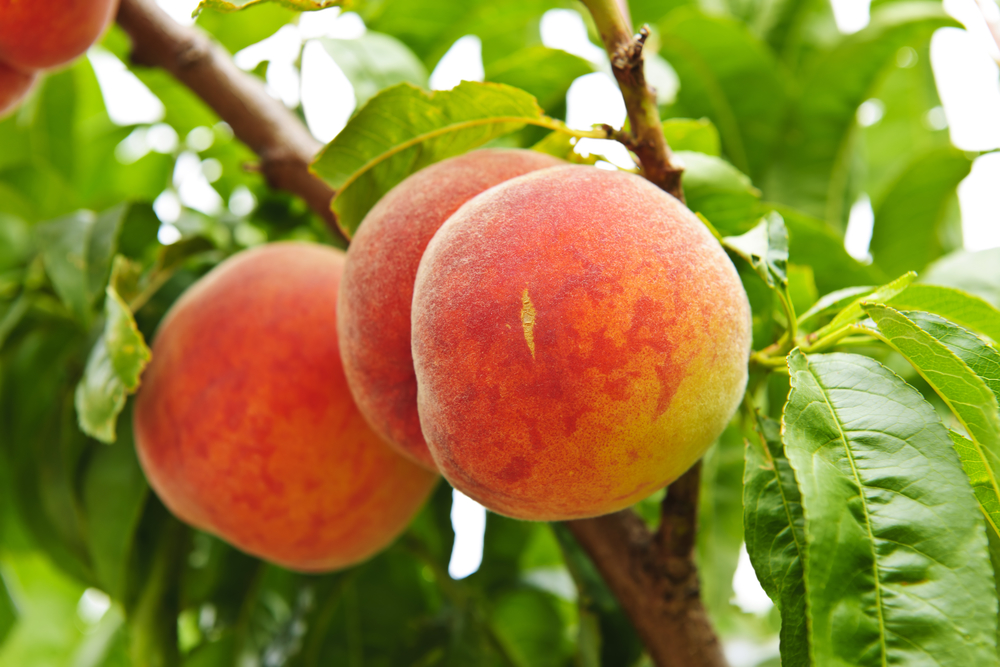
Sarah Scott reports, “We are still ahead of schedule on peach varieties being harvested. Early August Prince and August Prince are being picked now which is over a week earlier than usual. The fruit quality is still good with slightly smaller than ideal fruit. With the extreme heat and lack of rain in the past week, summer crops like tomatoes and cucumbers are looking rough. Bell peppers are doing well.”
Pee Dee
Bruce McLean reports, “Sweet potatoes are looking good. Establishment seems to be very good for the most part. Long green cucumbers, yellow squash, zucchini, cantaloupe, peas, okra, and sweet corn are harvesting well. Condition is good to very good. Sweet corn will be wrapping up shortly. Blueberries are pretty much finished, with only a few remaining fruit on Powderblue. Fruit condition is fair to good. Muscadines are coming along nicely and appear to have an excellent crop. Fresh muscadines should be beginning harvest soon, with wine/juice grapes still a few weeks from harvest. Be on the lookout for Grape root borer moths. They are starting to emerge. They were being caught in traps placed in vineyards in Marion and Horry counties.”
Tony Melton reports, “Harvested first crop of processing peppers. Continuing to pick and plant pickles. Processing greens are over for the spring crop. Harvesting the first crop of processing and seed peas and planting fall crop. Getting processing tomatoes out of the field as quickly as the plant can take them. Things are drying out, hope we don’t go into drought with the heat.”
Upstate
Kerrie Roach reports, “Spotty rain and high temperatures have left many small growers scrambling for irrigation options throughout the Upstate. Peaches and nectarines are still being harvested. Blueberries are just about finished, and farmers’ market produce is starting to wind down with the heat. Apples should begin next week with early varieties like ‘Ginger Gold’ and ‘Golden Supreme’.”
Andy Rollins reports, “Plenty of early blight, bacterial spot/speck on tomatoes this season, but some of the more troublesome problems have been various tomato virus problems. When diagnosing virus problems it is important to get lab verification because herbicide injury can look very similar when just going by visual symptoms. If you suspect herbicide drift from a neighboring farm. Look for damage to other broadleaf plants in the area in between the suspected source and the damaged plants. Follow the wind direction. You should have more severe damage on the leading edge. Also, herbicide residual from a previous crop like sunflowers can also give you herbicide damage that you did to yourself. Read and follow all pesticide label directions. There are plant back restrictions on some herbicides so be careful. If this is the case the damage should be fairly consistent/uniform throughout the area that was planted in the other crop.
Unlike both of these other situations, virus problems may come from your seed source, the greenhouse where plants were grown or from weeds in the field. Pokeweed is commonly a source, as are many other broadleaf weeds. Thrips, aphids, and whiteflies are all known to vector viruses into plants. Symptoms are what you see below with “shoestring” looking leaves, leaves with distorted veins, and mosaic yellow and green coloration. There are many viruses that infect plants. Each of them can show different symptoms and also they can each look different on other plants as well. It’s even possible for a healthy-looking plant with no symptoms to be infected with several viruses.”
Clemson Extension agents provided updates in The South Carolina Grower this week about the status of various crops being produced throughout the state.
Coastal
Zack Snipes reports, “Summer crops are all but about done. The afternoon thunderstorms, humidity, and heat have just about finished off the tomato and watermelon crops. Growers are getting fields ready for the fall season now. Consider putting up deer fencing now before crops are planted.”
Midlands
Justin Ballew reports, “We got some more rain early in the week, and the sky was overcast most of the week. Downy mildew finally showed up here in cucumbers. Even though it’s been found all over the coast, it took a while to make it this far inland this year. The dry weather we had most of June may have had something to do with that. Anyone growing cucurbits from now through the fall definitely needs to be applying preventative fungicides. Lots of fields are transitioning from spring crops to fall crops right now. We’re still picking sweet corn, tomatoes, peppers, eggplant, squash, zucchini, cucumbers, etc.”

Lalo Toledo reports, “Sweet potatoes are in the ground and thriving. Please be aware of any pest activity and disease activity. Weeds are becoming a problem, especially in organic operations. However, there are several options to suppress weeds. Please contact your extension agent for information on chemical and cultural practices. Hemp is having trouble taking off with so much heat, and weeds are gaining ground on it. Peppers are doing great with some minor bacterial lesions.”
Pee Dee
Tony Melton reports, “Poured rain every day last week – awful. Processing peas are ready to harvest but cannot get a dry period to burn down to harvest. Need to get second crop processing peas planted before August if fields will ever dry out – don’t forget to control thrips early and do your best to keep deer out of fields. Processing tomatoes & peppers are being harvested. Pickling cucumbers are continually being harvested and replanted. Sweet potatoes are planted, most have been laid-by, many have vines covering beds, and some are starting to size potatoes. We may have some insect damage on roots since it is difficult to get bifenthrin applied and plowed-in. Hopefully, the Lorsban will control insects, and since it is too wet to plow until the rain can wash the bifenthrin into the soil to keep the sun from degrading it. Don’t forget the boron on sweet potatoes.”
Upstate

Kerrie Roach reports, “Peaches are the showstopper this week in the Upstate! Even with what appears to be late cold damage causing split pits and some varieties not to ripen, the peach crop is still booming. Apples are maturing on schedule and growers should begin harvesting early varieties over the next few weeks. With limited and spotty rain events over the last seven days, irrigation has been vital for vegetable producers…. but heat and humidity (despite the overall lack of rain) have increased the need for fungicide cover sprays, as we’ve seen various fungal activity picking up across the board.”
Clemson Extension agents provided updates in The South Carolina Grower this week about the status of various crops being produced throughout the state.
Coastal

Zack Snipes reports, “It was a warm week with some sprinkled in showers along the coast. All crops are coming in right now with heavy watermelon volume. What’s left of the tomato crop is ripening fast. As far as pests go, I have seen a good amount of bacterial leaf spot in pepper, squash bugs and cucumber beetles in squash, and spider mites on beans, tomato, and melon.”
Midlands
Justin Ballew reports, “We got a little more rain last week and the temperatures were a little warmer than previous weeks. We’re still harvesting tomatoes, sweet corn, peppers, eggplant, peaches, squash, zucchini, beans, etc. Since the environment has been warm and wet, we’re starting to see diseases pick up. Seeing lots of powdery mildew and anthracnose on cucurbits and bacterial spot on tomatoes. Stay on your fungicide programs and rotate modes of action as much as possible. I’ve also been getting some reports of heavy spider mite activity on tomatoes.”
Sarah Scott reports, “We’ve had hot and, for the most part, somewhat dry conditions in the past week. Some areas received an inch of rain, but it was very spotty. Tomatoes, peppers, squash, corn, cucumbers, and melons are all being harvested now. Plums, peaches, and nectarines are also still being picked. The peach crop is about 10 days ahead of schedule.”
Pee Dee
Bruce McLean reports, “Vegetable crops are maturing nicely, even though some are exhibiting heat stress from the recent hot weather. Cucurbit Downy Mildew (on cucumbers) has been reported throughout the Pee Dee Region. Powdery Mildew is widespread on zucchini and yellow squash. Sweet corn is looking good, with good volumes being produced. Tomatoes, other than being stressed from the heat and the humidity, look pretty good and are bearing well. Sweet potatoes are still being planted. Muscadines are beginning to size and look to be a very good crop. Blueberries are winding down, with only the latest varieties being harvested now.”
Tony Melton reports, “Processing peppers and tomatoes are beginning to be harvested and they look good. With all the early winds and excessive rain, it was difficult but as my daddy would say ‘we made a silk purse out of a sow’s ear.’ Second and third crop pickles are yielding much better than the weather-beaten first crop. Processing peas will begin harvest this next week, so we badly need some dry weather, but the forecast is not favorable. Also, the amount of cowpea curculio is increasing rapidly, and an intense/timely spray program is needed to prevent what most call “stings (maggots) in the peas.” One grower got slack on his spray program and this week had to discard $6,000 worth of peas. Spray with a pyrethroid at or before the first flower, then every week until flowering is finished. The first spray is the most important because if you wait too late, the curculios are already in the field. Curculios are very hard to kill. When disturbed they ball up inside their protective coat, and your spray is repelled. My program repels them and attempts to keep them out of the field. Also, rotation is very important to keep down the population of curculios surrounding your fields.”

Upstate
Kerrie Roach reports, “Upstate peaches are beginning to ripen! While exciting, we have seen some physiological issues with sizing and softening that we attribute back to a late-season cold spell. While the peaches originally appeared to pull through without damage, we are now seeing peaches that are not sizing and those that do size up, only ripen on the very outer portion. It is a waiting game to see how each variety ends the season. In the meantime, market vegetable production is in full swing and the apple crop is looking fabulous.”
By Clint Thompson
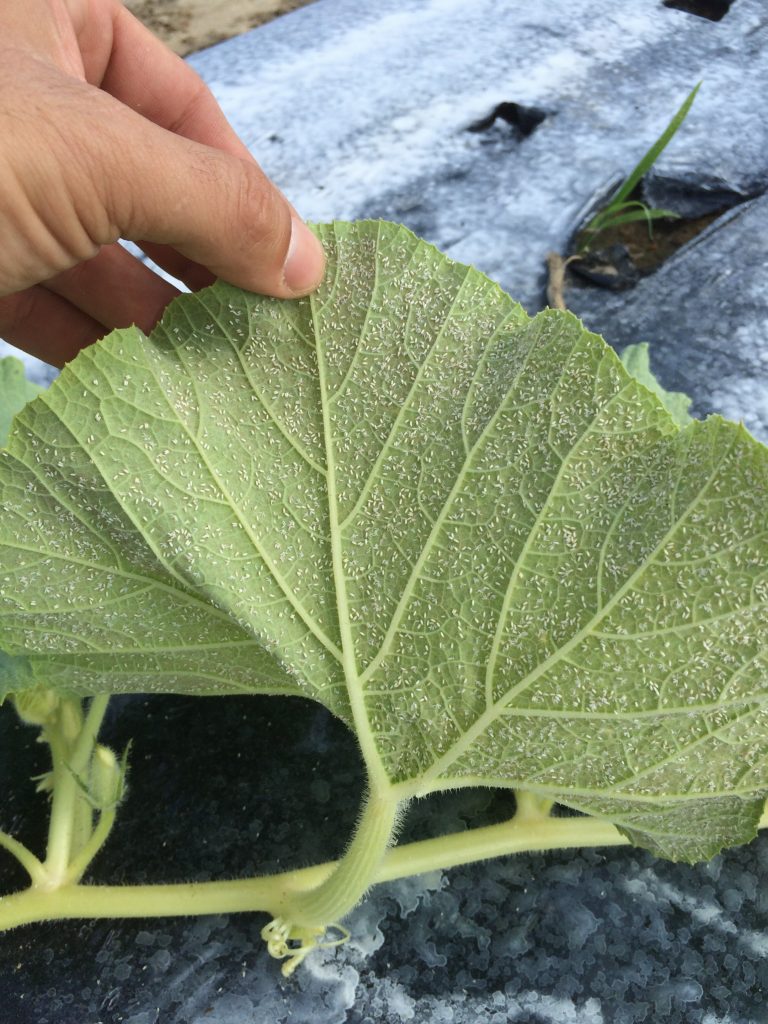
University of Georgia Cooperative Extension vegetable entomologist Stormy Sparks confirmed this week that whiteflies are back with a vengeance on susceptible vegetable crops and Georgia’s cotton, which is still just a few weeks old.
“I’ve been holding off a long time on saying it looks bad. But about a week ago, it’s just hard to say it doesn’t look bad,” Sparks said. “There’s still some things that could happen, but I saw some populations in some cantaloupe that you don’t usually see for another month or two. They’re already treating some cotton, apparently.
“We’re probably a month behind 2017, but we’re at least a month ahead of our normal year.”
Sparks said in May that whiteflies were already present in Georgia vegetables.
While colder temperatures do not eliminate whiteflies, they do kill many of their wild hosts. They also slow population development in cultivated hosts. Warmer temperatures this winter allowed for larger whitefly populations to overwinter and become mobile earlier.
“We already had the populations, there’s no doubt about that, earlier than normal in some areas, particularly coming out of kale. There’s a lot of things that can happen as far as weather and everything else that can impact it. There’s still some things that could happen to keep it from getting as bad as it did in 2017,” Sparks said. “If they get to a certain level, those rain events don’t have the same impact than they would at lower populations. I think we’re probably far enough long now that they’ll rebound fairly rapidly. That’s what I’m afraid of.”
Rain is expected all week in South Georgia, but Sparks believes a tropical storm-type system is what is needed to suppress whitefly populations.
UGA cotton entomologist Phillip Roberts said farmers are already treating for whiteflies in cotton which is month to a month and a half earlier than normal.
Sparks, Roberts and other specialists continue to preach sanitation with whitefly management. Farmers have done better in recent years in getting rid of their vegetables once they are done harvesting. That needs to continue this summer.
“If the vegetable growers get rid of those crops that are infested, if you’re done with them; if you get done with watermelon fields and cantaloupe fields … get rid of them. Don’t let them keep reproducing. The cotton guys just need to be keeping an eye on infestations and don’t let them build up there,” Sparks said.
Whiteflies migrate from winter vegetables to spring vegetables to agronomic crops, like cotton, to fall vegetables and back to winter vegetables. Whiteflies cause feeding injury issues in vegetables and transmit two new viruses: cucurbit leaf crumple virus and cucurbit yellow stunting disorder virus. Vegetables like squash, zucchini, cucumber, cantaloupe and snap beans are highly susceptible to these viruses.
According to the The South Carolina Grower, Bob Hall of Bush-N-Vine Farm in York, South Carolina is this year’s Swisher Sweets Farmer of the Year for South Carolina. He was nominated by Upstate Clemson Extension Agent, Andy Rollins.

Rollins said of Hall, “I am so proud of him and all his family for all they have done to make their farm and community great.” Hall will compete against farmers from other states in the Southeast for the overall 2020 Swisher Sweets Farmer of the Year. The winner will be announced at the Sunbelt Ag Expo in Moultrie, Georgia, which will be held October 20-22, 2020.

By Clint Thompson
Brett Blaauw, University of Georgia assistant professor in the Department of Entomology, says the time is now to treat San Jose scale crawlers which are peaking in peach orchards.
“Right around late June, early July and then again in August, we see these real high populations of their larvae, the crawlers. Crawlers are also susceptible to insecticides. They do not have that waxy coating yet. They’re the mobile stage of the scale. They’re leaving their mothers and searching for another part of the plant to settle down and start to feed. These crawlers have a few days of vulnerability so we can also try to time our insect sprays to target those scale crawlers,” Blaauw said.
He said in his blog that he expected this week to see a peak in crawler activity. South Carolina producers should expect to see crawler activity in the next week or two.
San Jose scale is a tiny insect that has a waxy coating. It covers and protects the whole body of the insect. It protects them from the environment. It protects them from other insects that would eat them. And unfortunately, it protects them from insecticides. Once these insects create their waxy covering, they are hard to kill, according to Blaauw.
They also reproduce at an extremely high rate. It does not take long for a minimal problem to balloon to a major concern for peach producers.
“Females can produce hundreds of offspring. Just from one female, she can produce almost 300 offspring. Of those 300 offspring, if they’re female, can go on to have 300 more offspring. The population can get quickly out of hand,” Blaauw said. “When you have thousands of these little insects feeding on the branch of a peach tree, it can quickly kill or reduce the vigor of that branch. If the problem goes untreated, you lose branches, and then you lose limbs and eventually you lose whole trees.”
Blaauw said another management option is to apply two dormant sprays of horticultural oil. It is best to spray once the trees are dormant and then before bloom next growing season. The high-volume sprays will suffocate the San Jose scale.
“That usually works pretty well and significantly reduces the scale population. But even when the growers are doing that, we’re seeing the numbers skyrocket about now. I can go out there and monitor almost any time of the season and find San Jose scale in the trees,” Blaauw said.
The San Jose scale can be traced back to the 1800s. With modern insecticides, the scale was not a problem in the 1900s. But it has come back with a vengeance in the 2000. It thrives in Georgia’s warm summers and winters and can be active all year long.
Another issue is that complicates farmers’ management options is that the scale may not impact the whole orchard. It could be clustered in one area or part of the orchard. It can be hard to manage if a grower has many acres of peach trees.

By Clint Thompson
Valent U.S.A. is offering a new insecticide that offers fast and long-lasting control of soft-bodied insects of vegetable and citrus crops.
This is the first year that producers will have access to Senstar Insecticide. It provides farmers with two effective modes of action for control of soft-bodied insects, including whiteflies, aphids, thrips and pysillids.
“Southeast vegetable and citrus growers have a new tool this year to protect their crops from damaging insect pests,” said Craig Campbell, regional Valent Field Market Development Specialist. “Senstar has two modes of action, and both have translaminar and systemic activity in the plant. That allows Senstar Insecticide to control all stages of the insect life cycle, providing powerful, long-lasting pest control.
“By controlling all the life cycle stages, including insect eggs, Senstar offers a unique benefit. It breaks down the insect population cycle, resulting in less potential for reinfestation. The growers see a lower pest count and better marketable yields.”
Senstar is very effective at reaching pests on the underside of the leaves, which are hard to reach with a spray. Its translaminar action means it can move up and down the leaves and manage those pests that feed on the underside.
Campbell said two sprays of Senstar are allowed through the season.
Pest management in vegetables and citrus is extremely important for producers. Not only do they feed on the plants and the crops themselves, pests can transmit diseases that can be detrimental to the plant. Thrips can transmit tomato spotted wilt virus in tomatoes. Psyllids vector Huanglongbing (HLB) disease, also known as citrus greening disease.
“Growers know this very well. Virus diseases can take down a vegetable crop. That’s a serious problem every year,” Campbell said.
Valent U.S.A. LLC, headquartered in Walnut Creek, Calif., develops and markets products in the United States and Canada that advance sustainable agriculture, protect crops, enhance crop yields, improve food quality, beautify the environment and safeguard public health. Valent products include a well-known line of quality herbicide, insecticide, fungicide and plant growth regulator products for agricultural, seed protection and professional use. Valent is a leader in marketing and sales of both traditional chemical products and biorational products developed by its affiliate, Valent BioSciences LLC. For more information about Valent or our full product line, please call 800-6-VALENT (682-5368) or visit valent.com.

Contact: USDA Press
Email: press@oc.usda.gov
(Washington, D.C., July 1, 2020) – Today, The United States-Mexico-Canada Agreement (USMCA) enters into force, replacing the decades-old NAFTA. USMCA is a better deal for America’s farmers, consumers and workers that will set them up for success for decades to come. U.S. Secretary of Agriculture Sonny Perdue penned an oped in the North Carolina Fayetteville Observer saying, “USMCA creates more market access for farmers from across our nation to sell their wholesome and nutritious products to our closest neighbors. This is a better deal for America that will grow our economy and put more money in the pockets of American families.”

More here from Secretary Perdue’s oped
“On my first day as Secretary of Agriculture, President Trump promised he’d fight for better deals for American farmers. That is why the president renegotiated the decades-old NAFTA and modernized it into a better deal for America’s farmers, consumers and workers that will set them up for success for decades to come…
“We are shown once again that President Trump has the backs of America’s farmers and thank him on the delivery of this much better deal…
“USMCA helps all of America’s diverse agricultural industries. This new and improved deal secures greater access to markets and lowers barriers for our agricultural products…
“USMCA eliminates Canada’s unfair Class 7 milk pricing scheme that was creatively developed to allow unfairly low-priced Canadian dairy products to undersell U.S. products in Canada and in third-country markets. United States poultry and egg producers will also see expanded access to Canada’s market, directly benefiting American producers in states like Iowa, Georgia, Arkansas and California…
“It includes rules to address all agricultural biotechnology, including gene editing, in support of 21st century innovations in agriculture. The agreement also improves the flow of trade with new and enforceable rules to ensure that sanitary and phytosanitary measures to protect human, animal, or plant life or health are science-based and transparent…
“USMCA also updates the rules of origin for processed fruits to ensure preferences benefit U.S. producers. Most importantly, the new agreement maintains the tariff-free access for nearly all U.S. agricultural commodities shipped into Mexico and Canada, providing America’s farmers and ranchers continued market access…
“The implementation of this deal sends a strong signal to other important export markets such as the United Kingdom and the European Union that President Trump and Congress are serious about pursuing and enacting future agreements that create better economic opportunities for all parties involved. The United States is open for business, and our farmers are ready to export more of their wholesome and nutritious products to consumers around the world…”
Additionally, Secretary Perdue joined FOX News’ Sandra Smith this morning on America’s Newsroom to talk about the USMCA. You may view their comments on the USMCA or on the image below to watch.
United States Department of Agriculture

By Clint Thompson
The time is now for grape producers to protect their crop against the grape root borer, said Brett Blaauw, assistant professor in the Department of Entomology at the University of Georgia. He said usually in north Georgia, the grape root borers will emerge in early July.
According to the UGA Extension Viticulture Blog, if farmers have not deployed their pheromone dispensers as part of the mating disruption tactic, it is time to get those distributed.

“Our mating disruption is probably our best option. That’s using a pheromone that basically confuses the male moths. It blocks them from finding the female moths so they can’t mate. No mating, no mates, no eggs, no larvae and then, hopefully, no disruption of the roots,” Blaauw said. “But because of its two-year life cycle, it takes a least two years for the mating disruption to start to show that it’s working in a vineyard. That can be tough because when you use something management you want to see it working right away. But the main disruption takes a couple of years to see any benefit.”
As the name implies, the grape root borer larvae feed on the roots. Blaauw said they have a two-year life cycle and will feed underground on the roots for almost 22 months. Unfortunately, it is out of sight, out of mind for many grape producers. Being underground, the borers go unnoticed until the vine begins to deteriorate.
“Previous research has shown that by having these larvae feeding on the roots it can reduce the vine’s yields by 50%. That’s just having one larvae,” Blaauw said. “The mature larvae are almost an inch long so they’re pretty good size larvae, a little bit like root boring caterpillars feeding for two years. Just having one can reduce yield by 50%. If you have more than one feeding on a vine, that could easily significantly reduce the survivability of the vine; it can reduce the fruit quality and eventually lead to vine death.
“Growing fruit in the Southeast is tough enough with diseases and other insects. Growing grapes is really tough. Grape vines, at least the vonifera type grapes are often subject to different diseases. One is Pierce’s Disease. Pierce’s Disease can take down vines pretty quickly, too. A lot of growers, when they have a vine that dies, they kind of assume it’s due to a disease. They’re not usually thinking about grape root borer just because it’s underground. You don’t really see what’s going on until you pull that vine out and see the roots all chewed up. Then it’s obviously too late.”
Another effective way to manage grape root borers is to suppress the weeds under the vines. This can significantly reduce the success rate of the eggs hatching and the larvae making it to the roots. If weeds are present, they serve as protective barriers for the little caterpillars. They protect them from the sun and protect them from other insects that are going to be feeding on them.
“If you get rid of those weeds, you create a pretty harsh environment. Bare soil is not a good place for an insect, especially if you’re a tiny little caterpillar,” Blaauw said.