According to Georgia Farm Bureau, Rep. Sanford Bishop (D-Ga. 2nd District) and Sen. Kelly Loeffler (R-Ga.) each announced funding for Georgia agricultural research.
On Oct. 16, Bishop, chairman of the U.S. House Appropriations Subcommittee on Agriculture, Rural Development, Food and Drug Administration, and Related Agencies, provided funding for pecan and peanut research in the FY2021 Agriculture Appropriations bill.
The bill included 1.5 million for research on pecan cracking and pasteurization technology, $1.5 million for pecan breeding and genetics research and $1.51 million for aflatoxin research at the ARS Peanut Lab in Dawson and Fort Valley State University.
“One of the most important things to me as the agriculture appropriations chairman is making sure the crops we grow here in Georgia continue their massive contributions to our local, state, and national economies while also feeding our citizens nutritious food,” Bishop said. “Pecans and peanuts are very healthy and are also two of our largest agricultural exports as a state.”
Loeffler
On Oct. 22, Loeffler, a member of the U.S. Senate Committee on Agriculture, Nutrition and Forestry, announced the University of Georgia will be receiving $323,834 from the USDA National Institute of Food and Agriculture to research and improve crop protection and pest management. The grant will allow UGA to study and develop tools to resist the diamondback moth, which causes severe damage to crops in Georgia’s agriculture regions.
“Farmers are the backbone of Georgia and this nation, and they deserve all the help and resources they can get to ensure their crops are protected,” Loeffler said. “I applaud USDA for awarding UGA with this grant, which will bolster its premier agriculture research program – which is already a leader in the nation – and help safeguard Georgia crops from the diamondback moth and other threats for years to come.”
According to Alabama Extension, the demand for organic crop production has experienced an upward trajectory in recent years. This increasing demand means there is a need for more farmers to produce organic vegetables at a reasonable cost, while also being environmentally sustainable.
For these producers, insect pest management is one of the aspects where they must watch their costs and consider the environmental impact of the management strategies they implement. Luckily, there are several integrated pest management (IPM) practices that can help producers do both.
Pest Exclusion Systems
Vegetable production in the Southeast already comes with risks, as insect pests threaten crops from seedling to harvest. According to surveys of specialty crop producers, potential crop losses from pest feeding average 55%. Crop contamination from insect excrement and other factors can also affect farm profits. These are referred to as the yield-limiting and yield-reducing factors, which all depend on how the crop is managed.
IPM practices, such as pest exclusion, can help with these factors.
Pest exclusion is based on the practice of physically blocking insects from reaching their host plants and is often overlooked by producers. Moths and large pests, such as stink bugs or leaffooted bugs, can be good targets of a well-designed pest exclusion system, especially on small acres with intensive vegetable production. There are two types of pest exclusion systems; temporary and permanent.
Temporary, or time-limited, systems are suitable for early season pest management to protect seedlings.
Permanent pest exclusion systems are a more intense use of pest exclusion fabric that provides season-long crop protection in high tunnels. This is called the high tunnel pest exclusion (HTPE) system, which is being intensively evaluated at 14 farm locations across Alabama.
There are numerous benefits that a pest exclusion system can offer in an organic vegetable production.
Short-term or season-long pest reduction.
Variable cost depending on material and design of the system.
Minimal training for implementation.
Growth and season extension from use of insect barrier fabric.
Overall reduction in the use of biorational insecticides with increase in natural enemy activity.
It’s important to note that not all crops and varieties may lend themselves to pest exclusion systems. Contact the Alabama Extension commercial horticulture regional agent in your area before making a major purchase decision. It is recommended that pest exclusion systems be integrated with the use of insect monitoring systems or traps and natural enemies for practicing true IPM.
Chances are, if you live in northeast Georgia you’ve come across an East Asian Joro spider this fall.
At almost 3 inches across when their legs are fully extended, they’re hard to miss. While they’re roughly the same size as banana spiders and yellow garden spiders, the distinctive yellow and blue-black stripes on their backs and bright red markings on their undersides are unique. Their enormous three-dimensional webs are a striking golden color and tend to be located higher off the ground than those of other spiders.
“We’ve been getting lots of calls and emails from people reporting sightings,” said Byron Freeman, director of the Georgia Museum of Natural History. “They seem to be really common in riparian areas and in urban areas around people’s houses, but they’re also in the deep woods.”
Joro spiders have spread widely since they were first spotted in Hoschton, Georgia, in 2013. They probably arrived by hitching a ride in a shipping container from China or Japan, according to Freeman. He and Richard Hoebeke, associate curator of the museum’s arthropod collection and a research professional in the University of Georgia College of Agricultural and Environmental Sciences Department of Entomology, confirmed the identity of those early arrivals based on genetic analysis in 2015.
Now, five years later, Joro spiders appear to have successfully established themselves in the area, with recent confirmed reports from as far afield as Blairsville, Georgia, and Greenville, South Carolina. But there is still much that remains unknown about them.
One important question is how they might affect the local ecosystem. Will they out compete other orb weaving spiders? Will they reduce insect populations through predation?
“We don’t know what the impact is going to be,” said Freeman, a faculty member in the University of Georgia Odum School of Ecology. “Right now, we’re trying to learn as much as we can about them.”
So far, early observations indicate that Joros are coexisting with the area’s other orb weaving spiders, with webs close to, and in some cases even attached to, one another.
And Joro spiders also appear to be able to capture and feed on at least one insect that other local spiders are not: adult brown marmorated stink bugs, an invasive pest that can infest houses and damage crops. In turn, Joro spiders are vulnerable to predators like mud dauber wasps and birds.
Freeman noted that dewdrop spiders, a kleptoparasite—as the name implies, they steal food from others—have been spotted in Joro webs.
“They may be switching from what we thought was their principal host, the banana spider, to this new kind of orb weaver,” he said. He pointed out that banana spiders, a relative of the Joro, are native to the Caribbean and Central America. They were first recorded in the U.S. in 1862 and have since naturalized.
“My guess is that this will be no different than the banana spider, and I don’t know that we can assess what the effect of the banana spider has been at this point,” he said.
Another question Freeman hopes to answer is how the males find their mates.
Joro spiders travel by ballooning, letting the wind carry them on a strand of gossamer.
“The male has to drift in and find the female,” Freeman said. “Sometimes there’ll be four or five males on a web, sometimes there’ll be one, so the males are moving between webs. When you have a large population it seems feasible that a male could just drift from one spot to the next, but when you don’t have a lot of webs around, how does the male show up?”
Freeman is also conducting further genetic analysis to determine what causes some Joro spiders to have a different color pattern. While most have distinctive black and yellow striped legs, some have legs that are solid black. These black morphs have other physical differences that are only apparent when viewed under a microscope, and Freeman has determined that they are genetically distinct members of the species.
Despite their size, Freeman said that Joro spiders don’t pose a threat to people.
“All spiders have venom that they use to subdue prey,” he said. “If you put your hand in front of one and try to make it bite you, it probably will. But they run if you disturb their web. They’re trying to get out of the way.”
Freeman said that Joros can be shooed away with a broom if they’re in a location that puts them too close for comfort.
But as for removing them permanently, he compared such efforts to shoveling sand at the beach.
“Should you try to get rid of them?” said Freeman. “You can, but at this point, they’re here to stay.”
If you spot a Joro spider — especially if you can provide a photo tagged with date and location — please contact Hoebeke at rhoebeke@uga.edu.
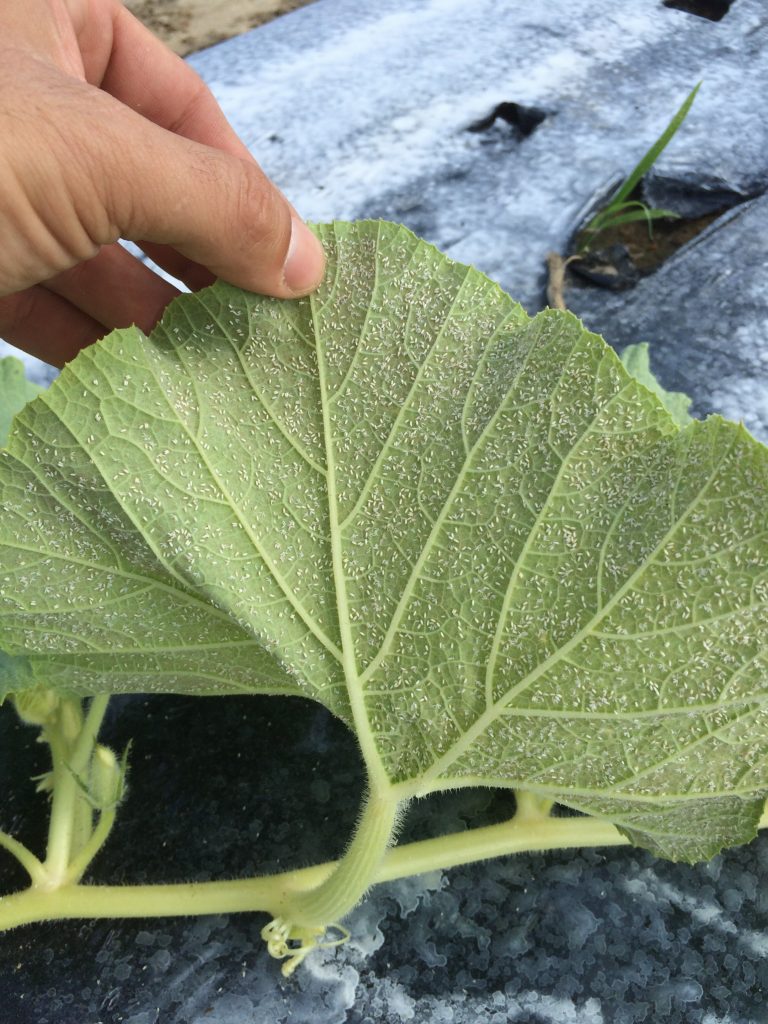
Around the Central Florida area, respondents report that whiteflies remain active in tomato and melons at mostly low numbers.
Growers and scouts in Southwest Florida report that whitefly pressure has declined with recent rains. Scouts report finding mostly low numbers in cucurbits, eggplant and tomato. But there are flare-ups reported with higher numbers showing up in eggplant and squash.
Scouts are reporting finding mostly low numbers of whitefly in eggplant on the east coast.
Reports from Homestead indicate that whiteflies are present in oriental vegetables.
Management
Management of whiteflies later in the season depends on early suppression of whitefly populations. Growers need to be aggressive with the best systemic materials like Venom, Sivanto Prime and Verimark, early in the season. Growers who are on seepage and not drip are at a particular disadvantage if whiteflies and virus are high early in the season.
Preventative soil applications of either imidacloprid, thiamethoxam, dinotefuran, flupyradifurone or cyanatraniliprole should be used preventatively in tomato and cucurbits.
Proper scouting is essential to manage silverleaf whitefly. Over the years, University of Florida entomologists have developed usable action thresholds that have been successful for many tomato farmers. However, these thresholds are only guidelines. Farm managers may modify them to fit their situations and expectations.
Thresholds
Silverleaf whitefly thresholds
0-3 true leaves 10 adults/plant
3-7 true leaves 1 adult/leaflet
Field hygiene should be a high priority and should be an integral part of the overall strategy for managing whitefly populations, whitefly-vectored viruses and insecticide resistance. Growers are advised to be alert for volunteer tomato or cucurbits that may be present in row middles and field margins as these may be a source of whiteflies and virus.
Stunted young trifoliates in the plant center (compact leaf mass). (Photos by Sriyanka Lahiri, UF/IFAS)
By Sriyanka Lahiri
Several arthropod pests occur in strawberries in Florida during the various stages of the crop cycle.
Cyclamen mites (Phytonemus pallidus), if present, originate from strawberry nurseries as hitchhikers on transplants. Thankfully, a very small percentage of growers reported a cyclamen mite infestation during the strawberry season of 2019–2020.
Soon after planting, armyworms (Spodoptera spp.), twospotted spider mites (TSSM, Tetranychus urticae) and the invasive polyphagous chilli thrips (Scirtothrips dorsalis) are typically found infesting plants.
TSSM can also arrive as hitchhikers on transplants, occasionally. The presence of armyworms on young foliage becomes immediately evident due to feeding holes left by their biting-chewing mouthparts. Both TSSM and chilli thrips feed on foliage using their piercing-sucking mouthparts. TSSM produce webbing on the surface of the foliage and lay eggs on these webs. However, chilli thrips differ in their oviposition practices.
The more devastating chilli thrips prefer feeding on the youngest open leaflets. Eggs are laid by the chilli thrips female into the leaf tissue using a saw-like ovipositor. This protects eggs from insecticides and predators. Both chilli thrips adults and larvae find refuge in concealed areas of the foliage, which makes them a very effective cryptic pest.
As plants progress toward flowering and fruiting, more thrips species appear, such as western flower thrips (WFT, Frankliniella occidentalis), common blossom thrips (F. schultzei) and Florida flower thrips (F. bispinosa) in addition to chilli thrips. Of these thrips species, both chilli thrips and WFT cause significant economic damage and develop resistance to insecticides easily.
DAMAGE
A cyclamen mite infestation can lead to severely stunted and crinkled leaves, aborted flowers, and bronzed and cracked fruits.
Chilli thrips larvae and adult. (Photo by Joseph D. Montemayor, UF/IFAS)
Chilli thrips cause necrosis at the site of feeding, which leads to darkening along the leaf mid-rib, followed by the spread of the dark coloration to lateral veins and petioles. Leaf bronzing, crinkling and deformation occurs during severe chilli thrips infestation.
Severe thrips and cyclamen mite infestations lead to bronzed and cracked fruits that are unmarketable.
An infestation of TSSM will lead to stippling of leaves initially. Uncontrolled TSSM populations become evident by the appearance of webbing.
MANAGEMENT
Management of cyclamen mites is best done with a preventive approach. Therefore, obtaining clean transplants is of utmost importance. Since all life stages of cyclamen mites show high mortality when exposed to hot water, a dip of frozen transplants into hot water at 111 °F for 10 minutes before planting may help. Alternatively, infested plants should be removed from the field.
The most significant early-season strawberry pest that is currently posing a management challenge in Florida is the invasive chilli thrips. Conventional insecticides are being used to manage thrips pests, but there are several naturally occurring beneficial insects that could be used. These include predators such as the big-eyed bug (Geocoris spp.) and the minute pirate bug (Orius insidiosus). Additionally, University of Florida Institute of Food and Agricultural Sciences (UF/IFAS) greenhouse experiments using potted strawberry plants have confirmed the efficacy of the WFT predator Amblyseius swirskii as effective for suppression of chilli thrips larvae.
An infestation of TSSM in open-field strawberries is best controlled by releasing the specialized predatory mite Phytoseiulus persimilis.
Armyworms are effectively managed by early-season application of biological insecticide formulations of Bacillus thuringiensis, subsp. kurstaki.
Pesticides registered for various strawberry pests are listed in the UF/IFAS Vegetable Production Handbook of Florida (https://edis.ifas.ufl.edu/pdffiles/CV/CV13400.pdf). It is important to select pesticides that are least harmful to beneficial arthropods, rotate modes of action and follow the label.
UGA CAES photo/A trio of winged fire ants perched on a branch.
By Sean Montgomery for UGA CAES News
A unique study conducted by University of Georgia entomologists led to the discovery of a distinctive supergene in fire ant colonies that determines whether young queen ants will leave their birth colony to start their own new colony or if they will join one with multiple queens. Researchers also found that ants were more aggressive toward queens who don’t possess the supergene, causing colony workers to kill them. This critical finding opens the door to new pest control methods that may be more efficient in eradicating problematic fire ant colonies.
“Learning about the way fire ants behave is very important baseline information,” said Ken Ross, a longtime professor of entomology at the university. “This information is key to helping us manage pest populations and predict what dissimilarities can happen in their environment.”
What is a supergene?
A supergene is a collection of neighboring genes located on a chromosome that are inherited together due to close genetic linkage. Studying these unique genes is important to understanding the potential causes for differences among the social structure of fire ants, specifically for controlling the species and building upon the existing knowledge base.
Researchers focused on young queen fire ants embarking on nuptial flights. They compared the supergene’s impact on the fire ants’ two primary types of social structures: monogyne, which is reproduction from queens that form a new nest, and pologyne, reproduction from queens that join an existing nest.
Ross initially worked alongside colleagues in his lab to discover a remarkable example of genetically encoded differences in social organization within the fire ant species Solenopsis invicta. The next step was to understand how these genetic differences result in complex behavioral and physiological variations among ants from single queen colonies versus colonies with multiple queens. Compounding this knowledge helps scientists further understand patterns of development in the species, increasing alternatives to combat invasive populations.
Led by a pair of UGA entomology graduate alumni, Joanie King, who earned her master’s degree in 2017, and Samuel Arsenault, who earned his doctoral degree in 2020, the team developed an experimental design that utilized a collection of samples from two fire ant organs — brain and ovarian tissues — and the complete range of social chromosome genotypes and social forms within this fire ant species.
Scientific Methods
The innovative study incorporated various scientific methods, leading to a collaboration of tools and resources throughout many different areas of the institution.
“UGA was a very supportive environment to conduct this research,” said Brendan Hunt, associate professor of entomology. “We received help preparing samples for RNA-sequencing from Dr. Bob Schmitz’s lab in the Genetics department, performed the sequencing at the Georgia Genomics and Bioinformatics Core, and utilized computational resources from the Georgia Advanced Computing Resource Center to analyze the data.”
These types of student-led projects give young researchers the chance to grow in a hands-on environment with mentorship and guidance from scientists with proven track records in the field.
“The graduate students gained experience that helped them transition to the next stages of their careers,” said Hunt. “Both have gone on to continue their studies of ant genetics.”
After earning their degrees and completing the research at UGA, King began pursuing a doctorate at Texas A&M University to study alongside Edward Vargo, and Arsenault works as a postdoctoral researcher with Harvard University’s Buck Trible Lab.
To read the full published research, check out the Wiley Online Library digital archive. For more information on the UGA department of entomology, visit ent.uga.edu.
Fire ant control is essential for Alabama vegetable growers hoping to protect their crop this fall. Alabama Cooperative Extension warns producers that fire ants are known to be pests of numerous vegetable crops, including okra and potatoes.
Ayanava Majumdar, Alabama Extension Professor, said fire ants can especially be harmful to vegetables because they’ll congregate on plants that have a heavy load of aphids. They will tend to protect aphids and other honeydew producers on vegetables. Fire ants can also damage the crops themselves and contaminate the produce.
“I think the issue is they get on plants that get a heavy load of aphids. They follow aphids. If plants have aphids you often have the ants protecting the aphids,” Majumdar said.
Few Management Options
Alabama Cooperative Extension offers producers a few management options. Control fire ant mounds around or outside the vegetable production area to prevent them from moving into the garden or field. Also, manage excessive plant residue on the soil. This will help increase detection of foraging ants, provides ants fewer places to hide and make it easier to scatter bait insecticides on open ground.
The best time to apply broadcast baits is now through Oct. 15. Mound treatments may be done year-round on warm, sunny days above 65 degrees F when the fire ants are active. Majumdar attests that the ants are active now.
“They’re pretty active in my peanut fields. They’re pretty active in and around my vegetable fields and my garden. They’re very active,” Majumdar said.
The greatest risk of whiteflies to fall vegetable production are the viruses they can transmit, according to Meade McDonald, Syngenta Insecticide Product Lead. That’s why growers need to utilize every weapon in the arsenal this year to combat a threat that is reaching its highest infestations since 2017.
“Using multiple modes of action and using as many tools that are available to the grower in his toolbox is really important to prevent tolerance and resistance from manifesting to these pests,” McDonald said.
Virus Vectors
Whiteflies can transmit the cucurbit leaf crumple virus and cucurbit yellow stunting disorder virus. According to University of Georgia crop loss estimates for fall 2017, these viruses caused between 30% and 50% of crop loss in squash and cucumbers and nearly 80% of crop loss in snap beans.
“This is a difficult to manage pest. Growers need as many tools as possible to control this pest. Controlling whiteflies is what I would call, it requires a programmed approach. There’s no one single crop protection product that a grower can use and deploy and have successful whitefly control. It’s going to take multiple modes of actions, multiple sprays,” McDonald said.
“I think growers in the Southeast are using a soil-applied insecticide; whether it be a neonic or a diamide, it is a great way to start the season strong and keep populations low. That has to be followed by timely in-season foliar applications of products like IGRs or a foliar diamide. Minecto Pro is one of our new products. It’s a great alternative to soil applied neonics.”
McDonald said a soil application is best followed by multiple foliar applications on 7 to 10-day intervals. That is what it is going to take to keep populations low and prevent viral transmission.
Environment Conducive to Whiteflies
Southeast growers can produce a spring and fall crop thanks to an environment that’s conducive to growing crops year-round. However, that makes certain cucurbits like squash especially vulnerable to whitefly pressure.
When temperatures don’t get cold enough to kill off the wild hosts, as was the case this past winter; then whitefly infestations are primed to be high and out of control earlier than normal.
“When you think about fall vegetable production in the Southeastern United States, when growers go in and plant fall vegetable crops, they’ve really got to be concerned about whiteflies. They’ve got to be ready to anticipate and be proactive,” McDonald said.
“The environment, simply in the Southeastern United States for the pest to manifest and for populations to build is just simply ideal. You’ve got ideal host crops almost year-round for whitefly populations not only to survive but thrive. We know these late summer, early fall temperatures enable that life cycle to speed up and populations can really be explosive this time of year, especially.”
Whiteflies are not the only insect wreaking havoc on vegetable crops this fall. According to Stormy Sparks, University of Georgia Cooperative Extension vegetable entomologist, broad mites are a problem for vegetable producers.
Sparks
“I’ve had several calls on broad mites, which are a problem primarily in peppers and eggplant,” Sparks said. “Unlike spider mites, spider mites like the middle of the summer because they like hot and dry weather, broad mites don’t like cold weather but they like it a little bit cooler and humid, which is what we have now. They tend to be a fall pest. Ten years ago, you never heard about them. But I’d say in the last three to five years, it’s almost an annual event.”
Large Host Range
According to UGA Extension, broad mites have a large host range, consisting of 60 families of plants. Along with peppers and eggplants, broad mites’ vegetable hosts include beets, beans, cucumbers, potatoes and tomatoes.
Damage is especially severe in bell peppers. The damage is caused by secretion of a plant growth regulator or toxin as the mite feeds, and extensive damage can happen at very low pest density.
“They make it look like the plant has a virus, same thing with eggplant. You get distorted growth. You get distorted fruit. It makes it unmarketable,” Sparks said.
Some acaricides provide excellent control of broad mites. Examination of plant terminals is necessary to evaluate control success. Damage can continue for two weeks after successful control.
University of Georgia CAES picture/Swelling (galls) produced by the root-knot nematode on the roots of okra grown on an organic farm in Georgia.
By Maria M. Lameiras for CAES News
While weeds and plant parasites are a concern for all agricultural producers, organic farmers are doubly challenged to combat these problems without chemical solutions. Through a grant from the U.S. Department of Agriculture, a University of Georgia researcher is working to discover and integrate biological products and cover crops to control nematodes and weeds in organic vegetable production.
Since joining the UGA College of Agricultural and Environmental Sciences in 2017, assistant professor of plant pathology and UGA Cooperative Extension nematologist Abolfazl Hajihassani’s lab has surveyed more than 400 vegetable fields in 29 Georgia counties for plant-parasitic nematodes and found 10 genera of nematodes. Hajihassani’s group found that root-knot nematode is the most prevalent based on distribution, soil population density and incidence, which is why he has focused his research on this particular pest.
“In certified organic production or on farms transitioning to organic, growers are not allowed to use chemicals. Producers have to use non-chemical procedures, which means that their management approach is very limited,” said Hajihassani, project director for the grant. “In this project we are trying to integrate a couple of techniques that we know have some efficacy as a single technique against nematodes and weeds to see if combining these strategies will result in the best management of nematodes and weeds and a higher crop yield than the growers’ standard practices.”
The three-year, $500,000 grant is part of the National Institute of Food and Agriculture’s (NIFA) Organic Transitions Program (ORG), which is designed to improve the competitiveness of organic livestock and crop producers, as well as those who are adopting organic practices.
Root-knot nematodes can enter a plant’s roots and move through its cells, where they grow, produce eggs and cause the roots to swell. This reduces the plant’s growth and yield potential in a relatively short timeframe and can lead to severe yield losses for organic farmers. South Georgia’s sandy soils allow root-knot nematodes to reproduce frequently because they can move easily through the soil’s loose texture and infect almost all vegetable crops. If the nematodes can’t be controlled in organic production systems, the producer may have to abandon the field and move operations to an uninfected area.
As part of the study, the team will cooperate with Raffi Aroian, a professor of molecular medicine at University of Massachusetts Medical School to identify native strains of Bacillus thuringiensis (Bt) crystal proteins, which have nematicidal tendencies against root-knot nematodes.
“The lab we are working with at the University of Massachusetts Medical School has been working on Bt strains for years, but they have never used these strains against plant-parasitic nematodes. They are going to give us some strains that have had efficacy against nonparasitic nematodes and we will screen those strains in the lab and greenhouse to find out the most effective for root-knot nematode control,” Hajihassani said.
In addition to the Bt strains, the team will research the use of entomopathogenic nematodes (EPNs) — nematodes that can kill other nematodes — and their bacterial metabolites to try to control root-knot nematodes.
“There are two known species of entomopathogenic nematodes that produce bacterial metabolites and we are trying to find out which one of those species or their metabolites have nematicidal efficacy against the root-knot nematode,” Hajihassani said.
Because weed control is another concern for organic production and farmers cannot use chemical herbicides, the team will test several cultivars of summer and winter cover crops in the field for the greatest nematode- and weed-suppressive qualities.
“We know which species and cultivars of winter and summer crops have suppressive effects against different common species of root-knot nematodes, in particular the southern and peanut root-knot nematodes. In field conditions, we need to find out the optimum timing for cover crop termination in our environments to get maximum suppression of weeds and nematodes,” he said. “Understanding the role of all these factors will help us integrate the best practices of cover cropping with the most effective bacterial or microbial combinations and commercial biological products for the control of nematodes and weeds in organic vegetable production systems.”
UGA researchers who are co-project directors on the grant are Ganpati Jagdale, UGA Extension nematologist; Timothy Grey, crop and soil sciences professor and UGA Extension weed specialist; Juan Carlos Diaz-Perez, horticulture professor; and Gregory Colson, agricultural and applied economics associate professor. David Shapiro-Ilan of the USDA Agricultural Research Service is also a co-project director on the grant.
For more information on research being performed by the Hajihassani Nematology Research Group, visit site.caes.uga.edu/nema.