A new University of Florida app will help the state’s blueberry growers identify and manage disease and insect injuries commonly encountered in Florida before their crop is ruined.
Collectively, blueberries are a $60 million-per-year crop in Florida.
Patricio Munoz, the UF/IFAS blueberry breeder and an assistant professor of horticultural sciences, came up with the vision for, and supervised the development of, the UF/IFAS Blueberry Growers Guide phone app, released on Dec. 1.
“Dr. Munoz saw the need for a field scouting guide for southern highbush blueberries that growers could use on their phones,” said Doug Phillips, statewide blueberry Extension coordinator. “Previously, the only blueberry scouting guide available was a paper guide for northern highbush blueberries, covering diseases and insects typically seen in more northern states.”
The new UF/IFAS app (type in “UF/IFAS Blueberry Growers Guide”) is available for both iOS and Android operating systems at the Apple Store and the Google Play Store, and it should help farmers who grow blueberries in the Sunshine State.
Phillips, who works at the UF/IFAS Gulf Coast Research and Education Center in Balm, led this project. He prepared the content and layout for the guide in collaboration with other UF/IFAS scientists: plant pathology Professor Phil Harmon, entomology Professor Oscar Liburd, horticultural sciences Associate Professor Peter Dittmar, and horticultural sciences Professor Jeff Williamson.
Phillips got help from Jose Delgado, a UF undergraduate who conducted early software development on the app. Delgado earned his bachelor’s degree in engineering in 2019.
The guide, which will ultimately be divided into multiple modules, is designed to help blueberry growers with various production issues on southern highbush blueberries. Currently, the app serves as a blueberry scouting guide to help farmers scout for diseases, insect pests, nutrient deficiencies and other damage, Phillips said.
Guide Resources
Resources in the guide include a diagnostic key, descriptions of symptoms, disease/insect life cycles, recommended management practices, an image gallery and links to UF/IFAS blueberry Extension publications. Users can access this information by using the diagnostic key to help identify symptom or injury causes and the image gallery to compare pictures of symptoms to observed symptoms.
They also can use a reference listing of diseases, insect injuries, nutrient deficiencies and other symptoms or injuries.
More functions will be added in the near future, Phillips said. They include a module with detailed information on all UF southern highbush blueberry cultivars.
“The UF/IFAS Blueberry Growers Guide will help Florida’s growers more easily manage damage from disease, insects, and other causes, and in the future will be a valuable resource for other production issues, including choosing which UF varieties are likely to perform well on their farms,” Phillips said.
Root-knot nematodes (Meloidogyne spp.) are one of the most rapidly spreading of all pests and pathogens. The southeastern United States (Florida, in particular) is a paradise for these parasites. Nematodes cause damage to vegetables all over the world, and anyone who has had to deal with root-knot nematodes knows how difficult they are to control.
Root-knot nematode damage is often not recognized and is frequently confused with other biotic or abiotic problems, such as disease, nutritional and watering issues. When nematode populations are high and weather and soil conditions are favorable, root-knot nematode damage can become so bad that total crop loss occurs. This is especially the case when soils are already warm at planting or when a double crop is planted on the same bed.
Soil fumigants like Telone-chloropicrin mixtures and metam-based products like K-Pam are the most effective products when nematode pressure is high. Deep-shank (18-inch) injections of Telone can provide additional control in problematic fields by targeting nematodes that hide in the subsoil. Fumigants must be applied at least three weeks before planting to avoid phytotoxicity to the crop.
NEW NEMATICIDES
In the past, when beds were not fumigated, nematicide options for vegetable growers were limited to Vydate (oxamyl) and a few biological products. Over the past years, two new nematicides, Nimitz and Velum, have become available for vegetable growers in the Southeast. The new nematicides are less toxic and have a safer label (caution instead of danger) than previous products. They can easily be applied through drip irrigation systems. These nematicides should not be considered fumigant replacements, as they will target only nematodes. Additional measures need to be taken to manage soil diseases and weeds.
Nimitz should be applied seven days before planting to reduce the risk of phytotoxicity to the crop, while Velum can be applied before and after planting. Fluopyram, the active ingredient in Velum, is the same as in the fungicide Luna, although no clear evidence of soil disease control was observed for Velum in University of Florida Institute of Food and Agricultural Sciences (UF/IFAS) experiments. Care should be taken not to exceed the maximum annual use rate of fluopyram when using both Luna and Velum.
Both Nimitz and Velum have been extensively tested at the UF/IFAS Gulf Coast Research and Education (GCREC) farm and are currently being evaluated in commercial fields. Their performance against root-knot nematodes on a variety of vegetables such as tomato, cucumber, squash, cantaloupe and watermelon was generally good and comparable to Vydate. Unless nematode pressure is too high, these products are a good alternative for growers that cannot or do not fumigate, or they may provide additional nematode control after fumigation when nematode pressure is high or long-season control is required.
ORGANIC OPTIONS
For organic growers, several biological products are available. They can be toxins derived from plants, bacteria or fungi while others are biocontrol organisms such as several species of bacteria and fungi. Some product names are ProMax, Kyte Gold, Ecozin, Dazitol, Majestene, DiTera and MeloCon. Typically, organic nematicides require multiple applications. In conventional production, they can be used as part of a program with chemical nematicides. Research into organic nematicides’ potential is ongoing at the GCREC and will be reported in future updates.
Root-knot nematode damage on tomato
Cover crops can also be good options to include in a nematode management plan. Summer cover crops like sunn hemp and sorghum-sudan grass can help reduce populations of most species of root-knot nematodes. The most common species in the Southeast are the southern (M. incognita), Javanese (M. javanica) and peanut (M. arenaria) root-knot nematodes. Often, vegetable fields will harbor more than one of these species. However, many more species exist.
In Florida, more than 15 root-knot nematode species have been found, including seven in vegetables. One particularly virulent and aggressive species is the guava root-knot nematode (M. enterolobii). This nematode has become a serious concern for the sweet potato industry in the Southeast and can cause severe damage to almost all vegetables grown in the region.
RESISTANT CULTIVARS
Vegetable growers that fumigate may not care much what species of root-knot nematode they have in their field as fumigants probably kill all species equally. However, knowing your root-knot species does matter when cover crops or nematode-resistant tomatoes are part of the nematode management plan. Research at the GCREC has shown that while some cover crops, like cowpeas, may be poor hosts to certain species of root-knot nematodes, they may be good hosts to other species.
Also, when root-knot nematode-resistant tomato cultivars are used, it is important to realize that while these cultivars are resistant to the three most common species mentioned above, they are not resistant to other root-knot species (including guava root-knot). Nematode-resistant tomato cultivars performed very well in root-knot nematode infested fields in recent trials in Florida. Root gall damage was negligible, and yields were increased compared to a susceptible cultivar. Fears, based on earlier reports that the nematode resistance gene in these cultivars might break down in the warm soils of Florida, were unjustified in GCREC trials.
The resistant cultivars also greatly reduced nematode reproduction and root-knot soil numbers by the end of the crop. This is often not the case when only a fumigant is used, as the fumigant will protect the crop from early nematode damage and yield loss, but nematode populations often increase by the end of the crop. Nematode-resistant cultivars are the easiest and cheapest method to manage root-knot nematodes, but unfortunately nematode resistance is rarely a priority in tomato and vegetable breeding programs.
File photo shows a cabbage field. The cabbage butterfly is a major nuissance for farmers.
The time is now to control insects in brassica crops like cabbage, broccoli, collard greens, kale and turnips. According to Ayanava Majumdar, Extension Professor in Entomology and Plant Pathology at Auburn University, they are still going to be a problem in the spring.
“The emphasis should be on preventing buildup of these insects on your farm because it only gets worse in the spring. It’s not going to go away,” Majumdar said.
One insect Alabama vegetable producers need to be wary of is the imported cabbage worm, also known as the cabbage butterfly.
“The cabbage butterfly, its caterpillar is like a sluggish, velvety caterpillar. It’s a very smooth looking caterpillar. It doesn’t move much, but it devastates a crop by direct feeding and also a lot of contamination happens from the feces of the caterpillar,” Majumdar said. “It may feed alongside with diamondback moth and loopers. But in my test plots the imported cabbage worm or cabbage butterfly is the predominant caterpillar that I see.
“That will be one insect to watch out for.”
Majumdar also cautions producers about the potential consequences of applying too much pesticides on your crops.
“Don’t overspray because then you are pushing insecticide resistance issues, especially if you have diamondback moth. It’s very notorious for resistance to pesticides,” Majumdar said.
Ash Sial, Associate Professor in the University of Georgia in the Department of Entomology, is receiving reports of slug infestations in Georgia blueberries.
According to the UGA IPM blog, slugs generally lay between 3 and 40 small transparent eggs at one time. Each slug can lay up to 400 per year. The slugs can contaminate the harvested fruit once harvest season approaches. They can reduce the quality by leaving slime trails on the fruit.
When do Producers Need to Monitor?
Sial
The best time to monitor for slug infestations is in early spring around March. Farmers can place small amounts of slug bait near a potential slug habitat. Habitats are the consistently wet and moist areas in the field. Check periodically for activity. Tolerance levels vary according to the end product usage and processor.
Slugs and snails rarely cause economic damage in blueberries. Treatment is necessary to control them. Several slug baits are registered for use in blueberries. The most widely used and effective are baits with metaldehyde.
It’s important to bait prior to harvest. This is common if slugs are known to be present.
Preventative Strategies
Preventative strategies are helpful for achieving long-term management.
Trellis the blueberry plants to keep branches from touching the ground. This practice reduces the number of slugs gaining access to the plant.
Mow or completely eliminate the vegetation in the plant row and between the berry rows. This can reduce slug habitat.
Keep crates and pallets away from damp soil and grass. It prevents migration of slugs into and under crates taken to the field before harvest.
Use geese as predators to control slug populations.
Eliminate consistently wet/moist spots in the field with good drainage. This reduces favorable habitat for slugs.
Slugs are soft-bodied mollusks. They do not have a shell. They can be as small as 0.25 inches to 10 inches longs. Their color can vary from yellow to green to brown to black. Some may even have spots or colored patterns.
University of Georgia CAES photo by David Riley/Shows diamondback moth and its damage.
Diamondback moths are starting to show up in some vegetable fields across Georgia, says Stormy Sparks, University of Georgia Cooperative Extension vegetable entomologist. Cole crops producers need to be wary of this pest, as it can pose a threat to cabbage, collards, kale and broccoli.
“Diamondback moth is starting to show up in some areas. We’ve had three or four really bad fields, and they’re really hard to control,” Sparks said. “It’s been scattered. It’s not just one area right now, either.”
Generations Per Year
According to UGA Extension, there are multiple generations per year in Georgia. Generation time will slow considerably in the winter months. However, greater moth activity has been observed when temperatures are higher than normal in December and January. That could be the case this winter with an extended La Nina weather pattern expected.
“That’s a strange pest. It has the potential to explode or disappear anytime of the year,” Sparks said. “They can be a problem in the middle of the summer and in the middle of the winter or they can just disappear.”
Insecticide Effectiveness
Sparks said they have looked at insecticide products like Proclaim and Radiant. He characterized their success as good to fair. Nothing looks great because this is a hard pest to kill.
“They are the world champion of insecticide resistance,” Sparks said.
He added that with the Group 28 insectides, resistance looks pretty severe.
According to UGA Extension, larvae will feed on foliage. Early instars can cause small channels in the leaf surface. Larger larvae can cause perforations in the leaf. Populations above 0.3 larvae per plant need to be controlled. Sparks recommends growers scout weekly to determine if that threshold level has been reached.
Whiteflies were projected to have a widespread, devastating impact on fall vegetable crops in Georgia. But according to University of Georgia vegetable entomologist Stormy Sparks, that never happened.
“We were setting up for an explosion of whiteflies in the fall and it never really occurred,” Sparks said. “I’m pleasantly surprised it wasn’t a lot worse than it was. In the summer, we were set up to be ugly, ugly.”
Greater Problem This Year
Whiteflies were a greater problem this year due in large part to a mild winter last year. They were widespread and posed a similar risk to the fall vegetable production that Georgia producers experienced in 2017. Thankfully, it never materialized.
“It didn’t get nearly as bad as I thought it was going to get. I think cotton growers deserve a pat on the back. I think they did a much better job of managing it than they have in the past because they expected it,” Sparks said. “I was really expecting virus to wipe out some of the crops and it didn’t happen. I was really pleased with that. I think a lot of it is just the area wide management of whiteflies.”
Impending La Nina
Whitefly management continues to be a crucial component of vegetable production with the expectation of a La Nina weather pattern this winter. A La Nina is expected to bring warmer temperatures and drier conditions throughout the winter and into early spring. This could allow for more overwintering of whiteflies if the colder temperatures do not kill off their host plants.
“We want cold weather to kill the host plants. We don’t ever get cold enough to kill whiteflies. It takes a lot of cold for a long period to kill a whitefly. But what we (want) is to kill the host plants, which all it really takes is a frost for a lot of them,” Sparks said.
“When we get rid of cucurbits, that gets rid of a lot of our major host crops. Then it’s management of whiteflies in those cole crops that is very important during the winter. The generation time really lengthens so you don’t tend to have a lot of buildup, but you can carry them through, the warmer it is and the less we manage them.”
Valent U.S.A. continues to tout Senstar Insecticide as another effective tool in the toolbox for vegetable growers trying to manage whiteflies.
It offers fast and long-lasting control of soft-bodied insects of vegetable and citrus crops. These pests include whiteflies, aphids, thrips and pysillids.
Whiteflies were widespread this year and led to the worst outbreak for Southeast growers since 2017. They continue to pose risks for fall producers, according to Craig Campbell, regional Valent Field Market Development Specialist.
“With these fall crops and brassicas coming in and tomatoes and peppers, (whiteflies are) bad again and getting worse,” Campbell said. “Growers are talking about it and using sprays to try to manage them. They’re bringing in viruses again as well. They’re a real problem again this year.”
Why is Senstar so Effective?
Senstar has two modes of action and provides both translaminar and systemic activity in the plant. This allows Senstar Insecticide to control all stages of the insect’s life cycle.
It is very effective at reaching pests on the underside of the leaves, which are hard to reach with a spray. Its translaminar action means it can move up and down the leaves and manage those pests that feed on the underside.
Craig Campbell talks about how Senstar is another option for growers.
“Growers need options and they can’t make mistakes. They’ve got to be on their management program, they’ve got to be spot on,” Campbell said. “When Valent released Senstar for Southeast growers this year, vegetable growers and citrus growers, we gave them a new option.
Craig Campbell talks about why Senstar is so effective.
“What we’ve done is we’ve taken two state-of-the-art products and used a very special formulation technology that allows them to be put in the bottle together. When a grower uses them with a good adjuvant for penetration, the products get in the plant; they move up and down the plant through the leaves. They provide consistent control. That’s super important and long lasting control, what a grower really needs.”
Availability Important in 2021
Senstar’s availability all of next season is crucial since whiteflies’ impact in 2021 could be sooner and even more widespread. According to Pam Knox, University of Georgia Extension Agricultural Climatologist, a La Nina weather pattern is expected to last through the winter and early spring. The lack of colder temperatures this winter could allow whiteflies to overwinter on host plants.
Whiteflies can also transmit cucurbit leaf crumple virus and cucurbit yellow stunting disorder virus. According to UGA crop loss estimates for fall 2017, these viruses caused between 30% and 50% of crop loss in squash and cucumbers and nearly 80% of crop loss in snap beans.
Campbell talked about why Senstar is a great tool to use in a rotation.
According to the South Florida Pest and Disease Hotline, worm pressure has been high in some parts of the EAA (Everglades Agricultural Area). Producers and scouts report finding loopers, bean leaf rollers and armyworms in beans. Loopers and armyworms are very common in lettuce plantings.
Across Southwest Florida, worm pressure has been low to moderate. Scouts are finding mostly southern armyworms with some loopers, fall and beet armyworms and few fruitworms. Melonworms have been common in cucumber and squash.
In the Manatee/Hillsborough area, worm pressure has subsided, but growers are still finding mostly low levels of hornworms along with southern and beet armyworms.
Reports from Homestead indicate that melonworms are present in some specialty cucurbits and squash.
On the East Coast, respondents report that worms are around, and pressure remains low to moderate depending on the location.
Rainfall this week combined with soil moisture can bring some unwanted problems for vegetable farmers and gardeners in Alabama, including slugs, according to Alabama Extension.
Ayanava Majumdar, Alabama Extension Professor in the Department of Entomology and Plant Pathology at Auburn University, said attacks from slugs can occur at various stages of vegetable crops with high intensity noticed in the late stages of crops that can lead to direct feeding damage and even crop contamination. Slugs are very common on brassica crops grown during cooler weather in Alabama, and several slugs may high inside the maturing crop.
Many crops have zero tolerance for slug contamination which can lead to crop disaster. In previous years, farmers have experienced slug activity in cabbage fields along with yellowmargined leaf beetles.
Slug management includes various cultural tactics. Manage surface residues and till the soil when necessary to prevent slug buildup. Drain waterlogged areas in and around crop fields when possible, or use abrasive materials such as sand in wet areas not under crop production. Limit irrigation or overhead watering during weather with frequent rainfall – use a soil moisture meter or other devices to accurately determine crop irrigation needs. Since slugs seem to like certain crops (e.g., soft-leaf brassicas), crop rotation, early planting and timely harvest may help reduce the overall population levels.
According to weather.com, there is an 80% chance of thunderstorms today in Auburn, Alabama where Majumdar is located.
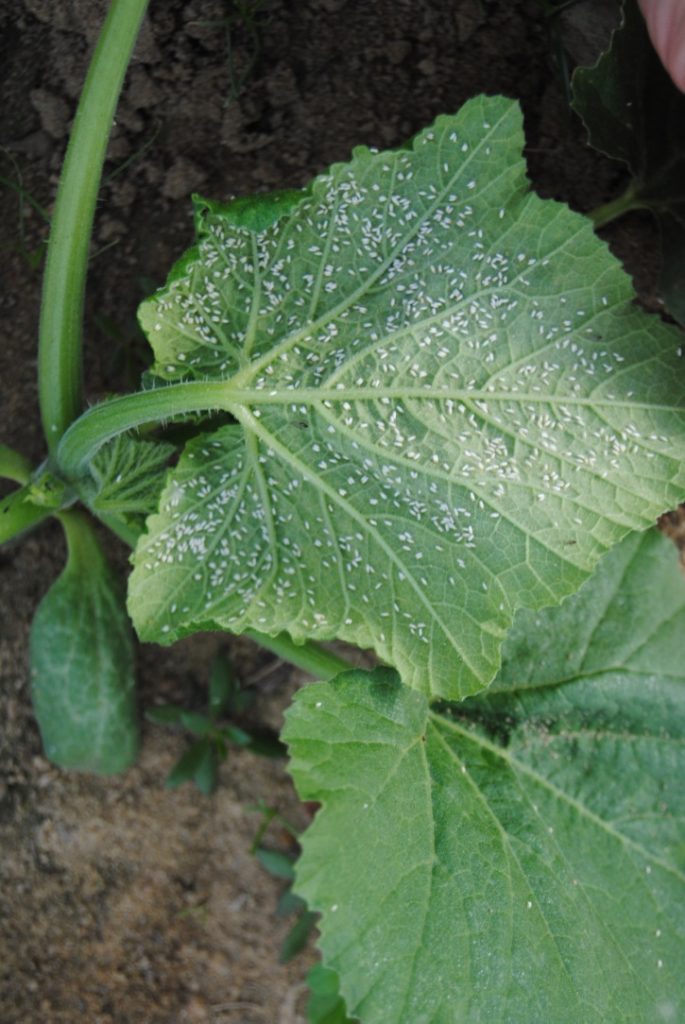
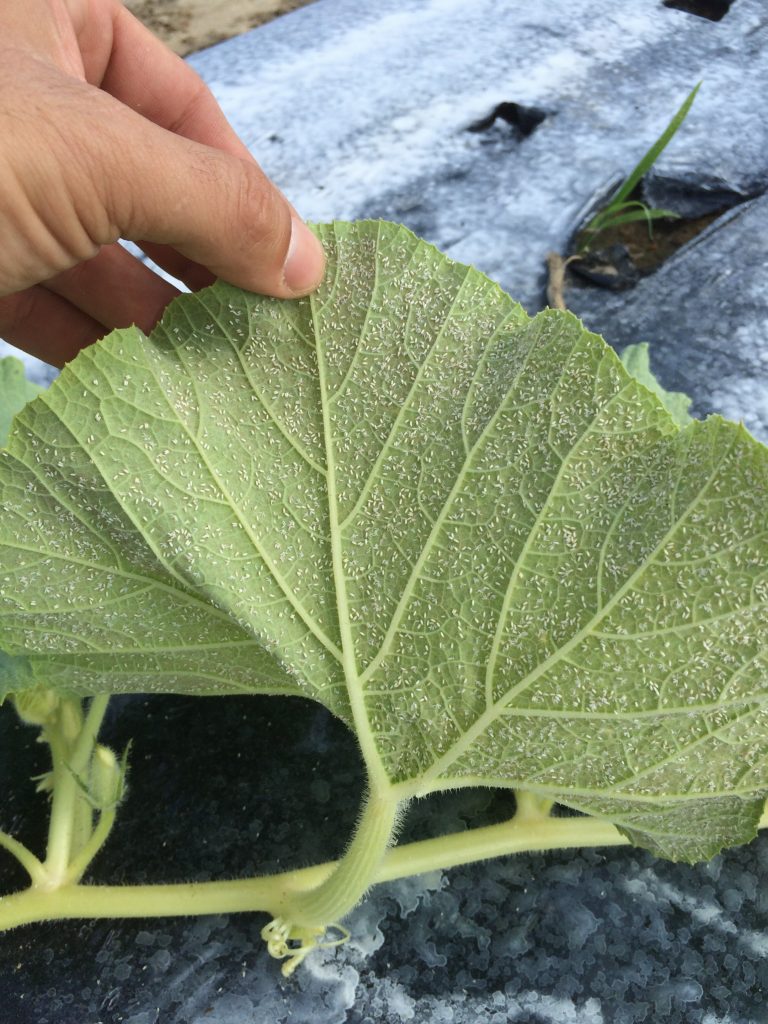
File photo shows whitefly adults feed on a yellow squash seedling.
This has been the year of the whitefly for vegetable producers in the Southeast. Even as they have been a problem for Georgia vegetable producers, they have also been a nuisance for Alabama farmers.
Ed Sikora, an Alabama Extension Specialist Professor in Entomology and Plant Pathology at Auburn University, said he’s seen quite a few whiteflies on some of the cucurbit crops like zucchini, yellow squash and pumpkin. The whitefly pressure has increased this year and is impacting locations not used to whitefly damage.
“I don’t work with insects typically, but they seem more common on the cucurbit crops in some of our monitoring plots this year than in past years. Every so often I’ll see the silverleaf damage on squash and so forth,” Sikora said. “This year they seem to be more common than I’ve seen in the last five years on that crop. I saw some last year in the Brewton area. This year I’m seeing them up around, even Auburn. It was heavy down in the Dothan area and in Brewton again.”
What’s most concerning for Alabama vegetable growers are the viruses whiteflies can transmit. They are responsible for transmitting multiple viruses, including cucurbit leaf crumple virus and cucurbit yellow stunting disorder virus. They’re also concerning for vegetable producers in Georgia where whiteflies are before coming to Alabama.
According to the University of Georgia crop loss estimates for fall 2017, the last major infestation period prior to this year, these viruses caused between 30% and 50% crop loss in squash and cucumbers and nearly 80% crop loss in snap beans that year. Vegetables like squash, zucchini, cucumber, cantaloupe and snap beans are highly susceptible to these viruses.
“We’re a little bit concerned because we know that they can transmit some plant viruses. These are occurring in Florida and we assume they are occurring in Alabama as well. We think with more whiteflies in the southern tier of the state that we’re probably seeing more whitefly-transmitted virus problems. That’s something we’re looking into, currently,” Sikora said.