Due to COVID-19, all pesticide license testing in Florida was suspended for more than six weeks. Now that the state has started to reactivate services, testing will resume at select UF/IFAS Extension offices on Monday, May 18.
Not all testing locations will open on May 18. Due to the number of COVID-19 cases in certain regions, some counties are opening services more slowly than others, and this will impact where UF/IFAS Extension can test. If your county Extension office is not yet open for testing, you may be required to travel to a county that is offering these services. Visit the UF/IFAS Pesticide Information Office’s website where the status of testing sites are monitored and updated in real time.
“We know that many of you are in great need of testing services so you can resume professional activities,” said Jason Ferrell, director of the UF/IFAS Pesticide Information Office. “We are working to address these needs while complying with both state and local ordinances. Please be patient with our staff as we reactivate these programs.”
Testing is currently operating by appointment only, and walk-ins will likely be turned away as a health precaution to control crowd size and maintain social distancing. There will also be requirements for your safety and the safety of others, which will be explained when you call to make your appointment. Participant safety is of highest concern, and it is highly recommended that you wear a face covering throughout the exam.
At the onset of COVID-19 closures, UF/IFAS and the Florida Department of Agriculture and Consumer Services (FDACS) explored ways to move testing online, which would allow applicators to take the test without visiting a testing location.
“Online testing is still a priority for UF/IFAS and FDACS, but we could not make it a ‘right now’ solution,” Jay said. “This endeavor will take much longer than six weeks, but we are excited to begin reopening testing locations to keep you working.”
Figure 1. Roots of blue lupin (left) and sunn hemp (right) are infected with Meloidgyne arenaria root-knot nematode and stained with acid fuchsin. Nematode galls and egg masses are visible on blue lupin, indicating its susceptibility to the nematode. In contrast, sunn hemp-infected roots are gall-free with a few egg masses, suggesting that it is a poor host for M. arenaria.
By Abolfazl Hajihassani and Josiah Marquez
Multiple cover crops are excellent candidates for vegetable growing systems in the southern United States due to their ability to fix nitrogen, build and maintain soil organic matter, and suppress soilborne pathogens, nematodes and weeds. In addition, cover crops can be a valuable strategy for improving microbial diversity and soil health when properly implemented.
There is plenty of evidence in scientific literature to support positive effects of certain cover crops in management of plant-parasitic nematodes. The key to success is understanding the factors that drive variation. Though suppressive cover crops will not eliminate nematodes from soil, they may reduce their population densities enough to allow proper production of susceptible vegetable crops in infested fields.
In Georgia, multiple root-knot nematodes (Meloidogyne spp.) are widely dispersed in the southern part of the state where they cause severe yield losses particularly in cucurbits, eggplant, tomato and pepper. During a survey in 2018 for nematodes in commercial vegetable-growing regions in southern Georgia, root-knot nematodes were found in approximately 67 percent of fields.
In the Southeast, chemical control is the most predominant approach for managing Meloidogyne spp. in intensive cultivation systems of vegetables.
However, certain summer cover crops, including sunn hemp (Crotalaria juncea), sorghum-sudangrass (Sorghum bicolor x S. sudanense) and velvetbean (Mucuna pruriens) have been implicated in reducing population densities of root-knot nematodes in soil. In Georgia, despite long growing seasons, the practice of growing two to three crops on the same piece of land often leaves a narrow window for the use of cover crops.
COVER CROP CULTIVAR CONSIDERATIONS
Many summer cover crops are susceptible to nematodes, resulting in an undesired population increase in soil during the growth of crops. To avoid this, cover crop species or cultivars that are poor hosts (resistant) to nematodes should be recognized.
In an attempt to find alternatives for control of root-knot nematodes in vegetable production systems, a series of greenhouse experiments was conducted in 2019 at the University of Georgia Tifton campus. The goal was to identify cover crop species/cultivars with potential to prevent the reproduction of M. javanica, M. incognita and M. arenaria. The cover crop susceptibility/resistance was characterized by evaluating root galling and egg-mass index.
Results exhibited that different cover crops respond differently to infection by root-knot nematodes. For example, certain nematode-infected cover crops produce both galls and egg masses on roots, whereas others may only induce either galls or egg masses (Figure 1). M. javanica, M. incognita and M. arenaria aggressively reproduced on blue lupine (Lupinus perennis), hairy vetch (Vicia villosa) and cowpea (Vigna unguiculata). These plants were highly susceptible to these nematode species.
Cover crops that were highly resistant across all three Meloidogyne species include velvetbean, marigold (Tagetes sp.) and sesame (Sesamum indicum). Resistance to parasitic nematodes is characterized as the ability of a plant species to prevent root-knot nematode development or reproduction.
The reproduction of these nematode species on sorghum-sudangrass and sunn hemp varied from susceptible (good host) to highly resistant (nonhost) plants. For example, an unspecified cultivar of sunn hemp was susceptible to M. arenaria and resistant to both M. javanica and M. incognita.
KEY POINTS
In summary, proper selection of a cover crop plays a key role in control of root-knot nematodes. It is important to note that a cover crop species may not provide resistance to all species of root-knot nematodes. In addition, all cultivars of the same cover crop may not create equal levels of nematode control.
Figure 2. University of Georgia researchers are studying the effects of sunn hemp and tillage practices on soilborne diseases, nematodes and weeds. Sunn hemp is harvested and chopped followed by tilling the residue into the soil.
Special attention to the presence of other plant-parasitic nematodes in soil is also necessary when planting a cover crop. Past research has suggested that Meloidogyne-resistant cover crops may support the reproduction of other nematode types in the soil. If vegetable growers think they are having issues with nematodes, soil samples can be analyzed at nematode diagnostic services to determine the types/species of nematodes and their population density for proper selection and management of cover crops to meet goals.
Other key factors to get the optimal benefits of cover crops are planting time, seeding rates and termination (mowing) times. Currently, field research (Figure 2) is being conducted in southern Georgia to determine the effect of spring and summer planting of sunn hemp for optimal biomass production and its influence on nematodes, weeds and soilborne diseases. The goal is to examine the effects of cover crops alone or in combination with tillage practice or chemical control approaches for effective management of plant-parasitic nematodes.
Figure 1. The pepper weevil is one of the most serious pests of peppers.
By Clint Thompson
Florida produce growers need to be wary of the pepper weevil, which is running rampant in the state’s vegetable fields.
According to the South Florida Vegetable Pest and Disease Hotline, pepper weevils are out of control on the East Coast in Florida vegetable fields. Growers are also seeing damage increasing in eggplant.
Damage is so extreme in remaining peppers that growers are having to terminate many of their plantings.
In addition, South Florida farmers are reporting that the Cuban pepper weevil is a problem.
University of Georgia entomologist David Riley said that 70% of the winter peppers imported into the U.S. are grown in Mexico, where pepper weevils originate. He stresses that even a small percentage of weevil-infested fruit can lead to an infestation.
Thresholds are one adult per 400 terminal buds or 1% of the buds infested. Populations are best observed by visual examination and yellow sticky traps.
Insecticides are commonly applied to the plant foliage at short intervals once budding begins.Chemical suppression is feasible, but insecticides vary in effectiveness. Despite the presence of chemical insecticides some loss is inevitable. Actara, Vydate, diamides and pyrethroids can be used in a program to control the pepper weevil. Consult the University of Florida/Institute of Food and Agricultural Sciences recommendations for currently labeled insecticides for proper control in Florida.
There are a couple of factors for farmers to consider if they hope to disrupt the weevil’s life cycle. Proper sanitation and a crop-free period, if it’s accompanied by the destruction of alternate hosts can be effective. Sanitation involves any practice that eliminates or reduces the amount of pathogen inoculum, pests, or weed seeds that are still present in the field.
Vegetable farmers are reminded they need to practice proper sanitation once harvest season ends. Doing so will protect against future pests and diseases.
According to the South Florida Vegetable Pest and Disease Hotline, one of the best tactics that growers can do for themselves and their neighbors is to clean up crop residues promptly after harvest. Sanitation involves any practice that eliminates or reduces the amount of pathogen inoculum, pests, or weed seeds that are still present in the field.
One of the biggest problems associated with lack of sanitation is with whiteflies. They overwinter and can survive on multiple hosts. This is especially true for those hosts that are not eliminated thoroughly after harvest. They are already a problem for Georgia vegetable farmers.
If farmers will destroy tomato vines promptly, they will kill off whitefly populations. They’ll also eliminate the transmission of the tomato yellow leaf curl (TYLCV) and other viruses to subsequent crops. It also will eliminate inoculum from late blight and other fungal diseases. This is particularly important in the case of TYLCV and other viruses. Sanitation, a crop-free period, and whitefly/thrips control are the only tools currently available for the management of this disease.
Downy and powdery mildew on melons can spread via wind from older, diseased plants to plants in surrounding fields that are still maturing. If farmers will plow or disk under infected plant debris, this will help cover up the inoculum and speed up the disintegration of plant tissue. It kills the pathogen.
Cull Piles
Cull piles should also not be neglected. Several scouts have reported over the past few years that they have found both insects and diseases such as TYLCV, late blight, whiteflies and others in volunteer plants springing up around cull piles.
Soil tillage can destroy insects and expose them to birds and other predators. It can also speed the breakdown of plant residues that harbor insects and plant pathogens. By either allowing the organic matter in a field to decompose completely before planting the next crop or allowing a fallow period between crops, you can enhance the control of numerous insects and diseases.
Florida vegetable farmers are struggling to manage high whitefly pressure amid trying to produce this year’s crop. According to the South Florida Vegetable Pest and Disease Hotline, tomato growers in central Florida are really struggling with heavy whitefly pressure.
It noted, “Some growers have already experienced whitefly and virus issues in spring crops and have pulled up entire first plantings due to very high incidence of Tomato Yellow Leaf Curl Virus. Respondents indicate that whiteflies are also increasing in melons. Whitefly pressure is also high in green beans.”
Around Southwest Florida, in the Immokalee, Florida area, pressure has been extreme for the acreage that remains to be harvested. These include for watermelons and other cucurbits.
On the east coast, respondents report that whitefly have become out of control in many tomato and eggplant fields. They’re also high in cucumber and pepper.
The South Florida Vegetable Pest and Disease Hotline is in its 23rd year and reaches more than 1500 individuals and businesses and covers more than 120,000 acres representing all major South Florida vegetable production areas.
Already in Georgia
Whiteflies are already a concern in Georgia. University of Georgia Cooperative Extension vegetable specialist Stormy Sparks confirmed the pest has been observed in vegetables in the South Georgia area.
The mild winter is a key reason why whiteflies are already a problem. While colder temperatures don’t eliminate whiteflies, they do kill many of their wild hosts. They also slow population development in cultivated hosts. Warmer temperatures this winter allowed for larger whitefly populations to overwinter and become mobile earlier.
Whiteflies cause feeding injury issues in vegetables and transmit two viruses: cucurbit leaf crumple virus and cucurbit yellow stunting disorder virus. Vegetables like squash, zucchini, cucumber, cantaloupe and snap beans are highly susceptible to these viruses. Commercial cultivars that have resistance or tolerance to these pathogens are not available.
For additional information about whiteflies, see UGA CAES News.
University of Georgia Cooperative Extension vegetable entomologist Stormy Sparks said whiteflies are present in Georgia vegetables. This is not good since cotton farmers have begun planting their crop, and whiteflies like to feed on cotton plants as well.
“There’s some. I don’t know if it’s worse or better or whatever compared to other years. Apurba’s been running those traps and checking some fields and he’s finding whiteflies,” said Sparks, referring to Apurba Barman, a postdoctoral researcher under UGA entomologist Michael Toews.
“Apparently, they’ve always been here. But yeah, noticeable numbers in April is early, particularly in any fields. Where he’s finding most of them is kale which is not a good sign. That’s one of the crops they overwinter in. This time of year, having numbers is not good in any crop.”
Why So Early?
While colder temperatures don’t eliminate whiteflies, they do kill many of their wild hosts. They also slow population development in cultivated hosts. Warmer temperatures this winter allowed for larger whitefly populations to overwinter and become mobile earlier.
“They’re able to carry through on crops a little easier. It never really gets cold enough here to really kill them, it just slows them down. Hopefully, the crops we have out there in the winter are not as good of hosts as some of our spring, summer or fall crops. You’re always hoping they’ll crash during the winter. But yeah, the mild winter undoubtedly plays a role in them overwintering a little better.”
Whiteflies cause feeding injury issues in vegetables and transmit two viruses: cucurbit leaf crumple virus and cucurbit yellow stunting disorder virus. Vegetables like squash, zucchini, cucumber, cantaloupe and snap beans are highly susceptible to these viruses. Commercial cultivars that have resistance or tolerance to these pathogens are not available.
Will They Get Worse?
The weather patterns over the next couple of months will determine if the whiteflies continue to worsen. How much rain will there be? How heavy are the rains and when will they occur? This is especially important as farmers move from winter crops to spring crops and then to cotton. Freezes in the winter and a tropical storm-type of weather system really impact populations.
“You never want a tropical storm but a good tropical storm at the right time really knocks them back,” Sparks said.
Sparks and other specialists continue to preach sanitation with whitefly management. He said farmers have done better in recent years in getting rid of winter vegetables once they’re done harvesting. That needs to continue with the spring crops once they’re done.
“If you’ve got crops where you know you’ve got them, if you’re done with the crop, get rid of that crop,” Sparks said. “I think overall we’ve been doing a better job with sanitation. That’s something we always need to hammer on and remind them that sanitation is critical.”
The Using Pesticides Wisely (UPW) program will be offered in an online format this year, due to the ongoing coronavirus pandemic. The program has helped Georgia reduce pesticide drift complaints to the University of Georgia Cooperative Extension Service. It will be held this week April 21-23 at various locations.
“Our Using Pesticides Wisely programs started in 2015. We are proud to say that every person in our state has been trained face to face. We appreciate the opportunity to communicate with our growers in that type of platform,” said University of Georgia Extension weed specialist Stanley Culpepper. He will provide a voiceover from UGA. “Obviously, everybody on planet Earth is influenced by this virus. So we had to adjust. We felt like the best way to adjust was for the Cooperative Extension Service, kudos to our county agents, to take the lead. We made the powerpoint presentations with voiceovers. That’s what will be presented during the trainings that’ll occur (this) week.”
UGA Extension and the Georgia Department of Agriculture created the UPW trainings in 2015. The Georgia Department of Agriculture will also have a representative as part of the presentations.
The state program is aimed at teaching farmers and other pesticide applicators how to properly apply pesticides. The number of pesticide drift complaints in Georgia to the Cooperative Extension Service have been reduced by 76% over the past five years, since the UPW trainings were implemented.
“If you’re going to apply the Dicamba products that are labeled for use in Dicamba in cotton or soybeans or you’re going to apply 2,4-D in their respective tolerant crops, you must have taken this training in 2019 or this year. You have to do that,” Culpepper said.”
Growers should choose one of the four webinar sessions and register for the date and time that works best for their schedule.
Session dates, times and registration links are:
April 21, 10 a.m. – Host: Bulloch County Extension Coordinator Bill Tyson, 912-871-6130. Register here.
April 22, 10 a.m. – Host: Laurens County Agriculture and Natural Resources Agent Raymond Joyce, 478-272-2277. Register here.
April 23, 10 a.m. – Host: Early County Agriculture and Natural Resources Extension Coordinator Brian Cresswell, 229-723-3072. Register here.
April 23, 6 p.m. – Host: Tift County Agriculture and Natural Resources Agent Justin Hand, 229-646-1413. Register here.
University of Georgia: Critical pesticide application training for pest control professionals and producers will go online for 2020.
The University of Georgia and Georgia Department of Agriculture dicamba training program, Using Pesticides Wisely 2020, will move to online delivery for the remaining sessions.
Using Pesticides Wisely (UPW) is a state program aimed at teaching farmers and other pesticide applicators how to properly apply pesticides to limit pesticide drift in Georgia. Only farmers and other pesticide applicators who were not trained in 2019 need to complete the 2020 training, according to a decision by the U.S. Environmental Protection Agency.
Growers should choose one of the four webinar sessions and register for the date and time that works best for their schedule.
Please note that each online session has its own registration link. It is important to use the link that matches your preferred time. Required registration information includes address, phone number, email and pesticide license number for each registrant. A license is not required for 2,4D application, so those registrants can enter N/A in that field.
Meeting links will be emailed to registrants prior to the 1.5-hour sessions. Participants will be able to submit questions using a chat box or over the phone. Attendees’ names will be placed on a list posted to the Georgia Department of Agriculture’s Auxin website. Please allow up to 21 days after the training date for names to be posted. This list will serve as the official training record and attendance verification.
Session dates, times and registration links are:
April 21, 10 a.m. – Host: Bulloch County Extension Coordinator Bill Tyson, 912-871-6130. Register here.
April 22, 10 a.m. – Host: Laurens County Agriculture and Natural Resources Agent Raymond Joyce, 478-272-2277. Register here.
April 23, 10 a.m. – Host: Early County Agriculture and Natural Resources Extension Coordinator Brian Cresswell, 229-723-3072. Register here.
April 23, 6 p.m. – Host: Tift County Agriculture and Natural Resources Agent Justin Hand, 229-646-1413. Register here.
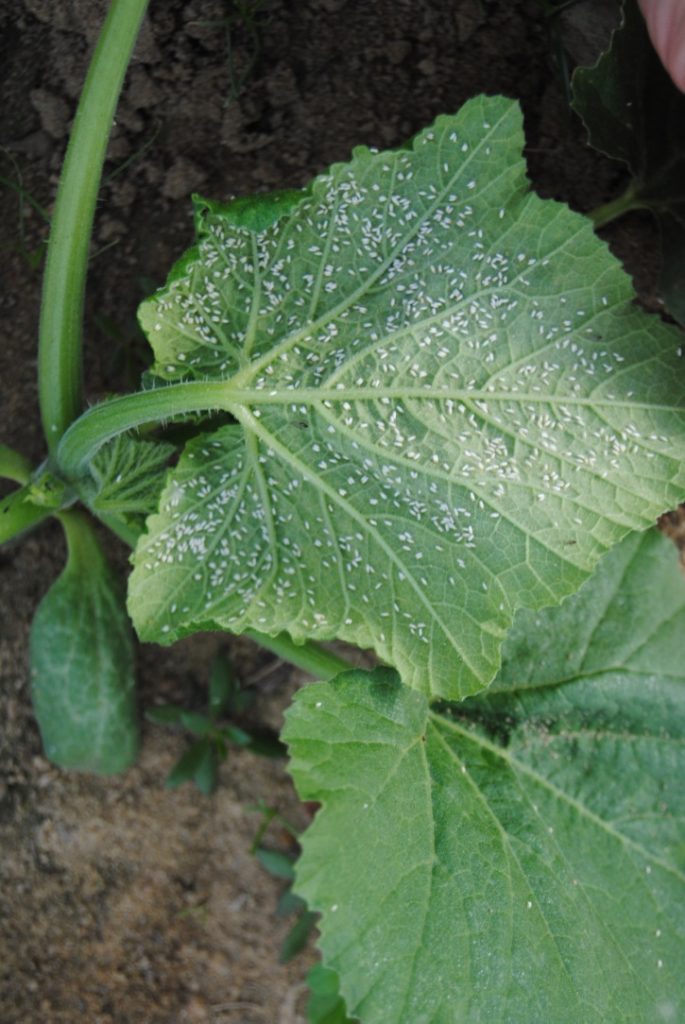
This file picture shows whiteflies on a squash leaf.
By Clint Thompson
Between the coronavirus pandemic and decreased demand for their product, Florida’s vegetable farmers have had their share of challenges this past month. Add whiteflies to the list.
According to the South Florida Vegetable Pest and Disease Hotline, the Immokalee, Florida area in South Florida has seen hundreds of acres abandoned. This is due to irregular ripening and high incidences of tomato yellow leaf curl virus disease (TLCVD).
There’s been some reports of 50% to 80% of the disease being seen in several vegetable fields. According to Gene McAvoy, University of Florida/IFAS Regional Vegetable Extension Agent IV Emeritus and President of the National Association of County Agricultural Agents, whiteflies have been problematic in tomatoes, watermelons and other cucurbits.
“We’ve had a number of growers destroy substantial amount of acreage, even before this whole COVID-19 thing blew up. We’ve had a lot of irregular ripening because of high levels of whiteflies. Most of our growers are using a resistant (tomato) variety so that’s not an issue in the round tomatoes. But especially with the Romas that have no resistance, they’re getting tore up,” McAvoy said.
The whiteflies’ impact on tomatoes is felt across Central Florida and on the East Coast where pressure is higher in older tomatoes. Whiteflies are also problematic in cucumber and pepper and are increasing in melons.
High incidences of whiteflies may be attributed to the mild winter. While colder temperatures don’t eliminate whiteflies, they do kill many of their wild hosts and slow population development in cultivated hosts. Warmer temperatures allow for larger whitefly populations to overwinter and become mobile earlier.
“Down here our strategy is to try to have clean fallow in the summer and not have anything for them. We usually start off pretty low but if we have a warm, mild winter like we’ve had the past couple of years where they start building in the fall, they just continue going this time of year. They basically become unmanageable,” McAvoy said.
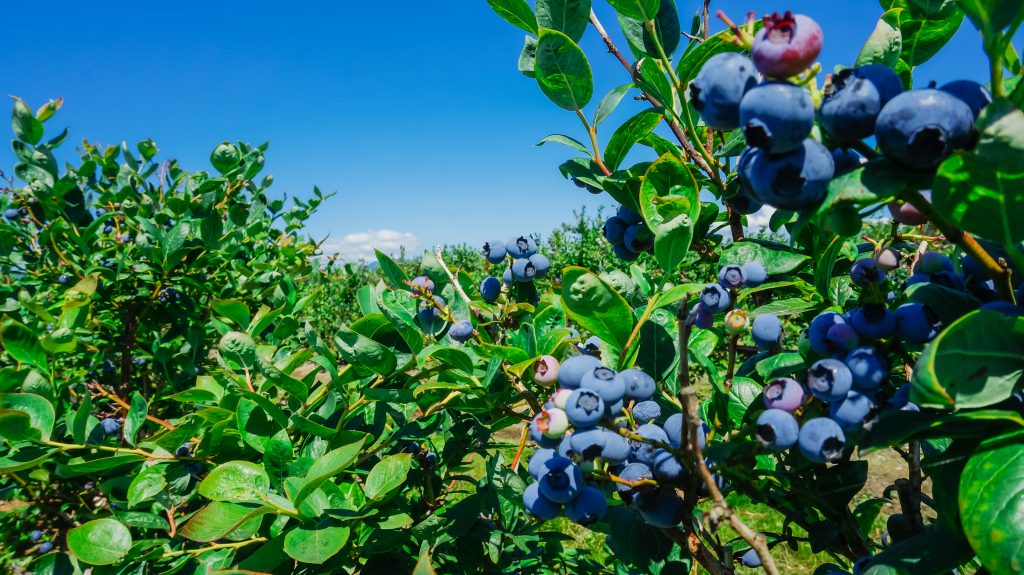
Mite management in blueberries is essential. File photo of blueberry production.
By Ashley Robinson
Several mite species have been reported as pests of Florida blueberries. According to Oscar Liburd, professor of entomology at the University of Florida (UF), southern red mites and false spider mites are especially high on growers’ radars this year.
SOUTHERN RED MITES
Currently, there is little known about the management of southern red mites in southern highbush blueberries.
“Five years ago, mites weren’t a pest seen in blueberries. However, within the last few years, they’ve shown up quite regularly,” Liburd says.
Southern red mites have caused 80% to 100% losses in some blueberry plantings and have caused some growers to abandon their plantings due to major losses. The mites insert their chelicerae into the plant, preventing the plant from developing normally and impacting crop yields.
According to Liburd, the first step growers should take to manage mites is to monitor their fields and properly identify the pest. Southern red mites are easy to identify due to their larger size and reddish-brown coloring.
FALSE SPIDER MITES
The False spider mite, or flat mite, is known to be an economically important plant-feeding mite in citrus. However, recently this mite was found to feed on southern highbush blueberries.
False spider mites are much smaller in size compared to southern red mites and can’t be clearly seen without a microscope. These mites harbor underneath the leaf along the mid-vein and are brick-red to yellow in color.
MANAGEMENT OPTIONS
Two miticides have recently been labeled for use in southern highbush blueberries – Magister and Portal.
Liburd has several recommendations for organic producers.
“Organic growers have the option to use sulfur or they can remove weeds from nearby host plants to reduce the number of mites. Also, water management to reduce plant stress is highly recommended as well as periodically releasing predatory mites can reduce populations,” Liburd said.
According to Liburd, farmers can also expect to see some new miticides soon, as well as some new and promising products for organic growers. In addition, Liburd expects to see new blueberry cultivars being developed that are resistant to these mite populations.