This pepper weevil grub was found inside a jalapeno pepper.
According to the South Florida Pest and Disease Hotline, pepper weevil pressure is high in Palm Beach County. Pepper weevil numbers are also increasing around the Homestead, Florida area.
Respondents report that weevil pressure continues to increase around southwest Florida. Older fields are hosting high populations, while adults are now showing up in most younger pepper plantings.
Weevil numbers remain mostly low in the Manatee Ruskin area.
Click here for management options of pepper weevil.
The sweetpotato whitefly (Bemisia tabaci) is one of the most problematic pests in vegetable production in the world and it is a key pest in squash. Most significant damage caused by this pest is due to the transmission of viral diseases and its ability to rapidly develop resistance to pesticides.
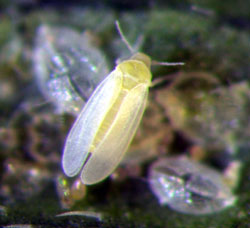
Sweetpotato whiteflies can develop from egg to adult in two to three weeks under optimal environmental conditions (77 to 91°F, 50-70% relative humidity). Adult whiteflies are ~0.03- inch-long, yellow insects with two pairs of iridescent white wings.
Females can live up to 24 days and lay up to 300 eggs. Eggs are oval, pearly white to yellow, and darken as they mature.
Whitefly nymphs disperse briefly within the same leaf and then attach permanently to the leaf while continuously feeding on its contents. Before turning into adults, nymphs are less flattened and have big red eyes.
THE DAMAGE DONE
Sweetpotato whiteflies are usually found living and feeding on the lower side of squash leaves. Nymphs excrete honeydew that accumulates on leaves, flowers and fruit when populations reach high numbers. This results in sooty mold (fungus) development, reduction in photosynthesis and fruit losses.
A) Silvered squash leaves. B) Healthy fruit (top) and fruit with discoloration due to viral infection (bottom)
Feeding of nymphs is also associated with the development of squash silverleaf disorder in pumpkins, winter and summer squash, and some types of butternut squash. Squash silverleaf causes the newly developing leaves to turn silver due to proteins in the nymph’s saliva. Decreased photosynthesis and yield reductions result from high silvering of the squash leaves.
Additionally, sweetpotato whiteflies transmit multiple viral diseases to squash. These include cucurbit leaf crumple virus, cucurbit yellow stunting disorder virus and squash vein yellowing virus. Common symptoms of viral diseases in squash include plant stunting, leaf and fruit malformation, yellowing and discoloration.
In Florida, squash is grown mostly during the fall from mid-September to mid-November. Some growers may also plant squash in the spring from mid-March to mid-April. It is common to have higher whitefly pressure during the fall compared to the spring season. The combination of whitefly-transmitted diseases with high pest infestations can cause up to 50% reduction in marketable yield during the fall compared with the spring season when fewer viral diseases and low whitefly infestation levels are observed.
WHAT TO DO
The management of plant viruses is best achieved when resistant varieties are available. However, there are no squash varieties resistant to whitefly-transmitted viruses yet. Therefore, squash plant viruses are mainly managed by suppressing the vector.
Sweetpotato whitefly populations are usually managed using insecticides that are applied on a weekly basis. However, the development of resistance against these insecticides is always a major concern. Entrust (spinosad) is a low-risk pesticide commonly used in vegetable crops, but it is not effective against whiteflies. Other low-risk pesticides such as M-Pede® (soap concentrate) or Azera® (azadirachtin + pyrethrins) are effective against whitefly populations and can be used together with biological control agents like predatory mites.
A) Adult predatory mite (Amblyseius swirskii) females guarding eggs. B) Larvae (left) and nymph (right) of A. swirskii
The predatory mite Amblyseius swirskii is an effective predator of major pests found in Florida squash including sweetpotato whitefly and thrips. A. swirskii feeds mostly on whitefly eggs and small whitefly nymphs. Data from University of Florida biological control field studies showed that the predatory mites released onto squash leaves can rapidly disperse to other plants and suppressed whitefly populations as early as four weeks after planting. Additionally, squash silvering can be significantly reduced when this predatory mite is released.
Data from field trials also indicate A. swirskii can disperse regardless of the squash cultivar. Moreover, squash cultivars exhibit different levels of sweetpotato whitefly attraction and susceptibility to silvering. Gold Rush is a sturdy squash cultivar that showed fewer silvered leaves compared to high-yielding squash cultivars such as Zephyr and Cash Flow. Additionally, Zephyr and Cash Flow seemed more susceptible to squash silverleaf.
Zephyr squash is very attractive to farmers and consumers due to its green-yellow tone, but it was observed to be highly attractive to whiteflies as well. This is probably due to the light green color of the leaves that make the plants easily detected by whiteflies.
No significant reductions in yield were observed despite high levels of silvering. However, plants were observed to be stunted and deformed when infested with high numbers of whiteflies and in the presence of whitefly-transmitted viruses. Thus, early management of sweetpotato whiteflies is recommended to avoid risking fruit quality.
It is important to combine the use of predatory mites with other practices such as intercropping flowering plants in row middles or at the edges of the squash crop to attract other predators and parasitoids that can complement the release of predatory mites. Additionally, low-risk pesticides can be used to lessen severe whitefly infestations three to five days before the release of the predatory mites. It is best to release the predatory mites early in the morning or late in the afternoon to avoid the hottest hours of the day, during days with low winds and when there is no forecast for rain.
Lorena Lopezis a postdoctoral research associate and Oscar E. Liburdis a professor at the University of Florida in Gainesville.
A farmer may have a certain Integrated Pest Management (IPM) plan to utilize during this year’s growing season. Mother Nature may have other ideas, however.
Ayanava Majumdar
Ayanava Majumdar, Extension Professor in Entomology and Plant Pathology at Auburn University, stresses that weather can challenge IPM plans.
“The local weather patterns are really challenging agriculture. Not just now, it’s been happening for a long time,” Majumdar said. “What I want to show you is how we’ve cycled between drought, a prolonged drought and then we had a very wet year and then we had a flash drought. These weather patterns are really impacting how insect populations are growing, how they’re behaving and then our effectiveness with insecticides, whether it be organic or conventional.”
Insect Impact
In the summer of 2016, a prolonged drought led to an increase in moth activity for fall armyworms, beet armyworms, squash vine borers and cabbage loopers. The following summer was a wet year, which led to major decreases for moth activity.
In the summer, 2019, a flash drought occurred. It led to a sudden increase in moth activity for soybean loopers, corn earworms, fall armyworms, lesser cornstalk borers, cabbage loopers, tobacco budworms, beet armyworms and squash vine borers.
“To me, I think that flash drought is very dangerous. In 2019, I saw two acres of tomato plots for research, that flash drought increased insect pressure so suddenly that we were just unaware of the high population that suddenly the crop was looking really bad with insect outbreaks. I think we are better situated for handling a prolonged drought. We have drip irrigation systems most of the time. But if you have a flash drought, you just don’t know, it comes suddenly, affects the crop and increases the insects,” Majumdar said.
He added that a flash drought can cause more than 70% crop loss in late-season tomatoes.
According to the most recent South Florida Pest and Disease Hotline, whitefly pressure continues to build across the region, with populations reaching high numbers. This is especially true in older cucurbit and fruiting vegetables at or close to harvest.
Whiteflies feed on various hosts but the crop that’s proven to be most vulnerable is older tomato fields that should have been terminated by now.
Growers and scouts on the east coach report that pressure is building in older eggplant and tomato. Whiteflies are migrating out of these crops and putting pressure on nearby fields. Whiteflies are also causing problems in some pepper.
In Homestead, whitefly numbers are high in tomato and other crops. Tomato yellow leaf curl virus, which is vectored by whiteflies, is also high in most tomato fields. Some hotspots are also present in beans.
A few hotspots of adults and nymphs have been reported in snap benas in Pahokee and Clewiston, Florida.
According to UF/IFAS, Asian bean thrips (ABT) populations continue to swing back and forth across the South Florida region. While flower thrips are the predominant species north of Miami-Dade, a few locations still are reporting ABT at the dominant species.
ABT populations ranged from 0.2 to 0.7 per bloom in southeastern Hendry County. Populations were reduced where records of 10 ABT per bloom were previously located to 0.1 to 1.1 per bloom. A change in the user’s pesticide program to include 5 modes of action multiple sprays per week is likely the reason for the population drop.
ABT populations ranged from 0.0 to 2.0 ABT per bloom at bloom and early pod development stages in northeastern Hendry County. Hotspots were reported in central Hendry County, where populations ranged from 0.1 to 1.6 ABT per bud or bloom.
Populations increased to 1.0 to 2.0 ABT per bloom or 1.0 to 5.0 ABT per plant in eastern Palm Beach County. A few hotspots remain in western and northwestern Palm Beach County, with reports of 1.0 to 2.0 ABT per bloom.
Snap bean plantings are still young in southern Martin County, so ABT was not reported. Beans were harvested, and young peas were not yet scouted in northern Collier County.
Another southern pea season means one thing for Alabama producers; cowpea curculio will be a factor.
“If you’re a southern pea grower, odds are you have seen this insect or will see this insect at some point in the production cycle,” said Neil Kelly, Alabama Extension Regional agent in Southeast Alabama. “Over the last several years, it has become devastating to southern pea crops in the Southeast for sure.”
As devastating as cowpea curculios can be, it’s important that growers utilize every tool in the toolbox.
Crop rotation helps prevent pest buildup. Spray frequently in 3-to-5-day intervals when label permits. Alternative insecticides applied to the soil and foliar application need high moisture.
Kelly recommends that growers start insecticidal treatments two to three weeks before flowering. Second generation curculios can overwhelm the crop if not controlled.
Mix PBO with synthetic pyrethroids, but it’s important to rotate chemicals to prevent resistance.
Another important management tactic is also something that should be done every year – scouting. Get ahead of the problem before it worsens throughout the season.
“Obviously, you’ve got to get out there and do your scouting. You’ve got to be diligent,” Kelly said. “You need to scout early in the morning. These insects have a tendency to go down and hide when the sun is bright. Usually, peak activity is sometime around 9:30, 10 o’clock in the morning. Much after that, it starts to get hot, and you’ll see them move further down in the canopy.”
What makes curculios difficult to spot is they’ll drop down and play possum at the base of the plants. It’s also important to check the weeds around the field, specifically broomsedge, narrow-leaved vetch and purple cudweed. Growers need to intensify scouting when flowering begins.
South Florida bean producers continue to contend with Asian bean thrips (ABT) populations. According to the University of Florida/IFAS, populations vary from farm to farm and planting to planting.
In southeastern Hendry County, populations averaged 0.1 ABT per bud and 0.2 to 0.5 ABT per bloom. Even the older plantings had reached counts totaling 2.2 ABT per bloom. Because of record numbers in one field, the crop was disced due to low pod set and damage to pods.
In northeastern Hendry County, ABT populations totaled as high as 2.0 ABT per bloom and early pod development stages, while in the central part of the county, populations have declined and are now at 0.1 to 0.3 ABT per bud or bloom.
In eastern Palm Beach County, populations were 0.7 ABT per bloom or 0.5 ABT per plant, while in western Palm Beach County, hot spots remain with 1.0 to 2.0 ABT per plant bloom.
Sneap bean plantings are still young in southern Martin County. ABT has not been reported.
Beans were harvested and young peas were not scouted in northern Collier County.
Damage from high populations can happen at budding. Therefore, populations must be monitored earlier in the growth cycle. There is currently no research to support thresholds for management. Some scouts are using 1.0 to 3.0 ABT per bloom for reference.
Preventative Measures
Prevention is one of the main components of any Integrated Pest Management program. These measures include cultural control, like sanitation, utilizing resistant varieties, and establishing crop free periods. It is also important to eliminate alternate hosts.
In Homestead, this is a huge problem for snap bean growers, as there are many specialty legumes that are grown for ethnic markets scattered around the area providing year-round hosts for the Asian bean thrips.
In other snap bean producing areas such as Palm Beach and Hendry Counties, there are few cultivated hosts. Weeds become the source of inoculum from one season to the next. The fecundity (ability to produce an abundance of offspring) of the thrips on these weed hosts, combined with the amount of these weed hosts in a given region, determines the base population level of the pest. Reducing weed hosts is critical in reducing the base population of Asian bean thrips.
Figure 1. Southern red mite adult female and male mating (top) and one egg (bottom).
Photo by L. Buss, UF/IFAS
By Oscar E. Liburd, Lorena Lopez and Doug Phillips
Mites can cause significant damage on blueberry plants if not properly managed. Mite species that feed on southern highbush blueberries (SHB) include the southern red mite (Oligonychus ilicis) and the false spider mite or flat mite (Brevipalpus yothersi). The southern red mite is the primary mite pest feeding on blueberry plants in the southeastern United States and is common in fall and early spring. The false spider mite, first reported on SHB in 2016, is more common during summer months.
SOUTHERN RED MITES
In Florida, southern red mite populations increase under dry weather conditions with warm temperatures (60 to 86° F) and reach their peak during the fall. Their life cycle can be completed within two weeks under these conditions, and populations can double within five days with overlapping generations, increasing their potential for significant yield impact.
Adults are similar in appearance to the red form of twospotted spider mites (Tetranychusurticae) and other red Tetranychus species, about 0.4 millimeter in length, red or brown to deep purple in color, with lighter colored legs (Figure 1). Females are slightly larger than males and have a more rounded body shape. Red to brown spherical eggs hatch into pale six-legged larvae. In the nymph stages, mites develop eight legs and are darker and larger.
Figure 2. Female adult flat mite
Photo by: R. Akyazi, University of Ordu
FALSE SPIDER MITES
False spider mites can complete their life cycle in about 19 to 20 days at around 77° F and 60 percent relative humidity. Adult flat mite females are flat and oval, approximately 0.3 millimeter in length, with red-orange coloring (Figure 2). Males and immature stages (larvae and nymphs) are similar in appearance and color pattern to the females but smaller. Eggs are bright red to orange and elliptical in shape.
DAMAGE
Southern red mites primarily live and feed on the lower side of SHB leaves. An accumulation of shed white skins can be observed when populations reach high numbers (Figure 3). Bronze coloring of leaves is the primary symptom accompanying southern red mite injury, with the intensity of bronzing increasing with the level of internal leaf damage (Figure 4). The southern red mite feeds on plant tissues by inserting its mouthparts into the leaf and removing cell contents, resulting in a decrease in the rate of photosynthesis.
In SHB, leaves heavily infested with flat mites typically develop necrotic brown spots (Figure 5).
Figure 3. Southern red mites shed their white skins on leaves.
Photo by D. Phillips, UF/IFAS
MONITORING
In addition to differences in body shape and color, there are other distinctions between southern red mites and flat mites to consider when monitoring for these pests. Flat mites are smaller, move more slowly and are best observed with a hand lens or under a microscope. Southern red mites move more rapidly and can be observed with the naked eye on blueberry leaves. Southern red mites tend to feed over the entire surface of the underside of leaves and produce a web over the infested surface to protect them from predators. Flat mites typically feed near the midrib or secondary veins on the underside of leaves and do not produce a web.
Mite populations tend to increase during hot, dry conditions. Frequent scouting for the presence of mites is recommended for early identification of infestations. Although southern red mites can be seen with the naked eye or a 10x hand lens, flat mites will need a higher magnification lens (20x) for identification.
Typical symptoms of mite feeding (bronzed leaves for southern red mites and necrotic spots for flat mites) are also a good indication of mite infestations. However, monitoring for adults in addition to symptoms is important since by the time symptoms appear, infestation has already occurred and defoliation risk is increased.
Closely examine the underside of leaves with the appropriate magnifying glass to look for adults, shed skins and webbing. Another way to scout for the presence of mites is to sharply tap the foliage onto a sheet of white paper to observe any adult mites.
Figure 4. Bronze-colored blueberry leaves are associated with southern red mite damage.
Photo by D. Phillips, UF/IFAS
The pests favor dusty conditions, and drought-stressed plants can be more susceptible to infestations. In addition to supplying plants with sufficient irrigation, applications of water should be made regularly to roadways or other dusty areas during hot, dry periods.
MANAGEMENT
The flat mite is an important pest of citrus and its biology and ecological interactions have been studied in that cropping system, as well as most of the management techniques used for its control. Because it was only recently reported in blueberries, there are no established guidelines for the control of this mite in blueberry plantings. There is also no available information on miticide performance against flat mites infesting blueberries.
The southern red mite is now an important pest in both protected and open-field SHB plantings. Three miticides — Magister (fenazaquin), Portal (fenpyroximate) and Kanemite (acequinocyl) — have recently been registered for use in highbush blueberries. These miticides target tetranychids and not specifically southern red mites, although Kanemite specifically mentions southern red mites on its label. The miticides control all developmental stages including larvae, nymphs and adults of southern red mites. In addition, Magister provides control of eggs by contact while controlling other stages by both contact and ingestion.
Data from University of Florida Institute of Food and Agricultural Sciences (UF/IFAS) 2020 field trials (where eight miticides were evaluated) indicate that Magister and Portal continue to be the best-performing miticides as shown in 2019 trials. Both products suppressed southern red mite populations and allowed bushes to recover from mite injury. Growers can only make one application per year using Magister and two applications per year with Portal. Kanemite was also effective at reducing southern red mites in 2020.
Additionally, two sulfur-based products were evaluated in the 2020 field trials. Sulfur-CARB, a suspended sulfur soil amendment (elemental sulfur and molasses), is sometimes used for foliar applications to repel mites and insects. It provided good performance for control of mites only after a second application (14 days apart), as well as lower levels of bronzing at the end of the experiment. However, this product is not labeled specifically for southern red mites in SHB. Cosavet DF (sulfur) was not effective at reducing southern red mites.
Figure 5. These necrotic brown spots on blueberry leaves are caused by flat mites.
Photo by: R. Akyazi, University of Ordu
Early identification of mite infestations and implementing management techniques before populations reach high numbers are recommended to avoid yield impacts. Although predatory mites have been an important tool that is used for controlling spider mites, to date they have not been successfully evaluated in blueberry systems.
For more information, see UF/IFAS Electronic Data Information Source Publication ENY-1006, Mite Pests of Southern Highbush Blueberry in Florida (edis.ifas.ufl.edu/in1284).
Oscar E. Liburdis a professor, Lorena Lopez is a post-doctoral research associate, and Doug Phillips is a blueberry Extension coordinator — all with UF/IFAS.
UGA CAES Photo/Phylloxera inside gall from a dissecting microscope.
There’s beginning to be budbreak in pecan orchards throughout the Southeast. As trees start to break dormancy, producers need to begin protecting their crop from one pest who impacts trees this time of year, says Lenny Wells, University of Georgia Cooperative Extension pecan specialist.
“We’re just starting to see it now. This is the time they need to (spray), if they’ve had problems with phylloxera, which is a little small insect that’ll cause those little warty bumps on the leaves and they can also deform the stems. Another species of them can deform the stems and really cause some serious problems there, because it’ll also deform the nuts and cause them to fall off really early,” Wells said. “The time to spray for them is right at budbreak. It’s getting about time to spray those. That’s the main thing they probably need to be looking for right now.”
According to UGA Extension, pecan leaf phylloxera is an insect comparable to aphids. Their feedings can lead to abnormal growths of leaf tissues, and the tissue forms a gall that surrounds the insects. Once it forms, no insecticide can penetrate to the insect.
Temperatures are starting to warm considerably in South Florida. Vegetable farmers need to be mindful of various insects that thrive in hot conditions.
“It’s been warming up so you kind of expect to see a flush of pests in the near future. It’s kind of hit and miss in some places with whiteflies and things,” said Craig Frey, University of Florida/IFAS Hendry County Extension Director.
Conditions are certainly favorable for insect pressure to increase. According to the US Drought Monitor, Hendry County and most of South Florida are listed as abnormally dry.
“The life cycles of the insects tend to shorten some. It’s been a couple of weeks since we’ve had cold weather. Instead of it being moderate for a little while, it’s been pretty hot,” Frey said. “They’re just reproducing quickly and starting to become more of an issue in different areas.”
“Pepper weevils, definitely, if you’re growing peppers; whiteflies for a lot of different things. They can be an issue on beans, even. Thrips are an issue on beans and tomatoes. Really, thrips and whiteflies on most crops. They’re two of the big ones.”