Category: Pecan

  • Thinning Pecan Trees Better Equips Producers For Future

    By Clint Thompson

    University of Georgia Cooperative Extension is encouraging pecan growers to thin their bumper crop this summer to avoid having a down year next season.

    Southeast Georgia Area Pecan Agent Andrew Sawyer said this year’s pecan crop exceeds the 70% fruit-bearing terminals they recommend pecan trees to have at this stage in the growing season, along with having an excess cluster of nuts.

    Pecan trees need to be thinned to avoid having a really down year next season.

    “There’s 90% to 100% of terminals with nuts in pretty much every situation I’m seeing. Then you’re having three, four or even five nuts in a cluster on many cultivars. That’s high as well,” said Sawyer, who said Georgia was bound to have a surplus of pecans this year following Hurricane Michael in 2018.

    “In Georgia this year, we’re probably having the biggest crops in a long time. It was actually kind of thought of it was going to be that way. Generally, after a really bad hurricane or weather event, the following year is pretty low just from the loss of limbs and fruiting branches. But then the year after that, which is 2020 for us, it ends up being almost overload. We’re seeing that.”

    Sawyer said farmers thin their trees normally around the last week in July or first week in August. But this year’s crop is about two weeks early. He projects the third week in July to be when most producers need to act.

    “If there’s any time to do it, it may be 2020. The whole reason for fruit thinning is to minimize alternation,” Sawyer said. “Alternating happens at least a couple of different ways. One of them is carbohydrate storage. That means when you have a large crop and it’s putting everything into that fruit, it doesn’t have a lot of storage for this upcoming year. That can affect next year’s crop. It can actually put those trees into alternation.

    “We’ve got a large crop in 2020. All of these 90% terminals and large cluster of nuts, the tree really can’t even fill that much.”

    The most common way for farmers to thin their crop is to shake the tree, much like they do when the pecans are ready to be harvested. Sawyer said to shake the trees for 1 to 2 seconds.

    “Most people, they’ll never do it. It’s so hard if you’re a grower to let these nuts fall off the tree. You’re having to just let them go,” Sawyer said. “You’re doing it for the overall future, long-term production of the tree, not this year’s production.”

    He cautions producers to shake a few days after a rain or turn irrigation off a few days before shaking to avoid damaging the tree. If there is abundant rainfall or high soil moisture, the cambium layer under the bark will slip more readily, making it easier to damage the tree.

    Growers also need to grease between the rubber flap or pad. This will allow movement between the flap and the pad, reducing movement between the shaker head and tree bark. This further reduces the risk of damaging the tree.
  • Georgia Growers Renew Pecan Assessment

    Photo courtesy of UGA College of Agricultural & Environmental Sciences.

    Georgia Department of Agriculture

    ATLANTA- Georgia pecan growers voted to continue an assessment of one cent per pound of pecans by producers with more than 30 acres for an additional three years — 83.5% of eligible ballots returned were in favor of the assessment.

    The Georgia Agriculture Commodity Commission for Pecans, also known as, the Georgia Pecan Commission was established in 1995 by the State Legislature and supports research, education and promotion of Georgia pecans. Most of the assessment funds are committed to include research on disease control, insect management, plant breeding, fertility, production and nutritional benefits; as well as promotion of pecans, both domestic and abroad. Georgia remains one of the top pecan-producing states in the United States.

  • Scout Aphids Early and Often

    University of Georgia Extension photo/Shows early black pecan aphid damage.

    By Clint Thompson

    According to UGA Extension, aphids are one of the most important pests pecan growers need to manage during the growing season. And they’re also one of the most difficult to control.

    Black-margined aphids and yellow aphids are present all season but it’s not uncommon to see a spike in numbers in mid-to-late June and in August. Andrew Sawyer, University of Georgia Cooperative Extension area pecan agent for Southeast District, said it’s important not to treat black aphids until you start seeing nymph clusters. The threshold is when nymph clusters appear on damaged leaves.

    With yellow aphids, a glossy appearance on the leaves called honeydew is commonly seen. Tree leaves can absorb a good bit of honeydew and be fine. The threshold is 50 aphids per compound leaf.

    If you’re seeing aphid damage on your pecan trees, Sawyer offers these tips.

    1. Don’t spray broadspectrum insecticides. These are pyrethroids and chlorpyrifos. These will harm beneficial insects and flare aphids.
    2. Ignore yellow aphids.
    3. Ignore black aphids before late July.
    4. If black aphids flare up within 3 to 4 weeks following application, apply aphid insecticides and rotate.
    5. Apply gibberellic acid, which is a plant growth regulator. It can prevent black pecan aphid injury and inhibit the establishment of black pecan aphids in the orchard. Gibberellic acid does not affect aphids directly and will not control any other pest, including yellow aphids. Three applications should be made at 2-week intervals, beginning in mid-July, applying 10 oz (or 5 oz of ProGibb LV Plus) each time.
    6. Try to save Nexter late season if needed for black aphids when mites are a problem.

    Sawyer emphasizes the importance of beneficial insects. The two easiest to see in the orchard are lady bug larvae and the eggs of green lace wings. If you flip over a compound leaf and see either of these, your beneficial population is good.

  • Pecan Tree Dieback Scary But Normal For Growers

    UGA Extension photo/Shows leaf scorching on a pecan tree.

    By Clint Thompson

    Leaf scorching and dieback on some young pecan trees is common this year with high temperatures, according to Lenny Wells, University of Georgia Cooperative Extension pecan specialist. But Wells assures growers the problem can be corrected.

    “We see that this time of year pretty much every year; young trees where they’re growing so fast that the root system can’t keep up with what the top is trying to produce. This time of year, it turns off hot and soil temperatures warm up some,” Wells said. “Water demand goes up and those young trees with the root system not fully developed yet have a hard time keeping up. They tend to grow out of it. It’s a scary thing for growers to see. But they do tend to grow out of it fine.

    “Anytime you have a tree like that, that’s struggling and you start seeing some shoots dying back and stuff like that, it’s a sign that’s something’s going on in the root system. If you prune back some of that top and bring the top of that tree back more in line with what the root system can support, that usually is a big help to it.”

    Wells cautions growers to maintain consistent soil moisture or apply water every other day. The longer irrigation is applied, the deeper the water runs. This allows the root system to develop deeper through the soil profile. This also prevents the soil from getting too hot. Soil temperatures that exceed 95 degrees F inhibit root growth.

    In the UGA Extension pecan blog, Wells also said that growers will get more vigor and healthy first-year growth if they plant before March.

  • Pecan Industry Seeks to Establish a Research and Promotion Program

    georgia pecans
    File photo shows shelled pecans and those still in shells.

    USDA Agricultural Marketing Service

    The U.S. Department of Agriculture (USDA) received a proposal from the National Pecan Federation (NPF) requesting the establishment of a research and promotion program to strengthen the position of pecans in the marketplace, maintain and expand markets for pecans and develop new uses for pecans.

    USDA is currently analyzing the proposal. If USDA finds the request justified, the department will publish in the Federal Register a proposed rule with a public comment period seeking input from the industry and interested stakeholders. A copy of the NPF proposal can be found here.

    The proposed program would be established under the Commodity Promotion, Research and Information Act of 1996 and would be financed by an assessment on domestic producers and importers of pecans and administered by a board of industry members nominated by the industry and selected by the Secretary of Agriculture.

    The proposal by the NPF calls for an initial assessment rate of two cents per pound of inshell and four cents per pound of shelled domestic and imported pecans. Handlers would collect assessments from producers based on the pounds of pecans received and importers would pay assessments on pecans when they enter the U.S. for consumption. Domestic producers and importers of less than 50,000 pounds of inshell pecans (25,000 pounds of shelled pecans) on average for four fiscal periods would be exempt from paying assessments.

    NPF proposed that the board consist of 17 members to include producers representing different pecan-producing regions within the United States and importers of pecans.

  • UGA Pecan Team Emphasizes Scab Disease Management

    By Clint Thompson

    The University of Georgia (UGA) pecan team is emphasizing scab disease management, since June and July are critical times for disease control.

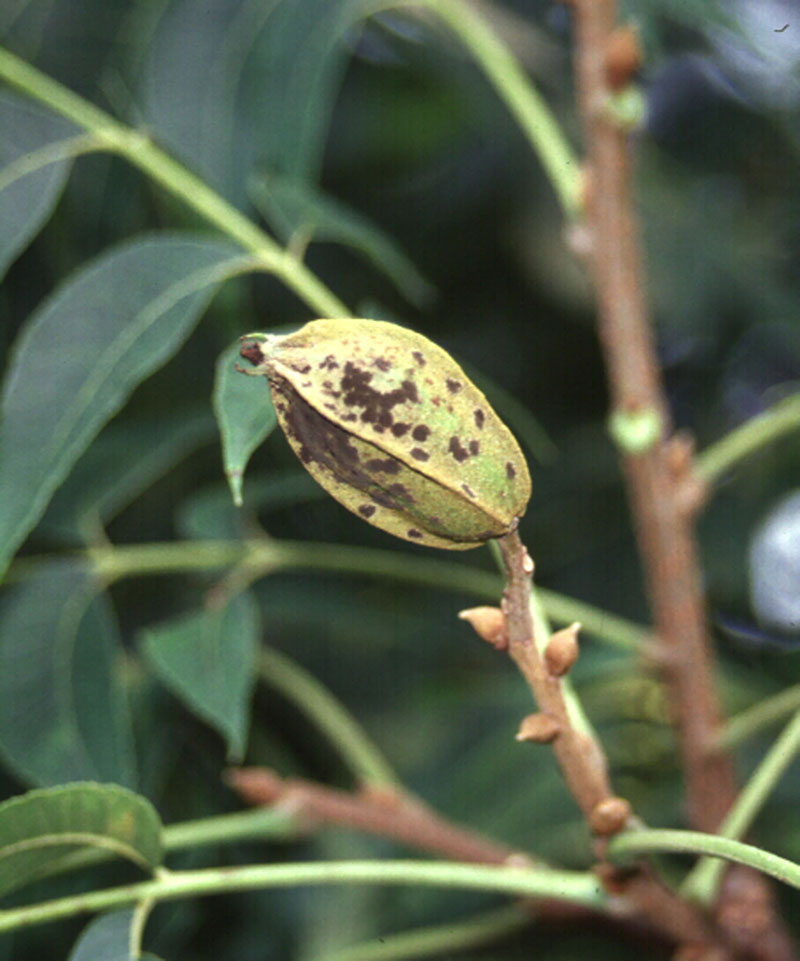
    UGA picture/Scab disease does not usually kill trees, but it can greatly reduce yields. The fungal pathogen that causes scab overwinters in the tree as lesions on stems and old nut shucks that remain in the tree after harvest. When temperatures begin to warm in the spring, the fungus becomes active and starts to produce new spores that are spread by rain and wind.

    According to UGA Extension pecan blog, plant pathologist Jason Brock’s recommendations are based on Extension plant pathologist Tim Brenneman’s research regarding scab disease:

    With Desirable or any variety with similar scab susceptibility, a rotation of Elast/Tin with Miravis Top is the strongest option. You could use consecutive applications of either, but keep in mind Miravis Top use restrictions include a 14-day minimum application interval and a maximum of 4 applications per year. In most cases, half rates for Elast/Tin are suitable. Research trials have shown that increasing the rate of Elast to 37 fl. oz. while mixed with Tin can provide better scab control, but only when disease pressure is high. Unless we get into a rainy summer, the half rates are the better option.

    Cultivars with relatively low scab susceptibility provide more options for fungicide selection. In addition to Miravis Top, Elast and Tin (either in a mix or used stand-alone), other fungicides are suitable for these cultivars. Another tank mix combination that has provided good nut scab control is a Group 3 (DMI) + Group 11 (strobilurin). This combination is available in a number of premixed products. A newer option that we have recommended is a 3-quart rate of a phosphite. While the phosphites’ strength is in foliar disease control, a high rate application is suitable for nut scab control of certain cultivars with low scab susceptibility.

    Aside from fungicide selection, important factors in scab control will be timely applications and good coverage. Pay close to attention to rain forecast and try to stay ahead of scab development; however, do not sacrifice good coverage by traveling too fast or trying to spray when weather conditions are detrimental to good coverage. Always remember to rotate chemistries regularly to manage fungicide resistance.

    Light Scab Disease

    In a previous VSCNews story, UGA Extension pecan specialist Lenny Wells said scab disease is currently light, but there has been “scabby weather” recently. The rainy weather because of Tropical Storm Cristobal last week could be a reason scab disease incidences begin to spike.  Wells said it usually takes a couple of weeks before growers start seeing scab because of excess rainfall.

    Scab is a fungal disease that infects the leaves or nuts of pecan trees. If it hits the nut early enough, scab can cause the pecan to blacken and fall from the tree. Some growers spray between 10 and 12 times during an average year to fight scab, Wells said. Scab thrives on trees that have received moisture. That is why a quick rain event is important and not prolonged rainy weather of several days in a row.

  • Recent Rains Could Lead to Spike in Pecan Scab Disease

    Pecan scab disease has been light this year but could change with the recent rains.

    By Clint Thompson

    Scab disease of pecans has been light so far this year. But could soon change with the recent rain events in the Southeast, says Lenny Wells, University of Georgia Cooperative Extension pecan specialist.

    “Scab so far has been light, but we’ve had some pretty scabby weather the last week or so. We’ll see, but I think everybody has been staying on top of it pretty well,” Wells said.

    The rainy weather as a result of Tropical Storm Cristobal this week could be a big reason scab disease incidences begin to spike. Wells said it usually takes a couple of weeks before growers start seeing scab as a result of excess rainfall.

    “If people were set to spray this week and it’s been raining like it is and they can’t get out there to spray everything like they need to because of the weather, then there may be some that get caught. (But) things are looking pretty good, and everybody’s staying on a good schedule,” Wells said.

    What Is Scab?

    Scab is a fungal disease that infects the leaves or nuts of pecan trees. If it hits the nut early enough, scab can cause the pecan to blacken and fall from the tree. Some growers spray between 10 and 12 times during an average year to fight scab, Wells said. Scab thrives on trees that have received moisture. That is why a quick rain event is important and not prolonged rainy weather of several days in a row.

    One reason Wells is optimistic this year is the new fungicide that is now in growers’ arsenal.

    “We’ve got a new fungicide we’ve got in the mix this year that I think is going to be a big help. A part of it is a chemistry that has two different classes of chemistry in it, and part of it is something we haven’t had before in pecans or been used before. Based on Tim Brenneman’s work it looks like it’ll be a big help for us,” Wells said.

    For other pecan-related stories, see pecan crop offers hope.

  • Light Scab Disease Reported in Pecan Orchards

    georgia pecans
    Pecans appear to be in good shape right now, thanks to light scab disease pressure.

    By Clint Thompson

    It is only May, but University of Georgia Extension pecan specialist Lenny Wells is optimistic about this year’s crop.

    “It looks great right now as far as crop load and the light disease pressure. Everything’s pretty clean. Everything looks great so far,” Wells said. “I just hope we can get them to harvest. We’ve got a long way to go. Hope we have a decent market when we get there.”

    The relatively dry weather throughout for most of the Southeast has also led to low scab disease pressure in pecan trees.

    “It’s been pretty light, been really light here since we got started spraying back in April,” Wells said. “So far, pressure has been very light, and I haven’t seen much problem at all with scab.

    “Early in the spring, it stayed cool a good while and that probably helped some too. But yeah dry weather more than anything. And when we have had rains, they were quick rains. It may have rained one day and then it cleared out and we’d have sunshine and wind several days to a week and then get another rain.”

    What is Scab?

    Scab is a fungal disease that infects the leaves or nuts of pecan trees. If it hits the nut early enough, scab can cause the pecan to blacken and fall from the tree. Some growers spray between 10 and 12 times during an average year to fight scab, Wells said. Scab thrives on trees that have received moisture. That is why a quick rain event is important and not prolonged rainy weather of several days in a row.

    “If we have rain events that kind of move in and out, those don’t cause us much problems. But it’s where we have these long sustained several days in a row of rain, that’s really when scab will get going,” Wells said.

    For other pecan-related stories, see pecan crop offers hope.

  • Georgia Pecan Growers Voting on One-Cent Assessment

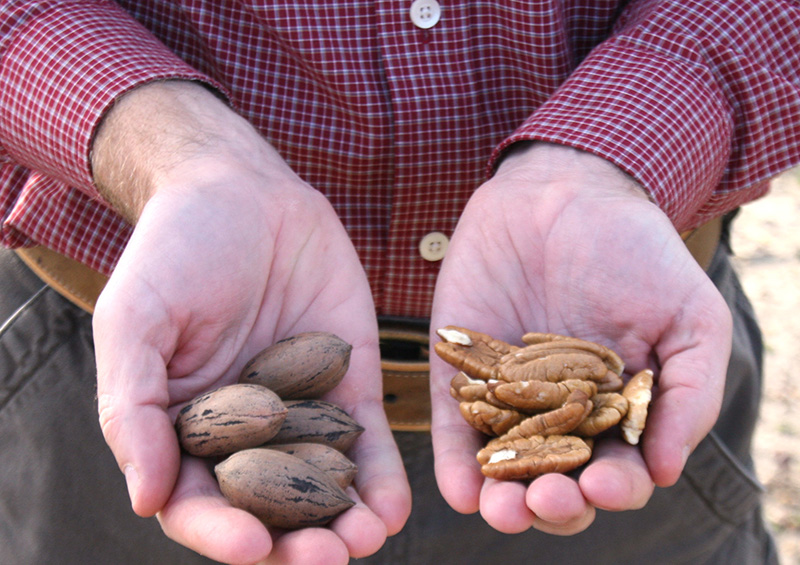
    Photo courtesy of UGA College of Agricultural & Environmental Sciences. Shows UGA pecan breeder Patrick Conner holding pecans.

    By Clint Thompson

    Georgia pecan growers are voting this month to renew a one-cent per pound assessment on pecans for the Georgia Agriculture Commodity Commission for Pecans.

    According to Andy Harrison, commodity commissions manager for the Georgia Department of Agriculture, ballots have been sent to Georgia growers of 30 acres or more. They will vote on the assessment, which is required under Georgia law. Producers are required to vote every three years to renew the assessment.

    “Of the balance that comes in, we need 2/3 voting affirmative on it. We’ve sent out about 700 or 800 ballots to pecan growers,” Harrison said. “It’s one cent per pound on pecans marketed. That money can be used for research, education, promotion for Georgia pecans.”

    All returning ballots must be postmarked by May 30. The back of the return envelope must be completed for the ballot to be valid. The commodity commission utilizes assessment funds for research, education, and promotion of Georgia pecans.

    Harrison emphasized that the Georgia Department of Ag administers the funds. But it is the Georgia Pecan Commission who decides how the money is spent.

    “Members of the commission decide where the money’s going. They vote on behalf of what they feel like is best for the growers’ interest. A lot of it goes to research for the University of Georgia and USDA,” Harrison said.

    Growers of 30 or more acres who have not received a ballot should contact Andy Harrison, at andy.harrison@agr.georgia.gov.

  • USDA Report Yields Results for 2019 noncitrus/nuts season

    Georgia’s pecan crop accounts for 29% of the nation’s production.

    By Clint Thompson

    The United States Department of Agriculture National Agricultural Statistics Service released its findings for noncitrus fruits and nuts in the Southern Region for the 2019 crop year. These estimates were based on grower surveys.

    Avocados: Florida’s production of avocados was up 88% from 2018. Its value of production was up 54%. Yields rebounded in 2019. Utilized production for the 2019 crop year was 25,540 tons.

    Blueberries: Georgia led the nation with 21,700 harvested acres in 2019. Utilized production was up 76%, and value of production was up 52% from 2018’s hurricane-damaged crop. Georgia produced 95,900 pounds. Utilized production in Florida was up 16%, while value of production was up 3%. Florida produced 24,200 pounds.

    Peaches: In Georgia, utilized production was up 44% and value of production was up 58% from the crop in 2018. Georgia utilized 33,780 tons of production. South Carolina’s utilized production was up 8%, while value of production was up 20%.

    Pecans: Georgia’s pecan crop accounts for 29% of the nation’s production. It had a 4% increase in utilized production and a 21% increase in value of production in 2019. The lingering impact from Hurricane Michael in 2018 and the dry summer in 2019 impacted the crop. Georgia produced 73,000 pounds.

    Strawberries: Florida’s utilized production was down 18% from last year, while its associated value of production was up 9%.

    For more information, see full USDA report.