Category: Pecan

  • N.C. Pecan Growers Expect Plentiful Crop

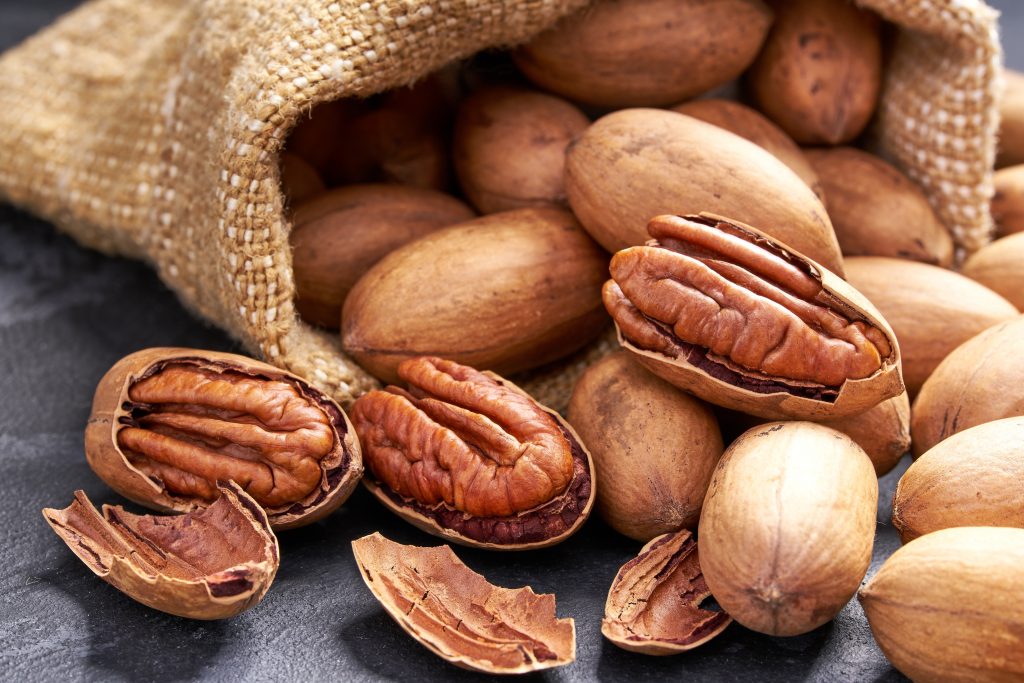
    File photo shows bag of pecans.

    Contact: Dexter Hill, pecan marketing specialist
    NCDA&CS Marketing Division
    252-527-7125; dexter.hill@ncagr.gov

    RALEIGH – After several years of weather-related setbacks, North Carolina pecan growers are reporting a strong crop. That is welcome news for farmers such as Tim Haithcock, who has been growing pecans for over 25 years.

    “My trees have been heavy,” Haithcock said. “They are looking very, very good with plenty of pecans on every variety.”

    Haithcock owns Indian Springs Pecans in Goldsboro. The 107-acre farm has about 30 acres of pecan trees as well as a nursery that grows trees for other commercial pecan operations. Haithcock attributes the good crop to adequate moisture and sunshine throughout the growing season. In addition, no major storms impacted eastern North Carolina during this year’s hurricane season.

    Haithcock began hand harvesting early-variety pecans at the end of September. He plans to start full-scale harvesting in the coming weeks. North Carolina’s pecan season will ramp up in early November and run through the end of the year.

    “Consumers should have no trouble finding North Carolina pecans this season,” said Agriculture Commissioner Steve Troxler. “Local pecans will be available in retail stores, at area farmers markets and directly on the farm. Wherever you shop, be sure to look for the Got To Be NC logo to know you’re getting a quality product from North Carolina farmers.”

    North Carolina is one of the top 10 pecan-producing states in the nation. Local farmers grow between 4-to-5 million pounds of in-shell pecans annually. While pecan trees can be found across the state, most commercial orchards are in eastern and southeastern North Carolina. To find a local orchard near you, go to www.buyncpecans.com.

  • Collins, Scott Work to Increase International Market Access for U.S. Pecans

    Collins

    WASHINGTON, DC – Rep. Doug Collins (R-Ga.) joined Rep. Austin Scott (R-Ga.) and 31 of their colleagues in sending a letter with bipartisan support to U.S. Trade Representative Robert Lighthizer encouraging the Administration to prioritize reducing India’s tariffs on American pecans as trade negotiations continue.

    “As you may know, American pecan producers have faced many challenges due to rising imports from Mexico, Chinese tariffs, natural disasters like Hurricane Michael, and the COVID-19 pandemic,” they wrote. “Gaining access to new markets for pecans will help ease the pain while orchards are replanted and a trade deal is negotiated with China.” 

    India’s current tariff rate for U.S. pecans is 36%, much higher than its 10% rate for pistachios and almonds. Lowering these high tariffs will allow American pecan farmers to compete in this important market.

    “Lowering the tariff on pecans would provide the Indian people with more economical access to tree nut varieties, while providing a much-needed economic boost to rural America,” they continued.

    Scott

    Read the full letter here.

  • Spray Program Top Factor When Considering What Pecan Varieties to Plant

    University of Georgia photo compares Pawnee varieties to Desirables and Stuarts.

    Pecan producers will soon be planting trees throughout the Southeast. But first, growers must decide what variety they’re going to plant.

    Scab susceptibility is the No. 1 factor that should influence what variety producers plant this year, according to Shane Curry, University of Georgia Appling County Extension Agriculture and Natural Resources agent.

    If growers are going to plant a variety like Cape Fear, it is going to require a high input of spray applications to protect against scab disease. If producers want low input varieties, they can choose Avalon, Excel or Lakota. Those varieties don’t require as much spray applications.

    Producer’s Preference

    It’s just a matter of how much time a grower wants to devote to taking care of their trees and whether they possess the spray equipment to make the necessary applications.

    “They definitely have a lot they have to consider. Or I guess really, one thing in particular, and that’s are they going to be able to spray as far as what we would say a high input of sprays from a fungicide standpoint or are they not going to be able to do that?” Curry said.

    “Obviously, if somebody is planting 50 trees, they’re probably not going to go buy a $20,000 or $30,000 sprayer, and some of those even cost more than that. Money’s just not going to work out on the end in small acres. A lower input variety would be more of the way to go. If someone is set up to spray, meaning they already have them or they’re going to put in enough to justify the equipment, they’ve got a few more options.”

    Early Varieties

    Lakota and Pawnee are the two varieties that produce a crop the earliest, which might generate a higher market price. However, Pawnee is very susceptible to scab disease, so it will require a high input spray program.

    “If pecan prices are high and quality is great, we can offset those costs. Every year (though) that’s not the case,” Curry said.

    Curry said planting is normally done during December and January when the trees are dormant.

  • NASS: Georgia Pecan Producers Forecast Big Production Gain in 2020

    georgia pecans

    According to Georgia Farm Bureau, Georgia pecan corn, hay, peanut, oat and wheat producers are set to harvest significantly larger crops in 2020 than they did in 2019, according to the October Crop Production Report from the USDA’s National Agricultural Statistics Service.

    NASS forecast Georgia pecan production in 2020 at 125 million pounds, an increase of 71% from 2019. If realized, this would be the state’s largest crop since 2007.

    Georgia corn growers are forecast to yield a record-high 182 bushels per acre. Corn for grain production in 2020 is forecast at 69.2 million bushels, up 24% from 2019.

    Hay producers in Georgia are expected to produce 1.8 million tons in 2020, up 19% from 2019.

  • Pecan Prices Better Than Originally Expected?

    Southeast pecan farmers should be encouraged by market prices as harvest season gets under way across the region. According to Lenny Wells, University of Georgia Cooperative Extension pecan specialist, prices for Pawnee varieties are up from what was originally projected, as are Stuarts.

    Plus, there is renewed buying interest from China, which has traditionally been the biggest buyer of U.S. pecans.

    “I’m hearing that there definitely is interest from China. They do definitely seem like they’re going to buy and possibly might buy quite a bit, which would help tremendously,” Wells said. “I don’t know that it’s going to help bring prices up all that much. I hope it does. At the very least it should stabilize prices some.

    “China wants to buy but they are definitely price sensitive at this point with everything going on. That’s why I say I don’t know that it’s going to make prices go up a lot, but it should stabilize it.”

    Pawnee Prices

    Wells said that Pawnees, which are typically the first variety to be harvested every year, are selling anywhere from $2.30 to $2.40 per pound, which is quite the improvement from the $2.10 mark that was discussed before the start of harvest season.

    “If (producers) have Pawnees, then yeah they probably need to go ahead and sell those. Once the other nuts start coming in, the price of Pawnees usually start to drop some,” Wells said. “So, I would go ahead and start to get rid of those.”

    They’re not the only variety selling better than expected, either.

    “I’m also hearing a little bit of encouragement on Stuarts. I was told a couple of weeks ago that we may see Stuarts up around $1.50, $1.60, which is a lot better than the $1.20 or $1.30 we were hearing a couple of months ago. So that’s good,” Wells added.

  • Pecan Crop Remains Ahead of Schedule

    georgia pecans
    File photo shows Georgia pecans.

    The pecan crop in the Southeast remains ahead of its normal production schedule, though cooler temperatures in recent weeks have slowed the crop’s progress, says Andrew Sawyer, University of Georgia Cooperative Extension area pecan agent for Southeast District.

    “I think the cool (weather) has actually slowed us down a little bit,” Sawyer said. “The crop was already 10 (days) to two weeks ahead anyway. We’ll still be ahead in the long run.”

    Farmers have already begun harvesting pawnee varieties. In normal production years, pawnees are usually the first varieties harvested, and then there is a gap before the rest of varieties are mature enough for harvest. However, others are already showing signs of being ready to be picked, Sawyer said.  

    “Desirables are cracking pretty strong which is probably on the early side for them, too. They’re looking good. Everything’s about to really get ramping up,” Sawyer said.

    All in all, this year’s pecan crop is projected to be one of the largest crops in recent memory, especially since Hurricane Michael impacted the region in 2018, disrupting production.

    “Definitely the biggest in a long time. It is going to be a big crop,” Sawyer said. “Expect some lower prices for sure.”

  • Uncertainty Remains in Pecan Market

    Photo courtesy of UGA College of Agricultural & Environmental Sciences.

    With some certainty, Georgia pecan producers are expecting a bumper crop this year. What remains uncertain is the market price farmers will receive at harvest.

    As growers are currently harvesting Pawnees with other varieties expected to be harvested next month, there is still an unpredictability regarding the pecan market, according to Phil Croft, manager of the Hudson Pecan Company.

    “Right now, we don’t 100% know this market trend. The only thing we can base it off of is what South Africa on the in-shell market sold into China. Those numbers are somewhere between $4.80 and $4.50 a kilogram, which relates back to $2.05 to $2.25 a pound delivered into China. That’s working it back to the grower level on a premium nut, $1.80, $1.90 a pound for our premium Desirables and qualities of that nature,” Croft said. “If China will come back in this thing and buy strong, I think that may be the bottom of the market, in my opinion. Nobody wants to hear that but at least it’s a starting point, and hopefully, it’s the bottom of it that where we can go up from there.

    “I feel like we have an opportunity here for this market to increase pretty quickly if all the ducks line up.”

    China

    China is the biggest buyer of U.S. pecans. But the relationship between the two countries has been strained recently with the coronavirus pandemic and the trade war that involved tariffs being place on goods by both countries. They established a Phase One Agreement where China would increase its purchases of agricultural products, but it still lags in its pursuit of meeting those purchasing goals.

    China’s role as a pecan purchaser cannot be understated.

    “They have been some great customers for many years. We hope that will work out. We hope that they will buy Ag products,” Croft said. “We saw a report the other day that the almond market is booming in China and it’s because of lower prices. That’s maybe what it takes to get the market picked back up over there with some cheaper prices initially. Hopefully, it’ll turn around into a positive.”

  • Shuck Decline in Pecans

    According to the UGA Extension Pecan Blog, shuck decline in pecans is starting to manifest itself in orchards across the state.

    Growers are starting to see symptoms of shuck decline in the orchard. Symptoms range from shucks turning all the way black to the tips, green shucks turning black and peeling back at the suture. In some cases, kernels are black and in other cases, there is no kernel. The degree of declining shucks varies from tree to tree.

    For growers to minimize the problem moving forward, they need to continue to irrigate. This will be critical if the weather turns dry later this month and in October.

    According to the UGA Extension Pecan Blog, the severity of shuck decline depends on when the decline started during development. If the shuck has already split open, likely, growers can still shake the nut from the tree and it will be fine. However, much of this dark color on the shucks beginning before they open may hurt yield and quality.

    Shuck decline is mainly a stress-related issue. It can be worse on trees with a heavy crop load.

  • Sally’s Impact on Alabama, Georgia Pecan Production

    UGA photo/Shows flooding in a pecan orchard.

    Georgia pecan farmers escaped serious damage last week following Hurricane Sally’s trek through the Southeast. Alabama producers were not so lucky, however.

    University of Georgia Extension pecan specialist Lenny Wells said Baldwin County, the heart of Alabama’s pecan production, was one of the counties hit hardest by Sally’s Category Two Hurricane status. According to the UGA Extension pecan blog, Wells said he has spoken with growers and pecan specialists in the area. The damage is worse than Hurricane Ivan in 2004.

    “From the ones I’ve talked to down there, they’re going through the same thing we went through with Michael (in 2018) and the same thing they’ve been through before with Ivan and so many other storms,” Wells said. “It sounds pretty bad over there. I think it’s worse on one side of the bay than the other. I think the east side of the bay got the worst of it. But it’s pretty bad.”

    Growers reported 25% to 75% of their trees down. That area received more than 20 inches of rain with 100 mph winds. Trees were laid on the ground and leaves and nuts were knocked off trees.

    Impact on Georgia pecans

    While Alabama producers were dealt a double whammy with excessive rainfall and high winds, Georgia’s pecan orchards experienced mainly flooding. There was between 6 to 8 inches of rainfall in some areas, according to the UGA Extension pecan blog.

    “There wasn’t a lot of wind damage that I’ve heard about or seen yet,” Wells said.

    Wells said this development may delay some growers from getting into orchards where Pawnees were ready for harvest. That is normally the earliest variety that is harvested. The remaining varieties will be ready in a few weeks.

    “We’re probably three weeks away, maybe two, but two to three weeks away from really getting started with Elliott and some of the early October varieties that we harvest. Probably by mid-October, I imagine everything will be ready this year,” Wells said. “Crop is a little early.”

  • USDA to Issue First Pecan Forecast for 2020

    georgia pecan

    ATHENS, GA – During the last week of September, pecan growers will receive a survey from the U.S. Department of Agriculture’s National Agricultural Statistics Service (NASS). Information from this survey will be used to forecast pecan production for 2020.

    “The pecan industry is an important part of U.S. agriculture, especially in southern states and it is crucial for us to have accurate data about this key sector of the economy,” said Anthony Prillaman, Directorof the NASS Southern Regional Field Office. “Around 2,600 producers from across the country, including more than 300 in Georgia will be contacted to accurately measure 2020 acreage and production for pecans. The data collected from this survey will help set pecan acreage and production estimates at both the state and U.S. level.”

    As an alternative to mailing the survey back and to help save both time and money, growers will have the option to respond to the survey securely online. Growers who have not responded by Sept. 29 will be contacted for a telephone interview by a National Association of State Departments of Agriculture (NASDA) enumerator. NASS safeguards the privacy of all respondentsand publishes only aggregate data, ensuring that no individual operation or producer can be identified.

    Survey results will be published in the October Crop Production report, to be released on Oct. 13.These and all NASS reports are available online at www.nass.usda.gov/publications. For more information call the NASS Southern Regional Field Office at (800) 253-4419.