Category: Pecan

  • Alabama Pecan Producer Still Picking up Pieces Following Hurricane Sally

    Picture from Adam Bertolla/Shows massive pecan tree uprooted by Hurricane Sally.

    Hurricanes wreaked havoc on agricultural production this summer and fall. Unfortunately, pecan producers were not immune to nature’s fury.

    Just ask Alabama farmer Adam Bertolla. He lost ¾ of this year’s crop as a result of Hurricane Sally in mid-September. He also lost 250 trees or a third of his pecan operation.

    “It killed me, because I lost over a third of my trees and these trees are over 90-year-old trees. People say, ‘You going to replant.’ I say, ‘Hell no, I’m not going to replant,’” said Bertolla, referring to Hurricane Sally that made landfall in Alabama on Sept. 16. “No. 1, there’s going to be some more storms come; No. 2, I’m too old, even though I’m in my early 50s. There’s just not any use in doing it. That’s what hurt me the worst is losing my trees.”

    What’s Left for This Year?

    “You talk about a 90-year-old tree, he’s a man now. Then you’ve got all of that stuff to clean up. We cleaned up the orchard without running over no more than we could. It looks like a guestimate of what I saved was probably a little less than a fourth. We probably lost three-fourths of my crop due to that much rain. In one orchard, they floated off and went down the river. They’ll float.”

    Bertolla estimates that he lost 250 trees. It can’t be understated how massive a loss it is considering the age of these trees and the yields they can potentially produce every year.

    “That’s a third of what I’m never going to have again. The other trees can’t make up for it,” Bertolla said. “My grandpa was a pretty young man when he planted those trees. It just makes you sick when see all of that. We’ve had storms and we’ve lost 50 and 100 here and yonder through the years but the (orchard) is really open now. There’s a lot of big gaps out there.”

    Eye of the Storm

    Bertolla’s pecan trees are located about 30 miles north of Gulf Shores, Alabama, which was in Sally’s direct path when she finally made landfall as a Category 2 Hurricane. The slow-moving storm that featured winds over 100 mph and torrential flooding overpowered massive pecan trees. It was a sight to see and left destruction that Bertolla was still picking up the pieces from this week.

    “If you’ve never seen a big pecan tree uprooted it’s something to see how big the roots are and how it was trying to do everything it could to hold onto the dirt but it just couldn’t. It was just too saturated that it couldn’t hold on any longer,” he added.
  • Pecan Prices Remain Low

    georgia pecan

    Rain and wind this week have made it a challenge for Georgia pecan producers harvesting this year’s crop. Farmers still can’t find a ray of sunshine amid declining prices.

    According to the USDA Pecan Report that was released on Tuesday, prices are lower than a week ago and most farmers with export quality pecans are holding them in storage until market prices increase; or they will wait until after New Years to offer them for sale.

    Prices include, for lots of 20,000 pounds or less: Cape Fear, $1.18 to $1.36 per pound; Desirables, $1.21 to $1.41 per pound; Elliott, 90 cents to $1 per pound; Seedlings, 40 cents to 50 cents per pound; Stuarts, 50 cents to 75 cents per pound; and Sumner, 70 cents to 80 cents per pound.

    For lots over 20,000 pounds, including truckloads; Cape Fear, $1.18 to $1.36 per pound; Desirables, $1.20 to $1.63 per pound; Stuarts, $1.30 to $1.33 per pound; Sumner, $1.23 to $1.38 per pound.

    The release stated that, “Prices paid to growers (late afternoon Tuesday, November 03, 2020 through late afternoon Tuesday, November 10, 2020) at buyers delivery point or F.O.B. the orchard including direct sales to end users, cents per pound in-shell of generally good quality in lots of 20,000 pounds or less unless otherwise stated.”

  • How Low Are Pecan Prices Compared to Previous Years?

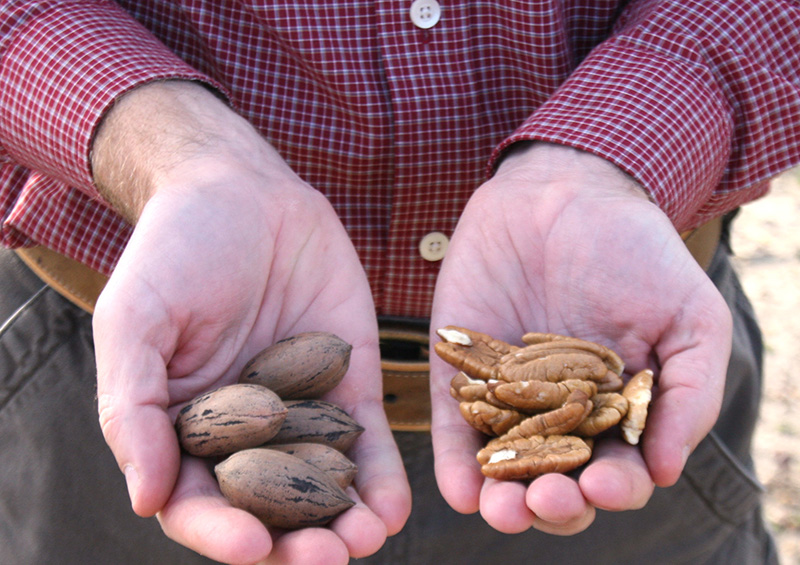
    Alabama Extension Photo shows pecan emerging out of its shell.

    Pecan prices are devastatingly low for Georgia producers. But how low are they compared to what farmers are used to this time of year? South Georgia pecan farmer Randy Hudson puts it in perspective.

    “We’re seeing prices anywhere from 30% to 50% less than what they’ve been the last three years,” Hudson said. “It makes a big difference. Of course, the expense of growing pecans is a very critical issue here. The expense of growing pecans has not been any cheaper, although, we have seen prices on the fuel side and there have been some prices that have gone down in other areas.

    “The production costs are still pretty high. Fixed and variable costs are running over $2,000 an acre. You’ve got a lot of expense in pecans. These low prices make it very difficult to be able to pay your bills.”

    USDA Pecan Report

    Following the release of the USDA Pecan Report that was released last Tuesday, prices ranged anywhere from 70 cents to 75 cents per pound for Stuart varieties to Sumners that were selling for $1.30 to $1.41 per pound (nut count 50-60) with meat yield 52% to 54%. Even Desirable varieties that did not have to overcome heavy scab disease pressure this season were selling for just $1.35 to $1.40 per pound.

    The next USDA Pecan Report will be released this Tuesday. Growers will be able to see if prices are stabilizing or continuing to freefall, which is a fear of University of Georgia Extension pecan specialist Lenny Wells. It’s especially disheartening since this is one of Georgia’s best pecan crops in recent memory. 

    Big Crop for Georgia

    “The reality is Georgia has a really big crop. The demand over the last few years has been reduced by the fact that the China tariffs increased to a point that China consumption has gone well down on pecans. We’re in a cycle where we may see reduced prices until we get consumption back up to a point that it would support higher prices,” Hudson said.

    “I personally think that after this election settles out, we may see a little firmness move into the market, I hope so. I think a lot of the bigger growers are counting on it. For the most part, there’s not a lot of nuts moving right now other than yard crop and maybe some small growers that don’t have the input costs of the bigger growers. There’s not a large volume of pecans that’s actually being traded right now. There’s a lot of pecans being held.”

  • Falling Pecan Prices Dishearten Growers Amid Bumper Crop

    Photo courtesy of UGA College of Agricultural & Environmental Sciences.

    It’s a disheartening feeling to know you have your best pecan crop in years only to face the worst market prices in at least the last 20 years. But that’s what pecan growers in Georgia are facing this fall, according to Lenny Wells, University of Georgia Cooperative Extension pecan specialist.

    As states like Georgia are currently harvesting a bumper crop, they’re encountering prices that have been a shock to farmers this fall.

    According to the latest USDA Pecan Report that was released on Tuesday, prices ranged anywhere from 70 cents to 75 cents per pound for Stuart varieties to Sumners that were selling for $1.30 to $1.41 per pound (nut count 50-60) with meat yield 52% to 54%. Even Desirable varieties that did not have to overcome heavy scab disease pressure this season are selling for just $1.35 to $1.40 per pound.

    Totally Unexpected

    “We knew (prices) would be lower, but I don’t think anybody expected it to go this low. I don’t know that it’s finished going down (either). I hope it is, and I hope we see some turnaround. There’s no way to know,” Wells said.

    How much farther can prices drop? There could potentially reach a point where pecans are not selling at all.

    “I think that’s probably the next step. I hope we don’t get to that point. It’s a scary situation for growers out there,” Wells said. “I think most all of them know about it now. But even as harvests were first starting, I think there were a lot of growers that didn’t realize that this was coming. Some did but most that did didn’t think it was going to get this bad.”

    Especially Frustrating for Growers Recovering from Michael

    It’s especially troublesome for producers considering the quantity of pecans there is this year. Some growers had pegged this season as a rebound year just two years removed from Hurricane Michael.

    “It’s especially frustrating for those guys down in Albany, Mitchell County, Bainbridge and that southwest corner who took such a hit from Michael. They dealt with that for two years; had their crop wiped out that year and not having much of any crop last year,” Wells said.

    Losing Scenario for Farmers?

    If you consider the input costs it takes to produce pecans every year, growers are going to lose money this year. It’s just a question of how much.

    “I did some crunching of some numbers the other day, just looking at the UGA pecan budget. It looked like to me that if you factored in your variable costs, your harvest costs, all of that added in together, the break-even price on pecans based on the UGA budget at around $1,800 per acre to grow pecans, was $1.53,” Wells added.

    “Last week, the average price (of pecans) was $1.44. I ran the numbers (Wednesday) morning with the new report that just came out (Tuesday) and it’s at $1.17 across all varieties. That includes Moneymakers and Seedlings and stuff like that.”

    “(Farmers) are hurting right now. They’re losing a lot of money right now.”

  • Very Low Prices for Georgia Pecan Producers

    Photo shows pecans being cleaned.

    Georgia pecan prices remain discouragingly low for farmers as harvest season is in full swing across the state. According to the USDA Pecan Report that was released on Tuesday, ranged anywhere from 70 cents to 75 cents per pound for Stuart varieties to Sumners that were selling for $1.30 to $1.41 per pound (nut count 50-60) with meat yield 52% to 54%.

    Elliott varieties (nut count 65-75) sold for $1.20 to $1.38 per pound with a meat yield of 50% to 53%.

    It’s important to note these prices are for in-shell pecans of good quality in lots of 20,000 pounds or less.

    For lots over 20,000 pounds, including truckloads; Desirable varieties sold for $1.25 to $1.46 per pound (nut count 45-51) with meat yield between 50% to 52%. Elliott varieties sold for $1.20 to $1.30 per pound (nut count 65-75) with a meat yield of 50% to 52%. Sumner varieties sold for $1.30 to $1.41 per pound (nut count 50-60) with a meat yield of 52% to 54%.

    The release stated that, “Growers are preparing their pecans to be tested and offering them for sale this week with many not making any deals or sales. They are either reoffered for sale or put into storage waiting until a price can be established and accepted by both sides. Purchases by shellers and domestic buyers are moderate to slow as well as retail gift pack purchases and it is expected to pick up before the Thanksgiving push for holiday sales. The export market is slow as compared to past years, especially the movement going to Asia.”

  • Alabama Extension Research Associate: Pecan Producers Took a Good Kick in the Guts

    Hurricane Sally damaged crops and structures along Alabama’s Gulf Coast when it hit Sept. 16. Cassebaum Farms in Lillian in Baldwin County sustained damage to its pecan crop during Hurricane Sally.

    What was potentially Alabama’s best pecan crop in years has been drastically reduced by two hurricanes.

    Alabama Extension Research Associate Bryan Wilkins estimates after Hurricanes Sally (in mid-September) and Zeta (last week), the state’s crop has been reduced to about 25% or less for this year.

    “This was the best crop we’ve had in years. We were probably looking at a heavy alternate bearing year next year, too. They’re going to be down for two years,” Wilkins said.

    That’s not even counting the future losses that are a result of trees being uprooted from heavy winds.

    “Zeta came right up through along the edge of Mobile County and into Washington County, down around Grand Bay…I had one guy tell me, ‘I’m going to put my shaker up because I sure don’t need it the rest of the year, they’re all on the ground,’” Wilkins said.

    “The further up in the state you get, the further east you get, they haven’t lost as much crop wise, but the quality has gone down. Some of them couldn’t get in to harvest, they got beat up in the wind.”

    Total Loss to Baldwin County

    Hurricane Sally delivered a total loss to pecan producers in Baldwin County, the state’s top pecan-producing county.

     “Baldwin and Mobile are the two major areas (of production). We’ve got some areas coming on like back over in the Wiregrass that got hammered with Hurricane Opal back in 1995. They’re recovering over there but they still don’t have the trees that we had over here,” Wilkins said.

    “It’s going to knock Baldwin County out of being the major producing county in this state, I think. We’re still trying to get counts right now.”

    But the biggest concern remains the impact these storms will have on the state’s pecan industry long-term. It’s a “generational” impact.

    “I’ve got one guy who lost, in one orchard, he lost 120 of them 90-year-old Stuarts. It’s generational. These guys that had those big trees, those 90-year-old trees or even 40-year-old trees, they’ll never see that yield again,” Wilkins said.

    “Their grandkids might or their kids. I don’t know how many of them are going to replant. I had a couple of them tell me they’re going to tend to what they’ve got left, but they’re not going to replant just because, right now they’re in their 60s, and by the time (the pecans) come online, they’ll be in their 70s.

    “They took a good kick in the guts. This one hurt.”

  • Scab Disease Important Factor to Consider Before Planting Pecans

    File photo shows what pecan scab looks like.

    Doug Chapman, Alabama Extension agent for Commercial Horticulture in North Alabama, says the ramifications of having scab disease in your pecan orchards can’t be understated.

    “It’s the difference between having pecans and not having them,” Chapman said.

    Even as pecan harvest is under way across Alabama, soon it will be time to plant new pecan trees. Pecan planting is usually done during December and January when the trees are dormant.

    However, before commercial growers and homeowners begin putting trees in the ground, they must consider their fungicide spray options to manage scab disease. If they don’t have a management strategy, they shouldn’t expect pecans to start falling in 8 to 10 years.

    “Scab is My First Suspect”

    “Scab can wipe you out. I’ve seen it to where, even if you were to make a few nuts, if there was a scab problem, they tend not to fill out,” Chapman said. “We get a lot of questions like, okay I’ve got pecans and they’re not filling. Here again, scab is my first suspect and until you can eliminate that, there’s not much point in talking about the rest of it.”

    Unpredictable Weather

    Weather was unpredictable this year for pecan growers. Chapman said it was really wet in the spring, but then it turned off dry. He doesn’t think scab was nearly as bad as it has been in other years. But the dry weather has also affected the nut size. If you didn’t have irrigation, the nuts didn’t size up when they should have.

    Scab Disease

    Scab disease does not usually kill trees, but it can greatly reduce yields. The fungal pathogen that causes scab overwinters in the tree as lesions on stems and old nut shucks that remain in the tree after harvest. When temperatures begin to warm in the spring, the fungus becomes active and starts to produce new spores that are spread by rain and wind.

  • Bishop, Loeffler Announce USDA Funding for Ag Research

    Bishop

    According to Georgia Farm Bureau, Rep. Sanford Bishop (D-Ga. 2nd District) and Sen. Kelly Loeffler (R-Ga.) each announced funding for Georgia agricultural research.

    On Oct. 16, Bishop, chairman of the U.S. House Appropriations Subcommittee on Agriculture, Rural Development, Food and Drug Administration, and Related Agencies, provided funding for pecan and peanut research in the FY2021 Agriculture Appropriations bill.

    The bill included 1.5 million for research on pecan cracking and pasteurization technology, $1.5 million for pecan breeding and genetics research and $1.51 million for aflatoxin research at the ARS Peanut Lab in Dawson and Fort Valley State University.

    “One of the most important things to me as the agriculture appropriations chairman is making sure the crops we grow here in Georgia continue their massive contributions to our local, state, and national economies while also feeding our citizens nutritious food,” Bishop said. “Pecans and peanuts are very healthy and are also two of our largest agricultural exports as a state.”

    Loeffler

    On Oct. 22, Loeffler, a member of the U.S. Senate Committee on Agriculture, Nutrition and Forestry, announced the University of Georgia will be receiving $323,834 from the USDA National Institute of Food and Agriculture to research and improve crop protection and pest management. The grant will allow UGA to study and develop tools to resist the diamondback moth, which causes severe damage to crops in Georgia’s agriculture regions.

     “Farmers are the backbone of Georgia and this nation, and they deserve all the help and resources they can get to ensure their crops are protected,” Loeffler said. “I applaud USDA for awarding UGA with this grant, which will bolster its premier agriculture research program – which is already a leader in the nation – and help safeguard Georgia crops from the diamondback moth and other threats for years to come.”

  • Various Varieties to Choose from When Planting Pecan Trees

    georgia pecan
    File photo shows pecans.

    The time to plant pecan trees is nearing for Georgia producers. Shane Curry, University of Georgia Appling County Extension Agriculture and Natural Resources agent, offers a plethora of options for growers to choose from.

    According to Appling County Crop E News, there are multiple varieties that are very popular and viable options for any farmer in Georgia.

    Avalon is one of the newer varieties that was bred by University of Georgia scientist Patrick Conner and became available around 2017. It has excellent percent kernel, about 47 nuts per pound and is about the size of the Desirable variety. Maybe most importantly, it is highly resistant to scab disease.

    Curry

    Lakota is another popular option that requires very little input. However, Pawnee is one of its best pollinators and is one of the most scab susceptible cultivars available on the market. Pawnee can require as many as 15 sprays for scab during the growing season. Lakota and Pawnee are also the earliest varieties we plant in Georgia, which can bring the highest prices on the market at that time of year, which is in late September and into October.

    Curry said Cape Fear is one of his favorites, though, it is not a low input variety. It will require spraying but yields and quality make it a variety worth planting. It is susceptible to bacterial leaf scorch, and quality can be affected when the tree overloads as it matures. But fruit thinning can help with that problem.

    Excel is another variety that requires low inputs and has good scab resistance. Pecan planting is usually done during December and January when the trees are dormant.

  • Harvesting and Storing Pecans This Fall

    Alabama Extension photo shows a pecan.

    Posted by: Victoria Dee

    AUBURN UNIVERSITY, Ala. – According to Alabama Extension, as leaves begin to darken and pumpkins decorate every doorstep, pecans are ripe and ready for harvest as fall settles in in the Southeast.

    These nutritious nuts are members of the hickory family and grow on towering shade trees commonly found in yards, orchards and pastures throughout Alabama. Though pecan harvest typically occurs from October to December, enjoying the bounty year-round is possible with proper harvesting and storing methods.

    Harvesting Pecans

    “Pecans are mature and ready to harvest any time after the shuck begins to open,” said Angela Treadaway, an Alabama Extension regional food safety and quality agent.

    When these shucks are open, shaking or thrashing branches becomes an easy way to harvest nuts directly from the tree. Doug Chapman, an Alabama Extension regional commercial horticulture agent, offers another option for removal of pecans from tree limbs.

    “While commercial growers use tree shakers, homeowners mostly can and do rely on natural drop from the tree,” Chapman said.

    Beware of leaving nuts on the tree too long, however, as predators often want to harvest them for themselves.

    If harvesting occurs early in the season, nuts will have a high moisture content, which would require drying before storage.

    “Dry them in the shell in thin layers on elevated screens, or hang them in small mesh bags in a well-ventilated area at room temperature out of direct sunlight,” Treadaway said.

    After approximately two weeks of drying, shell one or two and if the nuts are dry enough, they should snap when bent. This indicates that they are ready for immediate use or for storage.

    Storage

    Because of their high oil content, pecans are perishable nuts. Proper storage is the best way to ensure good quality year-round.

    “At home, unshelled pecans can be stored in a cool, dry place,” Treadaway said. “Shelled pecans should either be refrigerated or frozen.”

    Storing pecans away from air and light is crucial. Vacuum sealed bags or jars allow for the best storage. After properly storing nuts frozen, thawing and refreezing can occur repeatedly for a period of two years without loss of texture or flavor.

    Test stored nuts before using them in recipes. Rancid pecans have a bitter and oily taste. A dark color may also be a characterizing factor of rancid pecans. Make sure to discard any rancid nuts, as rancidity is not reversible.

    More Information

    For more information on harvesting and storing pecans, visit www.aces.edu or contact your local Extension Agent.