Category: Pecan

  • Fungicide Sprays Vary for Various Pecan Varieties

    By Clint Thompson

    It’s that time of year when Georgia pecan producers need to start protecting their trees against fungal diseases, including scab. According to the University of Georgia Extension pecan blog, sprays vary among the different cultivars and their specific level of resistance.

    Low Input Cultivars
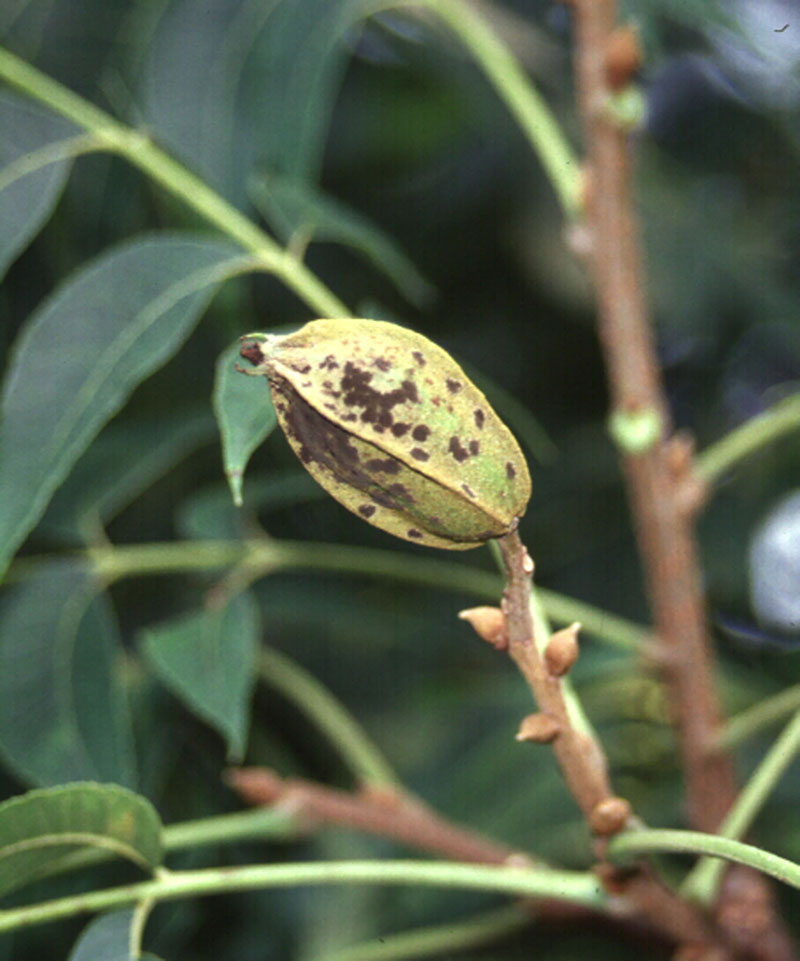
    Pictured is what scab disease looks like on pecans.

    Those that are considered low input cultivars include Avalon, Elliot, Excel, Kanza, Lakota and McMillan. These require a minimum of three sprays which help manage minor diseases like powdery mildew, anthracnose and downy spot, while also maintaining scab resistance. UGA Extension recommends growers apply a phosphite in mid-to-late April; another in mid-to-late May; and an 11+3 mix in early-to-mid June.

    Medium Input Cultivars

    Those medium input cultivars include Creek, Kiowa, Oconee, Sumner, Zinner, Ellis and Gloria Grande. These require fungicides to manage scab, which can be controlled without an intensive spray program.

    Scab should be controlled with seven sprays. UGA Extension recommends growers apply a phosphite in mid-to-late April; a phosphite or 11+3 in mid-May; Miravis Top in early-to-mid June; Elast+Tin or phosphite in mid-to-late June; Miravis Top in early-to-mid July; Tin or Elast+Tin in mid-to-late July; and Miravis Top in early-to-mid August.

    High Input Cultivars

    Those high input cultivars include Byrd, Cunard, Desirable, Morrill, Pawnee and Treadwell. These must be sprayed intensively if growers expect to produce a crop. They require at least 10 sprays and likely more in some locations. If you need more than 10, continue rotating Miravis Top and Elast+Tin.

    UGA Extension recommends growers apply a phosphite; another phosphite; 11+3 mix; Miravis Top+phosphite; Elast+Tin; Miravis Top; Elast+Tin; Miravis Top; Elast+Tin; and Miravis Top.

    Those medium-high cultivars include Caddo, Cape Fear, Huffman, Schley, Stuart, Tanner, Tom and Whiddon. These could fall into either of the other two categories.

    Group 3 and Group 11 fungicides contain both a Triazole and Strobilurin fungicide chemistry.

    Fungicide sprays should continue through shell hardening.

  • Breaking Ground: Pecan Trials Planted at UGA’s VOVRC

    UGA CAES photo/County agents Shane Curry, Ross Greene and Zack Williams planting pecan trees at the Vidalia Onion and Vegetable Research Center with Andrew Sawyer, SE District Area Pecan Agent and coordinator of the grant project which includes short-term demonstration plots and long-term research trials.

    University of Georgia Cooperative Extension is conducting pecan research at the UGA Vidalia Onion and Vegetable Research Center (VOVRC) in Toombs County.

    Pecan trees were planted earlier this year and will be the basis for long-term research plots and short-term demonstration plots.

    Research will focus on low-input pecan varieties that can successfully grow in Georgia without incidence of pecan scab. Plots will also serve as hosts for field days for Extension agents and producers.

    Andrew Sawyer, Southeast District Area Pecan Agent, initiated the project last year with a grant from the Georgia Pecan Commission.

    Sawyer compiled a team of specialists, county Extension agents, local growers and growers association representatives to make sure everyone had a hand in the process.

    “This is the essence of true Extension work,” he said of the team effort that helped get more than 140 pecan trees planted in February this year.

    The team planted various low-input cultivars including McMillan, Lakota, Avalon, Excel, Eclipse and Kanza. Sumner, an older variety, was also planted to be used in comparison, due to its susceptibility to pecan scab fungus and popularity among growers in Southeast Georgia. Many seedling trees were also planted which will be grafted with newer varieties in a few years.

    Sawyer and his team will highlight differing management tactics, including fertilizer, pruning, irrigation and spacing regiments and their potential impact on growth and yield.

    “Pruning is a very important cultural practice that is easier to demonstrate than discuss,” explained Sawyer, “so this site will be good for demonstrating the right way to prune pecans within their first four years.”

    Source: UGA Extension

  • Scab Disease: To Spray or Not to Spray?

    Picture shows scab disease on pecans.

    The calendar may say it’s time for pecan producers to spray for scab but the weather conditions, combined with the current market season, say otherwise.

    Lenny Wells, University of Georgia Cooperative Extension pecan specialist, says it still early to start spraying for scab disease this week. Next week should present a more optimal timeframe. It would also coincide with growers’ plans of reducing input costs.

    “One of the goals that most growers had going into this season was to try to save some money because they saw what the prices were this year. They know that with the kind of crop we had last year, we’re not likely to have a heavy crop this year, overall,” Wells said. “With the potential for low prices out there, saving money is on everybody’s mind. Fungicide sprays make up 12% of the budget of growing pecans; 12% of the variable costs of production. That’s one big area you could potentially save some money in.”

    Slower Progression

    Pecan trees are also progressing later than normal; about a week to 10 days later. The up-and-down weather conditions that consist of cold temperatures during Easter weekend and the current warmer temperatures have slowed the progression of the trees’ foliage. Some varieties like Elliott and Cape Fear have budded out. Others like Stuarts and Desirables are just now starting to come out.

    “By the calendar, growers are used to spraying by this time. There are some areas where there are some varieties where we’ve had heavy scab pressure or the site has heavy scab pressure because of the lay of the land; and you’ve got varieties that scab. Those situations, I can see an argument being made for going ahead and starting,” Wells said. “For the most part, I think it would be a little premature to start this week. Maybe next week, I think would be more like it.”

    Spraying too early will also have repercussions later in the growing season.

    “If you go ahead and jump out there and start spraying now when you don’t really have that much foliage to cover and the foliage development is later, that means that the crop development is going to be later and then our crop maturity and harvest is going to be later. If you start now and there’s not a whole lot out there to spray, that’s just extra spraying you’re going to have to do,” Wells said. “There’s soon going to be a point in the season where you’re going to have to spray. If you start now, you’re just extending that period of time out to where you’re going to have to keep spraying possibly more than you normally do.”

  • Georgia is Nuts About Pecans

    Samantha McLeod photo/Georgia Governor Brian Kemp designated pecans as the official state nut for Georgia.

    Brian Kemp is nuts about pecans. So is the rest of Georgia for that matter. Just call Georgia the “Pecan State.”

    Georgia’s Governor designated the pecan as Georgia’s official state nut on Friday at an event at Ellis Brothers Pecans in Vienna.

    According to the USDA Fruit and Tree Nuts Outlook, Georgia reclaimed the status as the largest pecan producer in the country after last season’s output, after being bested by New Mexico the previous two years.

    Last year’s harvest rose 95% to 142 million pounds. Statewide bearing acreage remained steady at 129,000 acres, with yields per acre estimated at 1,100 pounds per acre.

    According to the UGA Extension, pecans were ranked as the top state for pecan production by the 1950s. It’s a status that’s still true today.

    For more up-to-date information about pecan production in Georgia, see https://site.extension.uga.edu/pecan/.

  • The Pecan State: Georgia Once Again Top Producer with 142 Million Pounds

    Georgia is no longer second fiddle when it comes to pecan production. According to the USDA Fruit and Tree Nuts Outlook, Georgia is once again the largest pecan producer after being bested by New Mexico the previous two years. Production rose 95% to 142 million pounds last year. It is showing signs of recovery from Hurricane Michael in 2018.

    Statewide bearing acreage remained steady at 129,000 acres, with yield per acre is estimated at 1,100 pounds per acre, an increase 534 pounds from the 2019-20 season.

    U.S. pecan production was at 302 million pounds utilized in-shell. It’s an 18% increase and 4% higher than the October 2020 forecast of 292 million pounds.

    While production exploded last season, prices imploded. The USDA reports that the average grower price for pecans dropped from $1.84 per pound in 2019 to $1.32 per pound in 2020. This is likely attributed to an increase in supply and high beginning stocks.

    As a result, the value of production dropped from $471 million to $398.8 million.

    China remains one of the top markets for U.S. pecans with more than 70% share of in-shell exports, from October 2020 to January 2021.  

    Source: USDA Fruit and Tree Nuts Outlook

  • Still a Shock: Alabama Pecan Producers Moving Forward Following ’20 Storms

    Alabama Farmers Federation photo/Hurricane Sally damaged crops and structures along Alabama’s Gulf Coast when it hit Sept. 16. Cassebaum Farms in Lillian in Baldwin County sustained damage to its pecan crop.

    Not a day goes by that Alabama Extension Research Associate Bryan Wilkins doesn’t think about the impact two hurricanes had on his area’s pecan crop in 2020.

    “I think about it every day. Personally, cleaning up around my house, I’m still cleaning up dang mess around my house. I only had a few oak trees down around me. But then I go out to these farms where I’ve been doing research, the plots that I had research on, there ain’t nothing there now,” said Wilkins. “It’s a big wide-open spot in some of them. That’s going to alter how I’m doing things this year.”

    Huge Loss for Pecan Industry

    What was projected to be 3.5 million pounds in Baldwin and Mobile Counties was reduced to nothing following Hurricane Sally in September and Hurricane Zeta in October.

    Still, five months later, Alabama pecan producers continue to sift through the storms’ aftermath.

    “When you’re sitting there and you’ve got a block of 300 or 400 90-year-old trees gone down, and everybody and their brother’s trying to rent equipment, it just takes time to get to it,” Wilkins added. “It’s still a shock. You look here where I work on Auburn’s Gulf Coast Research and Extension Center, I’ve got one whole block of tree that’s just a big empty space right in the middle of it.

    “We’re learning new ways to do things. We’re adapting, these guys here, they’re resilient. They’ve been dealing with this, most of them their whole lives; Camille, Frederick, Danny, George, Ivan, Katrina, Opal and now this. These guys are resilient. It’s disheartening when it happens. Some of them are still a little bit disheartened.”

    Replanting Underway

    While some producers were adamant they were not going to replant, it appears that is not the case for all growers.

    “I’ve talked with some of them. At one time, a lot of them were like, ‘No, I’m done. I’m not doing this anymore.’ But now that, I’m not going to say the shock’s worn off, but they’ve kind of had time to sit back and regroup, I know there’s a lot of them that are replanting, at least going back and filling in the skips where they had blocks taken out or whatever,” Wilkins said.

    “I don’t know that they’re planting any new orchards or leased orchards. I know a lot of them are replanting land that they own or at least filling in the skips, planting trees that got downed. Some of them are still trying to decide what they’re going to do. Part of the problem is it took on into the winter to get cleaned up. Some of them aren’t even finished. Some of them are just now finishing.”

  • Breaking Ground: Pecan Trees More Effective in Planted Early

    Photo by Chris Tyson/UGA CAES: Shows pecan trees being planted.

    Pecan planting season has come and gone for most producers. University of Georgia Cooperative Extension pecan specialist Lenny Wells believes farmers who planted their trees in early February are more likely to succeed compared to producers who planted their trees later, or in mid-March.

    Data from 2020 research supports his belief.

    “It confirmed what I had been seeing. Those that were planted in February and even early March compared with middle of March, tended to be a little more vigorous and grow better than those planted later,” Wells said.

    According to Wells’ research, trees planted in early February yielded leaf area (size of the leaf) about 17mm, and even in mid-February, it was 20mm. But in early March, leaf area dropped to about 12mm and then to about 11mm in mid-March. Much higher leaf area on early planted trees is a sign of vigor in the tree.

    Supporting Evidence

    Other indicators like the trunk diameter growth, leaf length and average leaf width support the importance of planting early.

    “Anytime you pull a tree out of the nursery and plant it into the field, it’s going to undergo some transplant shock. We do recommend pruning the root system now as they plant. Even if they don’t, they’ve lost some of that root system that they had in the nursery in the digging process. When you put that tree planted out into an orchard, it’s got to develop some new roots and get going again before the top of that tree can start growing like it should,” Wells said. “Sometimes, just from the energy that’s stored in the buds and in the trunk of that tree, it’ll start pushing out new growth before it has the root system ready to support that new growth. That’s where you can get in trouble.”

    Unfortunately, most producers were unable to get in the orchard to plant trees this winter because of excessive rainfall.

    “This year, even if they wanted to plant in February, it was really tough to get those trees planted with all the rain we had during that time. A lot of them were forced this year to plant later. If they take care of them and manage them right and just don’t let those root systems get stressed for any reason, keep good water on them, they should be okay,” Wells said. “But it’s always better to get them in earlier so those roots get established before budbreak begins, which we’re at budbreak now.”

    Wells doesn’t recommend producers plant after budbreak which is the stage the trees are in now.

  • Pecan Producers Be Wary of Phylloxera

    UGA CAES Photo/Phylloxera inside gall from a dissecting microscope.

    There’s beginning to be budbreak in pecan orchards throughout the Southeast. As trees start to break dormancy, producers need to begin protecting their crop from one pest who impacts trees this time of year, says Lenny Wells, University of Georgia Cooperative Extension pecan specialist.

    “We’re just starting to see it now. This is the time they need to (spray), if they’ve had problems with phylloxera, which is a little small insect that’ll cause those little warty bumps on the leaves and they can also deform the stems. Another species of them can deform the stems and really cause some serious problems there, because it’ll also deform the nuts and cause them to fall off really early,” Wells said. “The time to spray for them is right at budbreak. It’s getting about time to spray those. That’s the main thing they probably need to be looking for right now.”

    According to UGA Extension, pecan leaf phylloxera is an insect comparable to aphids. Their feedings can lead to abnormal growths of leaf tissues, and the tissue forms a gall that surrounds the insects. Once it forms, no insecticide can penetrate to the insect.

  • QLA Deadline: Pecan Producers Reminded of April 9 Date

    Damage from Hurricane Michael in Tift County. By Clint Thompson 10-11-18

    Pecan producers still recovering from Hurricane Michael have three weeks to apply for the Quality Loss Adjustment (QLA) Program. The U.S. Department of Agriculture’s decision to extend the deadline from March 5 to April 9 allows farmers extra time to apply for a program that is assisting producers who suffered crop quality losses due to qualifying natural disasters in the 2018 and 2019 crop years.

    Crops that can be covered by federal crop insurance or the Noninsured Crop Disaster Assistance Program (NAP) are considered eligible for QLA.

    Crops must meet the following requirements to be eligible for the program:

    1. Suffered a quality loss due to a qualifying disaster event;
    2. Had a 5%-or-greater quality discount due to the qualifying disaster event.

    According to a USDA press release, the Farm Service Agency (FSA) began accepting applications on Jan. 6 and has received more than 8,100 applications so far.

    Hurricane Michael ravaged the Southeast pecan crop when it moved through the region in October 2018. According to UGA Extension, Georgia pecans suffered $100 million in direct losses to the crop in 2018, $260 million in losses due to lost trees and $200 million in direct losses for future income.

    To apply, contact your local USDA Service Center. Additional information is also available at farmers.gov/quality-loss. Producers can also obtain one-on-one support with applications by calling 877-508-8364.

  • Pecan Pest: Ambrosia Beetles Are Active

    A main insect pest of pecan trees is active right now.

    University of Georgia Cooperative Extension specialist Lenny Wells cautions producers that Asian Ambrosia beetles are active in young pecan trees. Beetle activity has been reported from Cook County, Fort Valley and different sites in Eastern Georgia, according to the UGA Pecan Extension Blog. Activity will only increase as temperatures warm up this week.

    UGA Extension photo shows damage done by ambrosia beetles in a pecan tree.

    “Due to excessive rain in February, many fields are very wet, and planting was delayed,” Wells said in the blog. “These late-planted trees, especially in wet areas, are the most likely to be affected. They will still be under considerable transplant shock and will be the most attractive to beetles.”

    Producers can identify beetle activity by the toothpick-sized sawdust tubes the beetles leave sticking out of holes bored in pecan trees. The less likely a tree is to survive an attack, the more often that tree is attacked by the beetles.

    Wells advises growers, who have experienced past issues with the beetles or who have new trees planted in the past two or three weeks, to apply a pyrethroid like Bifenthrin.