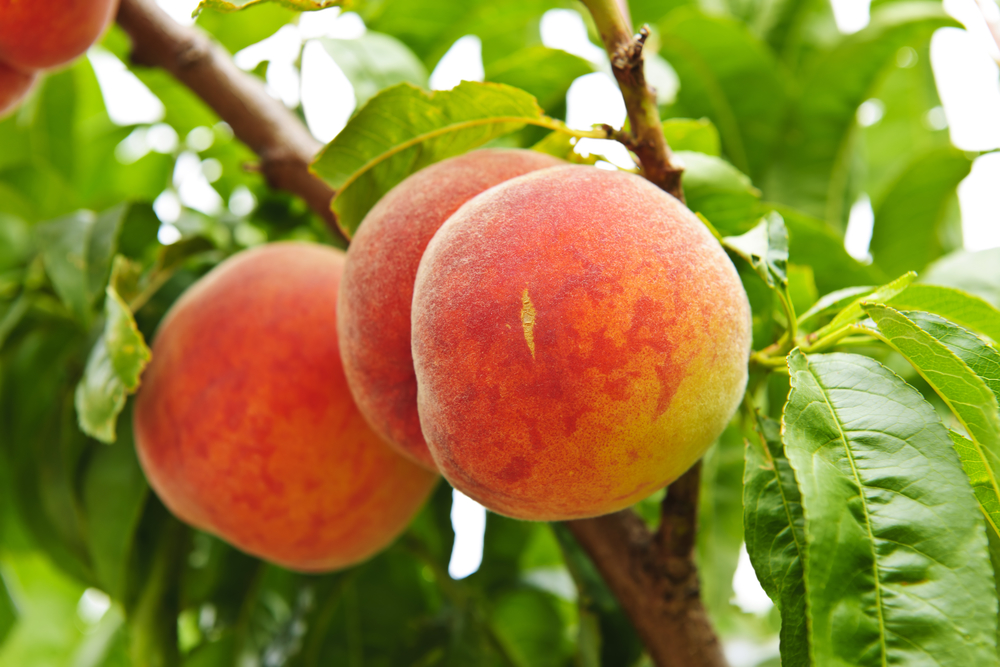
Pictured is a file photo of peaches that were harvested.
By Clint Thompson
Georgia’s peach crop is primed for a productive season. Hopefully, the market will oblige, says Dario Chavez, University of Georgia Cooperative Extension peach specialist.
“We think, in general, the majority of the varieties did have enough chill (hours). The ones that we think may have some issues with chill are the later varieties, the higher-chill varieties. We really didn’t get a freeze this year for peaches. That’s different from previous years,” Chavez said. “Overall, I have been looking at the plants and I see good fruit growing from the early varieties. The late varieties are still a little too early because the fruit is just starting to swell”.
“A variety for example like Julyprince that is a popular variety in Georgia and South Carolina, it’s looking very nice. We have a block of Flavorich, one of the first varieties that come in May, it has a nice crop, too.”
Georgia is one of the top peach-producing states in the country. According to UGA Extension, Georgia produces more than 130 million pounds of peaches every year. There are two commercial peach-growing regions in Georgia. The central region is the largest with about 1.6 million peach trees, which comprises 75% of the state’s production. The southern region produces about 30 million pounds of peaches annually.
While this year’s crop provides peach growers a sense of optimism with a little more than a month away from harvest, there is uncertainty regarding how the peaches will fare in the current market. Many fruit and vegetable markets are struggling right now amid the coronavirus pandemic. Chavez is hopeful that won’t be the case for his peach producers.
“Sadly, with all of this situation with the virus, we hope the market doesn’t get spooked or anything like that because we’re seeing a good crop right now,” Chavez said.
Chavez said in his blog in mid-February that if growers expect to have a potentially good crop, varieties must meet certain chill portions at a minimum by Feb. 15. He said middle Georgia was close to 50 chill portions. This means that, overall, conditions are like last season.
650 chill hours need ~ 30-35 Chill portions
750 chill hours need ~ 35-40 Chill portions
800 chill hours need ~ 40-45 Chill portions
850 chill hours need ~ 45-50 Chill portions
950 chill hours need ~ 50-55 Chill portions
Chavez emphasized in his blog that if a specific variety from last season had issues during bloom (either delayed or extended), because of weather conditions, then it’s more than likely going to be a similar situation this year.
Jeff Cook, University of Georgia Cooperative Extension Agriculture and Natural Resources agent for Peach and Taylor counties, says the ongoing coronavirus pandemic has forced peach producers and farming operations to take extra precautions when protecting their crews from becoming sick.
“They have separate crews so they’re trying to keep the crews a little more separated this year. But the biggest thing that they’ve all said to me is they’re trying to keep the crews away from the outside world,” Cook said.
Farmers limit the workers to the amount of time they’re exposed to other people that are not part of their specific crew.
“They’re trying to help reduce the amount of time they’re having to spend at the store or at the bank. Once a week they carry them to the bank and once a week they carry them to the grocery store,” Cook said. “To the farmer, if their crews get sick and they can’t pick peaches, then we’re in big trouble.”
Cook said some peach workers have been in place since February when farms started the peach pruning peach process. The second crews are now in place to help thin the peaches since a lot more people and hands are required. These peach crews also include those who’ll work in the packing sheds and help harvest once trees are ready.
Cook estimates that there are 10 to 12 workers in one crew, though, multiple crews may ride the same bus to a particular orchard. The workers are not close together out in the fields. Each one has a specific tree they work on, and trees are normally spaced 16 feet apart.
“When they are thinning, the ride there is as close as they are going to get to each other. When they’re out in the field, they’re not really near each other,” Cook said.
The country’s No. 2 state in peach production appears ripe for a productive season, pending how the market spirals over the next few months, according to Andy Rollins, Clemson Extension agent in Spartanburg, South Carolina.
“It’s looking really good overall as far as the amount of crop and how clean the crop actually is right now,” Rollins said. “(There’s) a lot of uncertainty, just like everybody, as far as what the market is going to bring. We’re still keeping on. The growers are taking care of everything, spray-wise. It looks to be one of the cleanest crops I’ve ever seen.
“I’ve spoken with some of the Georgia guys and on the ridge of South Carolina as well, and things look pretty good down there as well.”
Rollins assists farmers in the upstate or northern part of South Carolina. It amounts to about a third of the state’s crop.
Farmers across the country are feeling the pinch of an economic downturn amid the ongoing coronavirus pandemic. However, Rollins is encouraged about how early sales are going for his strawberry farmers. He believes a similar fate could await his peach producers when harvests of Flavor Rich varieties begin around May 25.
“We just started in strawberries and indications are good right now as far as movement of the product with strawberries. Even in this current situation, our wholesale market and several of our U-pick growers are actually doing fairly well,” Rollins said. “But yeah there is still that uncertainty of not sure what’s going to happen later. But really, based on the current situation, things are going pretty well.”
“It looks like we’re in the clear here at this point in the year. There’s been plenty of years where I’ve said that and that we’ve had events that changed. It seems like I’m saying that every year, but it really is a solid crop. We don’t see any major issues right now with anything,” Rollins said.
Submitted by Gene McAvoy, Regional Vegetable Extension Agent IV Emeritus with UF/IFAS
“Up to the end of Feb our growers were having a banner year and it looked like this season would be one of those homeruns that come around every 5-6 years.”
Here is a report that I prepared on the state of S Florida ag and shared with officials. (Long read but may shed some light on how COVID-19 is impacting agriculture in our area.)
Markets
On Tuesday, March 24, a local broker says, everything changed. From brokers, orders stopped and everything got quiet. On Wednesday, March 25, it got super quiet.
Since then tomato volumes are down 85%, green beans are like 50% and cabbage is like 50%.
R.C. Hatton has plowed under 100 acres of green beans, around 2 million pounds, and 60 acres of cabbage, or 5 million pounds.
Florida’s tomato growers target 80% of their production to restaurants and other food service companies, rather than to supermarkets. In this sector, growers are walking away from big portions of their crop.
Tony DiMare estimates that by the end of the growing season, about 10 million pounds of his tomatoes will go unpicked.
Some crops like potatoes and oranges are faring well, whileother produce isn’t selling like it used to.
With a lot of people staying home and buying mostly comfort foods, products like peppers, tomatoes and cucumbers have actually slowed down incrementally,” said Chuck Weisinger, president of Weis-Buy Farms, Inc.
“The biggest challenge we have right now is getting the stores to start buying,” said John Stanford, farm manager at Frey Farms.
As you know. produce is highly perishable and three weeks into this, many companies around Immokalee, Florida have already had to empty their coolers and dump produce. One dumped 20,000 pounds a day last week, let that sink in… 20,000 pounds of tomatoes a day. They dumped a total of 100,000 pounds so far. This is from one farm.
Three weeks in, most farms have exercised triage dumping and emptying coolers and are terminating fields for which they have no foreseeable markets. They are concentrating on maintaining fields that they still have demand for, unfortunately, depending on the crop – this is only 20-50% of the total planted.
Impacts on Ranchers
The cash market and futures prices are lower than anyone can remember. One local rancher sold calves this week and averaged $250 per head at the Arcadia auction barn. A few weeks ago he would have received $450 per head average, and that constitutes below breakeven.
In normal times, strategy would be to hold calves until the crisis is over, and hope prices will take an upswing. But there is huge uncertainty about how long this will last. A major compounding problem is the dry conditions, and lack of reserve forage. These weather patterns would normally dictate early weaning of calves. Hay costs, when available, and low market prices are a formula for hardship.
The extended impact on ranchers will be the cows not breeding back on schedule. Holding calves longer in hot and dry conditions puts a strain on a cow’s reproductive system. This has been well-documented by University of Florida researchers.
Many growers are exploring alternative methods of moving product.
Sam S. Accursio and Sons Farms’ in Homestead packing house opened direct sales to consumers, selling boxes at $10 in each of the past two weekends. They had cars stretched for half a mile in front of the packing house and were able to move 120,000 pounds of Redland-raised squash, tomatoes, beans and cukes. They also partnered with a farmer out of Mount Dora, Florida who had 30,000 flats of unsold blueberries and sold these at 12 pints for $20. Similar efforts were conducted by Alderman Farms in Bonita Beach, Florida, Farmers Alliance in Immokalee and others.
Martin County, Florida opened a pop-up drive-thru market that saw 500 cars in one day. Traditional commercial farms in South Florida have been overwhelmed by the support for the sales at their packinghouses – all fruit that would have otherwise gone unsold if waiting on traditional markets to purchase.
Growers are still concerned that a large amount of produce seen in the supermarket comes from Mexico.
According to Bill Braswell, since March 1, the start of the Florida blueberry season, Florida has produced 6.1 million pounds through last Thursday April 2. In that same time period, Mexico has imported 17.4 million pounds into the U.S., according to a USDA report. Mexico market price is $12 for a 6-ounce flat delivered to Chicago which translates to $2.60 per pound.
Labor
Growers are taking aggressive steps to protect workers from COVID-19, including keeping truckers separate from on-farm labor.
They have been taking advantage of training resources and posters supplied by IFAS Extension and others.
Agents have also shared information on essential services exemption and supplying growers with template essential services exemption letters to facilitate movement of their essential staff and labor.
Labor shortages – reports indicate that COVID-19 has delayed the U.S. government’s processing of H-2A work visas. This will impact growers in central and north Florida and up the coast.
Food banks
Last week, growers in Immokalee alone donated more than 3 million pounds of vegetables to Harry Chapin food bank, overwhelming their ability to store, transport and distribute the produce – they had to call a halt.
Farm Share, which partners with more than 2,000 food pantries, churches, schools and other nonprofits throughout Florida, is running at maximum capacity, despite having 25 refrigerated trucks, six warehouses of between 10,000 to 35,000 square feet and 40 to 50 drop sites from Jacksonville, Florida to Florida City, Florida. They usually help more than seven million pounds of food reach the hungry and now are faced with moving a lot more.
Over the past two weeks, Wish Farms has donated 220,000 pounds of fresh strawberries — equivalent to 241 pallets or nine semi-trailer loads — to feeding Tampa Bay.
Growers are having a tough time adapting because everything is happening so quick. Faced with a highly perishable product, growers are struggling to survive right now, with picking, packing and shipping everything that they can. Because of the coronavirus, things have changed. Buyers are demanding tight security, heavier sanitation, distancing and more.
We have heard many ideas and suggestions from the public and even local officials – what many people fail to realize is that picking, packing, cooling, storing and transporting vegetables costs money, and growers who have already lost millions of dollars are understandably reluctant to throw good money after bad. It also costs money to maintain fields with no hope of sales in sight. Growers are disking up fields and maintaining just what they feel they have markets for. Unfortunately, this is only about 20% to 30% of the total acreage. Each acre of tomatoes costs $10,000 to $12,000 to grow and $5,000 to $6,000 to pick and pack. Unmaintained fields rapidly succumb to pests and diseases and soon become a breeding ground threatening the health of nearby fields that growers are trying to save for their remaining markets.
It is not only veggies, as of yesterday about 7.7 pounds of milk has been dumped by one Central Florida co-op (there are a few in Florida). Milk is sold by the pound so that is 900,000 gallons.
While I don’t have the exact amount from the other co-op I would expect their numbers to match ours in north Central Florida and South Georgia. Unfortunately, we can easily say that 10 million pounds of milk has been dumped throughout Florida.
There are efforts to help farmers all over our state. In the dairy industry, there is a grassroots group of passionate producers, processors, promotion people, school representatives and Extension agents trying to get more milk moving. This group includes people from Florida and Georgia, that in normal times might view each other as the competition (different co-ops and different promotion boards). These efforts range from delivering school lunches, buying and delivering milk to food banks and those in need; contacting schools to increase their milk in each meal, contacting legislators to allow whole milk in school lunches (we need help with this), and asking stores to stop limiting the purchase of milk.
People really have no concept of the amount of food we are taking about – Immokalee alone ships approximately 400 to 500 semis of vegetables a day from March through mid-May. This is 15,750,000 pounds of vegetables headed to market every day. Add to this Belle Glade, Palm Beach Co, Homestead and the amounts are staggering. I know of one grower in Belle Glade who is disking up 1 million pounds of green beans every three days.
South Florida vegetable growers supply more than 150 million people in the eastern U.S., from Miami to Chicago, from late October to mid-May.
Here is a resource a producer may be interested in sharing – this is a clearing house for finding food – donating food etc.
(HCCGA) — FDACS has created the attached form for producers to fill out with their product availability. Once submitted, FDACS will utilize to forward to their Fresh From Florida contacts, as well as the Florida Department of Corrections, food banks and make connections with other State Departments of Agriculture in hopes of providing market opportunities to move product during the Coronavirus pandemic.
Peach season in Alabama and Georgia begins in late May.
By Clint Thompson
Peach season is less than two months away for Alabama and Georgia growers and Edgar Vinson, assistant research professor and Extension specialist in the Department of Horticulture at Auburn University, is encouraged by this year’s crop despite a very mild winter.
“I’m cautiously optimistic. I do think we got more chilling than the chill hour models tell us. But my concern now and concern of the growers is potential for frost damage,” Vinson said. “Hopefully, it’s warm for the rest of the season.”
Vinson said Alabama’s peach season begins in late May and extends to September, which is very comparable to Georgia, and unlike Florida farmers, who are already harvesting their crop amid warm temperatures. Vinson does believe growers are a little concerned with chill hours with respect to the varieties that require a lot.
“And that’s not to say we’re not going to have any issues with chilling, we’ll probably see some issues with chill accumulation, especially with our high chillers. A number of our growers still have quite a number of peach varieties that require higher chilling; 900 (hours) or above,” Vinson said. “In terms of the early-season to mid-season (varieties), they’re probably not as concerned. They’re more concerned with the varieties that require a high chill. That’s probably where we’ll see any signs or symptoms of a lack of chilling.”
Lack of chilling hours can affect the overall quality and appearance of the fruit, according to Vinson.
“There’s an over-pronounced suturing that runs the length of the fruit. Ideally, we want that to be minimal. But when there’s a lack of a chilling, that suturing is very pronounced,” Vinson said. “Also, the tip of the fruit, you don’t want a point there; you want that to be smooth. With fruit that shows lack of chilling, there’s an over-pronounced suture with a very sharp tip at the end of the fruit.”
Vinson also said there can also be smaller harvests over a longer period.
“That means your growers are having their crews go out to the orchards for longer periods. That cost more money and each harvest is yielding less. It can affect the growers’ operation that way,” Vinson said.