Category: Peaches

  • Three Joy Peaches Released

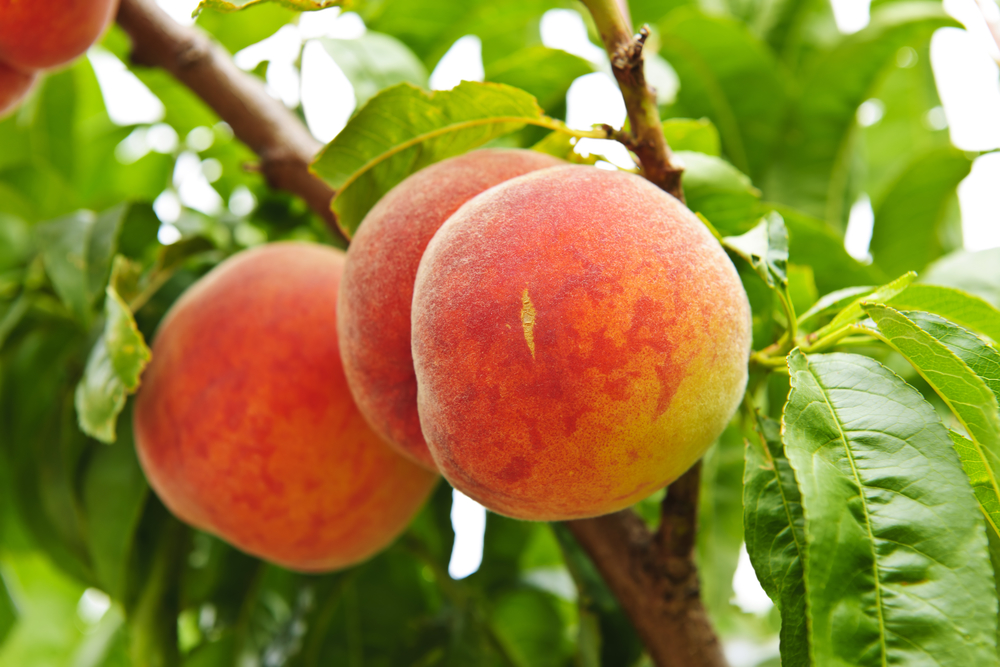
    ARS/Rich Joy peaches ripening on the tree in a Byron, GA., orchard.

    ARS News Service

    BYRON, GEORGIA, May 14, 2020 — The Agricultural Research Service (ARS) has released a trio of Joy peaches — Rich Joy, Liberty Joy and Crimson Joy — to enhance the southeastern fresh peach market.

    Rich Joy is named for its fruit’s rich flavor and as a way to honor ARS peach breeder William Richardson Okie, who retired in 2014. Okie is known for having developed the series of “prince” peach varieties, which are still in commercial use.

    Crimson Joy is named for its almost fully red-blushed skin. Liberty Joy is so called because it ripens near the Fourth of July, Independence Day.

    The three Joy peaches are not genetically related. They are all yellow-fleshed, soften slowly to a smooth buttery texture (a trait called melting), with balanced sugar/acid ratios and pleasant eating quality. But they differ in pedigree parentage, ripening time and chilling requirement (the minimum time a fruit-bearing tree must be exposed to temperatures below 45 degrees F before it will blossom).

    Breeders tend to choose a single “base” name for the varieties they develop to make their origins recognizable, explained research horticulturist Chunxian Chen, with the ARS Fruit and Tree Nut Research Unit in Byron, Georgia and developer of the Joy trio of peaches.

    “Joy is a wonderful word that expresses how people feel about enjoying a good peach,” Chen said. “It is one syllable, can be easily phrased with other words for naming of future releases and it fits well with some “unofficial” cultivar naming conventions.”

    Chen explained that new varieties continue to be needed because the southeastern peach industry is facing multiple challenges, including more incidences of warm winters and spring freezes, which can change chilling requirements. Other industry needs include improved fruit quality, competition from other fruits and imports, and demand for varieties with improved resistance to pests/diseases and reduced need for pesticides. There also is a need for varieties to fill certain harvest windows.

    “So we must continue to breed new peach varieties to meet growers’ needs, elevate overall production efficiency and market share and keep the industry sustainable and profitable,” Chen added.

    The value of fresh and processed peaches was estimated at $511 million for 2018, according to the USDA National Agricultural Statistics Service.

    Liberty Joy has the shortest chilling requirement of the three new varieties, about 650 chill hours. It ripens in late June to early July. It will be a good alternative to current commercial varieties in this harvest window such as Fireprince, Blazeprince, Scarletprince and Redglobe, all of which require about 850 chill hours and do not produce well when winter chill has been insufficient for flower bud maturation. Liberty Joy also appears to be less vulnerable to spring freezes, compared to other varieties with the same short chill requirement.

    Crimson Joy, which requires about 700 chill hours, has redder skin color, firmer fruit and improved fruiting reliability, compared to Harvester and Redhaven, which ripen at about the same time. In addition, Crimson Joy appears less vulnerable to some chill inadequacy and spring freeze.

    Rich Joy requires about 850 chill hours and ripens between Julyprince and Flameprince in mid-August. At maturity, about 90 percent of the fruit is bright red with an attractive yellow ground color on the fruit. This makes it preferable to older, less-blushed Cresthaven and Early Augustprince for the similar harvest window. As a late-season variety, Rich Joy fruits reliably with attractive, large, firm, premium fruit that appear to soften slowly on the tree, allowing it to be picked over a relatively longer period compared to other varieties.

    The Agricultural Research Service is the U.S. Department of Agriculture’s chief scientific in-house research agency. Daily, ARS focuses on solutions to agricultural problems affecting America. Each dollar invested in agricultural research results in $20 of economic impact.

  • Sweet Results for Florida Peach Farmer

    By Clint Thompson

    Florida’s peach season has come and gone. David Wheeler, peach farmer in Lake Placid, Florida, said his season started early and finished earlier. From a marketing standpoint, that was as good as he could have hoped for.

    Peach season is underway in Georgia and Alabama.

    “The marketing window, that was very good this year, yes,” Wheeler said.

    Wheeler produces 120 acres of peach trees and had success this year selling retail.

    “Walmart was very supportive of the Florida peach program. That really helped us. They took a lot of our volume,” Wheeler said. “They were very good to us.”

    In a previous interview, Wheeler confirmed that the high temperatures in March spurred the peaches to ripen earlier than normal. With hot and dry conditions felt throughout the state the past in March and April, peach season closed sooner than normal.

    Since Wheeler’s harvesting window closed sooner than normal, he didn’t have to compete against growers in Georgia or Alabama for marketing supremacy. Both states have just now started harvesting their peach crop. Wheeler didn’t have to compete for the market against larger-scale operations. The result was a good year despite a decrease in production.

    “I think overall (it went) pretty well. Production was down about 25% but we had a very heavy crop last year so that’s not a big surprise,” Wheeler said. “The fruit quality was outstanding. The best way I have to judge that is when I take peaches to friends; everybody raved about them this year. I know they were a good quality peach. Overall, I would say (it was) a good season, even though production was down and packouts were down.”

    Primarily a citrus grower, Wheeler, a peach farmer for nine years, began producing peaches when citrus greening disease became problematic in Florida and has since wiped out a bulk of citrus production in the state. He mainly produces a pair of varieties, UF Best and the UF Sun. Wheeler says he has had the most success producing UF Sun.

    To learn more, read about University of Florida peach breeding efforts.

    To learn more about peaches, see University of Georgia peaches.

  • Hydrogen Cyanamide for Uniform Bud Break in Peaches

    Ripe peaches ready to be picked on tree branches

    By Ashley Robinson

    Weather conditions are an important factor when it comes to growing peaches in Florida.

    Florida’s mild winters and fluctuating temperatures in the fall continue to be challenges for peach production. Because peach trees are deciduous, they require a certain amount of cold weather to become dormant. Once the cold weather requirement for dormancy is met, the warm spring weather ends the dormancy period, resulting in floral bud break.

    The number of chill hours needed to end dormancy depends on the peach variety. In the past several years, the required chill hour accumulation to achieve uniform bud break was often not achieved until late January.

    “Since our winters are so mild in Florida, we are seeing that the trees are not going into proper dormancy, which means the trees are never sleeping in the winters. You always see some amount of flowering which is a concern because you’re losing those buds and potential fruit, since they won’t be harvested” says Tripti Vashisth, an assistant professor of horticulture at the University of Florida Institute of Food and Agricultural Sciences (UF/IFAS).

    Hydrogen Cyanamide Trials

    Hydrogen cyanamide is a plant growth regulator used worldwide in fruit crops to break dormancy. The chemical is known for promoting uniform flowering, which is beneficial for growers because a uniform fruit set requires fewer passes to plant and harvest the crop. To ensure that hydrogen cyanamide works well for low-chill peach cultivars under Florida conditions, researchers at UF have been testing the effects of hydrogen cyanamide on peach production in Florida over the past three years.

    “We have found that hydrogen cyanamide is very effective in Florida conditions,” Vashisth says.

    According to Vashisth, most growers are applying hydrogen cyanamide at a rate of 1.2 or 1.25 percent. However, research results have proven that hydrogen cyanamide at a rate of .75 to 1 percent is highly effective in inducing bud break and is also more economically beneficial for growers.

    Timing is Key

    When using hydrogen cyanamide as a management tool, it is critical to apply it at the right time.

    According to Vashisth, from the time of application in North Florida, it took about six weeks for uniform bud break to occur. However, it only took about three weeks in Central Florida.

    “Right timing is very critical because if it is applied too late you can lose a lot of crop,” says Vashisth. “It needs to be a very educated decision that growers make.”

  • Be Careful How You Store Certain Fruits, Vegetables

    Peaches are sensitive to cold temperatures.

    By Clint Thompson

    University of Florida post-harvest plant physiologist Jeff Brecht cautions consumers about putting some fruit and vegetables in their refrigerators. Quality commodities like tomatoes, melons, avocados and peaches are chilling sensitive. Consumers need to be wary that too much cooling can affect the quality of certain produce.

    “I hear complaints about all of those where people say, ‘They’re tasteless. They’re not like I remember in the garden when I grew up.  They don’t have flavor.’ What it really is, those are all chilling sensitive, and they’ve been exposed to low temperatures for too long. They stop producing the aroma,” Brecht said. “The aroma is a super important component of flavor. That’s what it really is when you hear people complain about tasteless tomatoes is because they’ve been chilled. It’s a big problem that we have.”

    Clearing Up a Misunderstanding

    Brecht said there is a misunderstanding on the part of consumers about how best to handle different fruits and vegetables when they have them in their possession. Many of the vegetables can be injured by exposure to temperatures that are too low. Sensitivity is especially a concern for immature produce.

    “You can keep them too long in your refrigerator because you’ll actually start to compromise the quality,” Brecht said. “Even though I preach cooling, cooling, lower the temperature to maintain the quality, there’s a whole lot of fruits where you can’t go too far with that. That limits what you can do to keep them in good shape after harvest. You can’t cool them right down to 32 degrees or something like that, which you can do with a strawberry.”

    He also encourages consumers to buy local as much as possible. They’re not only providing much-needed business for producers amid tough financial times, they’re also getting fresher fruit.

    “Consumers are getting even better quality that way because they’re going to pick it up at the farm, take it home and probably eat it within a day or two. I would encourage people to patronize the direct sales farming operation to whatever extent they can,” Brecht said.

  • USDA Report Yields Results for 2019 noncitrus/nuts season

    Georgia’s pecan crop accounts for 29% of the nation’s production.

    By Clint Thompson

    The United States Department of Agriculture National Agricultural Statistics Service released its findings for noncitrus fruits and nuts in the Southern Region for the 2019 crop year. These estimates were based on grower surveys.

    Avocados: Florida’s production of avocados was up 88% from 2018. Its value of production was up 54%. Yields rebounded in 2019. Utilized production for the 2019 crop year was 25,540 tons.

    Blueberries: Georgia led the nation with 21,700 harvested acres in 2019. Utilized production was up 76%, and value of production was up 52% from 2018’s hurricane-damaged crop. Georgia produced 95,900 pounds. Utilized production in Florida was up 16%, while value of production was up 3%. Florida produced 24,200 pounds.

    Peaches: In Georgia, utilized production was up 44% and value of production was up 58% from the crop in 2018. Georgia utilized 33,780 tons of production. South Carolina’s utilized production was up 8%, while value of production was up 20%.

    Pecans: Georgia’s pecan crop accounts for 29% of the nation’s production. It had a 4% increase in utilized production and a 21% increase in value of production in 2019. The lingering impact from Hurricane Michael in 2018 and the dry summer in 2019 impacted the crop. Georgia produced 73,000 pounds.

    Strawberries: Florida’s utilized production was down 18% from last year, while its associated value of production was up 9%.

    For more information, see full USDA report.

  • Let the Peach Harvest Season Begin

    Peach harvest season is set to begin soon in Georgia.

    By Clint Thompson

    Those peach lovers ready for a ripe, juicy peach won’t have to wait too much longer. Peach harvest season is just a few days away, says Jeff Cook, University of Georgia Cooperative Extension Agriculture and Natural Resources agent for Peach and Taylor counties.

    “If they’re not picking any by Friday, they’ll be picking some by Monday,” Cook said. “They’ll be picking by next week.”

    Cook said Georgia’s peach crop are projected to be good, not great but definitely an improvement from previous down years where farmers were hurt by mild winters and late spring freeze events.

    “It’s kind of a normal year,” Cook said. “They used to say 80% of a crop is a full crop, and we’re probably a little bit less than that. We’ll have peaches all year. It’s definitely not like anything we’ve had in the past, the last few bad years.”

    Alabama Peaches

    He said peaches in Alabama may be hurt by the abnormally mild winter. Peaches need a certain number of chill hours to produce a crop. If they don’t receive enough, it could impact their yield and quality. Much of the peaches are grown in Chilton County, which is on a slightly higher elevation.

    “They’re still growing a lot of higher chill peaches. With the winter we had, I talked with one of the specialists over there and at the time I talked with him, he said they weren’t real happy about the crop they were seeing,” Cook said. “I don’t think they’ve really shifted their varieties to the lower chill peach varieties. I think this winter kind of got them.”

    Cook estimates that growers will harvest peaches through at least mid-August.

    “By mid-August, prices are starting to come down and the rest of the eastern United State is into it big. Everybody’s out there and peaches are everywhere. We’ve really positioned ourselves to get in early and get out early, the growers have,” Cook said.

  • Alabama Farmer: I Think Everybody’s Eyes Have Been Opened

    Fresh market produce for sale.

    By Clint Thompson

    Alabama fruit and vegetable farmer John Aplin has experienced a 500% increase in his strawberry customers this year. He believes it’s due to the ongoing coronavirus pandemic and its effect on people’s buying habits.

    “I know that we all didn’t get a 300, 400 or 500% increase in people who buy fresh fruits and vegetables this year,” said Aplin, who farms in Geneva County. “The virus does not affect our foods, but it is affecting the way people are buying food. I think after all of this is over with, we’re going to see a big difference in the way people are buying food. People are going back to, I don’t know, the 70s and 80s styles of buying food. Folks are beginning to talk about canning and preserving food.”

    Apling has already started harvesting his first variety of peaches, which are three weeks early. Tomatoes are also early this year and expected to be ready in two to three weeks. He’s hoping other crops will soon be ready as well.

    “Folks come to buy one thing. If we don’t have it, they buy something else,” Aplin said.

    “I think everybody’s eyes have been opened. Something could happen and you might need to be storing up for the winter. You might need to be saving a little bit of money instead of spending it all and living paycheck to paycheck. I think when it’s all over with, you’re going to see a huge change in people buying local. You can tell just by talking to customers, that they are even more concerned about where their food comes from. How many hands have touched their food before they put it on their plate?

    “I think that’s everybody’s mindset right now. They’re wanting something close by where they know where it came from.”

  • Georgia Peach Industry Expert ‘Optimistic’ About Crop, Market Outlook

    Georgia peaches should be ready for harvest in May.

    By Clint Thompson

    A Georgia peach industry expert is confident about his state’s marketing outlook amid the ongoing coronavirus pandemic.

    Duke Lane III’s company, Genuine Georgia, manages sales and marketing for the Georgia peach industry. He believes the market will be there for the Georgia peach farmers despite the presence of COVID-19 that has closed restaurants and shut down schools.

    “When you look at retail sales, produce and grocery, they’re up significantly. I think (the pandemic) will undoubtedly have an effect on foodservice. But our business has been built around grocery markets, retailers,” said Lane, who is also president of the Georgia Peach Council.

    “We feel like when you start thinking about summertime and feeling good, we feel like those are kind of thoughts that are synonymous with Georgia peaches. We’re pretty optimistic,” Lane said. “I feel like quality, flavor; absolutely. We’re going to kick off about the 18th of May and are just anticipating some big things.”

    Georgia is one of the top peach-producing states in the country. According to UGA Extension, Georgia produces more than 130 million pounds of peaches every year. There are two commercial peach-growing regions in Georgia. The central region is the largest with about 1.6 million peach trees, which comprises 75% of the state’s production. The southern region produces about 30 million pounds of peaches annually.

  • South Carolina Hopeful for Productive Fruit and Vegetable Season

    By Clint Thompson

    South Carolina is the country’s No. 2 producer of peaches.

    The current coronavirus pandemic has impacted fruit and vegetable farmers across the Southeast. South Carolina producers may be better equipped to deal with the current crisis based off who their normal clientele is.

    “I think everyone here is looking at Florida and is not liking what we see down there but hoping that our situation is a little bit different,” said Eva Moore, communications director at the South Carolina Department of Agriculture. “A lot of our market for our produce is in-state or neighboring states. Whereas I think Florida took a big hit with the tourism industry going away and that sort of thing. We’re in constant communication with our growers, just keeping an eye on things.”

    South Carolina thrives heavily on agriculture as a source of revenue for the state. Moore said there are 4.7 million acres farmed and 25,000 farms. Peaches are the state’s No. 1 fruit. Moore said there were approximately 17,500 acres of peaches in 2017, amounting to $18 million in production.

    Andy Rollins, Clemson Extension agent says the state’s peach crop appears ripe for a productive season this year, pending how the market spirals over the next few months.

    South Carolina is the country’s No. 2 producer of peaches behind California, according to the Agricultural Marketing Resource Center.

    Also, in 2017, there were about 2,800 acres of tomatoes, earning $34 million in production. Watermelon acreage totaled 4,900 with a value of $26 million.

  • UF Rootstock Research Key to Peach Production in Florida

    UF/Peach rootstock research at the University of Florida could be key in crop’s future in the state.

    By Clint Thompson

    Rootstock research could hold the key to the advancement of the peach industry in Florida. According to Lorenzo Rossi, University of Florida (UF) horticultural science root biologist, the research he’s teamed with UF colleague Jose Chaparro and Ph.D Student, Ricardo Lesmes, could be a game changer in the state’s peach production

    “In Florida, we have different type of soils, in particularly in peach-growing regions. We have the central part of Florida in which there is a deep soil profile and a lot of drainage. And we have an area here at the Indian River Research and Education Center, coastal Florida, where the soils are not deep. They have a shallow water table which means there’s a lot of problem with drainage,” Rossi said. “The idea is to create a rootstock for peaches that can do well in soils here. The rootstocks we have, at the moment, are only good for well-drained soils or those in central Florida.”

    How does the research work?

    Rossi and Chaparro are studying root traits and want to select a particular trait that allows the roots to grow laterally, instead of going deeper. If roots grew sideways, drainage issues would not be a concern because the roots aren’t going as deep in the ground.

    “The rootstocks we have right now, they don’t grow in soil that doesn’t have a lot of drainage. They don’t like water to stay there. They will die,” Rossi said. “Our idea was that if we started looking at root traits, you can select and breed rootstocks that can vegetate and be productive on soils that are not well drained. Unfortunately, we don’t have at the moment.”

    Rossi said growers are looking for alternative crops to grow since citrus greening disease wiped out a bulk of the state’s citrus crop. Peaches are a potential option.

    “Having a better rootstock will help them for sure and that’s what we’re doing,” Rossi said.

    Rossi said they have two or three more years left on this research.

    This year’s peach season in Florida started earlier due to high temperatures.