Vidalia onion farmers are expected to begin planting the crop this week. Disease management is already on the minds of Georgia growers, following last year’s tough season with bacterial diseases, according to Chris Tyson, University of Georgia Extension Area Onion Agent at the Vidalia Onion & Vegetable Research Center in Lyons, Georgia.
“We had some bacterial disease issues this past season,” Tyson said. “That’s one of those things, that’s something that really didn’t show its head until the end of the season. It was hard to foresee that.
“Bacterial diseases are tough to control. They’re probably the most challenging pest we have in onions period. It’s a big deal for everybody.”
Systems-Wide Approach
According to the UGA Vidalia Onion Extension Blog, bacterial diseases cause more economic losses in Vidalia Onions than any other pest. Tyson recommends growers take a systems-wide approach, which includes fertility, variety selection, maturity, weed control, insect control, bactericides and post-harvest management.
“With it fresh on their memory like that, they’re probably going to take into consideration anything they can do; any management strategies to help with that. That could be a lot of things. It could be variety selection to a certain extent or what maturity class of onions they try to grow,” Tyson said. “Sometimes for instance, typically, bacterial diseases that we see at harvest are worse the later you get in the season, so sometimes, earlier maturing varieties may miss some of that disease pressure.”
Center Rot
According to a UGA Extension publication highlighting bacterial diseases, by Bhabesh Dutta and Ron Gitaitis in the Department of Plant Pathology, center rot remains a huge issue for onion producers. Foliar symptoms initially consist of water-soaked lesions that cause the leaf to become bleached and blighted. Center rot management requires an integrated approach that aims at reducing potential sources of inoculum to count the spread of the bacteria.
Unfortunately, there are not any commercially available onion cultivars that are resistant to the disease.
“This past year we saw a good bit of center rot but we also saw some other bacterial disease that looks very similar to center rot that the management strategies would be very similar to that too,” Tyson said.
Growers are advised to plant early-maturing or mid-maturing cultivars. Thrips vector the spread of the bacteria among plants and fields. Controlling thrips pressure can be a successful management option. Weed management is also recommended. By reducing weeds, growers can potentially reduce the initial inoculum.
Sour Skin
Sour skin was also worse last year for producers. It is usually more of a problem during harvest in the latter part of the growing season. As it thrives in warm conditions, symptoms can manifest earlier in the season depending on temperature. The disease can progress from the upper foliage to the leaves in the lower part of the plant and then to the bulb’s outer scales.
Bulbs that are infected with sour skin usually have an acrid, sour odor and other foul odors that are associated with secondary organisms. Bulbs will turn reddish-brown to brown in color over time, as the tissues rot and copious amounts of fluids are produced.
Crop rotation may help with sour skin management. Avoid using overhead irrigation near harvest season will also reduce yield losses. Also, tactics that reduce the chances of irrigation becoming contaminated with sour skin bacteria will be beneficial.
Irrigate from wells or clean ponds that are weed-free can reduce inoculum levels.
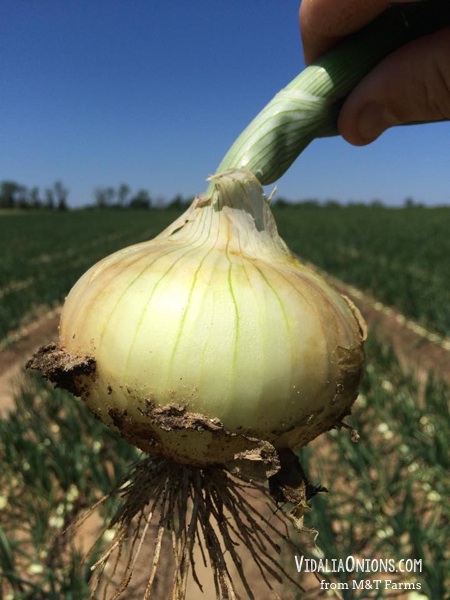
Photo courtesy of M & T Farms, Lyons, GA, and Vidalia Onions.com
The annual Vidalia Onion Production Meeting will be held virtually this year on Friday, Sept. 11, beginning at 9:30 a.m.
The topics that will be covered include variety trial review, flavor updates, nitrogen fertility management and onion disease management.
Everyone who wants to attend the meeting online will need to register before. Registered participants will receive a link the day before the meeting to log on.
Vidalia onion plants will soon be going in the ground across Southeast Georgia. Chris Tyson, University of Georgia Extension Area Onion Agent at the Vidalia Onion & Vegetable Research Center in Lyons, Georgia, pinpoints the week of Sept. 7 that some growers will start planting this year’s crop with most planting the week after.
“After Labor Day, definitely there will be some going in. Then there will be a lot that will go in around…I’ll just use the (Sept.) 15th as an arbitrary date. A lot of people will plant at the 15th; a big bulk of the onions. But there are some that are planted before then, definitely,” Tyson said.
Vidalia onion acreage the past two years has hovered around 9,300 acres, which is down from what it had been for several years prior. Tyson said this year’s acres could fluctuate some either way, but he doesn’t anticipate any huge changes in acreage.
“The acreage has been about the same the past two seasons. But you never know, it could go up some or it could stay the same,” Tyson said. “A lot of times we really don’t know until after planting, really what everybody does and what it’s going to actually look like.”
Seedbeds will be planted in September through the first of October.
Vidalia onion farmers will soon be planting next year’s crop.
Chris Tyson, University of Georgia Extension Area Onion Agent at the Vidalia Onion & Vegetable Research Center in Lyons, Georgia, said producers have already ordered seed and will prepare land with fumigation and treatments in August. Seedbeds will be planted in September through the first of October.
Low Supply in 2020
Growers are hoping for a better growing season in 2021. The onion supply was shorter this year, due in large part to different weather events. Storms came through Southeast Georgia in April and delivered hail damage to some of the onion crop.
“What the growers put on the shelf was a quality product, there just wasn’t as much of it to go around. Then the COVID pandemic created some extra challenges. It actually created a higher demand for a lot of food staples, and onions are one of those items. Fortunately, the Vidalia onions, most of those items end up on the retail shelf for direct to the consumer; the majority of them do, whereas some of other types of onions may go to food service,” Tyson said. “With the COVID going on, I think it hurt the food service industry, but it was good for the retail industry. Consumers, they’ve still got to eat, and they were going to the grocery store and eating at home more. That worked into our favor. When you have less to go around, the crop was short to begin with and when you have that, it makes it even shorter.”
The growing season also provided abnormally high temperatures in March. Tyson said a “heat wave” basically moved through the region that did not set well with the onion crop.
“To an onion that’s not used to that or that’s trying to grow a bulb, it created some stress for the crop. That was one reason for the shorter supply this year,” Tyson said.
UGA photo/Onion center rot is a financially devastating bacterial disease for Vidalia onion producers in south Georgia.
By Maria M. Lameiras for CAES News
After years of building and analyzing sample collections, plant pathologists at the University of Georgia have identified the genes that allow a type of bacteria that causes onion center rot to resist onions’ natural defenses in a “chemical arms race.”
The pathogen Pantoea ananatis can enter onions through the leaves — usually as a result of thrips feeding on the onion neck — and induces necrotic symptoms and extensive cell death in onion tissue.
When cellular damage occurs, onions and other members of the Allium genus, such as garlic, produce volatile antimicrobial compounds called thiosulfinates, the same compounds that make you cry when you cut onions and that give onions and garlic their characteristic smell and flavor.
These compounds normally kill invading bacteria. However, an 11-gene cluster of the P. ananatis genome allows the bacteria to tolerate the thiosulfinate allicin and colonize dead onion tissue damaged in its initial attack, according to a paper published this month in the journal Current Biology.
Center rot of onion, caused primarily by P. ananatis in the Southeast U.S., can be economically devastating to producers, leading to high crop losses both in the field and postharvest, said Brian Kvitko, an assistant professor in the Department of Plant Pathology at the UGA College of Agricultural and Environmental Sciences and lead author of the study.
Kvitko’s research into this pathogen is important because the bacteria resist onion’s natural defenses.
“Onions are a tricky host. Anyone who has ever cut onions knows they release a very potent irritant that can kill some bacteria, but these bacteria have a one-two punch,” Kvitko said. “The onion releases thiosulfinate, a potent reactive sulfur species that causes gross damage to cells by interfering with all kinds of cellular processes. The bacteria have picked up genes that allow it to take the hit from the thiosulfinate and then take over the dead onion tissue environment as a home to make more bacteria. Like little genetic gas masks. The onion itself already had built-in antibiotics and these bacteria found a way around it.”
Kvitko said that these bacteria cause disease differently than most other bacteria, which either break down plant cells walls with enzymes or “reprogram” plant cells by injecting them with proteins.
“So, bacteria can chew up the plant cells or reprogram them, but this is neither of those. These are not proteins that are being delivered, it is a chemically focused kind of disease. This is not the only example of this we have seen, but it is very rare,” he said.
Through genome sequencing, Kvitko’s lab identified differences in the P. ananatis genome from similar bacteria.
“These bacteria did not have any of the traits that were associated with a pathogen we knew. It was strange, but we didn’t know why. Now we have been able to find this different way of bacteria causing disease,” Kvitko said. “Knowing more about the pathogen and how it causes disease helps us find treatment and resistance strategies to manage this disease in the future.”
Onion center rot was first identified in Georgia in 1997 and can cause latent infections that are activated postharvest even if there were no overt signs of disease in the field.
“This is kind of an insidious disease in that the producer sometimes doesn’t know there is a problem until the crop is harvested, packed and shipped,” Kvitko said. “This disease is a big problem in onion-growing regions because bacterial diseases are hard to manage. There are a lot of diseases caused by fungi that we have fungicides to control, but we don’t have that kind of chemical strategy for bacteria.”
Although there are currently no identified onion cultivars with resistance to P. ananatis, knowing how a pathogen causes disease is a good step toward knowing how to find good host resistance, he added.
“To be able to fight something effectively, you have to know how it works. We know this thing is different. Knowing why and how it causes disease helps us to find a better way to fight it,” Kvitko said.
A key part of the research is the work being done by Bhabesh Dutta, assistant professor of plant pathology and UGA Cooperative Extension vegetable disease specialist on the UGA Tifton campus, who has collaborated with growers by collecting extensive samples of diseased plants for analysis. He then works with Kvitko on research both in the lab and in the field, an example of basic and applied agricultural research partnerships, which is a hallmark of collaboration and discovery at land-grant universities like UGA.
“We would not have made as much progress without Dr. Dutta’s long history with the systems and the good collection he’s been putting together for years,” Kvitko said. “The key thing that made this work wasn’t just collecting samples from diseased onions, but also from weeds in the fields and the thrips that are important in spreading the disease. That gave us a large panel of diversity to work from. We were able to look at all of the bacterial strains, even those that were very close to one another, to identify the genetic differences. We compared key regions of the genome that were only present in the strain that could infect onions. The genes that make specific regions of the genome different made the difference between which bacteria can and can’t cause diseases.”
With Vidalia onions at the top of the vegetable commodities grown in Georgia — at an annual farm gate value of $150 million — identifying the genetic traits of the bacteria responsible for the No. 1 disease in the state’s onion crop is an important factor in preventing financial losses for producers, Dutta said.
“There are 21 counties in Georgia with the marketing rights to grow and sell Vidalia onions, with nearly 65-70% of Vidalia onions being grown in Tattnall and Toombs counties,” said Dutta. “This is a high-value commodity for Georgia growers and this bacterial complex has become endemic in the Vidalia onion zone.”
While not all bacteria cause disease, Dutta’s research team has identified eight bacterial pathogens that are endemic to Georgia and which cause economic losses. Among the eight, one of the most prominent bacteria is Pantoea sp., which causes center rot. Other than Pantoea sp., Burkholderia cepacia — the causal agent of sour skin disease — is also prevalent in Georgia.
Building on a collection started by his predecessor, Ron Gitaitis, in the 1980s at UGA-Tifton, Dutta has assembled a collection of nearly 250 Pantoea bacteria strains from a diverse variety of sources including onions, weeds and thrips in his research program.
“Identifying the strain of bacteria that causes onion center rot allows us to survey producer fields and, if Pantoea sp. is prevalent in the environment, but it is not a disease-causing strain in onion, it gives us the ability to assess the risk that producer might have for center rot developing in onions during postharvest storage,” Dutta said.
Now that they have identified the 11-gene cluster responsible for the allicin resistance, Kvitko’s lab can start studying those genes.
“That’s where we are now. We know they have a cluster of 11 genes, but we don’t know exactly how it works. Is it specific to this type of bacteria? Or is there a way to keep bacteria from turning that resistance on?” Kvitko said. “Knowing more about the system, we have a nice list of potential weak points we can try to target, either through host resistance or some sort of novel chemical strategy. Bacteria are really tricky to manage; we have a limited tool set to work with and we want to have more.”
Because it would be impossible to change all P. ananatis bacteria, Kvitko’s team will also use what they’ve learned to develop pathogen-resistant onions.
“We are trying to see if there is any onion out there that the pathogen can’t kill. Finding onions that are resistant to the chemicals that are released by the bacteria and giving growers accurate information is important for mitigation,” he said.
Photo courtesy of M & T Farms, Lyons, GA, and Vidalia Onions.com
By Clint Thompson
Bob Stafford, manager of the Vidalia Onion Committee in Vidalia, Georgia, believes weather during the growing season has impacted this year’s Vidalia onion crop.
“We planted 9,373 acres and lost some to hail and we lost some to too much water. We had a bad growing season. We’ll have a good promotable supply, but they’ll be a little on the smaller size,” Stafford said. “We’ll have more mediums than normal. The consumers are still going to get a very good product.
“Our crop is generally over 90% jumbos but this time we’re going to have a lot of large-mediums and small jumbos.”
Today is the scheduled packing date for this year’s Vidalia crop. Stafford said the packing date is when you can start using the Vidalia Onion trademark, and it ensures the customers that the onions are mature.
This is the second straight year there has been considerably less Vidalia acreage produced.
“We started downsizing last year so we’ve planted the 9,300 acres for two years. We ordinarily go up to about 12,000 acres,” Stafford said. “What we decided to do, we wanted the same yield off of less acreage. We wind up every year selling between 5 and 7 billion bushels. We just want to get that many off of 9,000 acres. It’s all about yields per acre is what we’re after; higher yields, less acres.”
Stafford is not worried about this year’s market for onions compared to how other commodity markets have dropped amid the ongoing coronavirus pandemic.
“(Florida produce farmers) grew a lot of product for schools and restaurants and so forth. When this pandemic closed them down those products were just left hanging. Our product, there’s been a world shortage of onions because since this pandemic, people are cooking at home and the onion being a staple for the cooking, it’s managed to keep up pretty well with the supply,” Stafford said. “It hasn’t affected us that much. It has affected us some but not as much as some other commodities.”
Vidalia onion producers have begun harvesting the early maturing varieties this year, and Chris Tyson is excited about the potential of this year’s crop.
“The Vidalia onion crop definitely looks favorable this year. We are anticipating a quality harvest,” said Tyson, University of Georgia Cooperative Extension area onion agent at the Vidalia Onion and Vegetable Research Center in Lyons, Georgia. “Frequent and heavy rains created some adverse conditions earlier in the season, but growers have managed their crop well. They’ve done a great job managing their fertility and fungicide programs despite the weather.”
Growers started harvesting their earliest varieties in the beginning of April. The peak of harvest will occur near the end of the month.
There is optimism despite some localized outbreaks of downy mildew disease in the Vidalia Onion zone in Southeast Georgia, according to Bhabesh Dutta, UGA Extension vegetable plant pathologist. Severe and widespread cases have not been reported. He warns, however, things can change quickly with respect to infections in newer areas, as harvests continue to ramp up over the next few weeks.
“This all depends on how diligently our growers monitor their crops for initial infection and how aggressive they are on their protective fungicide spray schedules,” Dutta said. “Our onion growers have been on top of their game for the most part with respect to timely protective fungicide sprays. This in combination with some warm, clear weather may help reduce the onset or severity of downy mildew.”
Dutta said the first symptoms of downy mildew occur on older leaves as light green to pale yellow, which turn to tan and brown as the lesion ages. In Georgia, early symptoms can be diamond-shaped lesions that are mottled with pale and green areas interspersed. As colonization progresses, lesions may girdle the entire leaf. This could cause the total collapse of leaf tissues. Infected bulbs are reduced in size and typically don’t store well. In severe cases, 100% yield losses have been reported.
“Although bulb symptoms are rare to none, foliar infection and secondary pathogen colonization result in bulbs that are reduced in size and more often with internal rot,” Dutta said. “Healthy appearing bulbs from a downy mildew-infected crop do not store well and can get often discarded due to the internal rot.”
Photo courtesy of M & T Farms, Lyons, GA, and Vidalia Onions.com
Appropriated timing of fertilizer application during crop development ensures soil nutrient availability thorough the onion growing season. Typically, fertilizer is applied five times for Vidalia onion production in Georgia. However, researchers have found that control release fertilizer applications can significantly reduce the number of fertilizer applications while maintaining crop yield.
RESEARCH RECOMMENDATIONS
During the 2018-19 Vidalia onion growing season, researchers at the University of Georgia (UGA) conducted a field experiment to evaluate different fertilizer strategies, including control release fertilizer for Vidalia onion production.
According to Andre da Silva, UGA Cooperative Extension vegetable specialist, the field experiment compared grower standard practices with five control release fertilizer strategies. After harvest, statistical analyses were performed comparing total yield and bulb size distribution of the onions among treatments.
“Based on our findings, all of the control release fertilizer strategies increased yields compared to the standard practice used by growers,” da Silva says.
On average, control released fertilizer treatments proved to increase total yields by 25% compared to the grower standard practice. While all of the control release fertilizer strategies showed yield increases, applying the fertilizer once or twice throughout the season allowed for less fertilizer applications and nutrient requirements.
“When applying the fertilizer once or twice during the season, we applied only 96 pounds of nitrogen per acre versus 126 pounds,” da Silva says. He also mentioned that these strategies allowed for additional savings due to a reduction in tractor use and labor.
In addition to higher yields, the study also proved that control release fertilizer programs had an impact on bulb size, producing more colossal and jumbo bulbs compared to medium bulbs.
According to da Silva, control release fertilizer applications will be especially helpful to growers during the rainy seasons to ensure nutrient availability during the year and provide high crop yields.
Submitted by Gene McAvoy, Regional Vegetable Extension Agent IV Emeritus with UF/IFAS
“Up to the end of Feb our growers were having a banner year and it looked like this season would be one of those homeruns that come around every 5-6 years.”
Here is a report that I prepared on the state of S Florida ag and shared with officials. (Long read but may shed some light on how COVID-19 is impacting agriculture in our area.)
Markets
On Tuesday, March 24, a local broker says, everything changed. From brokers, orders stopped and everything got quiet. On Wednesday, March 25, it got super quiet.
Since then tomato volumes are down 85%, green beans are like 50% and cabbage is like 50%.
R.C. Hatton has plowed under 100 acres of green beans, around 2 million pounds, and 60 acres of cabbage, or 5 million pounds.
Florida’s tomato growers target 80% of their production to restaurants and other food service companies, rather than to supermarkets. In this sector, growers are walking away from big portions of their crop.
Tony DiMare estimates that by the end of the growing season, about 10 million pounds of his tomatoes will go unpicked.
Some crops like potatoes and oranges are faring well, whileother produce isn’t selling like it used to.
With a lot of people staying home and buying mostly comfort foods, products like peppers, tomatoes and cucumbers have actually slowed down incrementally,” said Chuck Weisinger, president of Weis-Buy Farms, Inc.
“The biggest challenge we have right now is getting the stores to start buying,” said John Stanford, farm manager at Frey Farms.
As you know. produce is highly perishable and three weeks into this, many companies around Immokalee, Florida have already had to empty their coolers and dump produce. One dumped 20,000 pounds a day last week, let that sink in… 20,000 pounds of tomatoes a day. They dumped a total of 100,000 pounds so far. This is from one farm.
Three weeks in, most farms have exercised triage dumping and emptying coolers and are terminating fields for which they have no foreseeable markets. They are concentrating on maintaining fields that they still have demand for, unfortunately, depending on the crop – this is only 20-50% of the total planted.
Impacts on Ranchers
The cash market and futures prices are lower than anyone can remember. One local rancher sold calves this week and averaged $250 per head at the Arcadia auction barn. A few weeks ago he would have received $450 per head average, and that constitutes below breakeven.
In normal times, strategy would be to hold calves until the crisis is over, and hope prices will take an upswing. But there is huge uncertainty about how long this will last. A major compounding problem is the dry conditions, and lack of reserve forage. These weather patterns would normally dictate early weaning of calves. Hay costs, when available, and low market prices are a formula for hardship.
The extended impact on ranchers will be the cows not breeding back on schedule. Holding calves longer in hot and dry conditions puts a strain on a cow’s reproductive system. This has been well-documented by University of Florida researchers.
Many growers are exploring alternative methods of moving product.
Sam S. Accursio and Sons Farms’ in Homestead packing house opened direct sales to consumers, selling boxes at $10 in each of the past two weekends. They had cars stretched for half a mile in front of the packing house and were able to move 120,000 pounds of Redland-raised squash, tomatoes, beans and cukes. They also partnered with a farmer out of Mount Dora, Florida who had 30,000 flats of unsold blueberries and sold these at 12 pints for $20. Similar efforts were conducted by Alderman Farms in Bonita Beach, Florida, Farmers Alliance in Immokalee and others.
Martin County, Florida opened a pop-up drive-thru market that saw 500 cars in one day. Traditional commercial farms in South Florida have been overwhelmed by the support for the sales at their packinghouses – all fruit that would have otherwise gone unsold if waiting on traditional markets to purchase.
Growers are still concerned that a large amount of produce seen in the supermarket comes from Mexico.
According to Bill Braswell, since March 1, the start of the Florida blueberry season, Florida has produced 6.1 million pounds through last Thursday April 2. In that same time period, Mexico has imported 17.4 million pounds into the U.S., according to a USDA report. Mexico market price is $12 for a 6-ounce flat delivered to Chicago which translates to $2.60 per pound.
Labor
Growers are taking aggressive steps to protect workers from COVID-19, including keeping truckers separate from on-farm labor.
They have been taking advantage of training resources and posters supplied by IFAS Extension and others.
Agents have also shared information on essential services exemption and supplying growers with template essential services exemption letters to facilitate movement of their essential staff and labor.
Labor shortages – reports indicate that COVID-19 has delayed the U.S. government’s processing of H-2A work visas. This will impact growers in central and north Florida and up the coast.
Food banks
Last week, growers in Immokalee alone donated more than 3 million pounds of vegetables to Harry Chapin food bank, overwhelming their ability to store, transport and distribute the produce – they had to call a halt.
Farm Share, which partners with more than 2,000 food pantries, churches, schools and other nonprofits throughout Florida, is running at maximum capacity, despite having 25 refrigerated trucks, six warehouses of between 10,000 to 35,000 square feet and 40 to 50 drop sites from Jacksonville, Florida to Florida City, Florida. They usually help more than seven million pounds of food reach the hungry and now are faced with moving a lot more.
Over the past two weeks, Wish Farms has donated 220,000 pounds of fresh strawberries — equivalent to 241 pallets or nine semi-trailer loads — to feeding Tampa Bay.
Growers are having a tough time adapting because everything is happening so quick. Faced with a highly perishable product, growers are struggling to survive right now, with picking, packing and shipping everything that they can. Because of the coronavirus, things have changed. Buyers are demanding tight security, heavier sanitation, distancing and more.
We have heard many ideas and suggestions from the public and even local officials – what many people fail to realize is that picking, packing, cooling, storing and transporting vegetables costs money, and growers who have already lost millions of dollars are understandably reluctant to throw good money after bad. It also costs money to maintain fields with no hope of sales in sight. Growers are disking up fields and maintaining just what they feel they have markets for. Unfortunately, this is only about 20% to 30% of the total acreage. Each acre of tomatoes costs $10,000 to $12,000 to grow and $5,000 to $6,000 to pick and pack. Unmaintained fields rapidly succumb to pests and diseases and soon become a breeding ground threatening the health of nearby fields that growers are trying to save for their remaining markets.
It is not only veggies, as of yesterday about 7.7 pounds of milk has been dumped by one Central Florida co-op (there are a few in Florida). Milk is sold by the pound so that is 900,000 gallons.
While I don’t have the exact amount from the other co-op I would expect their numbers to match ours in north Central Florida and South Georgia. Unfortunately, we can easily say that 10 million pounds of milk has been dumped throughout Florida.
There are efforts to help farmers all over our state. In the dairy industry, there is a grassroots group of passionate producers, processors, promotion people, school representatives and Extension agents trying to get more milk moving. This group includes people from Florida and Georgia, that in normal times might view each other as the competition (different co-ops and different promotion boards). These efforts range from delivering school lunches, buying and delivering milk to food banks and those in need; contacting schools to increase their milk in each meal, contacting legislators to allow whole milk in school lunches (we need help with this), and asking stores to stop limiting the purchase of milk.
People really have no concept of the amount of food we are taking about – Immokalee alone ships approximately 400 to 500 semis of vegetables a day from March through mid-May. This is 15,750,000 pounds of vegetables headed to market every day. Add to this Belle Glade, Palm Beach Co, Homestead and the amounts are staggering. I know of one grower in Belle Glade who is disking up 1 million pounds of green beans every three days.
South Florida vegetable growers supply more than 150 million people in the eastern U.S., from Miami to Chicago, from late October to mid-May.
Here is a resource a producer may be interested in sharing – this is a clearing house for finding food – donating food etc.
(HCCGA) — FDACS has created the attached form for producers to fill out with their product availability. Once submitted, FDACS will utilize to forward to their Fresh From Florida contacts, as well as the Florida Department of Corrections, food banks and make connections with other State Departments of Agriculture in hopes of providing market opportunities to move product during the Coronavirus pandemic.