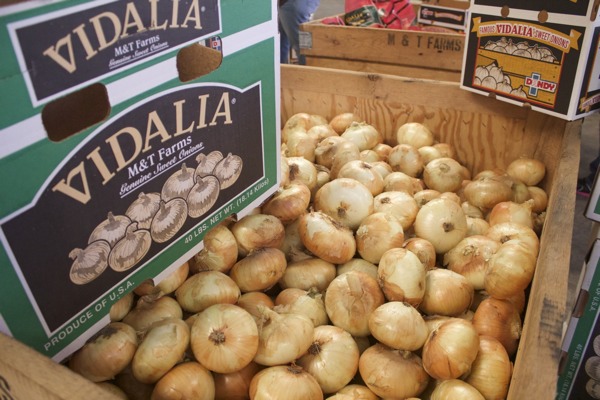
Vidalia onion harvests are underway in Georgia. It has been great harvest conditions for producers in the Southeast Georgia region. G&R Farms in Glennville, Georgia is one of the biggest Vidalia onion producers in the area. Pictured are photos from Thursday’s harvest.
Photo by Aubrey Shirley/UGA
G&R Farms will continue harvesting through mid-May.
April 19 was the pack date this year for Georgia Vidalia onions. An advisory panel comprised of industry leaders determined that April 19 be the first day of the year consumers could buy Vidalia onions.
Growers first dig onions and let them field cure. Then they’ll clip the onions and send to the grading house to be packaged and boxed up.
Today is the pack date for Georgia Vidalia onions. An advisory panel comprised of industry leaders determined that April 19 be the first day of the year consumers could buy Vidalia onions.
“A lot of growers were getting ramped up with harvest end of (two weeks ago) to really have onions that would be ready to sell for the pack date,” said Chris Tyson, University of Georgia Extension Area Onion Agent at the Vidalia Onion & Vegetable Research Center in Lyons, Georgia. “We’re still digging onions, clipping and grading. We’ve got a little bit of everything going on now. We’re starting to get into full swing of things.”
Growers in Southeast Georgia also could not have asked for better weather conditions to harvest their crop.
“It’s been clear and sunny. It hasn’t been too hot, yet We’ve had highs in the 80s, that’s almost perfect weather conditions for field curing onions,” Tyson said. “We start to get a little concerned when temperatures get hot. When it gets into the 90s, it’s harder on the onions. When it’s wet too, it’s the same thing. But it’s been mild and dry. It’s been really nice for them.”
Growers first dig onions and let them field cure. Then they’ll clip the onions and send to the grading house to be packaged and boxed up.
“I think we have a good, quality crop out there for the most part. This weather we’ve had up until now has really helped that,” Tyson said. “The weather can make us or break us. It’s been on our side so far. We’ve got a good-looking crop out there. I think the quality’s going to be really good.”
Photo courtesy of M & T Farms, Lyons, GA, and Vidalia Onions.com
University of Georgia Cooperative Extension will host the Vidalia Onion Field Day this year on Thursday, April 8, beginning at 10:30 a.m. It will be held outside and conclude at noon.
There will be a walking tour of the research plots at the Vidalia Onion and Vegetable Research Center in Lyons, Georgia.
2021 is the 35th Anniversary of the Passage of the Vidalia Onion Act by the State’s Legislature
ATLANTA, Ga. – The pack date for Georgia’s Vidalia onions will be April 19. The Georgia Department of Agriculture (GDA) and the Vidalia Onion Committee (VOC) made the announcement. The organizations are also celebrating the 35th anniversary of legislation that helped make Vidalia onions as popular as they are across the country.
The announcement means shoppers will soon be able to purchase Vidalia onions, which are only available for a limited time every season.
An advisory panel comprised of Vidalia industry members, state agriculture scientists and the Department of Agriculture determine the date each year. Soil and weather conditions are considered when selecting a date. This ensures only the highest-quality onions find their way to consumers.
“It is a special moment every year when we announce the Vidalia onions pack date, but this year we will mark the passage of the 1986 Vidalia Onion Act by our state legislature that played a defining role in making our state’s official vegetable an iconic brand recognized around the world,” said Georgia Agriculture Commissioner Gary Black. “I am pleased to announce April 19 as the 2021 pack date for Vidalia onions.”
Vidalia’s Popularity
Vidalia onions have grown in popularity since they were first discovered in the 1930s. The Vidalia Onion Act established that only sweet onions grown in 20 South Georgia counties and produced from a specific Granex seed and packed and sold on or after the official pack date each year could be called Vidalia onions.
For the 2021 season, approximately 10,000 acres of Vidalia onions were planted, according to VOC Chairman Aries Haygood. “We are anticipating a good harvest, and consumers across the country should have ample supply throughout the season,” said Haygood.
The vegetable is hand-cultivated by 60 registered growers. They represent about 40% of the sweet onion market. The onions are sold in every state.
UGA Extension photo/Shows botrytis disease in onion plants.
Field conditions are conducive for disease pressure to increase in Vidalia onion fields in Southeast Georgia. That’s why Chris Tyson, University of Georgia Extension Area Onion Agent at the Vidalia Onion & Vegetable Research Center in Lyons, Georgia, is imploring farmers to stay on top of their fungicide sprays.
“Looking around the fields last week, we definitely saw more disease showing up. Some of the fungal diseases like botrytis and stemphylium, we saw them showing up. That is expected this time of year,” Tyson said. “But they’re definitely showing up now that we’ve had warmer weather. We just want everybody to stay on track to manage that and all the other diseases, too.”
Excessive Rainfall
Like most of South Georgia, the Vidalia onion region received its fair amount of rainfall during February. According to the University of Georgia Weather Network, Vidalia, Georgia received 6.35 inches between Feb. 1 and Feb. 22. Then temperatures increased a week later. But this week, there was more rain, especially on Tuesday and Wednesday where 2.51 inches were recorded.
Despite the weather challenges, the onion crop looks good, overall, says Tyson. But as harvest nears, now is not the time to let up.
“We’re at a period of time in the crop where harvest for some of the early maturing onions is probably just about a month away. It seems like it’s right here, but we still have a long way to go even for those onions that will be ready soon; and then for some of the longer season ones that will be ready in six weeks or seven weeks. We still have a long way to go,” Tyson said. “We’re not out of the woods yet. We know from past experience that a lot can happen in the final few weeks before harvest. We’re keeping our fingers crossed right now because everything does look good at this point.”
Georgia Vidalia onion producers experienced much-needed sunshine last week. It allowed them to get back into the field and apply fertilizer and fungicide sprays, says Chris Tyson, University of Georgia Extension Area Onion Agent at the Vidalia Onion & Vegetable Research Center in Lyons, Georgia.
Photo by UGA/Shows Chris Tyson in an onion field.
“Growers were wide open last week trying to get caught up with fertilizer and with fungicides. I feel like, for the most part, we got caught up or close to being caught up with what we needed to be,” Tyson said. “If we had another rainy week, we would have probably been in trouble then, if we weren’t able to get in the fields last week.”
Plants had been slowed a bit amidst the excessive rainfall Georgia experienced most of February. But they showed encouraging signs of growth during the 70- and 80-degree temperatures.
“I tell you, they really have made some headway in the last week with the warm weather and sunshine. They have grown a lot,” Tyson said. “They have that ability to catch up really fast when we get favorable weather. We are still a little below average on our size of the crop and where we should be, but we’ve gained a lot of ground in the last 10 days.”
Main Concern Now
Tyson said growers’ biggest concern now is staying up to date on their fungicide applications.
“We just want to make sure we’re caught up in managing our diseases with our fungicide sprays to the best of our ability. As we enter into this second phase of the crop where it’s going to start to get big tops and start bulbing, we’re watching for Botrytis and Stemphylium, (Center Rot) and Downy Mildew. That’s the main thing really, that’s on a lot of their minds I think,” Tyson said.
Bacterial streak and bulb rot caused by Pseudomonas viridiflava. A: Foliar symptoms include water-soaked lesions and collapsed leaf tissues. The corrugated appearance is due to protruding veins in leaves. B: A blue-green appearance is occasionally observed in post-harvest rots caused by this pathogen.
By Bhabesh Dutta
The climate prevalent in the Vidalia onion zone (southeastern Georgia) is conducive to many diseases. Among the diseases, those that are caused by bacteria and fungi are the prominent ones. Some of the diseases caused by water molds or oomycetes (Pythium damping-off and downy mildew) can also be seen periodically. Based on my experience as a vegetable Extension pathologist and onion disease specialist in Georgia, I generally see a seasonality to some of the important diseases. This article covers points that relate to disease seasonality and management.
SEPTEMBER/OCTOBER PROBLEMS
Onion seeds are sown around mid-September to early October on seedbeds. Some of the diseases that are normally seen during this period are Pythium damping-off and foliar blight caused by Xanthomonas leaf blight and Pantoea sp.
Bulb rot symptoms of sour skin on onion. Photo credit: David B. Langston, University of Georgia, Bugwood.org
Fungicides labeled for onion are effective against Pythium and can be used as a soil application according to the label. Use of optimum watering and avoiding seedbeds in low-lying areas of the field can also help in managing this disease.
In terms of bacterial blights in seedlings on seedbeds, some growers use copper-based bactericides that are effective. Normally, nature takes its own course. When these seedlings are transplanted in the field, carry-over bacterial disease issues from seedbeds are seldom seen. This is in part due to the cooler conditions that are prevalent during December and January, which these bacterial pathogens do not prefer.
Onion seedlings are transplanted after Thanksgiving or in late November and continue until mid-December. Diseases are not so common during these months; however, Vidalia onion growers use a preventive spray of broad-spectrum fungicides that provides a general level of protection against foliar fungal pathogens.
Foliar symptoms of yellow bud disease on onion include intense chlorosis on emerging leaves and severe blight on the older leaves. Photo credit: Ronald D. Gitaitis, University of Georgia, Bugwood.org
JANUARY/FEBRUARY DISEASES
Fungal diseases are rare during December and January, but some bacterial diseases like bacterial streak and bulb rot (causal organism: Pseudomonas viridiflava) and yellow bud (causal organism: Pseudomonas coronafaciens) can be observed in late January to late February. Use of copper-based bactericide spray, optimum nitrogen fertilization and optimum irrigation generally help in managing these diseases.
WHAT TO WATCH FOR IN MARCH
As the temperature becomes moderate in March, along with frequent rainfall, Botrytis leaf blight (causal organism: Botrytis squamosa) and purple blotch (causal organism: Alternaria porri) can be observed. Stemphylium stem blight (causal organism: Stemphylium vesicarium) can also be seen in fields that are infected with either of these fungal pathogens. In general, Stemphylium sp. appears to be a weak pathogen under Georgia conditions, and it generally follows after Botrytis leaf blight, purple blotch or other diseases. A comprehensive fungicide program [as recommended by University of Georgia Cooperative (UGA) Extension] beginning in early March until harvest maturity (mid-April) effectively manages these three fungal diseases.
During the same time, the dreadful downy mildew disease (causal organism: Peronospora destructor) can also occur. Downy mildew is sporadic but aggressive. This disease is favored by prolonged leaf moisture and cooler night temperatures.
The fungicides that are labeled for use on onion against downy mildew are either moderately effective or less effective. Rotation of some of the moderately effective fungicides from different modes of action can help. Management practices that reduce prolonged leaf moisture and promote aeration can also help. The Vidalia Onion & Vegetable Research Center and UGA Extension specialists provide weekly forecasts of conditions that are conducive for downy mildew. These weekly alerts help onion growers to preventively spray against this pathogen.
Symptoms of slippery skin include white and bleached leaves (A) and soft-rot symptoms in bulbs (B). Photo credit: Howard F. Schwartz, Colorado State University, Bugwood.org
Bacterial diseases appear to be prevalent and problematic during the third week of March to harvest (late April) and can carry-over to storage (cause post-harvest losses). Some of the important bacterial diseases that Vidalia onion growers encounter are center rot (causal organism/organisms: Pantoea species complex), sour skin (causal organism: Burkholderia cepacia) and slippery skin (causal organism: Burkholderia gladioli pv. allicola). Sour skin and slippery skin are generally observed around harvest maturity.
Some of the minor bacterial diseases that can also be seen around harvest maturity are Enterobacter bulb rot/decay (causal organism: Enterobacter sp.), Rahnella bulb rot (causal organism: Rahnella sp.) and Pectobacterium soft rot (causal organism: Pectobacterium sp.).
Center rot outbreaks in Georgia generally coincide with the prevalence of thrips, which usually appear in late March and continue to increase in population throughout the rest of the crop growth period. Pantoea sp. can be acquired and effectively transmitted by thrips and hence, it is postulated that center rot appears in the Vidalia onion region when both thrips and Pantoea sp. are present together. Pantoea sp. can also be seed-borne, but its importance in disease outbreak may not be significant.
The bacterium is also present on asymptomatic weeds as an epiphyte, and in most of the cases, the bacterium in non-pathogenic. However, some of the Pantoea sp. on weeds can be pathogenic on onion seedlings/plants. As far as management of this disease is concerned, an effective weed and thrips management program along with a bactericide spray (program during susceptible onion growth stages) can effectively reduce the incidence and severity of disease in foliage and bulbs.
Onion bulbs reveal damage by infection with Enterobacter cloacae. Photo credit: Howard F. Schwartz, Colorado State University, Bugwood.org
Sour skin and slippery skin management are quite challenging; in most cases, use of a bactericide program does not seem to effectively manage these diseases. Crop rotation may provide a limited benefit, but due to the pathogen’s natural widespread prevalence in soil, real benefits of this cultural practice are hard to achieve.
Soil amendments with solarization, biofumigants and biocontrol also provided limited benefit, especially for sour skin. The UGA Extension Bulletin on bacterial disease management recommends avoiding overhead irrigation near harvest time. Another critical recommendation is harvesting onion at the optimum level of maturity followed by field curing for a minimum of 48 hours. Infected bulbs should be graded and discarded prior to storage with other healthy appearing onions. Evaluation of cultural practices, nitrogen fertilization, irrigation regimes (type, frequency) and post-harvest treatments are underway with support from the U.S. Department of Agriculture National Institute of Food and Agriculture Specialty Crop Research Initiative (2019-51181-30013) and the Vidalia Onion Committee grants. Production practices that generally reduce weeds, thrips and/or other insect pests, preventing injury to the foliage/bulb, avoiding over-irrigation, along with diligent use of a fungicide and bactericide spray program will help manage these diseases.
Photo by Chris Tyson/UGA: Here is a large botrytis leaf blight lesion that has sporulated and the “cloudy halo” appears around the initial spot on the leaf. The development of these symptoms increases during periods when leaves stay wet for several hours at a time.
University of Georgia research trials show that two fungicides may be losing their efficacy in the control of Botrytis Leaf Blight of Vidalia onions.
Chris Tyson, University of Georgia Extension Area Onion Agent at the Vidalia Onion & Vegetable Research Center in Lyons, Georgia, informed onion producers and industry leaders during a webinar last week that Scala and Luna Tranquility have shown reduced efficacy in controlling Botrytis, a disease onion producers contend with every year.
“Most of this information has not changed but (Bhabesh Dutta) did stress and wanted me to mention to you about Scala and Luna. Within the last year or so, he says they have started to slip a little bit in how well they worked for Botrytis,” Tyson said. “Don’t misunderstand us. He’s not saying not to use these products. But we just want to make you aware we may take them off this list. We may rearrange them in the future to reflect that. They’re still good products. We still want you to use them.”
Disease Symptoms
Botrytis Leaf Blight infects onion foliage. Initial symptoms include white, necrotic spots surrounded by pale halos. Leaves with severe symptoms may lead to reduced bulb size.
The most updated list of effective fungicides includes Omega 500 and Miravis Prime, both of which provide high-to-moderate control. Scala provides high-to-moderate control as well, and Luna provides moderate control. But if the trend continues, UGA may adjust their recommendations to reflect the diminished efficacy of those two options.
“Keep in mind the only change in Botrytis control from last year is that those (two treatments) haven’t looked quite as good. They’re still providing control, just not at the level we thought they might be,” Tyson said.
Omega 500 is a valuable option since it controls Downy Mildew as well.
Weather forecasts call for sunshine every day but Monday this week in South Georgia. It’s not a moment too soon for vegetable farmers itching to get in the field.
Picture by Chris Tyson/UGA: Shows an onion field flooded.
Unfortunately, the excessive winter rains have delayed work for producers. It could have a snowball effect heading into next fall, says Sam Watson, managing partner of Chill C Farms in Colquitt County, Georgia.
“We’re still not through planting cabbage, so we’re going to kind of have a mess there with that. We’re behind on planting cabbage,” said Watson, who hopes to plant the rest of his cabbage during the middle of this week. There are still plants in the greenhouse that should have been planted Feb. 1.
“Of course, we haven’t laid any plastic yet. We usually start planting about the second week in March. We’ve got a lot of decisions to make when we get to the point where we can lay plastic.”
Key Decision Forthcoming
Watson and other producers face a key decision moving forward. Normally a fumigant like Telone is applied before plastic is laid. The fumigant is trapped under the plastic, and farmers normally wait three to four weeks before planting.
However, that may not be ideal with growers who want to stick to their planting schedule – which for Watson is around March 15. If it stays sunny most of this week , it won’t be until next weekend before Watson can start the process. If he utilizes a fumigant at pre-plant, it wouldn’t be until the end of March before plants get put in the ground.
“Timing is pretty critical because you’ve got certain things that need to happen before you can even put the plant in the ground. Not being able to lay plastic is going to cause a lot of delays,” said Watson who has about 100 acres that need plastic applied. “If you plant two weeks late in March, that means it’s going to come off two weeks late, which means you’ll go two weeks later in July. It just starts snowballing on you. Timing is critical with these vegetables. If you’re late in the summer with your vegetable crop, then you feel like you’ve got to pick it later but then that gets you behind on your fall crop.”
Telone’s Importance
Telone provides control of nematodes. If growers bypass applying it in their first vegetable plantings, there are other management options they can use during the growing season, but none are ideal, Watson said. But that may be the route he has to use if he wants to stay on schedule.
“We need to be harrowing. We’ve got to get everything harrowed and get the dirt ready and then you’ve got to get fertilizer spread and be locked, loaded and ready to go laying plastic,” Watson said. “Of course, everybody’s going to be doing it at the same time, so you’ve got to get your fertilizer man there. There’s going to be more equipment go to running here next weekend and the week after than you can shake a stick at.”
According to the UGA Weather Network, Moultrie, Georgia received 15.75 inches of rain from Jan. 1 to Feb. 18; compared to 6.51 in 2020 and 6.61 in 2019.
Visible Sporulation of Downy Mildew on Vidalia Onion Leaf. Photo Credit: Chris Tyson
It was March 23 in 2020. In the prior season it was Feb. 28. In 2018 it was March 19. All were dates that Downy Mildew disease was initially discovered in Georgia Vidalia onions. If past seasons are any indication, the disease could soon be ripe for a problem for Vidalia onion producers.
“Downy is always on our minds this time of year and going to the end of the season,” said Chris Tyson, University of Georgia Extension Area Onion Agent at the Vidalia Onion & Vegetable Research Center in Lyons, Georgia. “It can be bad, and I want you to be prepared for it and make sure you’ve got the tools you need to fight it. As growers you know this is a tough disease. Sometimes when the weather conditions are right, sometimes it seems like there’s nothing we can do to stop this.”
Effective Products?
The most effective products available for protection are only moderately successful. Omega 500 and Orondis Ultra provide moderate control. Bravo and Zampro provide moderate-to-low efficacy. Growers are encouraged to incorporate Bravo and Phosphites into their spray program now for added protection.
“We’re recommending that everybody, if they haven’t already, start including products like Bravo and Phosphites … these are good protective products and they’re economical to use. We just need to be putting those in spray program as much as we can,” Tyson said.
Disease Impact
According to the UGA Extension Vegetable Blog, Downy Mildew can be a devastating disease to onion producers. It can cause losses in yield and bulb quality. Though the disease does not survive year-round in the Southeast Georgia region where Vidalia onions are produced, it moves into the area from wind currents from warmer areas.
In a prior VSCNews article, UGA Extension Plant Pathologist Bhabesh Dutta said the disease’s first symptoms occur on older leaves as light green to pale yellow, which turn to tan or brown as the lesion ages. Lesions may girdle the entire leaf. In severe cases, 100% yield losses have been reported.
“We’re already watching the weather conditions to look for conditions that are favorable for disease development,” Tyson said. “It’s time to be watching out for it. I would urge you to go ahead and consider stocking up on some Omega or Orondis or calling your retailer and seeing if they have some on hand or whatever you need to do.
“If we find Downy, there’s no time to go around and hunt for chemicals if you need one. Just be ready.”