Category: North Carolina

  • Senate Passes Resolution Declaring July “National Blueberry Month”

    July 31, 2020, Washington, D.C. – The U.S. Senate has passed a resolution designating July 2020 as National Blueberry Month, recognizing the contributions of the U.S. blueberry industry and acknowledging that purchasing blueberries supports farmers, jobs and the economy. The resolution echoes a proclamation from U.S. Secretary of Agriculture Sonny Perdue in March. 

    Senate resolution (S.Res. 656) was sponsored by Sen. Debbie Stabenow (D-MI) and co-sponsored by senators Patty Murray (D-WA), Maria Cantwell (D-WA), David Perdue (R-GA)  Angus King Jr. (I-ME), Susan Collins (R-ME) and Kelly Loeffler (R-GA). The resolution recognizes that highbush and wild blueberries have an annual economic impact of $4,700,000,000; a harvested area estimated at over 140,000 acres; are produced in 48 states by more than 15,000 farms and their families; and that highbush blueberry production in the U.S. has continually increased, with particular growth in the past two decades, to reach a harvest of 700,000,000 pounds in 2019. It also points to the research-based health benefits of blueberries. 

    NABC members met with lawmakers in Washington, D.C., in March.

    Last spring, members of the North American Blueberry Council (NABC) traveled to Washington, D.C., to encourage lawmakers to support blueberries by signing onto the resolution that reflects the incredible growth, value and impact the blueberry industry has on the economy and communities.

    Over 130 participants met with their senators and representatives to share NABC’s policy priorities and help raise the profile of the health benefits blueberries provide, as well as the economic impact blueberry growers have in their communities and the U.S. economy. These efforts influenced the Senate resolution passed yesterday .

    “Blueberry growers and others connected to the industry are very appreciative to have their life’s work recognized and celebrated during National Blueberry Month,” said NABC Chair Ken Patterson. “July continues to be our peak season, and this resolution helps draw attention to the important economic and health benefits of blueberries. We’re grateful to the senators who are helping us highlight our industry with this timely resolution.”

  • Sneak Peek: August 2020 VSCNews Magazine

    By Ashley Robinson

    The August issue of VSCNews magazine equips growers with the latest information and strategies to develop a sound fumigation system.

    With the loss of methyl bromide, many growers have struggled to maintain consistent soilborne pathogen and pest control with fumigants that are currently available. Gary Vallad, Johan Desaeger, Joe Noling and Nathan Boyd of the University of Florida Institute of Food and Agricultural Sciences (UF/IFAS) discuss supplemental fumigation strategies for tomato production.

    In 2018, a comprehensive survey identified root-knot nematodes as the top nematode pest among Georgia vegetable crops. Abolfazl Hajihassani, an assistant professor and Extension specialist and Chinaza Nnamdi, a plant pathology graduate student, both at the University of Georgia (UGA) in Tifton, share proper management practices to successfully control these pests.

    Anthracnose fruit rot disease is one of the most significant disease problems of commercial strawberry production in the Southeast. To control the disease, growers have typically relied on preventive fungicide applications, the most commonly used fungicide being quinone outside inhibitors (QoIs). However, growers have recently noticed a resistance to QoIs. Phil Brannen, Emran Ali, Jeff Cook, Sumyya Waliullah and Owen Hudson, all at UGA, present new recommendations and strategies for growers struggling with fungicide resistance.

    Desaeger, an assistant professor for UF/IFAS is back for another article in this month’s issue. This time, discussing Florida’s up and coming hemp crop. With an increased interest in hemp, researchers are investigating how nematodes may affect this new Florida crop.

    Additionally, Jenelle Patterson, a plant molecular biologist, shares how bioengineered sentinel plants could help protect future crops.

    Finally, it’s Expo time! Even though coronavirus has prevented growers from gathering in person for the Vegetable and Specialty Crop Expo, the virtual event will continue to provide growers with the great education they need. On Aug. 19–20, the seminar program will go online at VSCExpo.com, and growers can tune in and watch the seminar presentations from the comfort of their own home. Those who watch the seminars when they debut online will be eligible to win door prizes, including four $200 Bass Pro gift cards.

    There is no charge to attend the virtual Expo, but registration is required to view the seminar videos. Keep up to date on all the latest event information and register to attend at VSCExpo.com.

    If you would like to receive future issues of VSCNews magazine, click here.

  • N.C. Residents Warned Not to Plant Unsolicited Foreign Seed Sent to Them

    RALEIGH – North Carolina residents who have received seed shipments that they did not order from China or other foreign sources are advised not to plant these seeds because they could be a pathway for introduction of invasive species, insects and plant diseases.

    The North Carolina Department of Agriculture and Consumer Services has been contacted by numerous people who have received the seeds, which are likely the product of an international internet scam known as “brushing.”

    “According to the Better Business Bureau, foreign, third-party sellers use your address and Amazon information to generate a fake sale and positive review to boost their product ratings,” said Phil Wilson, director of the Plant Industry Division. 

    “Seeds are just one of the items used in this scam, however, you could receive other inexpensive items such as rubber bands, plastic toys, or empty bags.” This type of international shipment of plant material is unlawful and NCDA&CS asks anyone who received one of these unsolicited foreign shipments to save the contents along with all shipping labels and contact the Plant Industry Division toll free at 800-206-9333 or email at newpest@ncagr.gov.  Plant Industry staff will contact you to gather information and pick up the package.

    North Carolina residents are not in violation of any regulations if they received these shipments, but they are the key to identifying and stopping future shipments. 

  • USDA Announces Third Round of Farmers to Families Food Box Program Purchases

    (Washington, D.C., July 24, 2020) – U.S. Secretary of Agriculture Sonny Perdue announced on Friday the U.S. Department of Agriculture (USDA) will launch a third round of Farmers to Families Food Box Program purchases with distributions to occur beginning by September 1 with completion by October 31, 2020. The purchases will spend the balance of $3 billion authorized for the program. So far, over 46 million Farmers to Families Food Boxes have been invoiced and delivered.

    Secretary Perdue

    “This third round of Farmers to Families Food Box Program purchases is a testament to the great work done by vendors in support of American agriculture and the American people. It is also a testament that the program is accomplishing what we intended – supporting U.S. farmers and distributors and getting food to those who need it most. It’s a real trifecta, which is why we call it a win-win-win,” said Secretary Perdue. “The efforts of everyone involved form the backbone of the Farmers to Families Food Box Program and its goal to help fill the hunger gap in all of our communities.”

    “The Farmers to Families Food Box Program has created a tangible link between hungry families and struggling farmers impacted by the COVID-19 pandemic,” said Advisor to the President, Ivanka Trump. “Through this third round of Farmers to Families Food Box purchases announced today, the Trump Administration continues its steadfast commitment to supporting our farmers, bolstering our workforce and feeding families most in need during this critical time.” 

    Background:

    In this third round of purchases, USDA plans to purchase combination boxes to ensure all recipient organizations have access to fresh produce, dairy products, fluid milk, and meat products.

    Eligibility in the third round will be open to entities who can meet the government’s requirements and specifications. Proposals will be expected to illustrate how coverage will be provided to areas identified as opportunity zones, detail subcontracting agreements, and address the “last mile” delivery of product into the hands of the food insecure population.

    A notice explaining the solicitation process will be issued in the days to come with a webinar and other educational opportunities provided for those interested in participating. 

    In the ongoing second round of purchasing and distribution, which began July 1 and will conclude Aug. 31, 2020, USDA aims to purchase up to $1.47 billion of food for the program. For the second round, USDA extended contracts of select vendors from the first round of the program worth up to $1.27 billion. Some contracts were not extended at the vendors’ request or reduced based on information provided by the contractor. Additionally, in the second round, USDA approved up to $202 million in new contracts, via a new acquisition activity, with select vendors whose offers were not previously accepted due to various issues in their proposals. These distributors were selected to increase the focus on Opportunity Zones in order to direct food to reach under-served areas, places where either no boxes have yet been delivered, or where boxes are being delivered but where there is additional need.

    The first round of purchases totaling more than $947 million occurred from May 15 through June 30, 2020.

    More information about the third round of food box purchasing will be made available on the Farmers to Families Food Box Program website at www.usda.gov/farmers-to-families. Please monitor the website or subscribe for updates.

  • Farmer Feedback Essential for Adequate Analysis

    Feedback during the Notice of Funding Availability comment period for the Coronavirus Food Assistance Program yielded positive results for certain commodities added in coverage by the United States Department of Agriculture.

    It also pointed to the importance of farmers and industry leaders responding to surveys and requests for information. In this case, it allowed the USDA to make appropriate decisions regarding the allocation of funds.

    Adam Rabinowitz

    “I think there was some good feedback listened to and I think that open communication is important. I think it also stresses the need for producers to respond to requests for information where there’s these surveys or the USDA is collecting data. Because without that data, we can’t do adequate analysis that really tells their story,” said Adam Rabinowitz. He’s an Assistant Professor and Extension Economist at Auburn University.

    “From a research and Extension perspective, making sure the growers are answering these surveys that they’re providing the USDA with that data, that’s vitally important.”

    CFAP Coverage

    According to a USDA press release, commodities like blackberries, collard greens, kale greens and pineapple were added to coverage. Seven eligible commodities were provided expanded coverage under Category 1. These included apples, blueberries, garlic, potatoes, raspberries, tangerines and taro.

    “When we announced this program earlier this year, we asked for public input and received a good response. After reviewing the comments received and analyzing our USDA Market News data, we are adding new commodities, as well as making updates to the program for existing eligible commodities. This is an example of government working for the people – we asked for input and we updated the program based on the comments we received,” said Ag Secretary Sonny Perdue in the USDA press release.

    According to https://www.farmers.gov/cfap/specialty, eligible specialty crops in CFAP are broken down into three categories:

    1. Had crops that suffered a five percent-or-greater price decline between mid-January and mid-April as a result of the COVID-19 pandemic,
    2. Had produce shipped but subsequently spoiled due to loss of marketing channel, and
    3. Had shipments that did not leave the farm or mature crops that remained unharvested.

    USDA collected comments and supporting data for consideration of additional commodities through June 22, 2020.

  • North Carolina Announces Delivery of Personal Protection Equipment for Agricultural Workers

    The North Carolina Department of Health and Human Services (NCDHHS) is taking further action to prevent and respond to COVID-19 outbreaks among the agricultural workforce, delivering critical personal protection equipment for use by agricultural workers across the state.

    Roy Cooper

    “Agriculture is vital to our economy and food supply and it is critical that we protect farmworkers and their families from this virus,” said Governor Roy Cooper.

    Farmworkers are deemed an essential workforce and it is imperative that people who cultivate and harvest North Carolina’s wide variety of crops are protected. To support prevention efforts that are proven to help reduce the spread of COVID-19, NCDHHS is implementing its plan this week to deliver over 900,000 masks and other infection control supplies to North Carolina Cooperative Extension county centers across the state for distribution to farms and agricultural operations. In addition to masks, the deliveries included hand sanitizer and cloth face coverings for workers to take home.

    Thirty-one counties have been selected to receive the first delivery, including: Alamance, Alleghany, Ashe, Avery, Bladen, Columbus, Cumberland, Duplin, Durham, Edgecombe, Forsyth, Franklin, Granville, Greene, Guilford, Harnett, Henderson, Johnston, Lee, Lenoir, Lincoln, Martin, Mecklenburg, Nash, Pender, Pitt, Robeson, Sampson, Wake, Wayne, Wilson.

    “Many of our farmworkers live in group housing, putting them at higher risk of exposure to COVID-19. Providing masks is one way we are helping to protect workers,” said NCDHHS Secretary Mandy Cohen.

    NCDHHS is partnering with N.C. Cooperative Extension, the N.C. Department of Agriculture and Consumer Services (NCDA&CS), the N.C. Department of Labor (NCDOL) and the N.C. Agromedicine Institute to expedite a delivery plan and raise awareness about this resource among the farming community.

    “Some of these supplies have been difficult for farmers to source as demand has exceeded supply. I am grateful that farmworkers and farmers have been prioritized for these much-needed materials,” said Agriculture Commissioner Steve Troxler. “The health of our farmers and farmworkers is very important because we all rely on them every day.”

  • More U.S. Fruit Being Exported, Temporarily Importing Less

    Pictured are blueberries.

    We are now exporting more fruit from the United States than we were last year. According to a story from Gary Crawford, we are also importing much less fruit.

  • North Carolina Farmer of the Year is James Lamb

    According to the Sunbelt Expo website, this year’s North Carolina Farmer of the Year is James Lamb.

    Lamb is now eligible for the Swisher Sweets Farmer of the Year award and $15,000 cash prize given to the overall winner, who will be named at this year’s Sunbelt Ag Expo in Moultrie, Georgia on Oct. 20-22.

    Lamb was nominated as North Carolina Farmer of the Year by Jessica H. Tripp, District Field Representative for North Carolina Farm Bureau Federation.

    James Lamb

    “Lamb is the type of farmer who does everything in his power to help preserve the agricultural industry as a whole. He’s managed to maintain his farm operation while working full time for Prestage as an environmental specialist, a job that requires a huge commitment of time and energy,” Tripp said.

    Lamb built a pig nursery farm on the same 75–acre tract in Clinton where he grew up. He and his family manage the nursery operation and grow corn, soybeans, millet, and Bermuda grass and raise a few cattle. Over the years, Lamb has constructed two swine barns to house his animals and purchased three new tractors and attachments.

    He receives weaned pigs at 21 days of age from Prestage’s trucking staff and keeps them for seven weeks or until they are about 50 pounds, and then forwards them to finishing farms until they reach their market weight. At the nursery barn, pigs are provided with ample ventilation and supplemental heat of approximately 82 degrees.

    Lamb explained, “Here we have an eight-week cycle or turn that includes a week to clean the facility before the next turn begins. There are approximately 3,040 pigs here at any given time. Given our six-and-a-half cycles or turns per year, this amounts to around 20,000 pigs annually.”

    The yields on Lamb’s contract farm are as follows: 4.29 acres of irrigated Bermuda hay yields 6900 lbs.; 5 acres of millet are grazed by the farm’s cattle; 2 acres are planted with sunflowers as a wildlife habitat; and 22 acres of corn and soybeans yield 160 bushels per acre and 40 bushels per acre respectively. There is also an acre and a half of cultivated garden space. The farm has 7 brood cows and 1 bull. Seven calves per year are raised to approximately 400 pounds and then sold to market in Smithfield, North Carolina where they are sent on to a feed lot in the Midwest and grown to a finishing weight of 700 to 800 pounds.

    As the North Carolina winner of the Swisher Sweets/Sunbelt Expo award, Lamb will receive a $2,500 cash award, an expense-paid trip to the Sunbelt Expo from Swisher International of Jacksonville, Florida, and a $500 gift certificate from Southern States Cooperative.

    A Columbia vest from Ivey’s Outdoor and Farm Supply will be given to each state winner and nominator. Syngenta will donate $500 to the state winner’s charity of choice.

    Massey Ferguson North America will provide each state winner with a gift package and the overall winner with the use of a Massey Ferguson tractor for a year or 250 hours (whichever comes first). Southern States Cooperative will supply the overall winner with an additional $500 gift certificate. A Columbia jacket from Ivey’s Outdoor and Farm Supply will be given to the overall winner. Syngenta will provide a $500 donation to the charity of choice for the overall winner who will also receive a Hays LTI Smoker/Grill. In addition, the overall winner will receive a Henry Repeating Arms American Farmer Tribute Edition rifle from Reinke Irrigation.

    Sunbelt Expo

  • N.C. Mountain State Fair Canceled for 2020

    FLETCHER – As a result of the ongoing COVID-19 pandemic and the uncertainty of conditions come September, the N.C. Mountain State Fair will not be held in 2020. The fair was scheduled to take place Sept. 11 through 20.

    Troxler

    “I would like nothing better than to not be making this announcement today,” said Agriculture Commissioner Steve Troxler. “The Western N.C. Ag Center and the Mountain State Fair are important to the community. Both are cultural and economic forces and I am aware of the significant contributions they make. I am heartbroken for the small businesses, family farms, competitors and exhibitors impacted by this decision.”

    The decision to cancel this year’s fair was based on the following:

    • Safety and health of visitors and staff,
    • Current situation with the percentage of COVID-19 tests coming back positive,
    • the state only being in Phase II of reopening
    • social distancing measures limiting the size of gatherings remaining in place,
    • and the long-term financial health of the Western N.C. Ag Center

    Fair officials have determined that to socially distance the fair and follow CDC recommendations would result in a very scaled-back experience. “The fair is a magical place that is meant to offer an opportunity to temporarily escape the day-to-day,” Troxler said. “The lights, the smells, the food, the rides, the music and the fairgoers come together to make it a memorable experience. To offer anything less than a full experience and our very best efforts shortchanges everyone.”

    The decision to cancel is being made now to avoid incurring expenses for an event that may not be able to operate. The Mountain State Fair costs over $1 million annually to put on. The fair would have to commit over $500,0000 in contracts and expenses by the end of July to operate a fair this year. To date, 76 events scheduled to be held at the WNC Ag Center have cancelled, which has resulted in a significant loss of income.

    “Agriculture remains the heart of the fair and we remain committed to having a junior livestock show,” said Troxler. “We will be announcing details about these shows once they are worked out.

    “I have also asked staff to come up with ideas for events that we may be able to host at the Ag Center in place of a fair. I hope we can couple any events with a canned food drive because the issue of hunger never takes a break, and in fact the need is greater because of this pandemic.”

    The fair is already planning a comeback in 2021.

    “To say 2020 has been a year of disappointment is an understatement,” Troxler said. “My commitment to the people of Western North Carolina is that we will work even harder to put on the best Mountain State Fair ever when we return in 2021.”

  • UGA Entomologist: Whiteflies Not as Bad as 2017 But Still Bad

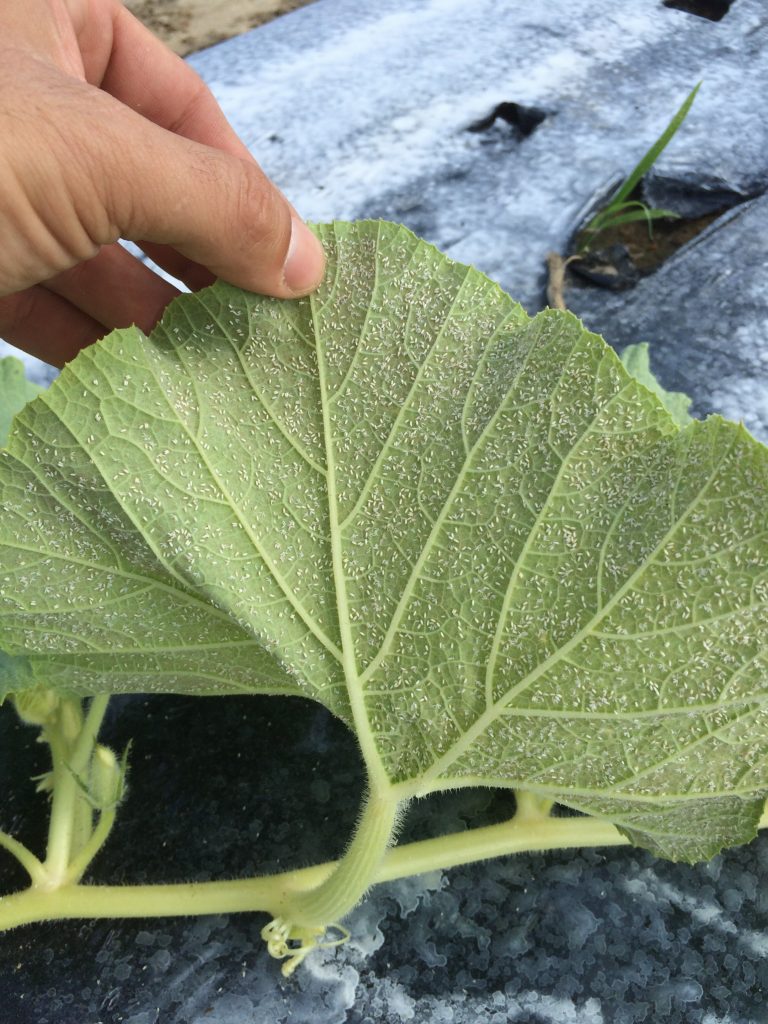
    File photo shows whiteflies infesting fall cucurbits.

    By Clint Thompson

    University of Georgia Cooperative Extension vegetable entomologist Stormy Sparks confirmed this week that whiteflies are back with a vengeance on susceptible vegetable crops and Georgia’s cotton, which is still just a few weeks old.

    “I’ve been holding off a long time on saying it looks bad. But about a week ago, it’s just hard to say it doesn’t look bad,” Sparks said. “There’s still some things that could happen, but I saw some populations in some cantaloupe that you don’t usually see for another month or two. They’re already treating some cotton, apparently.

    “We’re probably a month behind 2017, but we’re at least a month ahead of our normal year.”

    Sparks said in May that whiteflies were already present in Georgia vegetables.

    Why So Early?

    While colder temperatures do not eliminate whiteflies, they do kill many of their wild hosts. They also slow population development in cultivated hosts. Warmer temperatures this winter allowed for larger whitefly populations to overwinter and become mobile earlier.

    “We already had the populations, there’s no doubt about that, earlier than normal in some areas, particularly coming out of kale. There’s a lot of things that can happen as far as weather and everything else that can impact it. There’s still some things that could happen to keep it from getting as bad as it did in 2017,” Sparks said. “If they get to a certain level, those rain events don’t have the same impact than they would at lower populations. I think we’re probably far enough long now that they’ll rebound fairly rapidly. That’s what I’m afraid of.”

    Rain is expected all week in South Georgia, but Sparks believes a tropical storm-type system is what is needed to suppress whitefly populations.

    UGA cotton entomologist Phillip Roberts said farmers are already treating for whiteflies in cotton which is month to a month and a half earlier than normal.

    What Can Be Done?

    Sparks, Roberts and other specialists continue to preach sanitation with whitefly management. Farmers have done better in recent years in getting rid of their vegetables once they are done harvesting. That needs to continue this summer.

    “If the vegetable growers get rid of those crops that are infested, if you’re done with them; if you get done with watermelon fields and cantaloupe fields … get rid of them. Don’t let them keep reproducing. The cotton guys just need to be keeping an eye on infestations and don’t let them build up there,” Sparks said.

    Whiteflies migrate from winter vegetables to spring vegetables to agronomic crops, like cotton, to fall vegetables and back to winter vegetables. Whiteflies cause feeding injury issues in vegetables and transmit two new viruses: cucurbit leaf crumple virus and cucurbit yellow stunting disorder virus. Vegetables like squash, zucchini, cucumber, cantaloupe and snap beans are highly susceptible to these viruses.