North Carolina Department of Agriculture and Consumer Services
RALEIGH – Grade A dairy fluid milk producers in North Carolina who suffered losses because of COVID-19 disruptions in the milk supply chain can soon apply for assistance through the COVID-19 Dairy Aid Program 2020. A total of $2 million will be available, with limits on the amount paid to producers.
Troxler
“The application period opens Sept. 28 and closes Oct. 12, which is a fairly quick turnaround time,” said Agriculture Commissioner Steve Troxler. “Grade A dairy fluid milk producers will want to gather their information together now, so they can submit their application easily when the period opens.”
COVID-19 created serious disruptions to the food supply chain, including the state’s dairy industry. Dairy producers and processors across the state and nation lost portions of their market due to COVID-19 mandated shutdowns of K-12 school systems, institutions of higher learning and food service industries. In some cases, milk had to be dumped on farms rather than being sold, which resulted in losses for those farms.
The N.C. General Assembly approved the funding for the assistance, which comes from federal COVID-19 funds earmarked for North Carolina. A dairy study could also be part of the program. The N.C. Department of Agriculture and Consumer Services will manage the program and distribute funds. Eligible producers will be sent a letter next week with further details about the application process.
“The people of North Carolina are grateful that we have a fresh and local supply of dairy products available to consumers and pray that our farmers continue their hard work in safety and good health,” said N.C. Representative Jeff McNeely, one of the advocates for the dairy legislation.
To qualify, fluid milk producers must be inspected by the NCDA&CS Food and Drug Protection Division, qualify for the Grade A dairy program and be subject to the Federal Milk Marketing Order 5. Producers will be eligible based on the pounds of Class I fluid milk produced beginning in April.
RALEIGH – North Carolina Agriculture Commissioner Steve Troxler today co-signed a proclamation with Jennifer Ferre, the executive director of WNC Communities, in which both leaders pledge continued support for the Hemlock Restoration Initiative.
Troxler first announced the allocation of seed funding for the initiative in March of 2014. Since then, collaboration with WNC Communities has resulted in positive momentum in the effort to restore North Carolina’s hemlock trees to long-term health. Dead hemlocks can negatively affect nesting songbirds, trout populations, plant nurseries and landscapers, homeowners and tourism.
Troxler
“The hemlock woolly adelgid continues to kill a large number of eastern and Carolina hemlocks in North Carolina, but our combined efforts are making a difference,” said Troxler. “As just one example, we recently recognized dozens of N.C. Forest Service employees for a five-month project that treated nearly 42,000 hemlocks on more than 1,500 acres in the state. It was a huge project, and we’re committed to continuing our efforts in various ways.”
While NCDA&CS provides resources such as funding, forestry expertise and manpower, the Asheville-based nonprofit WNC Communities manages grants and other funding sources, recruits research partners and provides administrative support for the program.
“The proclamation further cements the partnership between the Department of Agriculture and WNC Communities, and it serves as a promise for the future of the Hemlock Restoration Initiative,” Ferre said.
File photo showsa research vineyard in North Carolina.
It is nearing harvest time for North Carolina grape producers. Unfortunately, original projections remain true for this year’s crop. It is expected to be a down year for grape farmers.
“With the vinefera grapes for the wine industry in the western part because of all of the frost events we had in the spring, most vineyards are down at least 50% this year in yield,” said Mark Hoffmann, North Carolina State small fruits Extension specialist. “We had a few who weren’t infected, and they actually had a real nice crop on the wine. But most vineyards have 50% to 60% loss this year, and very uneven number of clusters to wine, too. Some wines got more affected than others.”
Back in June, Hoffmann said a May frost impacted the western part of the Piedmont region as well as the Yadkin Valley. The area where the frost left the most impact produces about 80% of the state’s production. That is a big reason for the gloomy projection for this year’s crop.
“It was clear after the frost that it wasn’t going to be a bumper year this year,” Hoffmann said. “It’s not going to be a great year for the wine industry this year.”
He added that production is about two weeks late due to the frost and cool temperatures in the spring. Grape harvests in the Yadkin Valley are expected to start next week. Harvests are expected to last through mid-October.
Muscadine harvests are also expected to begin this week at the earliest, next week at the latest.
(Washington, D.C., Aug. 11, 2020) – U.S. Secretary of Agriculture Sonny Perdue announced today that additional commodities are covered by the Coronavirus Food Assistance Program (CFAP) in response to public comments and data. Additionally, the U.S. Department of Agriculture (USDA) is extending the deadline to apply for the program to Sept. 11, and producers with approved applications will receive their final payment. After reviewing over 1,700 responses, even more farmers and ranchers will have the opportunity for assistance to help keep operations afloat during these tough times.
Perdue
“President Trump is standing with America’s farmers and ranchers to ensure they get through this pandemic and continue to produce enough food and fiber to feed America and the world. That is why he authorized this $16 billion of direct support in the CFAP program, and today we are pleased to add additional commodities eligible to receive much needed assistance,” said Secretary Perdue. “CFAP is just one of the many ways USDA is helping producers weather the impacts of the pandemic. From deferring payments on loans to adding flexibilities to crop insurance and reporting deadlines, USDA has been leveraging many tools to help producers.”
Background
Background: USDA collected comments and supporting data for consideration of additional commodities through June 22, 2020. The following additional commodities are now eligible for CFAP:
Specialty Crops – aloe leaves, bananas, batatas, bok choy, carambola (star fruit), cherimoya, chervil (french parsley), citron, curry leaves, daikon, dates, dill, donqua (winter melon), dragon fruit (red pitaya), endive, escarole, filberts, frisee, horseradish, kohlrabi, kumquats, leeks, mamey sapote, maple sap (for maple syrup), mesculin mix, microgreens, nectarines, parsley, persimmons, plantains, pomegranates, pummelos, pumpkins, rutabagas, shallots, tangelos, turnips/celeriac, turmeric, upland/winter cress, water cress, yautia/malanga, and yuca/cassava.
Non-Specialty Crops and Livestock – liquid eggs, frozen eggs and all sheep. Only lambs and yearlings (sheep less than two years old) were previously eligible.
Aquaculture – catfish, crawfish, largemouth bass and carp sold live as foodfish, hybrid striped bass, red drum, salmon, sturgeon, tilapia, trout, ornamental/tropical fish, and recreational sportfish.
Nursery Crops and Flowers – nursery crops and cut flowers. Other changes to CFAP include: Seven commodities – onions (green), pistachios, peppermint, spearmint, walnuts and watermelons – are now eligible for Coronavirus Aid, Relief, and Economic Stability (CARES) Act funding for sales losses. Originally, these commodities were only eligible for payments on marketing adjustments.
Correcting payment rates for onions (green), pistachios, peppermint, spearmint, walnuts, and watermelons.
Producers Who Have Applied: To ensure availability of funding, producers with approved applications initially received 80% of their payments. The Farm Service Agency (FSA) will automatically issue the remaining 20 percent of the calculated payment to eligible producers. Going forward, producers who apply for CFAP will receive 100% of their total payment, not to exceed the payment limit, when their applications are approved.
Applying for CFAP: Producers, especially those who have not worked with FSA previously, are recommended to call 877-508-8364 to begin the application process. An FSA staff member can help producers start their application during the phone call.
On farmers.gov/cfap, producers can: Download the AD-3114 application form and manually complete the form to submit to their local USDA Service Center by mail, electronically or by hand delivery to their local office or office drop box. Complete the application form using the CFAP Application Generator and Payment Calculator. This Excel workbook allows customers to input information specific to their operation to determine estimated payments and populate the application form, which can be printed, then signed and submitted to their local USDA Service Center. If producers have login credentials known as eAuthentication, they can use the online CFAP Application Portal to certify eligible commodities online, digitally sign applications and submit directly to the local USDA Service Center. All other eligibility forms, such as those related to adjusted gross income and payment information, can be downloaded from farmers.gov/cfap. For existing FSA customers, these documents are likely already on file.
All USDA Service Centers are open for business, including some that are open to visitors to conduct business in person by appointment only. All Service Center visitors wishing to conduct business with FSA, Natural Resources Conservation Service or any other Service Center agency should call ahead and schedule an appointment. Service Centers that are open for appointments will pre-screen visitors based on health concerns or recent travel, and visitors must adhere to social distancing guidelines. Visitors are also required to wear a face covering during their appointment. Our program delivery staff will be in the office, and they will be working with our producers in the office, by phone and using online tools. More information can be found at farmers.gov/coronavirus.
Posted by Greg Astill, Markets and Trade Economics Division, Economic Research Service and Suzanne Thornsbury, Senior Advisor for Agricultural Economics and Rural Communities, Office of the Chief Scientist in Research and Science
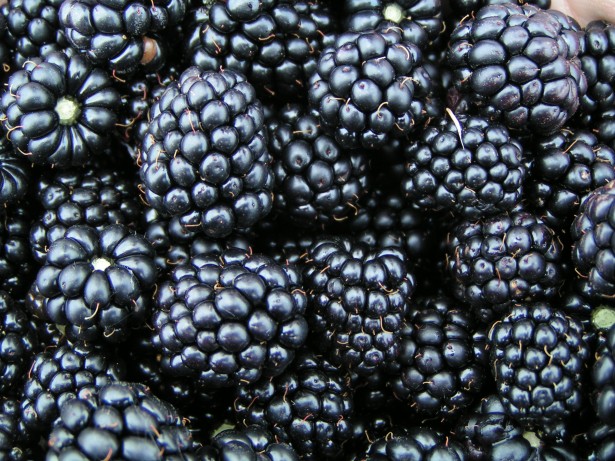
File photo shows blackberries.
Advances in technology, automation, and remote sensing is a cross-cutting, macro movement in science impacting agriculture outlined in the USDA Science Blueprint (PDF, 2.6 MB). The Science Blueprint guides USDA’s science priorities for the next 5 years, building from past success. Relative to other crops, many specialty crops are more dependent on agricultural labor for production, harvesting, and processing. This is part of a blog series that highlights research investments to advance automation and mechanization for specialty crops.
Each day we use technologies to solve problems and accomplish tasks that once would have taken much longer. Whether facial recognition software, a smart thermostat, or a robotic vacuum, technology has changed the way we live and work. Farmers are also using technology to make production of specialty crops, such as fruits, vegetables, and tree nuts, more efficient. These crops make up one third of U.S. crop production sales and one sixth of U.S. agricultural sales.
Between 2008 and 2018, USDA funded $287.7 million towards diverse research projects to develop and enhance the use of automation or mechanization in specialty crop production and processing. Most of these projects focused on precision agriculture, which includes a set of complex or “smart” technologies that tailor the needs of the plants to its specific environment or growing conditions, such as precise water, fertilizer, or pest or weed control. For example, a smart sprayer identifies individual trees in an orchard, their size, shape, and leaf density to adjust spray and reduce herbicide use. A smart irrigation system provides water only to the plants that need it, when they need it, continually adapting to crop conditions as the weather changes.
Some USDA projects focus on development of specific components that will eventually be combined into more complex technologies. Sensors generate high-quality data on crops, weather and soil. Remote sensing data, gathered by satellites, includes information like crop growth, soil moisture, or weather conditions while drones gather more localized data on weed, pest, or disease prevalence. Machine learning algorithms convert the data into useful forms of information to help manage the farm.
Other projects include development of job aids or automated machinery to help farm workers work more efficiently, such as an adjustable trellis system to make harvesting blackberries easier or mechanical thinners and pruners for vineyards and orchards. And some automation or mechanization technology helps with harvesting and processing, such as a flash freezing system or a mobile, in-field computerized apple sorter.
USDA funded $287.7 million toward a diversity of research projects to develop or enhance the use of automation or mechanization in specialty crops between 2008 and 2018
Source: USDA, Economic Research Service, based on data provided by USDA’s Agricultural Marketing Service, Agricultural Research Service, and National Institute of Food and Agriculture.
According to the UGA Extension Viticulture Blog, North Carolina State small fruits Extension specialist Mark Hoffmann provided a webinar on the 2020 grape harvest. Click here for a link to the webinar.
Southeast watermelon growers delivered a flavorful crop this year that yielded a sweet price at the market, said Mark Arney, executive director of the National Watermelon Promotion Board.
Photo taken by Clint Thompson/Shows watermelons for sale at the Farmers Market in Cordele, Georgia.
“We’re happy, we’re happy for the guys. Obviously, the guys that didn’t have a crop, it doesn’t matter how hot the market is, they’re not going to make money. We feel terrible for those guys,” Arney said. “The crop has been excellent quality, that’s helped.”
High Prices
Carr Hussey, a watermelon farmer in Florida and Alabama and chairman of the board of the Florida Watermelon Association, said in early July that prices were averaging 22 cents per pound. It was a huge increase from the 14 cents growers had grown accustomed to in previous seasons.
Watermelons were in high demand due in large part to the short supply. Georgia acreage decreased almost 4,000 acres this year. Imports from Mexico were down 10% overall for the season, according to Arney. Because of weather-related issues, Georgia’s crop did not start until 7 to 10 days later than normal.
Typically, Georgia and North Florida harvest watermelons at about the same time, which could lead to a surplus on Memorial Day weekend. That did not happen this year, however.
There were even fears of a shortage at various times during the growing season.
“You had a combination of the lateness of Georgia, of the Mexican crop being down around 10% overall for the season and the flavor being exceptional. All of those things brought a situation where you did have a shortage,” said Arney, who’s concerned about the current impact that Hurricane Isaias will have on watermelon production along the Atlantic Coast. “Who knows, there may even be more of a shortage (now) with the weather. Watermelons like rain, but too much rain means the guys can’t get into the fields if they’re using these school buses to harvest. They have to wait until things dry out. That could delay as well.”
Little Impact From COVID-19
While COVID-19 impacted the food service industry, as restaurants closed in response to the pandemic, watermelons were not one of commodities that felt the brunt of the impact.
“The first couple of weeks it was panic time. We saw some pretty big slumps. Then all of a sudden, things started taking off. It was like, wow, what’s going on. Well, No. 1, flavor has been really good. I had one grower describe it as a vintage year. He’s been in the watermelon business forever and said, ‘I can’t remember a crop with this good of a flavor.’ That certainly helped,” Arney said. “I think produce in general is up because so many people are sheltered and can’t go to restaurants even though there’s been a little bit of openings. But because so many people are not eating in restaurants; they’ve got to eat, so they’re going to either order online or go to the grocery store. Watermelon’s a great bargain. It’s healthy.
“Watermelon’s an excellent source of Vitamin C and it’s also probably one of the better bargains, if not the best bargain for fruits at costs per serving, which is around 17 cents.”
Jacob Barney, invasive plant expert at Virginia Tech University, giving one of several reasons why we should not plant seeds that show up at our door unsolicited from unknown sources.
Due to the cancellation of the 2020 Sunbelt Ag Expo show, plans for the selection of the 2020 Swisher Sweets/Sunbelt Ag Expo Southeastern Farmer of the Year Winner have been amended. Originally, this year’s judging tour was planned for August 10-14. Due to current health concerns, the tour has been postponed indefinitely. 2020 State Winners will be recognized, and an overall winner will be announced at the 2021 Sunbelt Ag Expo. A new class of state winners will not be selected in 2021.
“We have considered virtual options for the judging tour and the awards ceremony, but the Farmer of the Year program is not a virtual event. The program is about so much more – the interaction amongst our 10 state winners, and the 265 winners that have been awarded over the last 30 years cannot be replaced. To have a Farmer of the Year class not be able to experience the in-person judging tour, the trip to South Georgia and the Sunbelt Ag Expo is not an option in our book,” said Chip Blalock, Sunbelt Ag Expo Executive Director.
The Sunbelt Ag Expo looks forward to welcoming visitors and the 2020 Farmer of the year class in 2021 as it showcases the latest in farming technology, October 19-21. Visit www.sunbeltexpo.com for more information.
Farmers impacted by COVID-19 and hoping to take advantage of the Coronavirus Food Assistance Program have a little more than three weeks left before the Aug. 28 deadline. That is when the United States Department of Agriculture will stop accepting applications from producers.
Runge
Through CFAP, USDA made available $16 billion in financial assistance to producers of agricultural commodities who have suffered a 5%-or-greater price decline due to COVID-19 and face additional significant marketing costs as a result of lower demand, surplus production, and disruptions to shipping patterns and the orderly marketing of commodities.
Max Runge, Extension specialist in agricultural economics at Auburn University, believes CFAP has been a success for growers.
“Overall, I think it has been a success. It provided some much-needed funding and hopefully some cash flow for some producers that needed it. It wasn’t a perfect program. I know some people feel like they were left out or they didn’t get enough, or it should have been done differently. But overall, I think it was very helpful to our producers.”
In mid-July, the USDA, amended the original crop list covered under CFAP to include additional commodities, including the addition of blueberries to Category 1.