Multimedia Journalist Clint Thompson recaps a few stories from this past week in VSCNews.
Category: North Carolina
-
North Carolina Extension Seeks Help With Survey

North Carolina Cooperative Extension seeks help from farmers with a short survey. As producers fill out the survey, it will help Extension assess the impact of the coronavirus pandemic on the specialty crop (fruit and vegetable) and agritourism industry in North Carolina. The survey will help shape Extension’s response.
N.C. State IRB approved the survey. Also, Extension specialists in the Department of Horticultural Science at N.C. State University conducted the survey. It is done in collaboration with the Center for Environmental Farming Systems and the N.C. State Local Foods Initiative.
Extension asks that all farmers fill out this voluntary and anonymous survey. It will be open from April 23 through May 7.
In a previous story ran in VSCNews, Chris Gunter, an N.C. State Extension specialist, reported that the vegetable crop in North Carolina looks “fabulous” so far.
Mark Hoffmann, North Carolina State small fruits Extension specialist, also reported that he expects a bumper crop this year. Hoffmann is optimistic that his state’s strawberry producers will not have problems selling their crop.
“With the whole COVID-19 situation, it’s very different right now. It looks like operations that can sell directly to customers, the direct-to-customer sales is something that’s picking up right now,” Hoffmann said. “Right now, I don’t think there’s a problem getting strawberries a home.”
-
N.C. State Extension Specialist: Vegetables Look Fabulous
By Clint Thompson

Chris Gunter North Carolina vegetables look “fabulous,” according to Chris Gunter, N.C. State Extension vegetable production specialist. In fact, the main concern appears to be having enough workers in place to pick the crop once harvest season begins. And also how to keep their labor force safe amid the ongoing coronavirus pandemic.
“They’re more concerned about how it’s going to impact their workers. How are they going to get farm workers here? How are the workers going to be impacted? What precautions should they take in order to protect their workers once they’re here?” Gunter said.
He said that many of the farm workers who report to work every year are having less difficulty getting through the border entry process this season compared to those who are new.
“Those farms that have had workers and are getting the same workers back, their workers are starting to arrive now,” said Gunter. He emphasized that farming operations are taking all the precautions they can to protect their workers during the coronavirus pandemic.
“They’re trying to social distance, physically distance each other when they’re working. If that’s not possible, then taking precautions, like wearing a cloth face covering or frequently cleaning and sanitizing their hands or surfaces that they touch.”
Farmers are mostly harvesting greens right now along with mainly cool-season vegetables.
Sweet potatoes are the state’s No. 1 vegetable. There are also a significant amount of cucumbers, along with bell peppers, tomatoes, cantaloupes and watermelons.
“Our crops are just a little bit behind Florida and (Georgia). Our strawberry season looks very strong so far (as well). All we need is to get rid of some of this rain and get people out buying fruits and vegetables,” Gunter said.
-
Non-Traditional Marketing Outlets Still Options for Small-Scale Producers
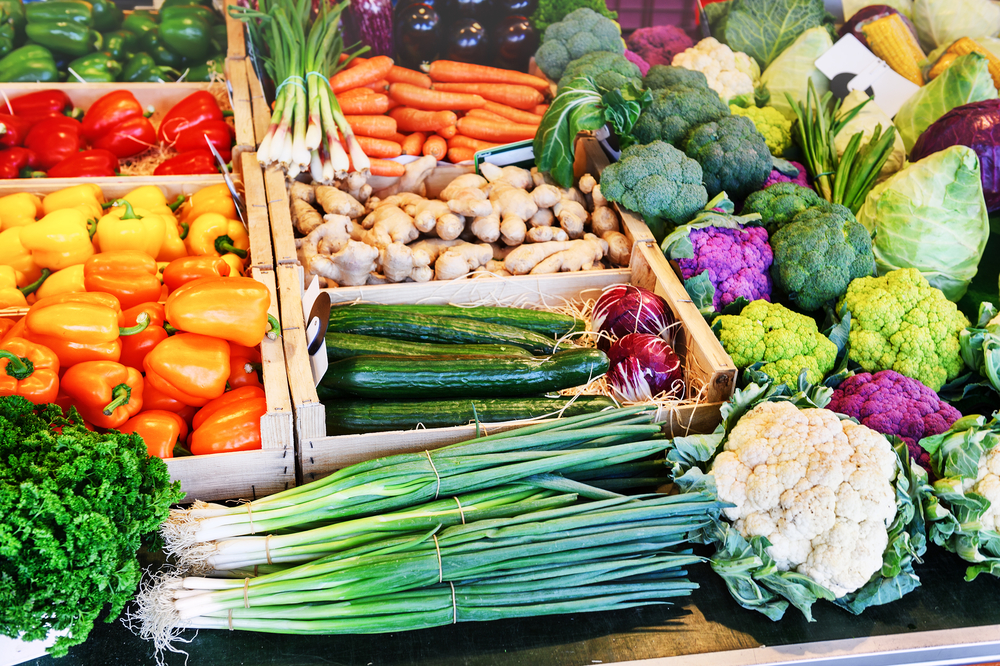
Fresh fruit and vegetables on sale at a farmers market in this file photo. By Clint Thompson
N.C. State Extension Vegetable Production Specialist Chris Gunter believes non-traditional marketing outlets are still viable options. They provide opportunities for small-scale fruit and vegetable farmers to capitalize on amid the ongoing coronavirus pandemic.
Outlets like farm-to-customer delivery and farmers markets are still available for those producers. Gunter believes the demand is still high.
“People aren’t as able to get to traditional retail outlets like grocery stores and the normal supply line is backing up. There’s excess produce because demand is down,” Gunter said. “But if you are innovative and you have outlets that are non-traditional or can shift from traditional outlets to new outlets, the demand is high. These non-traditional markets are seeing an increase in demand because people still want that fresh produce. It’s just less available at their traditional retail outlets.”
Many people avoid traveling to retail grocery stores for concern over their own health. If they buy directly from farmers or have the grower deliver directly to their door, it is more convenient. And it is now a more popular option. Individually boxed fruit is a growing alternative for consumers.
“Places like the Produce Box here in Raleigh, (North Carolina) which has a way to aggregate produce from growers all over and make its own custom boxes for those customers, they’re seeing lots and lots of increase in demand,” Gunter said.
This option is not suited for all growers. Because of restaurants and schools closing for fear of spreading the disease, large-scale farmers have been most impacted the most, especially in Florida. Gunter said a large-scale grower would overwhelm these non-traditional outlets with produce. Also, consumers don’t want just one type of fruit or vegetable.
“For the large, wholesale growers, they’re not tapping into that market usually because their volume is so high,” Gunter said. “They’re used to delivering to distribution centers or direct to a retail outlet.
“(Also) customers still want a mix of fruits and vegetables. Having (just) a box full of squash doesn’t really work for the consumer.”
However, traditional outlets will need to be restored. Non-traditional outlets are not sustainable.
“Supply lines are going to have to become re-established in order to supply people once these immediate lockdown precautions are lifted. I think you’ll see people start to go back to traditional retail markets,” Gunter said.