Category: Irrigation

  • Well Water Quality, Irrigation System Management Crucial for In-Season Success

    UGA CAES Photo/Shows an in-lab water analysis test at UGA CAES.

    Well water quality and irrigation system management should be a top priority for vegetable and specialty crop producers gearing up for the spring season.

    Gary Hawkins, an Assistant Professor in Water Resource Management at the University of Georgia College of Agricultural and Environmental Sciences, said a good clean well has reduced risks of pathogens and other bacteria in it.

    Testing your water and irrigation systems now can prevent potential problems that may arise during the season.

    “This time of year, they should be in the process of closing their systems down. Winterizing their irrigation systems is one good thing they can do. A second thing they can do this time of the year is really have an outline of how they could fix any leaks, geysers or anything else that makes their system inefficient,” Hawkins said. As they start thinking about cranking back up in the spring, late February, March, April timeframe; doing any irrigation water test.”

    W33A Water Quality Test

    Hawkins recommends a W33A water quality test that tests the chemistry in the water.

    “That’ll test the basics, but it’ll also give us a sodium absorption ratio or an SAR number. That’ll give the farmer some indication of the combination of alkalinity Ph and what minerals are in the water itself, ground water or surface water. Is that water either going to corrode their pipes or is it going to lay down kind of a film in there that’s actually going to start clogging up their pipes?”

    He also recommends a W35 bacteria test, which is especially important for producers irrigating vegetables and edible plants.

    Other Points to Remember

    Hawkins also emphasized that producers do not store chemicals or fertilizers close to the well head. In case there is a disconnection at the well head, any leaks of those products could get down by the well casing and to the aquifer.

    It’s also important to keep the area clean around the well head so it is more visible. That way it is not at risk of getting hit with a tractor.

    Southeast Regional Fruit and Vegetable Conference

    Hawkins delivered a presentation about well management during this week’s virtual Southeast Fruit and Vegetable Conference. The conference, which is normally held in January in Savannah, is being held virtually this year due to COVID-19 concerns. The three-day event will be held through Thursday, Jan. 7.

  • Drip Irrigation Efficient Means to Deliver Water to Plants

    File photo shows drip irrigation in a tomato field.

    Drip irrigation vs. overhead irrigation? That truly is the question for vegetable and specialty crop producers in Alabama who are poised to produce a crop in 2021.

    Eric Schavey, Regional Extension agent in Northeast Alabama, advises producers to choose drip irrigation. It is more efficient in delivering water to the plant roots.

    “As far as a production standpoint, the drip irrigation is more efficient. You’re actually putting the water where it needs to be,” Schavey said. “Drip irrigation puts it there at the plant where it can go into the ground where the roots can take it up. You don’t get any of that splash from an overhead droplet like you get during a rain. If we have any fungus or anything that is on our soil surface and it splashes up, it gets on the lower leaves, especially tomatoes.

    “When you’re looking at early blight (disease), it’s naturally in our soil. When we get rainfall or overhead irrigation it splashes up and starts on the bottom leaves first and moves its way up the plant.”

    Water Lost Using Overhead Irrigation

    There is also a misconception that if farmers are using overhead irrigation, all of that water is getting to to the plants. However, much of that water evaporates before hitting the soil.

    “Depending on how our weather has been, you take a July day here in Alabama, 90 degrees and you go to water and that air is dry with overhead, you’re probably losing 40% of it, at least,” Schavey said. “And it’s not on target. I know water is cheap. In Alabama, we have an abundance of water, but we’re two weeks away from a drought at any time.”

    Why is Drip Irrigation so Efficient?

    Sub-surface drip irrigation is primarily used for vegetable production. Most commercial farmers grow vegetables on a plastic covering that lies above the drip irrigation system. The water is applied directly to the plants’ roots. It is thereby more efficient.

    “Once it starts dripping, that emitter or that drip tape is dripping it out right on that soil surface, then it actually fans out in a ‘V’ in that soil column. It’s really narrow to the plant at first and then widens out,” Schavey said. “It’s good, because you want those roots going deeper. If you’ve got a triangle and it’s inverted down in the ground, those roots that ran left and right, they’re going to run down to that water and you’re going to have a deeper root system.”

  • Facts of the Flow: Lake Okeechobee, 2020 Year-to-Date

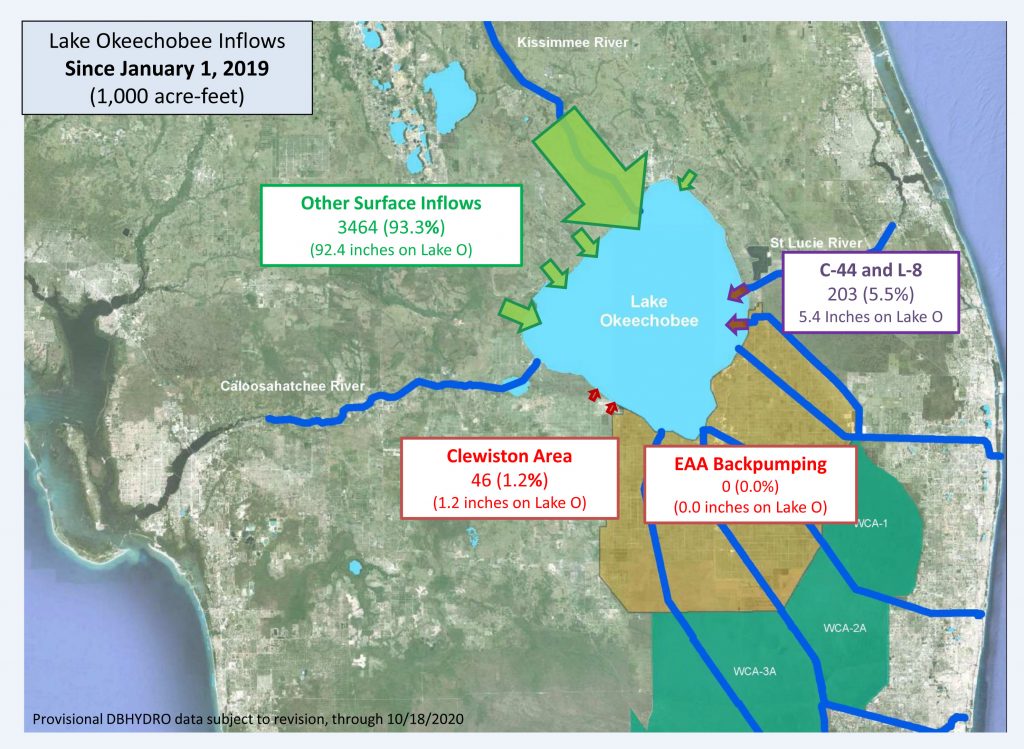
    (SFWMD) — Here is the latest update on inflows into Lake Okeechobee for the calendar year to date. This data is provided by SFWMD’s DBHYDRO database.

    lake okeechobee

    There has been no back-pumping into Lake Okeechobee from the Everglades Agricultural Area this year.

    Source: South Florida Water Management District

  • Smart Irrigation Tools for Blueberry Growers

    Figure 1. A: The University of Georgia Smart Sensor Array (UGA SSA) node is installed in blueberries. The electronics are housed in the white PVC container. The spring allows the antenna to bend when farm vehicles pass overhead. B: The UGA SSA sensor probe integrates three Watermark sensors and can be customized to any length.

    By Vasileios Liakos

    One of the goals of the University of Georgia College of Agricultural and Environmental Sciences (UGA CAES) is to develop new irrigation methods and tools for crops. Researchers, including myself, Erick Smith, George Vellidis and Wes Porter, have been developing smart irrigation scheduling tools for blueberry growers in Georgia since 2015. Smart irrigation is a new method of irrigation that uses technology and information to make more accurate and faster decisions.

    UGA has developed two smart irrigation tools for blueberries — the UGA Smart Sensor Array (SSA) and the Blueberry App.

    SYSTEM RECORDS SOIL MOISTURE

    The UGA SSA is a system that records soil moisture within fields. It consists of a monitoring system, a commercial server that receives soil moisture data wirelessly, and a website that presents soil moisture data and recommends irrigation rates. The monitoring system consists of smart sensor nodes and a gateway. Each node has a circuit board, a radio frequency transmitter, soil moisture sensors, thermocouple wires and an antenna (Figure 1a). Each node accommodates two thermocouples for measuring temperature and a probe that consists of up to three Watermark® soil moisture sensors (Figure 1b).

    “Soil moisture sensors record soil water tension, and we realized very soon that farmers could not make irrigation decisions based on the sensor readings. It was necessary to convert sensor readings into amount of irrigation,” said UGA precision agriculture specialist George Vellidis.

    To overcome this problem, we utilized soil properties and a model to convert soil water tension numbers into inches of irrigation that is needed to saturate the soil profile. Additionally, farmers can see in real time their soil moisture data to make irrigation decisions for each location in fields using a web-based interface that was developed by UGA.

    IRRIGATION SCHEDULING APP
    Figure 2. Left: The main screen of the Blueberry App tells growers how many hours they need to run their irrigation systems and how many gallons they are going to use. It also allows them to check accumulated rainfall from the past seven days and the expected crop evapotranspiration for the next seven days. Right: Blueberry growers do not have to check the app daily since it notifies users if there is rain at the field and how much irrigation they need to apply.

    Blueberry growers can also use the Blueberry App on their smartphones to schedule irrigation (Figure 2). The app runs a model that uses reference evapotranspiration (ETo) data and the Penman-Monteith equation to calculate the irrigation needs of blueberries.

    The innovation of the Blueberry App is that it is programmed to receive forecasted ETo data for the next seven days for every location in the United States from the Forecast Reference Evapotranspiration service of the National Oceanic and Atmospheric Administration. Precipitation data are received from the Georgia Automated Environmental Monitoring Network and the Florida Automated Weather Network (FAWN).

    UGA has developed a crop coefficient curve that shows the water needs of blueberries in Georgia every year. The goal is to include more coefficient curves from other states. This will be capable if more blueberry growers use the app.

    By knowing the total ETo for the next seven days and the crop coefficient values of the blueberries, the crop evapotranspiration of blueberries can be calculated, and irrigation events adjusted accordingly.

    EVALUATION OF SOIL MOISTURE SENSORS

    Another interesting project, involving soil moisture sensors and blueberries, began a few months ago. The objectives of the project are to 1) compare different commercially available soil moisture sensors in blueberry soil, 2) determine the accuracy of each type of soil moisture sensor in blueberries and 3) determine which soil moisture sensor type is best for use in blueberries.

    Figure 3. Field trials are testing four different soil sensor types in blueberry fields.

    The soil moisture sensors used in this project are Watermarks, Irrometer tensiometers, Aquachecks and Decagons (ECHO EC-5). The selection of these sensors was made based on their popularity in the United States. Table 1 shows advantages and disadvantages of different types of soil moisture sensors.

    This study takes place at a UGA blueberry farm in Alapaha and at two commercial blueberry farms in Alma and Manor. At each site, the four different soil moisture sensor types have been installed close to each other along the beds to collect data to meet the objectives of the project (Figure 3).

    Source: Practical use of soil moisture sensors and their data for irrigation scheduling by R. Troy Peters, Kefyalew G. Desta and Leigh Nelson, 2013, Washington State University.

  • Facts of the Flow: Lake Okeechobee, 2020 Year-to-Date

    (SFWMD) — Here is the latest update on inflows into Lake Okeechobee for the calendar year to date. This data is provided by SFWMD’s DBHYDRO database.

    lake Okeechobee

    There has been no back-pumping into Lake Okeechobee from the Everglades Agricultural Area this year.

    Source: South Florida Water Management District

  • Shallow Subsurface Drip Irrigation for Organic Growers

    Figure 1. Shallow subsurface drip irrigation is laid with a drip tape layer to a depth of 4 to 5 inches in organically grown lettuce.

    By Tim Coolong

    Subsurface drip irrigation (SDI) has been around for many years in a variety of different iterations. Most typically, SDI refers to a permanent drip system installed fairly deep (18 inches) and is used for irrigating agronomic crops such as corn or cotton.

    In many cases, vegetable crops are too shallowly rooted for a traditional SDI system, but some processing tomatoes are grown using SDI. However, a shallow SDI system, where drip tubing is buried at a depth of 4 to 6 inches (Figure 1), may be a tool that both conventional and organic vegetable growers can use.

    ADVANTAGES

    For organic growers, the ability to use shallow SDI offers two main advantages. The first is that crops can still be shallowly cultivated during the season without worrying about cutting drip tape. Second, having drip irrigation buried can allow for wetting of the root zone without excessive wetting of the soil surface. During dry seasons, this can reduce weed pressure (Figure 2).

    Figure 2. Acorn squash is grown with shallow subsurface drip irrigation (left) and surface drip (right). While this crop was grown conventionally with herbicide, notice the lack of grass weeds in the shallow subsurface drip irrigation plot compared to the surface drip. Earlier in the season, when this picture was taken, the surface drip-grown plants were slightly larger, but that difference subsided later in the season.

    Studies have also reported an increase in rooting depth and fertilizer use efficiency with shallow SDI. Many companies make drip tubing layers. University of Georgia (UGA) research has even used bed shapers/plastic layers to form beds and lay buried drip tube without using plastic mulch. In studies conducted with shallow SDI during a single season, no difference was seen in flow rate or clogging due to roots growing into the emitters. To keep costs low, 10-mil thick drip tubing was used since researchers only planned to use it for a single season. More permanent SDI systems use much thicker walled tubing.

    LIMITATIONS

    While shallow SDI can be a good tool for helping organic growers reduce weed pressure and improve cultivation, there are some potential limitations. UGA studies found that when comparing shallow SDI to surface drip, transplants with smaller (i.e., shallower) root balls initially grew quicker when planted into surface drip plots — particularly when weather conditions were dry and hot promoting stress.

    Many of the studies were conducted on loamy soils. It is likely that the lack of capillary movement of moisture on sandy soils may limit the use of shallow SDI in those situations. Further, the shallow SDI system did not wet the surface adequately to germinate seeded crops.

    Lastly, although leaks were not common, rodents did chew into the buried drip tubing on occasion. Nonetheless, based on experience working with shallow SDI, it is a useful tool for organic vegetable farms.

    More details on the role of shallow SDI on weed management can be found online (see www.intechopen.com/books/weed-and-pest-control-conventional-and-new-challenges/using-irrigation-to-manage-weeds-a-focus-on-drip-irrigation) in “Using irrigation to manage weeds: A focus on drip irrigation.”

  • Potential La Nina Weather Event Could Impact Pecans Later This Season

    An increasing likelihood of a La Nina weather event this fall could impact row crop farmers and specialty crop producers as well, said Pam Knox, University of Georgia Cooperative Extension Agricultural Climatologist.

    “When we do have a La Nina, we do tend to have a little bit drier than normal fall. Dryness in the fall isn’t necessarily bad. It’s helpful for the people that’s trying to harvest. It’s just that if you’re trying to fill in the last of the pecans or get a little more growth out of the peanuts then dry conditions are not necessarily good,” Knox said.

    According to the pecan production calendar, pecan’s water requirements are especially high in August and September. UGA pecan experts say water needs are 300 to 350 gallons per tree per day or 3,600 to 4,200 gallons per acre per day.

    Knox said we are in a La Nina watch right now and is unclear how strong of a La Nina it’s could be.

    “Typically, when we have a La Nina occurring, and right now we’re under a La Nina watch, the conditions in the Eastern Pacific Ocean are cooler than normal. They’re expected to stay that way. Usually it takes four months before they’ll declare an official La Nina,” Knox said. “The predictions are it might last until January or February and then go back to neutral conditions. It’s not necessarily one that’s going to be really long.”

  • UGA Helps Produce Growers With Water Quality Calculations and Education

    Drip irrigation lay in a tomato field.

    By Josh Paine for UGA CAES News

    An online tool developed by the University of Georgia College of Agricultural and Environmental Sciences is helping produce growers assess their water quality and prepare for increased testing requirements.

    Uttam Saha, a program coordinator at the UGA Agricultural and Environmental Services Labs, developed an online calculator and simulator to help educate farmers and Extension agents with necessary actions related to the water quality component of the Produce Safety Rule (PSR) in the Food Safety Modernization Act (FSMA).

    The water quality subpart of the rule covers produce types that are frequently consumed raw to ensure growers use water that does not contribute pathogen contamination — like E. coli, norovirus or parasites — to produce so that it is ultimately safe for human consumption.

    “The rule requires a lot of technical knowledge to understand the water-testing needs and to determine whether a farm is in compliance,” said Saha.

    The PSR requires farms to establish a Microbial Water Quality Profile (MWQP) for each untreated water source used on the farm, as well as conduct annual microbial water quality surveys. This MWQP is based on the levels of generic E. coli measured in a water source over time, and testing frequency varies depending on the source of the water.

    The program, available at aesl.ces.uga.edu/calculators/FSMA, also provides various model situations to train users.

    “The biggest change for most farmers is the production (preharvest) water requirements, due in part to increased testing frequencies and the required calculations to determine water microbial quality,” said Laurel Dunn, an assistant professor of food science. “These calculations are not intuitive, so a tool was needed to assist farmers interpreting the results of their water tests.”

    Dunn and her colleagues produced an instructional video on preharvest sample collection available at t.uga.edu/5Zj and another on postharvest sampling at t.uga.edu/5Zi.  

    Requirements for the smallest and final group of farms covered by the PSR began in January 2020. However, the water requirements don’t go into effect until January 2022 for large farms (more than $500,000 in average sales), January 2023 for small farms (between $250,000 to $500,000 in average sales), and January 2024 for very small farms (between $25,000 and $250,000 in average sales).

    “Farms aren’t required to even begin taking water samples until 2022, but are strongly encouraged to do so, and many third-party audits require them to do it already,” said Dunn. 

    Fruits and vegetables grown for the fresh market are Georgia’s third-largest agricultural sector, with a combined farm gate value of more than $1.8 billion, according to UGA agricultural economists.

    In addition to testing, at least one person on each farm covered by the PSR must have attended a Produce Safety Alliance Grower Training by the compliance date. The Georgia Department of Agriculture and UGA Department of Food Science and Technology have partnered to offer courses. Learn more about the trainings and more at agr.georgia.gov/produce-safety-program.aspx.

    Georgia produce growers can contact their local UGA Cooperative Extension office for more information about testing frequency and requirements, for submitting water samples for testing by UGA Agricultural and Environmental Services Labs, and for interpretation by UGA experts including Saha and Dunn.

    To learn more about UGA Extension food science programs, visit extension.uga.edu/programs-services/food-science.

  • Frost and Freeze Protection for Vegetable Crops

    Written By Chris Gunter, N.C. State Extension Vegetable Production Specialist

    Weather predictions for this weekend include clear skies with minimal or calm winds, which are conducive to cold temperatures and could lead to freeze or frost conditions in North Carolina.

    On Sunday morning, May 10,  low temperatures are predicted to drop into the 30s with some temperatures possibly below freezing in low lying rural areas. Record low temperatures for May 10 are in the lower 30s at the Greensboro and Raleigh-Durham locations, and 39 ºF at Fayetteville. Not only are daily low-temperature records threatened, but the latest spring freeze on record is May 10 for Raleigh (31 ºF) and May 8 for Greensboro (32 ºF).

    Frost

    As cold temperatures are threatening, agents and specialists are getting calls from concerned vegetable growers worried about potential damage on their crops. A frost occurs when temperatures dip to 32 ºF and water starts to freeze on low lying surfaces. If water within the plant cell or between the plant cells freeze, this can result in damage to plant tissue. The following vegetable crops can be grouped according to their cold tolerance based on their physiology. It is important to remember that cold damage results from the actual temperature and the duration of that temperature.

    We usually think of frost as occurring at temperatures from 31-33 ºF and this will result in damage or killing the foliage of warm-season plants like beans, corn, cantaloupe, cucumbers, eggplant, okra, southern peas, peppers, potatoes, sweet corn, sweetpotatoes, squash, tomatoes, and watermelon.

    When temperatures dip below 26-31 ºF, this is a hard frost or freeze. There are cool-season crops that will tolerate a temperature dip to these temperatures for a limited period of time. These include broccoli, cabbage, cauliflower, chard, English peas, lettuce, mustard, onion, radishes, and turnips. They will likely show foliage damage due to the cold and this may result in a yield reduction later in the season, but the plant will survive.

    In the event that the temperature drops below 26 ºF during a hard freeze for a longer period of time, there are some vegetables that will survive these temperatures. Cold season crops like Brussels sprouts, beets, collards, kale, parsley, and spinach should survive.

    Charlotte Glen wrote a great article about seeds and seedlings surviving cold temperatures. We encourage you to check it out here:

    Will My Vegetable Seedlings Survive This Weekend’s Cold

    Protecting from these cold temperatures can be a little more difficult to answer. Growers who have solid set irrigation in place and have experience with frost protection using overhead water applications, may be planning to use this method. This requires large volumes of water and continuous applications throughout the cold event. For most vegetable growers however, overhead solid set sprinkler irrigation is less common than drip irrigation or travelling guns and pivot irrigation systems.

    Usually maintaining good soil moisture prior to the event can be helpful, as the water in the soil retains heat longer and releases it slowly during the cold event. For this reason, it is also recommended not to cultivate just prior to a frost or freeze, so that as much water can be retained in the soil as possible. The cultivation can damage plant roots and increase stress on the plants. In addition, cultivation opens additional spaces in the soil, allowing cool air to penetrate deeper into the soil profile.

    Other methods for frost protection include using row covers, which come in various lengths and thicknesses depending upon the level of protection needed. Growers can also use waxed paper cups, to cover the transplants in the field, during an overnight cold period. These are labor-intensive methods, but may be an option if areas are small enough and the farm has sufficient labor to put on and remove the covers as temperatures warm back up. If coverings are used, it is important to monitor temperatures under the covers. Be prepared to remove the covers before temperatures under the cover rise too high and result in heat stress.

    For full story, see freeze protection for vegetable crops.

  • Recent Rains Helping Alleviate Parts of Florida’s Drought

    By Clint Thompson

    This week’s release of the U.S. Drought Monitor is expected to show improvement to Florida’s current drought conditions. That’s the belief of David Zierden, a state climatologist at Florida State University’s Center for Ocean-Atmospheric Prediction Studies.

    “I anticipate the drought monitor will show improvement, especially in north Florida. Right now, it seems the driest part of the state is down in southwest Florida, around the Big Cypress National Preserve and the Naples area. That’s looking to be the driest part of the state right now, after these recent rains,” Zierden said. “Now that we’ve been in this cycle of one storm after another and bringing frontal and low-pressure systems that bring rains to the state, we’re at least holding our own if not easing the drought situation.”

    Record Heat In March

    According to last week’s U.S. Drought Monitor, the central and southern parts of Florida were either in moderate drought or severe drought. It’s a continuation from March when there was little rainfall and extreme temperatures.

    “Especially the month of March was record-setting warm here in the state of Florida, like 7.1 degrees warmer than normal for March. For a state-wide average, it was definitely a record. On top of that, much of the peninsula, basically from Gainesville south, only received a few hundredths or a few tenths of an inch of rain during March. That’s what really accelerated the onset of drought quickly and pretty dramatically,” Zierden said.

    Water Shortage in SW Florida

    The drought has been so bad in the southwest part of the state that, according to a press release, the Southwest Florida Water Management District issued a Phase I Water Shortage for the District’s central and southern regions on Tuesday. This includes Charlotte, DeSoto, Hardee, Highlands, Hillsborough, Manatee, Pasco, Pinellas and Sarasota counties.

    The primary purpose for a Phase I water shortage is to alert the public that watering restrictions could be forthcoming.

    A Phase I water shortage order does not change allowable watering schedules, however it does prohibit “wasteful and unnecessary” water use.

     Zierden said the recent rains should ease the state into the summer thunderstorm rainy season.

    “These rains in April have really been important and help make this transition into the summer rainy season much easier than it would have been if we would have had a dry April,” Zierden said.