Category: Georgia

  • Drought Still a Problem for Florida

    The latest map from the U.S. Drought Monitor shows how dry conditions are in Florida and in parts of southern Alabama and Georgia.

    By Clint Thompson

    Even with much-needed rainfall this week and more expected this weekend, Florida remains in a drought; severe in some cases. The southern portions of the state and along the peninsula will remain drier than normal for the foreseeable future, according to Pam Knox, University of Georgia Cooperative Extension state climatologist, .

    “I’ve been watching the drought in Florida because we’ve had issues along the south border in Georgia. I know things have been worse in Florida. I heard David Zierden (state climatologist for the Florida State University Center for Ocean-Atmospheric Prediction Studies) give a talk about it this week. He thinks it’s probably going to get worse before it gets better,” Knox said. “I have a friend in Miami, and they’ve been setting records for the number of days in the 90s. I don’t see for most of the peninsula of Florida that they’re going to have big relief soon.”

    Much of the central part of the state, including Polk County and Hillsborough County, is classified in a severe drought or ‘D2’ status, according to the U.S. Drought Monitor, The majority of Florida is in ‘D1’ status or classified in a moderate drought.

    “Eventually the rainy season will come, and they’ll get some relief at that point. But in the meantime, it’s going to be pretty hard on producers, especially those who are growing forage or who need fairly moist conditions,” Knox said. “I don’t think there’s going to be short-term relief from the drought in the Florida peninsula.”

    In the northern part of Florida, as far west as Escambia County, across the state to Nassau County, conditions are a little better but still classified as abnormally dry, which is also the case for the southern part of Georgia.

    “It looks like to me the next couple of weeks are going to be fairly wet, not continuously wet, but I think we’re going to get two or three storms that will go through and bring us some rain,” Knox said. “For those areas, I think there will be some relief. But I think farther south in Florida, the front may not get that far and so they may be stuck in the warm and fairly dry air for at least the next couple of weeks until we switch into more of a summertime pattern.”

    The northern parts of Georgia and Alabama remain fairly wet as vegetable producers, especially those in Alabama, try to get their plants in the ground.

    According to the U.S. Drought Monitor, Mobile County and Baldwin County remain in moderate-to-severe drought status along the Gulf Coast.
  • Vidalia Onion Crop on the Smaller Size

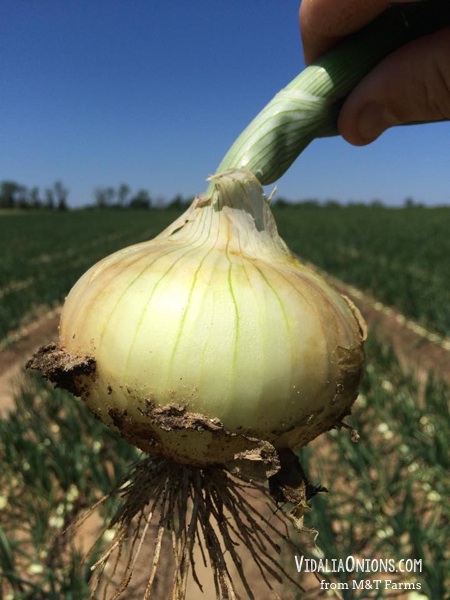
    Photo courtesy of M & T Farms, Lyons, GA, and Vidalia Onions.com

    By Clint Thompson

    Bob Stafford, manager of the Vidalia Onion Committee in Vidalia, Georgia, believes weather during the growing season has impacted this year’s Vidalia onion crop.

    “We planted 9,373 acres and lost some to hail and we lost some to too much water. We had a bad growing season. We’ll have a good promotable supply, but they’ll be a little on the smaller size,” Stafford said. “We’ll have more mediums than normal. The consumers are still going to get a very good product.

    “Our crop is generally over 90% jumbos but this time we’re going to have a lot of large-mediums and small jumbos.”

    Today is the scheduled packing date for this year’s Vidalia crop. Stafford said the packing date is when you can start using the Vidalia Onion trademark, and it ensures the customers that the onions are mature.

    This is the second straight year there has been considerably less Vidalia acreage produced.

     “We started downsizing last year so we’ve planted the 9,300 acres for two years. We ordinarily go up to about 12,000 acres,” Stafford said. “What we decided to do, we wanted the same yield off of less acreage. We wind up every year selling between 5 and 7 billion bushels. We just want to get that many off of 9,000 acres. It’s all about yields per acre is what we’re after; higher yields, less acres.”

    Stafford is not worried about this year’s market for onions compared to how other commodity markets have dropped amid the ongoing coronavirus pandemic.

    “(Florida produce farmers) grew a lot of product for schools and restaurants and so forth. When this pandemic closed them down those products were just left hanging. Our product, there’s been a world shortage of onions because since this pandemic, people are cooking at home and the onion being a staple for the cooking, it’s managed to keep up pretty well with the supply,” Stafford said. “It hasn’t affected us that much. It has affected us some but not as much as some other commodities.”

  • Managing Nematodes in Potatoes

    By Ashley Robinson

    There are a variety of nematodes that damage Florida potatoes. These plant-parasitic nematodes are small, microscopic roundworms that feed on plant tissue, causing severe damage to growers’ crops.

    Pictured are potatoes.

    To combat nematode populations, researchers at the University of Florida Institute of Food and Agricultural Sciences (UF/IFAS) have been testing new nematicide products.

    ONGOING FIELD TRIALS

    Nematicide application is one of the main management strategies available to growers in potato production. Zane Grabau, assistant professor of nematology at UF, is one of the researchers experimenting with new nematicide products at the UF/IFAS Hastings Research Station.

    “Most of our nematode research continues to center on testing new nematicide products.  Growers rely heavily on a few nematicides, so new chemistries are always useful,” Grabau says.

    There are two field trials taking place at the research station, one of which is testing Nimitz, a newer, liquid nematicide that contains the active ingredient fluensulfone. According to Grabau, they have done a lot of work with Nimitz over the past few years.

    “Nimitz is a little bit different as it is a non-fumigant, so it’s put out as a liquid, making it a little bit easier for growers to work with,” Grabau says.

    Over the past three years of working with Nimitz, Grabau’s results showed that the nematicide performed at or near the level of the one most common fumigants, Telone II, for managing sting nematode. It’s one of the most problematic and common nematodes in the area.

    In addition, they’re also experimenting with Majestene, a bionematicide to control nematode populations. Majestene is a certified organic product, formulated of dead bacteria that produce chemicals toxic to nematodes. In terms of application, Majestene is very similar to a chemical nematicide as it is biologically based.

    “Since it’s our first year testing it, we don’t really have any data yet, but we’re hoping to be able to see how it performs. For this year, the way we’re looking at it is as a potential supplement to a fumigation application,” Grabau says.

    ADDITIONAL MANAGEMENT RECOMMENDATIONS

    Although nematicide applications are the most effective way to manage nematodes, there are additional management strategies. Crop rotation of less susceptible crops, cultural and tillage practices, and use of nematode-free seed potatoes are additional strategies for growers to consider on top of nematicide applications.

    “One of the big things we encourage growers to do is to try and practice crop rotation when they can,” Grabau says. “This could either be with cash crops or cover crops. It’s just important that they are considered a poor host for nematodes or not a host at all.”

  • Georgia Peach Crop Primed for Success

    Pictured is a file photo of peaches that were harvested.

    By Clint Thompson

    Georgia’s peach crop is primed for a productive season. Hopefully, the market will oblige, says Dario Chavez, University of Georgia Cooperative Extension peach specialist.

    “We think, in general, the majority of the varieties did have enough chill (hours). The ones that we think may have some issues with chill are the later varieties, the higher-chill varieties. We really didn’t get a freeze this year for peaches. That’s different from previous years,” Chavez said. “Overall, I have been looking at the plants and I see good fruit growing from the early varieties. The late varieties are still a little too early because the fruit is just starting to swell”.

    “A variety for example like Julyprince that is a popular variety in Georgia and South Carolina, it’s looking very nice. We have a block of Flavorich, one of the first varieties that come in May, it has a nice crop, too.”

    Georgia is one of the top peach-producing states in the country. According to UGA Extension, Georgia produces more than 130 million pounds of peaches every year. There are two commercial peach-growing regions in Georgia. The central region is the largest with about 1.6 million peach trees, which comprises 75% of the state’s production. The southern region produces about 30 million pounds of peaches annually.

    While this year’s crop provides peach growers a sense of optimism with a little more than a month away from harvest, there is uncertainty regarding how the peaches will fare in the current market. Many fruit and vegetable markets are struggling right now amid the coronavirus pandemic. Chavez is hopeful that won’t be the case for his peach producers.

    “Sadly, with all of this situation with the virus, we hope the market doesn’t get spooked or anything like that because we’re seeing a good crop right now,” Chavez said.

    Chavez said in his blog in mid-February that if growers expect to have a potentially good crop, varieties must meet certain chill portions at a minimum by Feb. 15. He said middle Georgia was close to 50 chill portions. This means that, overall, conditions are like last season.

    • 650 chill hours need ~ 30-35 Chill portions
    • 750 chill hours need ~ 35-40 Chill portions
    • 800 chill hours need ~ 40-45 Chill portions
    • 850 chill hours need ~ 45-50 Chill portions
    • 950 chill hours need ~ 50-55 Chill portions

    Chavez emphasized in his blog that if a specific variety from last season had issues during bloom (either delayed or extended), because of weather conditions, then it’s more than likely going to be a similar situation this year.

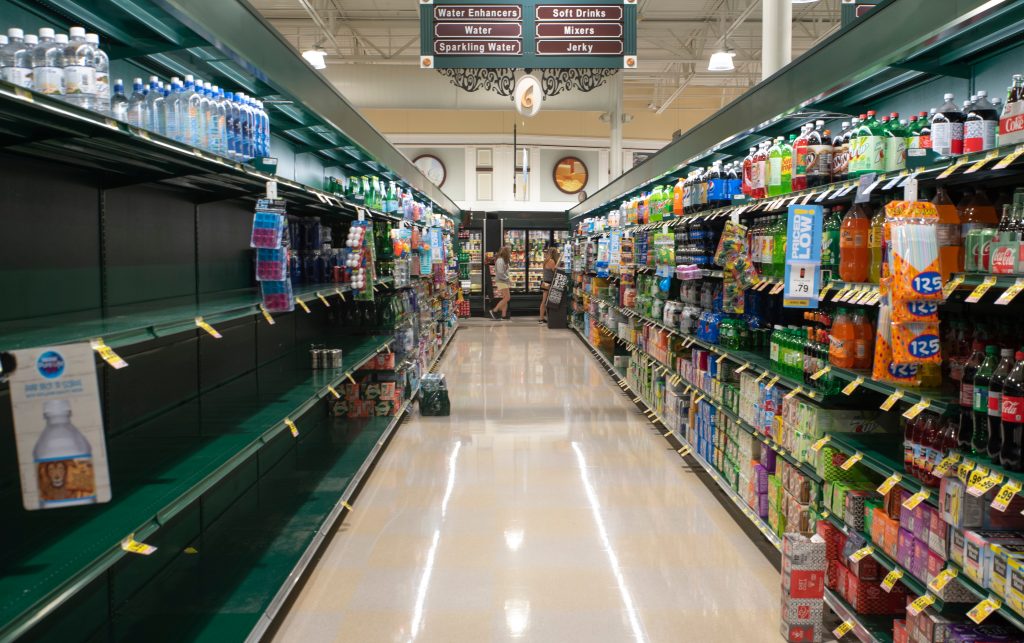
  • Why Are the Grocery Store Shelves Empty?

    coronavirus
    Courtesy: Sharkshock/Sutterstock.com

    By Gopinath (Gopi) Munisamy for UGA CAES News

    While all industries have been seriously affected by the COVID-19 pandemic, food and agriculture have been among the hardest hit segments of the U.S. economy. The primary reason lies in the composition of household food expenditures.

    The impacts of the pandemic appear to vary by commodity based on two critical issues: perishability and labor use. Perishables like fruits, vegetables and milk are among the hardest hit. Many of these industries also depend on labor for growing and harvesting.

    There is no immediate shortage of food in the U.S., according to the U.S. Department of Agriculture (USDA). However, the current demand for items such as grocery-size products and on-demand delivery is greater than what is in abundant supply – bulk, large-sized products and processed shipments to restaurants that remain open.

    This demand-supply mismatch appears to mimic anecdotal evidence of price spikes and empty store shelves on the consumer side and the collapse of demand and dumping of food on the farm side, with a range of linked effects in the middle.

    Wholesale food demand reduced, supply chain shifts

    Households spent $1.7 trillion on food in 2018, 54% of which was spent on food away from the home at restaurants, bars, sports venues and other establishments, according to the USDA Economic Research Service. A dramatic drop in foot traffic at all types of restaurants began in the second week of March.

    Supermarkets and grocery outlets have also experienced a significant reduction in foot traffic. But delivery and on-demand services have been strained by the sudden surge in demand from people under stay-at-home orders and social distancing guidelines, which includes nearly 90% of the U.S. population.

    With the drastic fall in food demand away from home, multiple forces were unleashed rapidly, causing ripples that stretched farther into every food and agricultural commodity.

    First, the supply chain serving food service industries did not have many buyers. A case in point is cheese, where the major supplier, Wisconsin, found two-thirds of its demand fall to near zero within a week or two.

    Second, social distancing guidelines and shuttered non-essential businesses affected supply chains serving both food services and retail grocers.

    The results include a significant slowdown in the operations of processing and distribution, shortage of workers at farm, processing and distribution (trucking) facilities, and a shortage of cleaning and sanitizing supplies. Compounding these effects are the resources spent in contact tracing and quarantine if and when a worker tested positive for COVID-19.

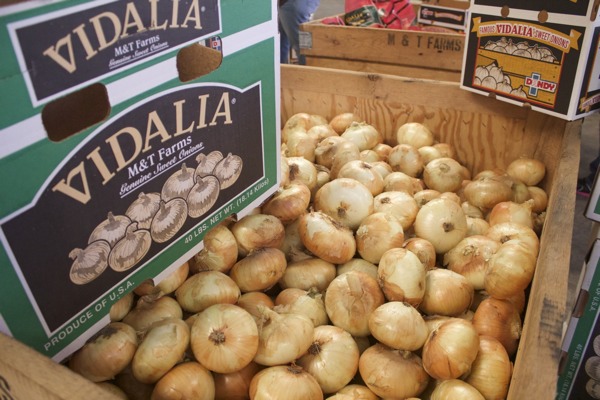
    Third, is the urgent need to transition products run through food services into those that consumers need at the grocery store. For example, restaurants usually buy diced vegetables, like onions, in 60-pound bags, but consumers at grocery stores usually buy 3- to 5-pound bags of unpeeled onions. Also, large cheese blocks sold to food services, which generally have sizable storage space, cannot be chopped overnight into packs of ounces and pounds to sell at grocery stores.

    (The author is a professor of agricultural and applied economics in the University of Georgia’s College of Agricultural and Environmental Sciences. Chen Zhen, associate professor in the department of agricultural and applied economics, contributed to this story.)

    To read the rest of the story, see UGA CAES Newswire.

  • Peach Crew Safety a Concern for Farmers During COVID-19

    By Clint Thompson

    Pictured is a file photo of peaches on a tree.

    Jeff Cook, University of Georgia Cooperative Extension Agriculture and Natural Resources agent for Peach and Taylor counties, says the ongoing coronavirus pandemic has forced peach producers and farming operations to take extra precautions when protecting their crews from becoming sick.

    “They have separate crews so they’re trying to keep the crews a little more separated this year. But the biggest thing that they’ve all said to me is they’re trying to keep the crews away from the outside world,” Cook said.

    Farmers limit the workers to the amount of time they’re exposed to other people that are not part of their specific crew.

    “They’re trying to help reduce the amount of time they’re having to spend at the store or at the bank. Once a week they carry them to the bank and once a week they carry them to the grocery store,” Cook said. “To the farmer, if their crews get sick and they can’t pick peaches, then we’re in big trouble.”

    Cook said some peach workers have been in place since February when farms started the peach pruning peach process. The second crews are now in place to help thin the peaches since a lot more people and hands are required. These peach crews also include those who’ll work in the packing sheds and help harvest once trees are ready.

    Cook estimates that there are 10 to 12 workers in one crew, though, multiple crews may ride the same bus to a particular orchard. The workers are not close together out in the fields. Each one has a specific tree they work on, and trees are normally spaced 16 feet apart.

     “When they are thinning, the ride there is as close as they are going to get to each other. When they’re out in the field, they’re not really near each other,” Cook said.

  • U.S. Congressman: A Fourth Relief Bill Will not Happen Fast

    By Clint Thompson

    Austin Scott

    United States Congressman Austin Scott (GA-08) believes if there is a fourth coronavirus relief bill to help people like farmers and aid agribusinesses, it will not happen fast.

    Scott, along with fellow Congressman Sanford Bishop (GA-02), spoke about the recently passed Coronavirus Aid Relief and Economic Security (CARES) Act and its different provisions. Due to circumstances regarding the health and well-being of members of Congress, passing another piece of legislation may have to wait.

    “There are 535 members of Congress. There are at least five that have tested positive for the coronavirus. There are several others that have been on quarantine because they’ve been exposed to it,” said Scott on April 3. “One of the questions is, at what point are you able to bring 535 people back in to work in close proximity and actually get something done? I think this last bill was unique in the way that it was passed. I don’t think it is possible to pass another bill with simply the Senate effectively drafting the bill and the House, including myself, voting yes by voice on the bill.”

    The Paycheck Protection Program (PPP) was an integral part of the $2 trillion CARES Act. It was designed to aid small businesses recover amid the ongoing coronavirus pandemic. However, it may not have enough funds to support the $350 billion allocated for the program. Congressman Buddy Carter (GA-01) believes additional funding will be ready if needed through a Phase 4 relief package. Scott reiterates his position that another stimulus package will still take some time to pass.

    “I would tell you, if there is a fourth relief bill, I think a couple of the areas that are going to have to be looked at. (No.) 1, from a timing standpoint, I think it would be more than 30 days from now before another bill passed. (No.) 2, at that stage, we will have a better indication of what the revenue impact is on state and local governments and on our healthcare providers,” Scott said.

  • Pecan Farmers Need to Watch out for Budmoths

    By Clint Thompson

    Budbreak in pecan trees is under way in orchards across the Southeast, and farmers need to be wary of one particular pest – budmoths.

    Budmoths were a nuisance last year on pecan trees and have already showed signs of infesting young trees during the first week in April.

    A bag of shelled pecans in this file photo.

    University of Georgia Cooperative Extension pecan entomologist Angelita Acebes offered tips on her blog on how to identify a budmoth and what management options are available at this point in the growing season.

    Pecan growers can recognize budmoth damage by the webbing around newly-developed leaves and small dark spots on the tips of those leaves.

    During the spring, adult moths start laying eggs and can lay eggs in about six days. Unfortunately, the young larvae will feed on the leaves. Then they spin a web to roll the leaves where they’ll bore into the shoot. Once in the shoot, an insecticide will be ineffective because it can’t reach them.

    Whether to spray your trees at budbreak is a question that can go either way. Spraying at budbreak is an option since there’s a small window to effectively apply an insecticide. If farmers have time to scout, treating when the infestation is first noticed is also an option.

    When considering what insecticide to apply, worm materials are more ideal if you can catch budmoth outbreaks early. If budmoth damage is severe and the initial outbreak was missed, Lorsban is the only option for quick control.

    For more information, see Acebes’ blog.

  • Vidalia Onion Crop Looks ‘Favorable’ Despite Presence of Downy Mildew Disease in Localized Areas

    File photo of Vidalia onions for sale.

    By Clint Thompson

    Vidalia onion producers have begun harvesting the early maturing varieties this year, and Chris Tyson is excited about the potential of this year’s crop.

    “The Vidalia onion crop definitely looks favorable this year. We are anticipating a quality harvest,” said Tyson, University of Georgia Cooperative Extension area onion agent at the Vidalia Onion and Vegetable Research Center in Lyons, Georgia. “Frequent and heavy rains created some adverse conditions earlier in the season, but growers have managed their crop well. They’ve done a great job managing their fertility and fungicide programs despite the weather.”

    Growers started harvesting their earliest varieties in the beginning of April. The peak of harvest will occur near the end of the month.

    There is optimism despite some localized outbreaks of downy mildew disease in the Vidalia Onion zone in Southeast Georgia, according to Bhabesh Dutta, UGA Extension vegetable plant pathologist. Severe and widespread cases have not been reported. He warns, however, things can change quickly with respect to infections in newer areas, as harvests continue to ramp up over the next few weeks.

    “This all depends on how diligently our growers monitor their crops for initial infection and how aggressive they are on their protective fungicide spray schedules,” Dutta said. “Our onion growers have been on top of their game for the most part with respect to timely protective fungicide sprays. This in combination with some warm, clear weather may help reduce the onset or severity of downy mildew.”

    Dutta said the first symptoms of downy mildew occur on older leaves as light green to pale yellow, which turn to tan and brown as the lesion ages. In Georgia, early symptoms can be diamond-shaped lesions that are mottled with pale and green areas interspersed. As colonization progresses, lesions may girdle the entire leaf. This could cause the total collapse of leaf tissues. Infected bulbs are reduced in size and typically don’t store well.  In severe cases, 100% yield losses have been reported. 

    “Although bulb symptoms are rare to none, foliar infection and secondary pathogen colonization result in bulbs that are reduced in size and more often with internal rot,” Dutta said. “Healthy appearing bulbs from a downy mildew-infected crop do not store well and can get often discarded due to the internal rot.”

  • Farmers Markets Still Option for Produce Growers

    desantis
    Fresh produce on sale at a farmers market in this file photo.

    By Clint Thompson

    Produce farmers in the Southeast are struggling with markets that have disappeared because of the loss of restaurants and closure of schools amid the ongoing coronavirus pandemic. But Max Runge, Extension specialist in agricultural economics and rural sociology at Auburn University, believes farmers markets remain a viable option for fruit and vegetable growers, especially those who operate on a lower scale.

    “We’ve had pretty good farmers’ markets across Alabama. A number of producers sold through those. I think those are still going to be strong,” Runge said. “I think the market that we have lost is the farm-to-table where the farmers are selling directly to restaurants. We’ve lost that market, at least for now. But I think the smaller production to farmers market that are selling locally, I think those will be okay.”

    Florida fruits and vegetables farmers have struggled over the past month with their food service market drying up, amid restaurants across the U.S. being forced to closed. Many had to leave perfectly good produce in the field just because they didn’t have a buyer to sell to.

    Runge believes, though, that his state’s smaller produce farmers could still reap the benefits at area farmers markets.

    “We don’t nearly have the large commercial operation that there is in Southwest Georgia. We’ve got some. But the majority of them are smaller producers and I think those will hold on,” Runge said. “A lot of those have customers that they’ve sold to for years at these farmers’ markets, and they come back year after year. I think that’ll continue. I think there may be some more interest from people that maybe haven’t purchased from them in the past. And they’re certainly taking advantage of the farmers’ markets.”