Category: Georgia

  • Watch out for Invasive Species

    By Clint Thompson

    The United States Department of Agriculture (USDA) wants help in identifying invasive species that threaten our food supply and cause plant diseases. Especially since April is designated “Invasive Plant Pest and Disease Awareness Month”

    Citrus greening is a result of damage from Asian citrus psyllids, which are invasive species.

    Samantha Simon, USDA’s Executive Director of Emergency and Domestic Programs, says invasive species can threaten agriculture and many farming operations, especially in the Southeast.

    “In the Southeast, there are many that like to call the Southeast home. That includes the Asian citrus psyllids, which is this little bug that likes to attack citrus plants. It can also spread citrus greening. There’s also the emerald ash borer beetle. It attacks our ash trees, resulting in the destruction of tens of millions of ash trees in 35 states throughout the United States. There’s also the imported fire ant,” Simon said. “It travels in the soil, can travel in hay and can travel on equipment.”

    Time is now to be on the lookout

    Simon emphasizes that since it’s springtime, invasive species or “hungry pests,” are on the move and looking for sources of food. These can range from a wide variety of trees to various food crops. These pests need to be reported to the USDA if they’re spotted.

    “Hungry pests are emerging and they’re going to be out there moving around. We’re out there moving around as well. It’s a great time for us to look around for unusual signs of the pest or disease in the trees, in our plants, in our own backyard,” Simon said. “The hungry pests can, they can hurt from citrus growers to wine producers.

    “There’s always a risk for exotic fruit flies, which of course, will impact fruits and vegetables and nuts as well. Thankfully, at the moment, we do not have any of those. We’re actively working to keep those out of the southeast. It’s important to know, the things we move, whether it’s bean plants, or fruits or vegetables or untreated firewood, may include these hungry pests.”

    To learn more about Asian citrus psyllids, see psyllid management.

    “It’s devastated millions of acres of citrus in Florida as well as Texas and California. We are working actively with the citrus industries to help prevent the spread of citrus greening,” Simon said.

    The United Nations (U.N.) designated 2020 as the International Year of Plant Health. The goal was to raise awareness about the devastating impact invasive pests have on the environment, food security and global economy. The U.N. estimates that each year, invasive pests destroy up to 40% of food crops. They can also cause $220 billion in trade losses worldwide. This trade, worth nearly $1.7 trillion annually, is crucial for human survival and economic growth in rural areas.

  • Georgia Peach Industry Expert ‘Optimistic’ About Crop, Market Outlook

    Georgia peaches should be ready for harvest in May.

    By Clint Thompson

    A Georgia peach industry expert is confident about his state’s marketing outlook amid the ongoing coronavirus pandemic.

    Duke Lane III’s company, Genuine Georgia, manages sales and marketing for the Georgia peach industry. He believes the market will be there for the Georgia peach farmers despite the presence of COVID-19 that has closed restaurants and shut down schools.

    “When you look at retail sales, produce and grocery, they’re up significantly. I think (the pandemic) will undoubtedly have an effect on foodservice. But our business has been built around grocery markets, retailers,” said Lane, who is also president of the Georgia Peach Council.

    “We feel like when you start thinking about summertime and feeling good, we feel like those are kind of thoughts that are synonymous with Georgia peaches. We’re pretty optimistic,” Lane said. “I feel like quality, flavor; absolutely. We’re going to kick off about the 18th of May and are just anticipating some big things.”

    Georgia is one of the top peach-producing states in the country. According to UGA Extension, Georgia produces more than 130 million pounds of peaches every year. There are two commercial peach-growing regions in Georgia. The central region is the largest with about 1.6 million peach trees, which comprises 75% of the state’s production. The southern region produces about 30 million pounds of peaches annually.

  • UGA Specialist: Pecan Crop Fine Following Cold Snaps

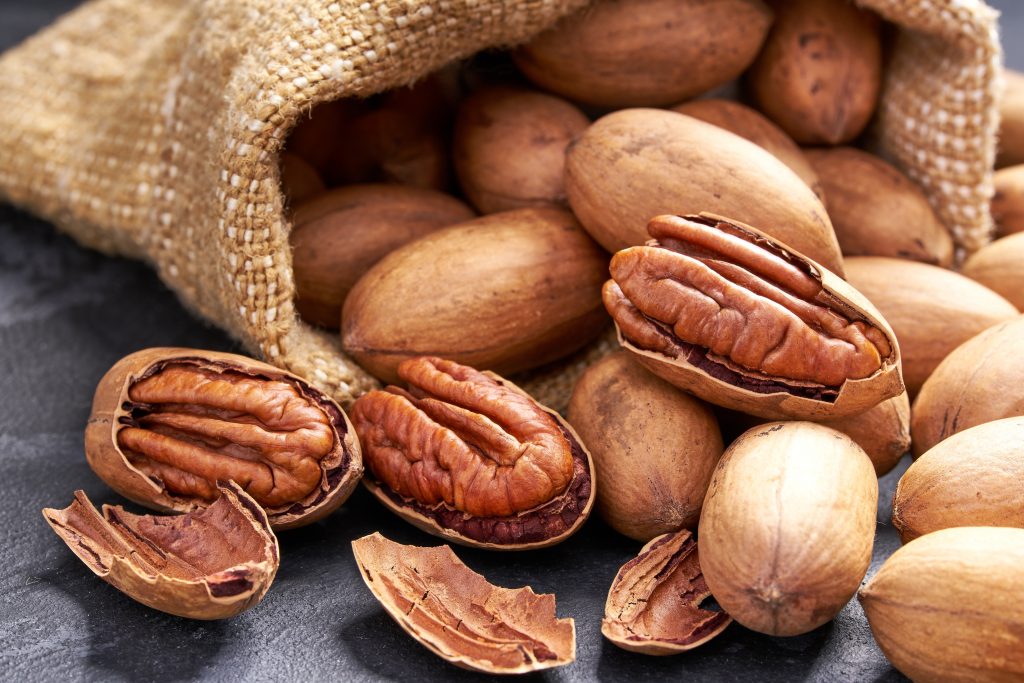
    Pecan trees will not be impacted by recent cold snaps.

    By Clint Thompson

    Recent cold temperatures will not have any impact on the development of this year’s pecan crop, says Lenny Wells, University of Georgia Cooperative Extension pecan specialist.

    Wells estimates that pecan farmers saw budbreak at least two weeks early this year. With that early budbreak back in March, temperatures were still warm. Pecan trees put their foliage on from the bottom of the tree up. All that early foliage that came out on the bottom part of the tree and started growing well. Then rains and cold fronts came soon after.

    “We had some cooler temperatures and some nights down in the low 40s, which is nowhere near anything that would hurt us. But it did slow this growth down, especially the buds that were breaking in the top of the tree. That has slowed the growth in the top of the trees a little bit,” Wells said. “When you look at some trees from a distance, it looks like the bottom leafed out good, but the top is real thin. That’s just because those little cool snaps we had slowed things down. I don’t think it’s going to be an issue.”

    He reassured pecan producers in his blog that as temperatures and the soil warm up, the problem will correct itself.  

    However, cool soil temperatures can lead to Zinc and Boron deficiencies. The trees can’t take these nutrients up from the soil as easily when soil temperatures drop. So, Wells advises growers to stay up to date with their foliar sprays.

    “Every spring, your soil temperatures warm up a little slower than the air temps do. Spring is the critical time for the tree to get that zinc and boron. When those soil temperatures are cool, they’re not able to take it up there well from the soil,” Wells said. “That’s why we usually will put on Zinc and Boron foliar sprays early in the season. Regardless of what your soil levels are, we do it for that reason because they can’t pick it up from the soil early in the season when they need it the most.”

    Symptoms of such temporary deficiencies include bare limbs, small, yellow leaves, rosette and mouse ear.

    To see how Wells is confident in this year’s pecan crop, see vscnews.com.

  • Sulfur Applications Help Protect Grapes Against Powdery Mildew

    A tour of the research vineyard at the Clanton Research and Extension Center in Chilton County at the Alabama WIneries and Grape Growers Association meeting in September 2019. Grapes are grown by Elina Coneva and the staff at the CREC. Grape varieties are developed by Dr. Andy Walker, a grape breeder at UC Davis.

    By Clint Thompson

    University of Georgia Cooperative Extension Fruit Disease Specialist Phil Brannen believes grape producers can better protect their crop against powdery mildew disease and preserve essential fungicides with sulfur applications.

    Brannen believes sulfur is a viable alternative that growers need to utilize, especially since resistance has developed in two different classes of chemicals. Those classes are the quinone outside inhibitor (QoI) class and the demethylation inhibitor (DMI) class. Growers risk disease resistance developing in the succinate dehydrogenase inhibitors (SDHI) class of fungicides as well.

    “That’s one reason I’m encouraging people to incorporate more sulfur in their programs. It’s just to try to take less pressure off this one remaining chemical that works really well. We can save it for the more critical time we need a really active powdery mildew material,” Brannen said.

    He said growers need to be smart when applying sulfur and be mindful of its ability to burn the plants.

    “The main issue we have with it is not to humans or the environment, it’s actually to the plant itself,” Brannen said. “If you put out sulfur on a really hot day, especially if there’s a lot of high humidity or the foliage is wet, it will burn the grapes severely. It can actually cause significant damage to the plant itself. That’s one reason people have avoided using it on vinifora grapes.”

    Brannen recommends that producers apply sulfur either later in the evening or at night when temperatures are lower. That’s when there’s little risk to the plant.

    But growers should also be mindful of sulfur’s harmful potential to themselves.

    “It’s not dangerous in the sense that it won’t kill you. You do have to realize it will burn your eyes. You go into a vineyard and if you’re doing tying operations and things like that, and if you spray sulfur and rub your eyes, your eyes are going to burn,” Brannen said. “It’s not going to put your eye out. But it’s going to be something that you have to be aware of. It’s not as user friendly as some of these other materials.”

    Powdery mildew’s impact

    Powdery mildew disease is problematic for grape producers because of its ability to infect almost any part of the plant. It can cause leaves to desiccate, become dry and fall off.

    The major concern is when powdery mildew infects the fruit itself. A limited amount on fruit will not allow sugars to come up to the fruit. If there’s no sugars in the berries, it leads to an inability to make good wine.

    “It essentially renders the fruit into something you can not use. You can’t allow powdery mildew on the fruit at all,” Brannen said.

  • Georgia Pecan Growers to Vote on Assessment Renewal

    georgia pecans
    File photo of a bag of pecans.

    Georgia Department of Agriculture

    ATLANTA, GA – Georgia pecan growers of 30 acres or more will vote in May on the renewal of a one-cent per pound assessment on pecans for the Georgia Agriculture Commodity Commission for Pecans.

    Pursuant Georgia law, producers are required to vote every three years to renew the assessment. Voting takes place May 1 through May 30, and all ballots must be postmarked by May 30. Additionally, the back of the return envelope must be completed for the ballot to be valid.

    The commodity commission utilizes assessment funds for research, education, and promotion of Georgia pecans. Among the research funded is support for a University of Georgia (UGA) pecan specialist and breeder whose research includes disease and insect management as well as health benefits of pecans. Additionally, funding helps promote Georgia pecans in domestic and international markets.

    Growers of 30 or more acres who have not received a ballot should contact Andy Harrison, at andy.harrison@agr.georgia.gov.

  • Promoting Health Benefits of Blueberries Could Boost Sales

    Pictured is a file photo of blueberries.

    By Clint Thompson

    Produce industry experts believe consumers are, and will continue to be more health conscious, which is good news for blueberry producers.

    “It’s very apparent to me that consumers are getting the message because when you look at things like the blueberry category, the strawberry category, the citrus category, we’re seeing great movement in those types of items,” said Melissa Byland, senior buyer in produce at Walmart. “I think consumers are definitely connecting fresh produce and specific items within fresh produce in the aspect that they contribute to better health. We’re definitely seeing the impacts of that in our business.”

    Health Benefits

    According to UGA Extension’s blueberry site, blueberries are a good source of vitamin C, iron and fiber. They’re cholesterol-free, sodium-free and possess an important source of potassium.

    Research concludes that the antioxidants in blueberries help protect the body against chronic diseases associated with aging.

    “We talked to one scientist who said there are seven things you should be eating to boost your immune system to protect you from any virus. Blueberries were on the list. We need to take advantage of that in this current situation to educate consumers,” said Cathy Burns, CEO of the Produce Marketing Association. “I don’t think it’s going away anytime soon. People are going to continue to be concerned about health. Obviously, what Melissa is seeing in her sales is very consistent with what we’re hearing with retailers across the board. It’s our time to shine and really focus on eating fresh fruits and vegetables, and blueberries fits squarely in that.”

    According to the U.S. Highbush Blueberry Council, Georgia and Florida, along with eight other states, help produce more than 98% of the country’s blueberry crop.

    Blueberry producers should really profit in the upcoming months. Byland said the latter part of spring and into summer, berries are under the spotlight at Wal-Mart. And it’s not changing.

    “For us, we look at May, June and July as the Super Bowl of berries. We’re really planning to execute business the same way we have in the past. I know that quality and availability is at its best during this time. We’re able to offer customers larger pack sizes,” Byland said. “We’re really gearing down and looking toward running our summer business the same way we always have. It’s a great opportunity also for us to feature locally grown products, which we try to do as often as we possibly can. We know that it definitely resonates with customers. It gives them a great feeling about being able to support their local farmers.”

  • N.C. State Economist: Second Quarter Should Be Horrible Amid Coronavirus Pandemic

    Pictured is a farmer in his field.

    By Clint Thompson

    The ongoing coronavirus pandemic has dealt a devastating blow to the U.S. economy and especially the American farmer. North Carolina State Extension Economist Mike Walden believes the country needs to do what it can to help those farmers rebound from the current recession.

    “We do need to worry about keeping our farmers afloat. Fortunately, in the stimulus plan, there was about $50 billion that was allocated for various programs that would help farmers,” Walden said. “We certainly need to watch our farmers.”

    Fruit and vegetable producers are struggling because of the lack of the food service market. Restaurants have either closed or reduced their business traffic to try to limit the spread of COVID-19. However, that has caused a problem for producers, especially in Florida.

    “If you look at where people get their food, we’re almost split 50-50 between people eating their food in their homes in home-prepared meals versus eating them in restaurants,” Walden said. “The restaurant industry is essentially shut down. There is some pick-up and take-home but that’s a small fraction of what they do. The problem for the farmer is that their supply chain is geared towards that 50-50 split. People don’t understand that farmers just can’t take the produce that they were sending to restaurants and just ship them over the grocery stores. There are different regulations and different packaging.

    “That’s creating a real headache for farmers.”

    On Friday night, the United States Department of Agriculture announced the Coronavirus Food Assistance Program (CFAP). According to the USDA press release, President Trump directed USDA to craft this $19 billion immediate relief program to provide critical support to farmers and ranchers, maintain the integrity of our food supply chain and ensure every American continues to receive and have access to the food they need.

    Walden still warns that the economy will likely get worse before it gets better.

    “The second quarter, which is how most economic data are calibrated, is going to be horrible. It’s going to probably be a record in terms of drop of GDP (Gross Domestic Product). But we should start to see growth come back in the third quarter and fourth quarter,” Walden said. “But it’s likely not going to be until, I would say, at the earliest, mid-2021 before we’re back to where we were before this started.”

    Walden said he’s been an economist for more than 40 years. This is his sixth recession but admits this one is much different than the others.

    “Most recessions are caused by imbalances in the economy, particularly over-indulgence in debt. Businesses and consumers taking too much risk,” Walden said. “This is a recession that has actually been mandated by the government. The government has said we have a problem with the coronavirus. It is easily spread. In order to contain it, in order to limit deaths, in order to not overwhelm our hospital system, we have to essentially shut down a large part of the economy.

    “All of the bad numbers we’re getting now should not be surprising because we have to do this in order to control the virus. Apparently we are getting good numbers on that. We will likely see the economy contract by somewhere between 25% and 30% in the second quarter, that is April, May and June. The unemployment rate may very well get over 15%. But the good news is this should be short-lived. We should probably see some return to growth in the third quarter and then forward.”

  • Using Pesticides Wisely Program Offered Online This Year

    By Clint Thompson

    Stanley Culpepper

    The Using Pesticides Wisely (UPW) program will be offered in an online format this year, due to the ongoing coronavirus pandemic. The program has helped Georgia reduce pesticide drift complaints to the University of Georgia Cooperative Extension Service. It will be held this week April 21-23 at various locations.

    “Our Using Pesticides Wisely programs started in 2015. We are proud to say that every person in our state has been trained face to face. We appreciate the opportunity to communicate with our growers in that type of platform,” said University of Georgia Extension weed specialist Stanley Culpepper. He will provide a voiceover from UGA. “Obviously, everybody on planet Earth is influenced by this virus. So we had to adjust. We felt like the best way to adjust was for the Cooperative Extension Service, kudos to our county agents, to take the lead. We made the powerpoint presentations with voiceovers. That’s what will be presented during the trainings that’ll occur (this) week.”

    UGA Extension and the Georgia Department of Agriculture created the UPW trainings in 2015. The Georgia Department of Agriculture will also have a representative as part of the presentations.

    The state program is aimed at teaching farmers and other pesticide applicators how to properly apply pesticides. The number of pesticide drift complaints in Georgia to the Cooperative Extension Service have been reduced by 76% over the past five years, since the UPW trainings were implemented.

    “If you’re going to apply the Dicamba products that are labeled for use in Dicamba in cotton or soybeans or you’re going to apply 2,4-D in their respective tolerant crops, you must have taken this training in 2019 or this year. You have to do that,” Culpepper said.”

    Growers should choose one of the four webinar sessions and register for the date and time that works best for their schedule.

    Session dates, times and registration links are:

    • April 21, 10 a.m. – Host: Bulloch County Extension Coordinator Bill Tyson, 912-871-6130.  Register here.
    • April 22, 10 a.m. – Host:  Laurens County Agriculture and Natural Resources Agent Raymond Joyce, 478-272-2277. Register here.
    • April 23, 10 a.m. – Host: Early County Agriculture and Natural Resources Extension Coordinator Brian Cresswell, 229-723-3072. Register here.  
    • April 23, 6 p.m. – Host: Tift County Agriculture and Natural Resources Agent Justin Hand, 229-646-1413. Register here.
  • UGA, Georgia Department of Agriculture Offer Critical Training for Pest Control Application Online

    By Maria M. Lameiras for UGA CAES News

    University of Georgia: Critical pesticide application training for pest control professionals and producers will go online for 2020.

    The University of Georgia and Georgia Department of Agriculture dicamba training program, Using Pesticides Wisely 2020, will move to online delivery for the remaining sessions.

    Using Pesticides Wisely (UPW) is a state program aimed at teaching farmers and other pesticide applicators how to properly apply pesticides to limit pesticide drift in Georgia. Only farmers and other pesticide applicators who were not trained in 2019 need to complete the 2020 training, according to a decision by the U.S. Environmental Protection Agency.

    Growers should choose one of the four webinar sessions and register for the date and time that works best for their schedule.

    Please note that each online session has its own registration link. It is important to use the link that matches your preferred time. Required registration information includes address, phone number, email and pesticide license number for each registrant. A license is not required for 2,4D application, so those registrants can enter N/A in that field.

    Meeting links will be emailed to registrants prior to the 1.5-hour sessions. Participants will be able to submit questions using a chat box or over the phone. Attendees’ names will be placed on a list posted to the Georgia Department of Agriculture’s Auxin website. Please allow up to 21 days after the training date for names to be posted. This list will serve as the official training record and attendance verification.

    Session dates, times and registration links are:

    • April 21, 10 a.m. – Host: Bulloch County Extension Coordinator Bill Tyson, 912-871-6130.  Register here.
    • April 22, 10 a.m. – Host:  Laurens County Agriculture and Natural Resources Agent Raymond Joyce, 478-272-2277. Register here.
    • April 23, 10 a.m. – Host: Early County Agriculture and Natural Resources Extension Coordinator Brian Cresswell, 229-723-3072. Register here.  
    • April 23, 6 p.m. – Host: Tift County Agriculture and Natural Resources Agent Justin Hand, 229-646-1413. Register here.

  • West: Hope to be Stabilizing Influence During Time of Uncertainty

    By Clint Thompson

    Effective July 1, the University of Georgia (UGA) College of Agricultural and Environmental Sciences (CAES) will have a familiar face to serve as interim dean.

    Joe West

    Joe West, who recently retired as assistant dean from the UGA Tifton campus, just hopes he can be a stabilizing influence during a time of uncertainty in the Ag industry in Georgia.

    “People know me. I’m fortunate enough over my career that I’ve been in several different jobs and worked in Athens, so I know a lot of the key folks at the University of Georgia,” West said. “Already having that network of University of Georgia leadership and having their support is important. Talking with the leadership in Ag. We’ve got so much uncertainty in our industry. It’s really, really suffering right now. We as a college need to figure out what’s our role, what we can do to try to help this industry and help our farmers.”

    West will take over for Sam Pardue, who will retire June 30. West has also agreed to work half time in May and June in preparing for his new role.

    Georgia’s state colleges and universities have been impacted by the ongoing coronavirus pandemic. All have moved to online instruction for the rest of the semester. But West said research remains a priority and will continue to be under stricter guidelines.

    “Social distancing and things like that, we’re certainly observing,” West said. “As I understand it, our vice president for research, David Lee, has been, to the extent he can in keeping our people safe, he’s been very helpful in letting our field people get their research plots in. He’s come to understand how important timing is and that if we don’t get a crop in by a certain time, it’s a loss for us from a research standpoint. We’re not totally shut down. We’re getting some research in the fields, and again, ensuring that our people are safe. You can be in a tractor by yourself and be socially isolated.”

    UGA CAES coordinates research on three experiment stations and eight research and education centers throughout the state on various crops, including fruit and vegetables.

    For more information, see UGA CAES Newswire.