Category: Georgia

  • UGA Research Aimed at Helping Hemp Varieties Adapt Better to Southeast

    Pictured is a hemp field that UGA’s Jason Wallace and Matthew Johnson studied hemp at.

    By Clint Thompson

    Georgia farmers can begin growing industrial hemp this year. Many Georgia growers are enthusiastic about the new opportunity. But most varieties have not been selected for Georgia’s climate. There is little information about which ones will do well.

    University of Georgia scientists are hoping their research will help hemp producers profit for many years to come. UGA scientist Jason Wallace and student Matthew Johnson are studying the genetics of different varieties. They hope to improve them to better adapt to the Southeast region.

    “The first step is finding something that actually works [in Georgia] and survives,” says Wallace, a member of UGA’s Department of Crop and Soil Sciences. “Once we have that, the next goal is to ask, ‘How do we make this better? What do we want to change to make it more profitable, less likely to go over the legal limits [of THC], and require fewer inputs?’”

    Breeding Trials

    UGA grew a collection of 60 hemp varieties in several locations around the state last year. They scored how well each did to identify the best varieties and began breeding trials to produce even better ones.

    Johnson, a graduate student in UGA’s Institute of Plant Breeding, Genetics, and Genomics, believes many of hemp’s traits need to be improved if it is to be adapted to growing conditions in the Southeast.

    “During these past 100 years when this crop’s been pushed off for legal reasons, the most advanced work that has ever happened in plant genetics and in fruit cultivar development happened,” Johnson said. “Corn has gone from maybe 20 to 30 bushels an acre to yields of 200 to 300 bushels per acre.  Hemp has had no improvement [for large-scale production]…. You need to make it a plant that can be harvested with a machine and stay within legal limits…. Those are more long-term goals and do need to be approached from the genetics research.”

    Wallace is confident that hemp research can be accelerated with the technology he and Johnson have access to.

    “With the technology we have now, you can develop tools in just 2 or 3 years that took corn or wheat 30 or 40 just because the technology has come so far, so fast,” he said.

    Challenging Research

    Hemp research is still a challenge since the crop has been illegal for decades. With limited prior studies in genetics, Johnson has had to develop and validate a lot of the foundational data on his own.

    “There aren’t a lot of well-known protocols,” he says. “If I want to know how to do something in corn, I can call up 100 different researchers and they can tell me how to do [it]. If I want to know how to cross two hemp plants together, I have to figure that out. Not much is set up. I’ve had to figure out how to make my plants produce pollen, how to cross them, how to control them. I’ve (also) had to figure out what nutrients to use.”

    Despite those challenges, Johnson is excited about the crop’s potential.

    “To be honest, this [industrial hemp] is what got me interested in agriculture genetics in the first place. I’ve been studying this crop for 10 years, since I was in high school. To be in this position and to be able to do this research is a dream come true.”

    Although industrial hemp is the same species as marijuana, it lacks the high concentrations of a chemical–tetrahydrocannabinol, or THC–required to give people a high.

  • Florida Blueberry Farmer: I’m a Fan of Having Our Own Domestic Supply of Food

    By Clint Thompson

    Blueberry prices have not improved much, and Mexican imports may be a reason why, says Florida farmer Ryan Atwood.

    Pictured are highbush blueberries.

    “I don’t think (prices have) move the needle much. Part of it is this Mexico deal. Mexico brought another 5 million pounds in last week. Mexico just keeps putting more and more fruit on our window, even Georgia’s window now,” Atwood said. “Normally, they would fall off by this time of year, but they’re going strong still for some reason.”

    Atwood believes being dependent on other countries for food is a dangerous precedent, especially since farmers like himself are more than capable of producing crops.

    “I’m a fan of having our own domestic supply of food. I think it’s a security issue for our country. We’ve got to grow our own food. You saw what happened 10 or 12 years ago when we used to import all that oil and then we got own domestic supply going again. Other countries are going to be able to control you if they control your food supply,” Atwood said. “I just don’t see where it’s in our best interest to allow these foreign competitors into our market when we have a domestic supply of fruit.”

    Industry Leader

    Atwood, who lives in Mount Dora, Florida, is one of the state’s blueberry leaders. He farms 56 acres of blueberries, manages another 350 acres and is part-owner of the largest packing house in the Southeast United States.

    Unfortunately, Atwood’s blueberry crop this year was harvested at an inopportune time. He started picking high volumes of blueberries around March 18 when the coronavirus pandemic shut down the country. The market dropped almost overnight.

    “I think it went from about $5.50 a pound, which is a really great price to you couldn’t hardly move the fruit; you would be lucky to sell it at all, like within two days,” Atwood said.

    Atwood believes prices can improve but various components will have to factor in growers’ favor.

    “I could see Georgia coming off their peak and North Carolina have some early damage, and I think two weeks from now could get interesting. That’s me just guessing,” Atwood said. “If Mexico actually does stop putting fruit over here, at some point they will fall off. If North Carolina’s early crop is not there and Georgia is over its peak, I could see the market tightening up a little bit.

    “I won’t have any fruit in here, but I could see it being good for somebody.”

  • Freezing Fresh Fruits and Vegetables Extends Shelf Life

    University of Georgia pic/Label your food prior to freezing and include the date it was packaged.

    By Clint Thompson

    Not all freshly picked fruits and vegetables are meant to be eaten right away. Freezing them will extend their shelf life.

    If fresh produce is properly frozen, much of the flavor that consumers savor and nutritional value that is constantly promoted will be retained.

    Elizabeth Andress, a faculty member in the University of Georgia College of Family Consumer Sciences, wrote in a news story that extreme cold temperatures stop the growth of microorganisms. It also slows changes that lead to spoilage. But it will not sterilize the food.

    “It’s important to use good sanitary practices when preparing and packaging food for the freezer,” said Andress, director of the National Center for Home Food Preservation. “When thawing the food, it’s important to use good temperature control to prevent the surviving bacteria and molds from becoming a problem on warming food. Fortunately, most vegetables can be cooked right from the frozen state. If you need to thaw foods before using them, inside the cold refrigerator is the safest way to do so.”  

    For additional tips on thawing and using frozen foods, visit nchfp.uga.edu/how/freeze/thawing.html.

    Package the Food for Best Protection in the Freezer

    Before placing food directly in the freezer, there is an important step to consider. Plastic bags are the most frequently used packaging material for freezing food items. Although plastic freezer containers or glass canning/freezing jars will work as well.

    No matter what you use, the packaging materials must be durable, leakproof and easy to seal with airtight sealing surfaces.

    “Don’t use paper cartons, like milk boxes,” Andress said. “Many plastic containers foods are packaged in for purchase, like yogurt, dips and sour cream. They do not provide characteristics for preserving quality in the freezer. Some materials may let air and moisture through them which is not good. Freezer-weight plastic bags, freezer foil and coated freezer paper are good for odd shaped foods.”

    To read the full story, see news story.

  • Georgia Peanut Commission Adding Own Flavor to Farmer’s Produce Boxes

    By Clint Thompson

    The Georgia Peanut Commission (GPC) is adding its own flavor to produce boxes being sold this week by Lewis Taylor Farms in Tifton, Georgia.

    For the second straight week, Lewis Taylor Farms is selling boxed produce to consumers in South Georgia. The orders of self-quarantine amid the current coronavirus pandemic means there’s a lack of a foodservice market. This has led to a sharp decline in demand for fresh fruits and vegetables. These include those grown at Lewis Taylor Farms.

    Last week’s produce box at Lewis Taylor Farms.

    Don Koehler, GPC executive director, said the commission donated four packs of peanuts and recipes to be included in this week’s box. This allows consumers to cook quesadillas and stir fry as well as blueberry crisps with items they purchased from Lewis Taylor Farms.

    “The things all of those recipes have in common, besides having produce out of that box, was that the fact we had peanuts and peanut butter in them,” Koehler said. “In a stir fry, you think about it, a lot of oriental food has some kind of nuts in it. Peanuts are pretty common in those places. That was about 20 minutes from the refrigerator to the plate to do that whole stir fry.”

    Koehler said the recipes are simple with common ingredients that most everyone will already have in their kitchens.

    “The thing that we know is, the folks that get that box are going to their kitchen to cook. If we can get them to think about using peanuts as an ingredient, then it’s a win for all of us,” Koehler said.

    This Week’s Produce Box

    This week’s box will feature turnips, broccoli, yellow squash, onion, blueberries and cabbage.

    Last week, Lewis Taylor Farms offered collard, kale, zucchini, onion, strawberries and broccoli. People drive to Lewis Taylor Farms on Wednesday and receive their produce without getting out of their car.

    Once they’re ready for harvest, watermelon, cantaloupe, eggplant, cucumber and bell pepper could be included as well.

    Lewis Taylor Farms grows more than 6,500 acres of produce each year.

  • Farm Recovery Block Grant Deadline for Georgia Farmers is April 30

    disaster
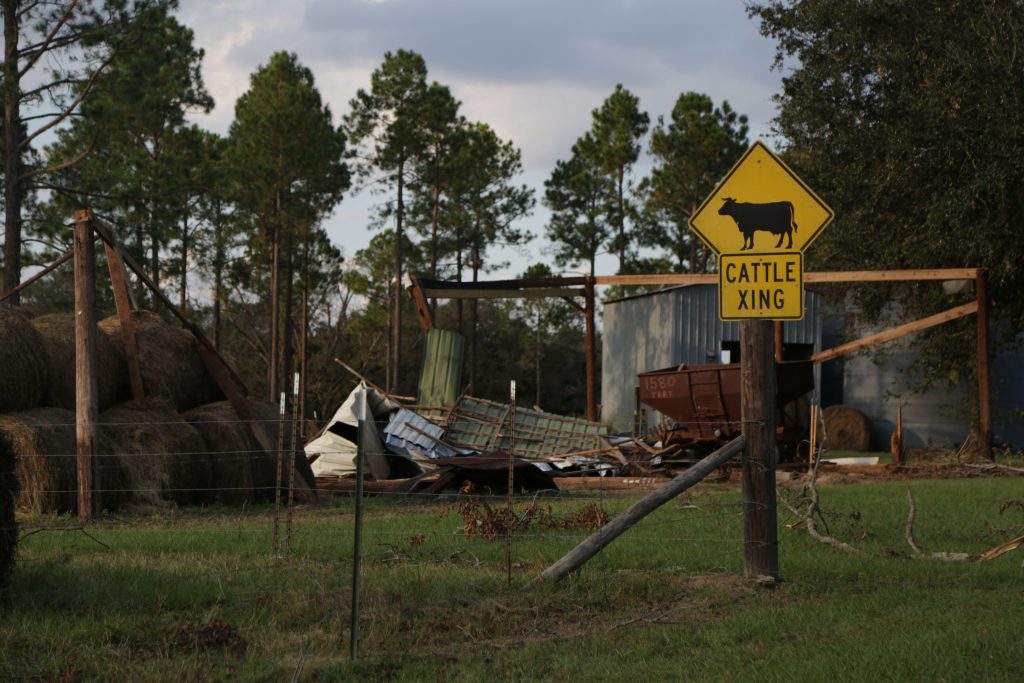
    Impact from Hurricane Michael.

    By Clint Thompson

    The Farm Recovery Block Grant deadline for Georgia farmers who were dealt financial losses by Hurricane Michael is Thursday, April 30.

    The Georgia Department of Agriculture is accepting online applications. The block grant funds include $347 million.

    This block grant program is designed to compensate producers for losses and expenses in seven categories of assistance, according to farm recovery. These include beef, dairy, fruit and vegetable, pecan, poultry, timber, and uninsured infrastructure.

    University of Georgia Cooperative Extension Ag economist Adam Rabinowitz believes all eligible farmers need to take advantage of the program.

    “Those block grants are really important for those who didn’t have any other assistance from USDA programs to recover from Hurricane Michael. It’s not your typical crop producers. It was some of your others in terms of trees and some infrastructure,” Rabinowitz said. “It certainly helps in a time when, just in general, we’re dealing with financial issues, continued recovery from Hurricane Michael and just real unknown. It’s essential to get those applications in by that extended deadline of April 30.”

    Georgia farmers and forest landowners in 95 eligible counties who suffered losses can enroll at farmrecovery.com.

    For more information and a guide to help prepare applicants for enrollment, visit farmrecovery.com.

    Hurricane Michael caused more than $2.5 billion in losses to Georgia’s agricultural sector, the state’s leading industry. This was according to estimates from the UGA Cooperative Extension agents and agricultural economists.

  • UGA Extension, Georgia Department of Agriculture seek to help farmers get produce to public

    University of Georgia/Georgia producers eager to sell fresh produce are being connected with buyers who need their products through UGA Extension partnership with Georgia Grown.

    By Maria M. Lameiras for CAES News

    Georgia farmers and agricultural producers eager to sell fresh produce and other products are being connected with consumers and other buyers who need their products through a new partnership between University of Georgia Cooperative Extension and the Georgia Department of Agriculture’s Georgia Grown program.

    Because of disruptions to the industry triggered by the COVID-19 crisis, many agricultural producers in Georgia — particularly smaller growers and producers — are experiencing difficulties getting their products out to those who can use them.

    Through its Georgia Grown Ag-products Industry Promotion and E-commerce Promotion programs, Georgia Grown — a state membership program designed to help agribusinesses thrive by bringing producers, processors, suppliers, distributors, retailers, agritourism and consumers together — will waive all membership fees for the service until July to help producers affected by the crisis.

    “The first step is facilitating connections between consumers and growers. There are many people who are looking for fresh produce and cannot find it, and we have producers who have produce and cannot sell it,” said Laura Perry Johnson, associate dean for Extension at UGA’s College of Agricultural and Environmental Sciences.

    Types of Products

    Types of agricultural products that qualify for the program include everything from vegetables, fruits and other produce. Also included are seafood, meats, dairy, poultry products and any other agriculture-related products, such as honey and prepared foods.

    “We are getting a lot of interest from many types of buyers, including consumer, wholesale, food banks and some restaurants,” said Matthew Kulinski, deputy marketing director for Georgia Grown. “This is a good way for producers who normally sell to restaurants to have a new outlet for their produce.”

    Georgia farmers who are keeping regular hours, providing curbside pickup, home delivery or e-commerce sales during the COVID-19 crisis can join the programs. They can visit the Georgia Grown Ag-Products Industry Promotion or Georgia Grown E-Commerce Promotion pages and fill out forms that will add their information to a statewide database of producers. It will be shared with consumers and buyers.  

    UGA Extension will support the program through its network of county agents and specialists throughout the state.

    “This is a grassroots effort that starts with all of our Extension agents, specialists and coordinators who have the relationships with these growers, producers and farmers,” said Johnson. “We are working on several different ways to get this information out to producers and consumers, including our Extension website emergency resources page and through traditional and social media. Together we can make this into something that will not only help agriculture in Georgia but the people who need access to fresh food as well.”

    Georgia Grown also provides a Pick your Own list of all producers who offer that option on their farms. This is for consumers who are interested in picking their own produce.

    View the list of farms and markets by county at extension.uga.edu/ag-products-connection

  • This Week in VSCNews

    Multimedia Journalist Clint Thompson recaps a few stories from this past week in VSCNews.

  • Georgia Farmer Thinking Inside the Box

    Workers at Lewis Taylor Farms pack boxes with fresh produce.

    By Clint Thompson

    One South Georgia farmer is thinking inside the box when it comes to moving this year’s fruit and vegetable crop.

    Like his brethren in Florida, Bill Brim’s farming operation has been impacted by the orders of self-quarantine amid the current coronavirus pandemic. The lack of a foodservice market led to a sharp decline in demand for fresh produce including those grown at Lewis Taylor Farms in Tifton, Georgia, where Brim is a co-owner.

    With excess fruit and vegetables, Brim decided to offer boxed fruit to consumers in the South Georgia area. Brim was overwhelmed by the response last week.

    “We just started last week. We did like 350, I think. Next week we’ve already got over 700,” Brim said. “It’s crazy. We could wind up with 1,000 before it’s over with. We’re looking forward to it because we need to move some produce. We’re so far down on greens and stuff like this. Our revenue stream has come to nothing because of the coronavirus.”

    What’s offered?

    Last week, Brim offered collard, kale, zucchini, onion, strawberries and broccoli. People drove to Lewis Taylor Farms on Wednesday and received their produce without getting out of their car.

    Fresh produce in a box ready to be sold in Tifton, Georgia.

    “They lined up out here. We had masks on and gloves on and toted it to the car. They dropped a $20 bill into a box and kept going,” Brim said. “It makes you feel good to know that people in this country are like that. But everybody wants fresh produce, too, and this is a good way for them to get it.

    “We’re just trying to generate some income because we’re so way down.”

    Brim said this marketing outlet is not set up for all farming operations. It is hard to capitalize on unless you are big enough and have got enough product and different kinds of products. This week’s box will feature turnips, broccoli, yellow squash, onion, blueberries and cabbage.

    Brim is not a blueberry farmer, but he is a staunch supporter of other growers like himself. He buys blueberries from another producer in Lakeland, Georgia.

    “We like to use all of our product, but you’ve got to change it up a little bit,” Brim said.

    Watermelon, cantaloupe, eggplant, cucumber and bell pepper could be included as well, once they’re ready for harvest..

    To place an order for this week’s box, fill out an order form. All orders must be placed by Sunday night.

    Lewis Taylor Farms grows more than 6,500 acres of produce each year.

  • Georgia Blueberry Growers Work to Overcome Challenges

    Pictured are highbush blueberries.

    By Ashley Robinson

    University of Georgia area Extension blueberry agent Renee Holland is confident about this year’s crop despite a challenging season.

    “This season, we have a beautiful blueberry crop load in Georgia,” Holland siad. “The berry quality is excellent, and thankfully, we’ve had very little disease or pest issues this year.”

    Challenges Facing Growers

    Georgia blueberry growers are no strangers to facing difficult challenges and growing seasons, and this year is no exception. In the midst of COVID-19 growers have had to face additional challenges on top of their typical weather and labor issues. However, Holland believes that growers have mobilized like never before, creating the safest environments possible.

    “The virus has definitely affected the amount of labor coming into the country, but that’s nothing new to us. We’re used to having labor shortages,” Holland says.

    Growers have implemented additional hand-washing stations and have reduced their workforce to do more with less.

    “They’ve really thought about how they’re going to partition the labor force and how to keep people separated and in small groups and to have people living together also be the same people who are working together in the field. They also have plans set in place if someone gets sick. I’ve seen the growers mobilize like never before, they’re checking their employee’s temperatures every day. It’s been amazing to see how quickly they’ve mobilized and put safety measures in place. They’ve really done their homework,” Holland says.

    Considering COVID-19, UGA Extension and blueberry growers encourage consumers to purchase fresh Georgia blueberries. Blueberries are a great source of vitamin C, iron and fiber. In addition, they’re cholesterol-free, sodium-free and possess an important source of potassium. In light of COVID-19, many consumers are looking to become more health conscious and consume fresh produce, which will benefit both consumers and producers.

    UGA Extension specialist Laurel Dunn has published materials for consumers on food safety and sanitation amid COVID-19. According to Dunn, there is no evidence to suggest that COVID-19 is transferred by food. However, consumers should continue to wash and sanitize their fresh produce as normal. Click here for additional information about food safety and COVID-19.

    “It’s good to eat fresh produce. We want consumers to know eating fresh produce will not put them at risk.” Holland says.

  • UGA Researcher: Vegetable Morphology Key in Helping Plant Breeders

    University of Georgia/UGA researcher Esther van der Knaap working in the greenhouse.

    By Clint Thompson

    University of Georgia plant biologist Esther van der Knaap has studied genes in vegetables for more than 20 years. She believes the more information that scientists can obtain about a vegetable’s morphology; referring to its size and shape; the better equipped plant breeders will be in creating new and better cultivars.

    The lack of knowledge on morphological traits often hampers the efforts by plant breeders to create improved types. More information would greatly assist in the development of new cultivars in a variety of crops. That’s where van der Knaap’s work factors in.

    “For breeders, when they develop a new variety, they need to maintain the proper shape and size of the produce, in addition to any novel trait that makes the new variety superior over an older variety. You can create new tomato varieties that are resistant to any disease that we’re facing right now. But if the new variety doesn’t produce a fruit with the proper dimensions, nobody will likely pick it up,” van der Knaap said. “Consumers wouldn’t recognize it and processors can’t process produce that is too large or too small or with unusual shapes. The morphology of produce is incredibly important.”

    University of Georgia

    Gene Knowledge

    The knowledge of the genes has advanced the efficacy in tomato breeding programs because it enables the creation of improved cultivars that feature the appropriate dimensions of the produce. She discovered the different genes that aide in the development of tomato fruit shapes also influence other vegetables. These include potato tuber shapes, as well as the shapes of melons, cucumbers, leaves and grains.

    Size and shape are important components because they are what consumers identify with when purchasing certain vegetables in grocery stores or at the farmer’s markets.

    “In tomatoes, the smaller shapes like grape tomatoes or the cherry tomatoes are used more for salads. If you want to make sauces and soups, you purchase the roma tomatoes. Everybody uses tomato slices on hamburgers, and for those you take the large beefsteak tomatoes. They are nice for slicing. Consumers recognize produce and each type has a specific culinary purpose,” van der Knaap said.

    She communicates her research findings in publications so that breeders can use the knowledge to develop better cultivars.

    “You always have to create better cultivars when it comes to yield and drought or disease resistance. There are always new diseases emerging in plants and we have to stay ahead of them,” van der Knaap said. “Fortunately, in most cases, there’s always a better crop variety around the corner. We need to stay ahead of diseases as diseases emerge very rapidly, as we know now with COVID-19.  Plants are no different from people when it comes to being susceptible to diseases that can be devastating.”