Like other commodities, the potato industry has been hurt by COVID-19.
The National Potato Council and state grower organizations wrote Ag Secretary Sonny Perdue recently to talk about potatoes that have nowhere to go for processing.
The Hagstrom Report says the council noted more than “1.5 billion pounds of fresh potatoes for processing and potato products are trapped in the supply chain with no likely customers.” Mountains of potatoes were being given away or left to cow feed as surplus crops are piling up despite government efforts to distribute the potatoes as part of food boxes being given to needy families.
The potato industry feels like the USDA’s new Farmers to Families Food Box program, as well as other initiatives, aren’t enough to dent the losses in a sector that depends heavily on foodservice sales.
Kam Quarles (Quarrels), CEO of the National Potato Council, says, “It was clear the people who were doing well in retail could probably take more advantage of this than the impaired side of the business, which is food service.” The NPC sent a letter to USDA saying, “This oversupply has impacted both the 2019 and 2020 crop for U.S. family farms that grow potatoes. Some of these farms will have no ability to sell their 2019 or 2020 crop.”
The industry suggested several enhancements regarding eligibility and payment rate adjustments that will help USDA help the industry.
(From the National Association of Farm Broadcasters)
Blueberry industry leaders were disappointed its farmers were not included in category 1 of the Coronavirus Food Assistance Program. They hope to rectify the situation during the 30-day comment period that the USDA has allowed for feedback.
“Where we landed with the direct payment program, obviously we learned (two weeks ago), it was disappointing because the one category that would really capture the impact on the U.S. grower was category 1,” said Alicia Adler, vice president of the U.S. Highbush Blueberry Council (USHBC) and the North American Blueberry Council (NABC). “Obviously, categories 2 and 3, we were included with direct payment rates in those categories, but it was really category 1 that would capture the impact.”
According to specialty crops in CFAP, producers of specialty crops are eligible for CFAP payments in three categories:
Had crops that suffered a 5%-or-greater price decline between mid-January and mid-April as a result of the COVID-19 pandemic,
Had produce shipped but subsequently spoiled due to loss of marketing channel, and
Had shipments that did not leave the farm or mature crops that remained unharvested.
Comment Period
When the USDA issued CFAP on May 21, it allowed for a comment period. This could lead to amendments being made to the guidelines set forth for blueberry producers. That is what industry leaders are hoping for.
“We submitted comments that still show decline in 2020 was steeper than in 2019 but also capture that daily price data which shows a 60% price decline between mid-March and mid-April. That was directly a result of the COVID crisis and literally the market closure,” Adler said. “We know that they are reviewing comments as they come, and we are anxious to learn if we’ll be included in category one and what the next steps are for that category.”
Adler said the earliest blueberry production is from mid-March to mid-April which showed decline due to the coronavirus pandemic. Florida represents more than 85% of production during that timeframe.
USDA is accepting applications through August 28, 2020. Learn more at farmers.gov/cfap.
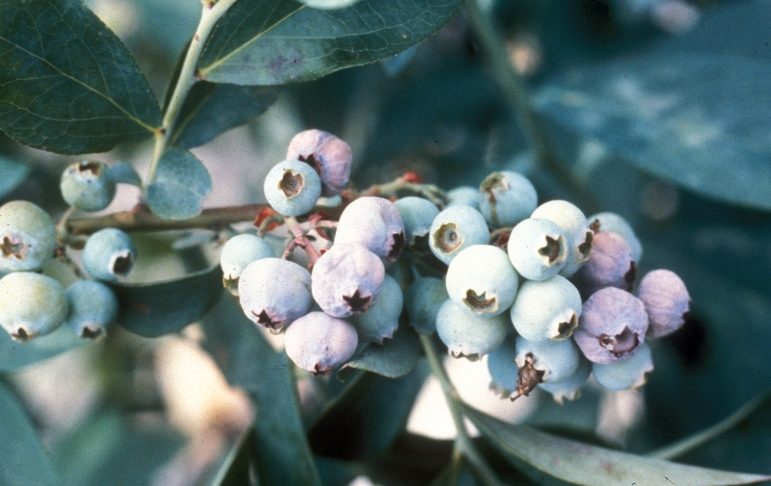
Mummy berry disease is caused by the fungus Monilinia vacciniicorymbosi and is an important fungal disease of blueberries.
Posted by Elina Coneva and Ed Sikora (Alabama Extension)
Current wet and cooler than normal conditions are conducive for mummy berry disease in blueberry, according to Alabama Extension. Mummy berry disease is caused by the fungus Monilinia vacciniicorymbosi and is an important fungal disease of blueberries that can cause yield losses of up to 50% when conditions are favorable for disease development.
The pathogen can infect shoots, flowers and fruit. The fungus overwinters in the previous year’s berries that have fallen to the ground. In early spring, a mushroom-like spore cup emerges from the infected berries near the soil surface. Fungal spores are released from these structures when bud swell begins and green tissue is present. Spores are spread via wind and rain. Early detection and control is necessary to reduce the impact of this disease on a crop.
Symptoms and Disease Development
Early season infection of flower buds and stems is promoted by wet conditions and cooler than normal temperatures. The earliest symptoms of mummy berry include drooping of developing leaves and shoots in the spring followed shortly by browning of the upper side of bent shoots, midribs and lateral veins of leaves. The bend in twig tips can resemble a shepherd’s crook. Vegetative shoots, leaves, and infected flowers are killed within four days after discoloration begins.
After initial infection, the pathogen produces conidial spores that appear as tan-gray tufts on blighted shoots. Conidia are then dispersed by wind, rain and insect pollinators to healthy flowers. Once the fungus has been introduced to the flower, it will germinate with the pollen and infect the developing fruit. Evidence of blossom infection does not appear until the fruit begins to ripen. As normal berries ripen, the infected berries begin to shrivel and turn a pinkish color. Shriveled berries drop to the ground.
Control Strategies
An integrated pest management program including both cultural and chemical control strategies is needed for best results. For new orchards, select resistant varieties or late blooming cultivars, if available. Also avoid wet sites and/or improve drainage to reduce conditions that favor mummy berry development. Remove wild blueberries or unwanted plants from the vicinity of the orchard to reduce overwintering inoculum.
If mummy berry is detected in an orchard, try to remove or destroy infected fruit at the end of the harvest season. This could include covering mummies with at least 2 inches of soil or mulch. Limit or delay overhead irrigation until petal fall during the growing season. Follow a fungicide spray program that is effective for controlling mummy berry from green tip until petal fall.
Photo by UGA CAES/Shows watermelons piled the side of a row at the UGA Tifton Campus in 2016.
By Clint Thompson
Georgia’s watermelon harvest will ramp up next week.
According to Samantha Kilgore, executive director of the Georgia Watermelon Association, acreage is projected to decrease this year to 19,000 acres. It would mark a significant drop from previous years’ harvests. According to the National Agricultural Statistics Service, from 2016-2018, Georgia averaged a harvest of just more than 23,000 acres.
“In 2019, we probably had upwards of 21,000 or 22,000 acres. If anything, it’s kind of evidence of the market leveling out a little bit from having a higher amount of watermelons harvested last year and then people pulling back to adjust to demand,” Kilgore said.
No Watermelon Shortage
There was concerns that there could be a watermelon shortage by Memorial Day. With South Florida’s crop ending a little early due to torrential rains, farmer Carr Hussey, chairman of the board of the Florida Watermelon Association, feared there might be a shortage. However, Kilgore reassures watermelon lovers that there is plenty of locally grown crop in stores.
“I picked up a Georgia grown watermelon at Kroger on Tuesday. We’re not hearing anything about a shortage,” Kilgore said. “The bulk of Georgia product will be ready the first week of June. There could be a little bit of a lag. But I don’t see that stores will be empty by any means.”
Kilgore is confident in how the Georgia crop has progressed this year. Good weather during the growing season has been a huge plus.
“Everything’s been really good. The past few years we’ve had some weather events that have made the harvest season difficult. We haven’t had that this year,” Kilgore said. “I was talking to one of our marketers last week and they expect watermelons shipping this week to get in stores next week.
“The quality of these Georgia watermelons is good. Because like I said the weather’s been pretty mild and not too wet. They’re not battling any major disease issues that could be caused by flooding or bad weather.”
UGA photo/UGA Extension staff joined Georgia Grown staff to load boxes of produce into hundreds of waiting cars at the Gwinnett Georgia Grown to Go event on May 27.
By Maria M. Lameiras for UGA CAES News
Like the moments before a race begins, dozens of staff with Georgia Grown and University of Georgia Cooperative Extension prepared to load thousands of pounds of fresh fruit and vegetables into hundreds of waiting cars and trucks stretched out in long lines at the Gwinnett Georgia Grown To Go event in Lawrenceville, Georgia, on May 27, even before the 3 p.m. start time.
Held at Coolray Field, the event was the third in a series of events being held around metro Atlanta to give consumers a chance to purchase produce straight from the farm — and to give farmers the opportunity to sell crops that have seen the marketplace narrow due to the COVID-19 crisis.
“There is food that is growing in Georgia that is just going to rot in the fields if the farmers can’t find buyers, and we have hunger on the other end,” said Mary Black, county coordinator and Family and Consumer Sciences agent with the Gwinnett County UGA Extension office. “We hope this will help connect the farmers with the people who need the food.”
In addition to helping coordinate the event with county officials, Gwinnett County Extension provided each customer with information packets that included recipes, nutrition information, and tips on food preservation and food safety, as well as links to UGA Extension resources available at extension.uga.edu/topic-areas/food-health.
The event’s online presale orders totaled $82,733 for mixed vegetable boxes, flats of blueberries, cases of peaches, bags of Vidalia onions, as well as artisan cheeses and gourmet cooking sauces; all from Georgia producers, said Paul Thompson, deputy director of marketing and promotion with Georgia Grown. It’s a division of the Georgia Department of Agriculture focused on promoting agribusinesses. Day-of sales generated another $21,146.
Tina Fleming, director of community services with Gwinnett County, said that the event served as an opportunity to bring fresh produce to the county’s residents and to assist disadvantaged members of the community. Those who ordered online ahead of the event were given the option to pay to donate a box of produce to local service organizations, resulting in the donation of 118 boxes of produce. After the event, farmers donated another 1,004 boxes of vegetables, 218 flats of blueberries, 10 boxes of peaches and 120 pounds of onions for food-insecure Gwinnett citizens.
“This has been a multi-agency event and a great partnership for us,” said Fleming. “There was a lot of talk about the event on social media and it has been a benefit for our county residents, as well as generating donations for 11 community nonprofit agencies that serve the county.”
Coolray Field, where the event was held, is a Gwinnett County-owned venue that is the home of the minor league Georgia Stripers baseball team. The setting offered an ideal location, with nearby access to I-85 and the space to accommodate the trucks needed to deliver the produce as well as customer traffic.
“We hope to be able to do this again this year,” Fleming said.
Corbett Brothers Farms from Lake Park, Georgia, and Southern Valley Fruit and Vegetable from Norman Park, Georgia, worked together to bring 2,750 boxes of mixed vegetables to Gwinnett for the event.
Ken Corbett, founder of Corbett Brothers Farms, said the Georgia Grown to Go events have helped fill a void left when revenues from food service and restaurant customers dropped due to COVID-19 restrictions.
“I have been pleasantly surprised in the amount of interest we’ve seen and, just as important, is educating consumers on what Georgia farmers grow,” said Corbett, whose family farm started in 1987 with 1 acre of bell peppers and now primarily grows bell peppers, cucumbers, zucchini and yellow squash, along with about a half dozen smaller scale crops, on 3,000 acres. “As farmers, we help each other out all the time, and it has been good to have Georgia Grown on our side in this.”
Customers were encouraged to post about their experience on social media using #GeorgiaGrownToGo.
“Great event in Gwinnett yesterday! Well run and very organized, even with long lines and rain. My fridge is stocked with wonderful fresh veggies and fruits! So happy to support our Georgia farmers,” wrote Gwinnett County consumer Debbie Holmes Martin on Facebook.
Information on upcoming Georgia Grown to Go events is available at georgiagrowntogo.com and additional resources for producers and consumers are available at extension.uga.edu.
University of Georgia Cooperative Extension Ag economist Adam Rabinowitz encourages farmers to submit applications for the Coronavirus Food Assistance Program (CFAP) sooner rather than later.
Adam Rabinowitz
The application process for CFAP started this week. The program provides relief to American farmers and ranchers impacted by the coronavirus pandemic.
When details of CFAP were announced, the first guideline for eligibility requirements was a payment limitation of $250,000 per person or entity for all commodities combined. With so many producers projected to participate in the program that will provide up to $16 billion in direct payments, there is a chance of not having enough funds available.
“The USDA has estimated that there may be insufficient funds. As a result, they’re making payments in two phases. The initial payment is 80% of what the producer will be eligible for. Only if funds are available, (will) the remaining 20% will be paid,” Rabinowitz said. “There is that chance that additional funds will be allocated in the future. That certainly could help but it’s certainly not a guarantee.
“My recommendation is to get it in sooner than later. This way your paperwork is there.”
Specialty Crops Covered
For eligible specialty crops, the total payment will be based on the volume of production sold between January 15 and April 15, 2020; the volume of production shipped, but unpaid; and the number of acres for which harvested production did not leave the farm or mature product destroyed or not harvested during that same time period, and which have not and will not be sold. This has created some concern among farmers in Georgia and Alabama that their crops will not be covered based solely on the dates outlined in the program.
Specialty crops include, but are not limited to, almonds, beans, broccoli, sweet corn, lemons, iceberg lettuce, spinach, squash, strawberries and tomatoes. A full list of eligible crops can be found on farmers.gov/cfap. Additional crops may be deemed eligible at a later date.
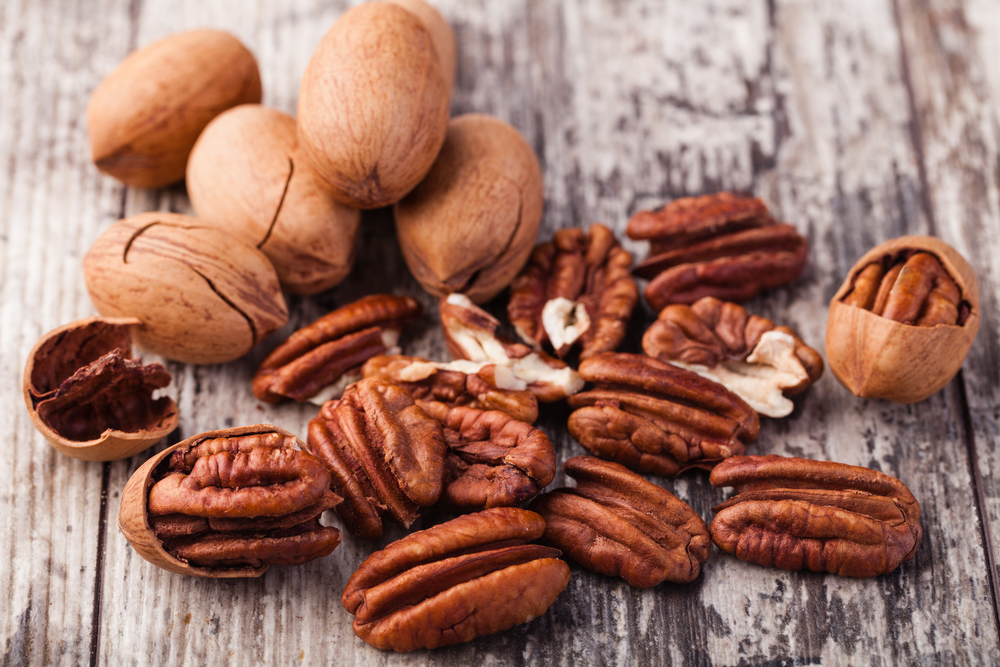
All Georgia pecan growers planning to vote on this month’s one-cent per pound assessment need to have their ballots postmarked by Saturday, May 30.
Georgia’s pecan farmers are voting this month to renew a one-cent per pound assessment on pecans for the Georgia Agriculture Commodity Commission for Pecans.
Ballots have been sent to Georgia growers who own at least 30 acres or more. The vote on the assessment is required under Georgia law. Producers are required to vote every three years to renew the assessment.
According to Andy Harrison, commodity commissions manager for the Georgia Department of Agriculture, of the returning votes, there needs to be a 2/3 voting affirmative for the assessment to pass. He estimates there have been about 700 or 800 ballots sent to pecan growers.
It’s one cent per pound on pecans marketed. That money can be used for research, education or promotion for Georgia pecans.
The back of the return envelope must be completed for the ballot to be valid. The commodity commission utilizes assessment funds for research, education, and promotion of Georgia pecans.
Harrison emphasized that the Georgia Department of Ag administers the funds. But it is the Georgia Pecan Commission who decides how the money is spent.
Growers of 30 or more acres who have not received a ballot should contact Andy Harrison, at andy.harrison@agr.georgia.gov.
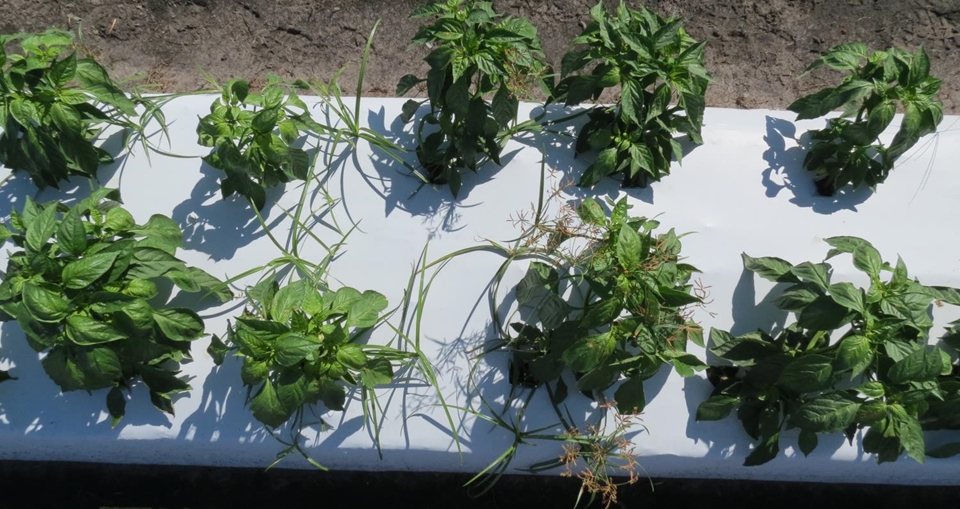
An overhead view of a plasticulture vegetable bed shows nutsedge weeds emerging through the plastic.
By Clint Thompson
University of Georgia Cooperative Extension weed specialist Stanley Culpepper encourages vegetable growers to diversify their management programs against nutsedge. This protects against potential resistance and provides adequate control.
“In general, I would say with our guys, I’m not overly concerned because our fields with our most nutsedge, they get fumigation, they get tillage and they get herbicides,” Culpepper said. “My guys are quite diverse. Will we have resistance one day? Sure, we will, but we are quite diversified in our management approach. We’re not selecting for resistance, say compared to an agronomic guy who goes out and sprays roundup or dicamba three times.”
According to Alabama Cooperative Extension, purple nutsedge and yellow nutsedge are prevalent in most areas where vegetables are grown. Both are perennial weeds that propagate mainly by the production of tubers. While growers maintain control of nutsedge, it comes at a cost, says Culpepper.
“That pest is still the most problematic. Doesn’t necessarily mean we’re not controlling it, but we’re spending a lot of money to control it that we wouldn’t have to spend if it wasn’t so problematic,” Culpepper said. “The one that’s causing us the most money without a doubt in the plasticulture system is nutsedge.”
Why Is It So Problematic?
Farmers who implement plasticulture still struggle with nutsedge because it can penetrate mulch.
“Even if you haven’t poked a hole in the mulch, nutsedge can penetrate it itself. It can damage the mulch and be there before you plant. It can come at any time even if your plant is shading out the plant hole. It’s very unique that way,” Culpepper said. “Is it killing us? Is it hurting our guys? No, I think we’re doing a pretty daggum good job. It’s a repetitive challenge and costing us a lot of money to try to manage.”
Diversification is key since there are very few herbicides that are effective regardless of the vegetable crop being grown. It is not like peanuts where farmers can apply Cadre or cotton where Roundup can be applied. Nutsedge control in vegetables is limited to a couple of products.
“It’s there and probably in every single field but they’re doing a really good job controlling it. It’s not like some disease that jumped on us last week and is going to wipe us out. That’s not it at all,” Culpepper said. “But that’s the one I still say is most challenging for our vegetable growers in plasticulture systems.”
May 27, 2020 — LAGRANGE, GA – Sweet, refreshing Georgia watermelon is coming to a store near you in early June. The 2020 watermelon crop is expected to have the crisp, sweet flavor and high quality unique to Georgia watermelon.
Georgia watermelons will soon be ready for purchase.
While Georgia has had a cool spring, consumers should still start seeing Georgia Grown watermelons in stores the first week of June. The Georgia season typically peaks around June 20.
“We expect excellent quality and even more, we are eager to have a successful growing season,” said Rob Greene, Georgia Watermelon Association (GWA) President and owner of Lime Creek Farms in Arabi, Georgia.
Planting for Georgia’s watermelon crop began in March. From planting to harvest, watermelons typically need 90 days to grow, ripen, and be ready for harvest. With more than 18,000 acres of watermelon harvested on average each year, the state of Georgia ranks in the top 4 in the United States for production among Texas, Florida, and California.
Georgia watermelon is expected to hit stores by June 3. Consumers can pick up watermelon in local stores and markets throughout the southeast. The 2020 GWA Queen Ambassador, Lindsey Westberry, would normally be in stores this summer, but due to COVID-19 restrictions, she is helping consumers through serving in other ways in her local community.
Georgia Watermelon Association Queen Ambassador Lindsey Westberry helped members of the National Guard at Second Harvest of South Georgia to pack food boxes in Valdosta, Georgia.
Just before Memorial Day, Westberry joined with members of the National Guard at Second Harvest of South Georgia (SHSG) to pack food boxes for the local community in Valdosta, Georgia. SHSG provides more than 3 million meals to those with food insecurity.
“Having the opportunity to give back to my community alongside many of our service men and women was truly a blessing,” she said. “I believe in living a life of use to others and I look forward to continuing to bring smiles to people’s faces through watermelon.”
On social media, Westberry will be putting together many recipes, safety and how-to tutorials so consumers can enjoy their local watermelon.
“It’s more important now than ever to support your local economy – and we do that from purchasing in season produce like watermelon when it comes in stores,” said Samantha Kilgore, GWA Executive Director. “Let watermelon help cool you off this summer and rest assured that your local growers do everything they can to provide a safe, sweet, and satisfying product!”
The Georgia Grown To-Go program generated excitement last weekend for consumers in Marietta and provided a boost in sales for some of the state’s farmers, including Bill Brim.
Pictured by Clint Thompson/Boxes are prepared at Lewis Taylor Farms in Tifton, Georgia to be sold directly to consumers. Similar boxes were sold last Saturday at the Georgia Grown To-Go event in Marietta, Georgia.
As part of the Georgia Department of Agriculture’s (GDA) “Buy Georgia Grown, Now More Than Ever” campaign, Georgia Grown partners with local governments to connect produce farmers directly to consumers in highly populated areas throughout the state. Last Saturday, Lewis Taylor Farms, along with about other semi-loads that included chicken, beef, blueberries, sweet corn, and dairy, were represented in Marietta, Georgia.
Brim, who co-owns Lewis Taylor Farms in Tifton, Georgia, complimented Georgia Ag Commissioner Gary Black in his efforts of connecting Georgia producers with a consumer base yearning to purchase Georgia Grown products.
“I think he was trying to help us as farmers and move some of our product and let people know that with the coronavirus, we’re still in business. We’re still trying to do everything we need to do for Georgia Grown and American Grown,” said Brim. “Of course, Georgia Grown is important to us but we want people to buy American Grown if they’re not from Georgia. Commissioner’s really pushed that really hard.”
Quite the Response
Brim said they prepared 1,540 produce boxes that included beans, blueberries, onions, cabbage and zucchinis. Boxes costs $36 presale and $40 on site. Brim estimated there was about 70% pre-ordered. Brim said there were between 7,000 and 10,000 cars in line to purchase products.
“They’re looking for (Georgia Grown), I think. Gary has done a good job of pushing the media to let them know. Jessica (Kirk) got interviewed and she talked about Georgia Grown and American Grown,” said Brim about his daughter, who helped represent Lewis Taylor Farms last Saturday. “It’s been pushed out there in the media pretty hard.”
What is Georgia Grown To-Go?
Georgia Grown To-Go is a series of pop-up markets, primarily in metro Atlanta, that provides customers an opportunity to purchase fresh produce directly from farmers with limited contact, drive-through service.
In a press release, Black said, “We are excited to offer this great opportunity to help bridge the gap between consumers in metro areas and our farmers in South Georgia. With foodservice channels limited, Georgia Grown To-Go pop-up markets are a great and innovative way to make sure our consumers have access to the Georgia Grown products they crave. We have enjoyed joining forces with our local government and non-profit partners in an effort to best serve our communities during this unprecedented time.”
Lewis Taylor Farms Background
Brim established himself as an industry leader when he, along with Ed Walker, purchased Lewis Taylor Farms in 1985. Over the next five years, Brim helped transform Lewis Taylor Farms into a diversified transplant and vegetable production farm operation.
When Brim became a co-owner of Lewis Taylor Farms, it had only 87,000 square feet of greenhouse production space. The farm now boasts 81 greenhouses with more than 649,000 square feet of production space.