U.S. Secretary of Agriculture Sonny Perdue speaks at the Citrus Expo in 2017. He spoke with Clint Thompson with AgNet Media about CFAP.
By Clint Thompson
Coronavirus Food Assistance Program (CFAP) payments are already starting to be issued across the country to farmers impacted by COVID-19.
Some specialty crop growers in the Southeast have already started receiving funds.
As of June 8, in Florida, 95 specialty crop applications have been submitted with $11.5 million in payments issued by the USDA. In Georgia, 91 specialty crop applications have been submitted with $340,938.92 in payments. In Alabama, six specialty crop applications have been submitted with $40,102.30 in payments.
In North Carolina, 13 specialty crop applications have been submitted with $33,898.82 in payments. In South Carolina, nine specialty crop applications have been submitted with $27,780.48 in payments.
Photo by Phil Brannen-UGA/Shows powdery mildew disease.
According to UGA Extension Viticulture blog, University of Georgia Cooperative Extension Fruit Disease Specialist Phil Brannen says powdery mildew is just starting to show up on untreated plants in the research grape vineyard at Blairsville, Georgia.
“I hope you will not see it yet in well managed vineyards, but recent rains and other difficulties may have hampered spray programs,” Brannen said.
Spray programs need to be applied on a 7-to-10 day interval when rain events occur as often as they are. Growers also need to use the more efficacious materials at critical infection periods such as bloom and early cover sprays.
It’s important to scout your vineyards and make sure to contact your local county agent should you have questions concerning this disease or others. The 2020 Southeast Regional Bunch Grape Integrated Management Guide can be found at small fruits. It contains valuable information related to the timing and efficacy of fungicides for powdery mildew.
Farmers are currently submitting applications for the Coronavirus Food Assistance Program (CFAP). In some instances, checks have already been issued to producers impacted by COVID-19.
Sonny Perdue
U.S. Secretary of Agriculture Sonny Perdue talked about CFAP with Clint Thompson, multimedia journalist with AgNet Media. In particular, he discussed the cap placed on the payments issued to each eligible grower.
It’s a surreal moment in Georgia politics as two years of policy work hangs in the balance after lawmakers pressed the pause button on the 2020 legislative session due to the coronavirus pandemic. Before turning our full attention to working with state and federal leaders to navigate through the heath crisis, the Georgia Agribusiness Council (GAC) was actively engaged with legislators. Several bills of importance were still in play when things came to a halt.
Much of the early talk in the Capitol centered on Georgia’s budget as Gov. Brian Kemp called for across-the-board cuts to government agencies and programs. Debate was intense behind the scenes as everyone fought for their piece of the budget pie. Led by Chairman Terry England in the House and the late Senator Jack Hill in the Senate, Georgia agriculture fared relatively well. We were pleased to see many areas of importance, such as the department of ag and University of Georgia Extension specialists, saved from the deep cuts that first seemed imminent at the beginning of the session.
Many of the budget discussions are now irrelevant with lawmakers presented with a completely different scenario for budgeting for the 2021 fiscal year after a shutdown of the state and national economies.
RIGHT TO FARM ACT
Georgia Agribusiness Council’s Jake Tench and Will Bentley present Gov. Brian Kemp with a pair of Georgia-grown Wrangler jeans. Also pictured are Rep. Gerald Greene and House Ag Chairman Tom McCall.
After flying through the Georgia House of Representatives during the 2019 session, the Georgia Right to Farm Act (HB 545) remained tabled in the Senate as lawmakers continued to be badgered with misinformation from several environmental activist groups. The Right to Farm Act would provide added protections for Georgia’s farmers against frivolous “nuisance” lawsuits and would provide these protections evenly across all segments of agriculture, including fruits and vegetables.
This bill is vitally important to close loopholes in our current law and is supported by Gov. Kemp and leaders from both the House and Senate. If and when lawmakers resume the 2020 session, the final vote will be extremely close.
DISASTER PAYMENTS AND TAXES
HB 105 by Rep. Sam Watson, a South Georgia produce and cattle farmer, would exempt Hurricane Michael disaster payments from state income taxes. The bill passed through the House in 2019 and passed through the Senate shortly before crossover day. The main sections of the bill exempt payments from the U.S. Department of Agriculture (USDA) directly related to Hurricane Michael from state income taxes.
However, lawmakers in the Senate used the bill as a vehicle and attached additional language that deals with the taxation of ride share services in Georgia. While we often use Uber and other ride-sharing platforms to get around Atlanta during the legislative session, we focused our support on the portions of the bill that will have real impacts on agribusiness in Georgia. This bill moved far enough prior to the shutdown to make its way to the governor’s desk for final signature.
HEMP LEGISLATION
Georgia’s hemp program was a hot topic all year and lived up to the hype during the session. We worked to ensure loopholes in Georgia’s laws were removed and also worked to secure much needed funding for the program to be properly administered. This legislation primarily focuses on five key changes to last year’s legislation that was signed into law. These changes include:
Cleaning up the language within the bill to include and align with the rules and regulations that were released by USDA last year.
Allowing colleges and universities within the state to do on-farm research and to have a contractual agreement with third parties for this research.
Adding language to allow greenhouse growers to sell plants to other growers and to also allow for growers to sell to processors in other states that have a USDA-approved plan.
Increasing processor permit fees to $25,000 for the first calendar year and a $50,000 permit fee for renewal every year thereafter. This aims to make the regulatory program self-sustainable.
Codifing transportation requirements to call for documentation of the load.
The department of ag has already begun working with hemp growers and processors, and we are excited to see if this new crop option will provide a boost to agribusiness in the state like it has been touted to do.
TAX EXEMPTIONS FOR FOOD BANKS
A bill by Rep. Houston Gaines that now has added significance is HB 882, which would extend tax exemptions for food banks. This bill would eliminate the sunset period for the exemption from state and certain local sales taxes for the sale of food to qualified food banks. It would also expand the exemption for the use of food donated to qualified nonprofit agencies to include disaster relief. With food banks playing a large role in the coronavirus relief efforts, we hope that this bill will be considered in the Senate as soon as lawmakers return to conclude the session.
AG STRUCTURE EXEMPTIONS
HB 690, by Rep. James Burchett, passed the House with a vote of 169-1. This bill aims to exempt agribusinesses from having to pay full permit and inspection fees on agriculture buildings and structures. While the bill will still require these structures to get inspected and permitted, the fees for these services will be capped at $500.
The bill will only apply to those producers who qualify for a GATE (Georgia Agriculture Tax Exemption) card through the Georgia Department of Agriculture. The structures that qualify for this legislation must be used directly for the commercial production or processing of agriculture commodities and will also include farm labor camps and housing for migrant workers.
Dozens of other bills that have impacts on Georgia’s specialty crop industry have seen action throughout the session. We have no way of knowing when lawmakers will return to complete the 2020 legislative session, but GAC will be there when they do. We will continue to advocate relentlessly for the best interests and priorities of Georgia agriculture.
Will Bentley is president of the Georgia Agribusiness Council.
United States Secretary of Agriculture Sonny Perdue was in Lakeland, Fla. on Monday. He attended a farmers to families food box event. It’s a new program that the United States Department of Agriculture launched to purchase $3 billion in excess food from farmers and distribute to families in need.
He talked about the program with Clint Thompson, multimedia journalist with AgNet Media.
Secretary Perdue talks about the Farmers to Families Food Box Program.
Photo by University of Georgia/Shows Japanese beetle.
According to the UGA Extension Viticulture Blog, Japanese beetles are starting to become more widespread in west Georgia vineyards. University of Georgia entomologist Brett Blaauw says the pests are only beginning to emerge but expects the populations to increase exponentially over the next few weeks.
“In large enough numbers, Japanese beetles can be a severe pest of grapes during the summer, feeding mainly on foliage and (thankfully) rarely on the berries,” Blaauw said. “More problematic is Japanese beetles feeding on new plantings. Older, established vines can withstand some feeding damage, but young vines can quickly become defoliated from these beetles. Special attention should be given to newly-planted vineyards.”
As temperatures continue to heat up as we progress throughout the summer, this is ideal weather conditions for beetles to be active. They love warm, sunny days and congregate in groups on vines to feed and mate near the top of the canopy.
There are no thresholds for Japanese beetle leaf damage. However, management is required when feeding damage is below the top trellis wire or about 15% of the leaves are damaged.
“Growers should rely on their judgment and experience to determine whether beetle abundance and/or injury warrants chemical control,” Blaauw said.
Photo by UGA/The pepper weevil is one of the most serious pests of peppers.
By Clint Thompson
Pepper weevils are once again a problem for pepper growers in the Southeast. Weevils are a problem wherever present, whether it is in high populations or low populations.
“Anytime you have pepper weevil it’s a problem and in very low populations because of the contamination. High populations can cause fruit abscission. It can hurt your yields considerably. But even low populations just because the potential contamination causes marketability problems,” University of Georgia Cooperative Extension vegetable entomologist Stormy Sparks said. “We’ve had some fields where we’ve had enough to collect populations which is pretty bad.”
Prevention Is Key
Sparks said there are a limited number of pesticides available that are relatively effective.
“Pepper weevil is difficult to control just because it’s a weevil, its biology. The only stage you can control is the adults. Once it lays an egg, you don’t get a shot at that particular insect until it’s an adult again,” Sparks said. “The egg is inside the fruit. The larvae is inside the fruit. It pupae inside the fruit. It emerges inside the fruit. Then when it comes out looking for a mate, you’ve got to try to kill it before it mates and starts laying eggs,” Sparks said. “With pepper weevil, it’s basically preventative. You try to prevent establishment in a field. Once they become established in a field, it’s almost impossible to spray your way out of it.”
According to a prior story on pepper weevils, they were out of control in Florida vegetable fields along the East Coast.
“Pepper weevil, which five years ago was not a consistent problem, but it’s been a consistent problem the last three years. We’re overwintering them,” Sparks said. “Pepper growers are fighting pepper weevils on a consistent basis.”
Unless changes are made by the Georgia Legislature to the Department of Agriculture’s proposed budget cuts, five state farmers market locations could soon become business casualties.
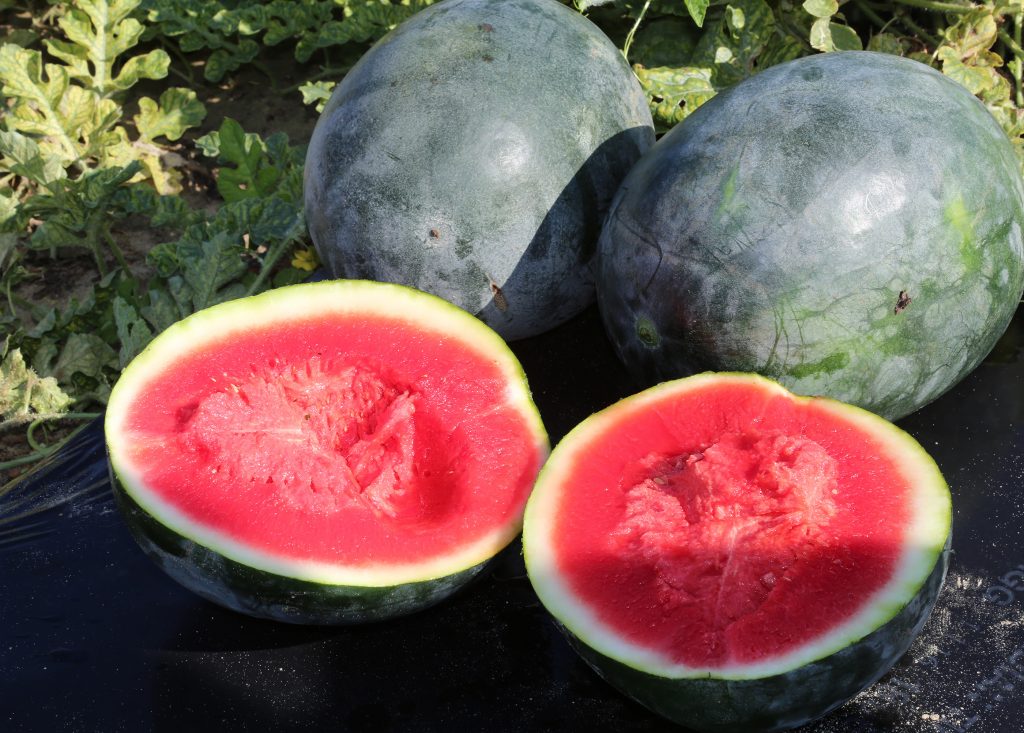
Watermelons on display at a farm on the UGA Tifton campus. Watermelons are a main commodity sold at the Cordele Farmers Market.
Locations in Augusta, Cordele, Macon, Savannah and Thomasville are on the list to be cut. Julie McPeake, Georgia Department of Agriculture Chief Communication Officer, said the proposal has been sent to the Legislature. It’s up to its members to either accept or make any necessary adjustments.
Budget cuts are unfortunately a necessary evil that must be done during this recession which is a result of the coronavirus pandemic.
“With the 14% budget cuts that were requested, you’ve got to make some decisions. Unfortunately, some of those tough decisions require looking at hard numbers. When you have some markets that are having trouble to turn a profit, that’s one of the first places you’ve got to turn to, to save that money,” said Paul Thompson, marketing director for the Georgia Department of Ag.
11% Budget Cuts Instead
Multiple media outlets reported this week, though, that Kemp informed government agencies that they only had to cut the fiscal year 2021 budget by 11%.
“That would be good if that does indeed come to pass. That’ll be wonderful,” Thompson said. “There’s a lot to be determined yet and worked through, but certainly anything would help. It absolutely could have some effect.”
The different farmers market locations vary in what commodities are mainly sold there. In Cordele, the “Watermelon Capital of the World,” it is known for watermelons and cantaloupes being bought and sold this time of year through the early part of July.
“The Cordele Market is most definitely in its season as we speak. It’s a very busy market for the melon season, and we are in that now. Thankfully, we’ve got time to work through this. I don’t see any impact as far as the market for this melon season,” Thompson said. “We will be able to get through this season. Again working with those folks, hopefully, there’s a way everybody can come to the table and some interested parties can get together and we can make it work out in the end.”
July 1 begins the next fiscal year. Thompson said they should know something in the next few weeks as to the future of each of the markets.
Hemp producers in the Southeast need to be mindful of fire ants. They will damage the stems of hemp plants if not treated, said Katelyn Kesheimer, Auburn University Assistant Professor and Extension Specialist.
“My phone has been ringing off the hook with fire ant problems the last seven days, really. A couple of weeks ago, we had all of those storms that came through; a lot of rain and temperatures are increasing. We started seeing fire ant swarms about two weeks ago. All of those swarms led to newly mated females that became queens that started mounds and now are chewing on the stems of hemp,” Kesheimer said. “It’s very quick because these seedlings are no more than 20 centimeters tall in some instances. They’re just a couple of inches, not that big. The fire ants make a mound at the base of the plant and start stripping the bark and tunneling through the stem.
“I don’t even know if I was onboard with hemp this time last year, but this just seems kind of early for fire ant problems in hemp. I was caught off guard with how many issues we were having.”
Growers have already started planting this year’s crop. Fortunately, there are management practices growers can implement to control fire ant issues. But they need to do them.
“I’ve been recommending people get out there and bait because that’s going to take at least a couple of weeks but also do individual mound treatments. We have some products approved for hemp by the Department of Ag. I think a lot of growers did not heed my warning to put out bait in the fall,” Kesheimer said.
The United States-Mexico-Canada Agreement (USMCA) will enter into force July 1. Unfortunately, it’s still without much protection for vegetable and specialty crop producers, according to economists and industry leaders.
Joyner
Florida Fruit and Vegetable Association President Mike Joyner hopes that will change soon.
“When Congress passed USMCA, we unfortunately did not get the provisions we were hoping for in USMCA. The Florida delegation, to the person, hung together. Because they hung together, we were able to get a commitment from Ambassador (Robert) Lighthizer to come up with a plan as to how we’re going to address this issue,” Joyner said. “We felt like that was a strong commitment. It’s in writing. We trust Ambassador Lighthizer. Right now, all indications are USMCA will go into effect July 1.
“If you go back and look at the letter, the commitment that the delegation was able to get, that within 60 days of entry into force, Ambassador Lighthizer has to have a plan. Probably within the next few weeks, we’ll present some information to the U.S. trade Representatives Office that they need to consider. It’s data that clearly shows what’s happening with Mexican produce. We’re hoping that over the next two or three months, we can work with Ambassador Lighthizer and his team and come up with something that will help solve this issue.”
USMCA Background
According to the USMCA press release, the agreement marks the beginning of a historic new chapter for North American trade by supporting more balanced, reciprocal trade, leading to freer markets, fairer trade, and robust economic growth in North America. However, Southeast farmers still will compete against imports of Mexican produce.
“The concern with the USMCA, in terms of specialty crops, is that there are a lot of lower priced crops, low cost labor in Mexico that are coming into the U.S. and competing with southeast fruits and vegetables,” UGA Cooperative Extension Ag Economist Adam Rabinowitz said. “There was hope that there would be some restrictions or some assistance that would help with the ability to compete with those Mexican imports. But there was nothing within that. As a result, it’s looking like there’s going to be a challenge in terms of being able to compete on price with the southeast fruits and vegetables with the imports from Mexico.”
The influx of Mexican produce was especially discouraging this year for farmers. They had to deal with the aftermath of the coronavirus pandemic at a peak time of spring harvest.
In a prior VSCNews story, Charles Hall, executive director of the Georgia Fruit and Vegetable Association, said “it’s insulting to the specialty crop growers who are suffering with COVID-19. It’s taken away markets. Then on top of that, we’ve got Mexican products coming in on top of us to drive the prices even further down.”