Georgia is no longer second fiddle when it comes to pecan production. According to the USDA Fruit and Tree Nuts Outlook, Georgia is once again the largest pecan producer after being bested by New Mexico the previous two years. Production rose 95% to 142 million pounds last year. It is showing signs of recovery from Hurricane Michael in 2018.
Statewide bearing acreage remained steady at 129,000 acres, with yield per acre is estimated at 1,100 pounds per acre, an increase 534 pounds from the 2019-20 season.
U.S. pecan production was at 302 million pounds utilized in-shell. It’s an 18% increase and 4% higher than the October 2020 forecast of 292 million pounds.
While production exploded last season, prices imploded. The USDA reports that the average grower price for pecans dropped from $1.84 per pound in 2019 to $1.32 per pound in 2020. This is likely attributed to an increase in supply and high beginning stocks.
As a result, the value of production dropped from $471 million to $398.8 million.
China remains one of the top markets for U.S. pecans with more than 70% share of in-shell exports, from October 2020 to January 2021.
Georgia’s hemp production is expected to decrease in 2021. Tim Coolong, associate professor in the UGA College of Agricultural and Environmental Sciences, believes there are various factors that will contribute to hemp acreage being down compared to last season.
“I think a lot of growers are going more towards, kind of, I’ll say smokable flower. It’s more of a boutique product,” Coolong said. “The flower bud that you’re selling has to have a great appearance; has to have a good smell. In order to do those kinds of products, it’s very hard to do large acreage. It’s very labor intensive. You’re going to be more apt to see people just doing a few acres of that type of market.”
Oversupply Problem
Then there’s overproduction and the impact last year’s oversupply had on market prices.
“You can actually produce quite a bit of CBD from one acre of hemp. When you have hundreds or thousands of hemp planted, that actually equates to a lot of CBD isolates. I think like many things, farmers overproduced,” Coolong said. “We’re very good at growing stuff. We’re excellent at growing a lot of high-yielding crops. I do think we overproduced so people want to cut back to let the market catch up.
“Just like a lot of other veggie crops, if we cut back on acreage a little bit, it’d probably increase the prices.”
Mike Evans, director of plant industries who oversees the hemp program at the Georgia Department of Agriculture, said there were 144 licenses issued in 2020 with 1,450 acres intended for hemp production and 186 greenhouses.
As of mid-March, Coolong said there were about 90 growers who had received licenses to grow hemp in 2021.
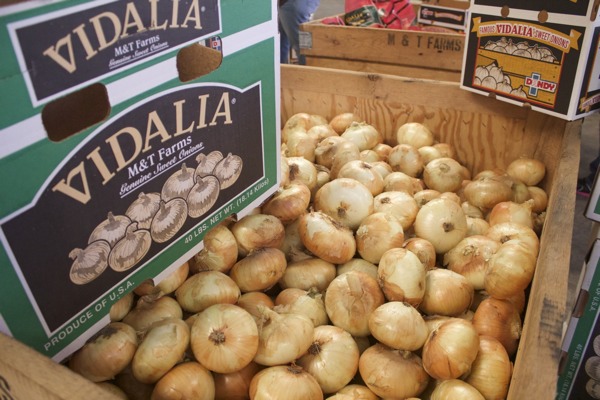
Photo courtesy of M & T Farms, Lyons, GA, and Vidalia Onions.com
University of Georgia Cooperative Extension will host the Vidalia Onion Field Day this year on Thursday, April 8, beginning at 10:30 a.m. It will be held outside and conclude at noon.
There will be a walking tour of the research plots at the Vidalia Onion and Vegetable Research Center in Lyons, Georgia.
A fully mature cluster of black-skinned muscadine grapes
The newly formed Georgia Agriculture Commodity Commission for Wine and Grapes will hold its first meeting on Friday, April 16 at 10:30 a.m. at the Atlanta Farmers Market in Forest Park, Georgia. The meeting will be in the Administration Building of the Georgia State Farmers Market (enter from the market side). The address for the meeting is 16 Forest Parkway, Forest Park, 30297.
The meeting’s purpose is to elect a chair and vice-chair from the commission members appointed earlier this year by the Commodity Commission Ex Officio Committee. The meeting’s agenda will also be to discuss operations and guidelines of a Georgia Agriculture Commodity Commission, as well as the marketing orders and assessments and how to implement them.
The Georgia Wine and Grape Commission was created by the Georgia General Assembly in 2020 at the request of Georgia wine and grape producers.
Social distancing guidelines and masks are encouraged.
For more information, please contact:
Andy Harrison Manager, Commodity Commissions Georgia Department of Agriculture Andy.harrison@agr.georgia.gov (404) 710-1196
Photo by Clint Thompson/Shows farmer Dick Minor talking with U.S. Congressman Sanford Bishop and Senator Raphael Warnock.
The two issues Southeast vegetable and specialty crop producers want and need assistance with the most are labor and imports. Georgia farmers and industry leaders made sure Senator Raphael Warnock heard their concerns on Wednesday.
The U.S. Senator visited South Georgia as part of a farm tour that stopped at Minor Brothers Farm in Leslie, Georgia. Along with Congressman Sanford Bishop, Warnock heard from producers about the impact that imports from Mexico are having on various commodities, including cucumbers and squash. Both crops are the focus of separate U.S. International Trade Commission Section 332 investigations that will be heard on April 8.
“The message is we still have issues we’ve got to deal with,” Georgia farmer Dick Minor said. “As they say, if you’re not at the table, you might be on the menu. We are constantly trying to get in front of our leaders and express what our issues. Today we’re going to talk mostly about labor and trade. Those are the two biggest issues in specialty crops.”
Labor Reform
The House has already passed the Farm Workforce Modernization Act, which offers reform to the current H-2A program. The bill has been sent to the Senate.
“Obviously, the H2A bill they have in front of Congress. We need to tweak those a little bit to help us,” Minor said. “The trade issues we’ve got with cucumbers and squash in front of the ITC that we’re going to try to get some help with Mexican imports that are coming in much cheaper than our products and affecting our markets. Those are the two main things we want to talk to him about today.”
Georgia farmer Bill Brim and Charles Hall, executive director of the Georgia Fruit and Vegetable Growers Association also spoke.
Warnock expressed a desire to learn more about the No. 1 industry in Georgia.
“I chose to be here to focus on agriculture. I hope that signals to you how important this issue is to me,” Warnock said. “I’m here to hear from you. You can’t represent folks without talking to them.”
Easter is Sunday, which means it’s time for at least one more cold snap for vegetable and specialty crop producers to contend with. On cue, temperatures are expected to drop as low as 39 degrees on Thursday and 36 degrees on Friday in Lake Park, Georgia, according to weather.com.
Echols County is where Justin Corbett and his brother, Jared, farm bell pepper, chili pepper, eggplant, yellow squash, zucchini, cucumbers, cabbage and satsumas. Justin is holding out hope that they can avoid a frost, which could be devastating.
“We’re hoping that we don’t wind up with a frost out of it. It’s looking like it’s going to be very close this weekend,” Corbett said. “It could be yield-altering at least. If we get a severe frost out of it, it could be catastrophic.
“You’re going to have different vegetables that are a lot more susceptible. A cucumber’s probably the most susceptible that we grow.”
Corbett Brothers Farms are back on schedule after winter rains delayed most South Georgia producers from applying plastic and fumigation on a timely basis. However, warmer temperatures in recent weeks allowed fields to dry out and farmers to get plants in the ground.
“We’re on schedule right now. It put us behind early on. We’ve done some catching up in the past couple of weeks,” Justin added.
Photo by Chris Tyson/UGA CAES: Shows pecan trees being planted.
Pecan planting season has come and gone for most producers. University of Georgia Cooperative Extension pecan specialist Lenny Wells believes farmers who planted their trees in early February are more likely to succeed compared to producers who planted their trees later, or in mid-March.
Data from 2020 research supports his belief.
“It confirmed what I had been seeing. Those that were planted in February and even early March compared with middle of March, tended to be a little more vigorous and grow better than those planted later,” Wells said.
According to Wells’ research, trees planted in early February yielded leaf area (size of the leaf) about 17mm, and even in mid-February, it was 20mm. But in early March, leaf area dropped to about 12mm and then to about 11mm in mid-March. Much higher leaf area on early planted trees is a sign of vigor in the tree.
Supporting Evidence
Other indicators like the trunk diameter growth, leaf length and average leaf width support the importance of planting early.
“Anytime you pull a tree out of the nursery and plant it into the field, it’s going to undergo some transplant shock. We do recommend pruning the root system now as they plant. Even if they don’t, they’ve lost some of that root system that they had in the nursery in the digging process. When you put that tree planted out into an orchard, it’s got to develop some new roots and get going again before the top of that tree can start growing like it should,” Wells said. “Sometimes, just from the energy that’s stored in the buds and in the trunk of that tree, it’ll start pushing out new growth before it has the root system ready to support that new growth. That’s where you can get in trouble.”
Unfortunately, most producers were unable to get in the orchard to plant trees this winter because of excessive rainfall.
“This year, even if they wanted to plant in February, it was really tough to get those trees planted with all the rain we had during that time. A lot of them were forced this year to plant later. If they take care of them and manage them right and just don’t let those root systems get stressed for any reason, keep good water on them, they should be okay,” Wells said. “But it’s always better to get them in earlier so those roots get established before budbreak begins, which we’re at budbreak now.”
Wells doesn’t recommend producers plant after budbreak which is the stage the trees are in now.
The Georgia Fruit and Vegetable Growers Association (GFVGA) encourages its members to begin communications with local health providers so their farmworkers can get vaccinated.
This followed the announcement from Governor Brian Kemp that beginning Thursday, March 25, all Georgians aged 16 and older were eligible for the vaccines.
GFVGA continues to communicate with the Georgia Department of Public Health (DPH) regarding the urgency for farmworker vaccinations. Local DPH districts are beginning to plan for on-site and pop-up clinics. Your local DPH and health providers are the best source of information on when these will become available.
What would it look and feel like for the United States to be totally dependent on foreign countries for food? While it’s a scenario that might seem unfathomable for some, it’s a proposition that keeps inching closer to reality.
“If things don’t change and they keep going the course they’re going, people are going to look up one day and say, ‘Why can’t I find anything from the U.S.?’ Because of the costs that we’re paying and what we’re battling, we’re going to start dropping like flies eventually,” said Georgia farmer Jason Tyrone.
More and more farmers are calling it quits because it is unsustainable to compete against imports from other countries. Cheap labor costs and the subsidization of Mexican farmers allow produce like blueberries, strawberries, squash, tomatoes and cucumbers to be imported into the U.S. at staggeringly low prices. Markets react, and the American farmers suffer.
How can they compete? They can’t.
“You just think we got into trouble when were waiting on medications and stuff from China for a pandemic. You just wait and see what happens when we have to ask Mexico for food to eat,” Georgia farmer Ricky Powe said. “To break even on a box of pepper is probably $10 or $11. That’s just to break even, no profit, just to get your money back. When they’re allowing this pepper in at $6, we’re losing $5 or $6 a box on pepper, there’s nobody that’s going to stay in business.
Future Generations
Vegetable farmers like Powe and Tyrone cringe at the thought of future generations being totally dependent on other countries for food.
“The American consumer says we want to buy our food as cheap as we can get it. If Mexico sends it over here at $4, we can buy it cheaper. I say, you’re exactly right. But you don’t know what you’re buying. If you put everybody out of business in the United States, then you’re going to be totally dependent upon a foreign country for your food,” Powe said.
The problem is not slowing down, either. Imports are increasing at a rate that producers from Georgia and Florida can’t keep pace.
“The scary part of this, say we do get to where the U.S. farmer can’t afford to do produce because of the labor costs differences, input costs differences, that’s kind of scary from a national security standpoint. Do you want to depend on stuff from other countries to totally feed our country? It’s scary if you think about it,” Tyrone said.
UGA CAES Photo/Phylloxera inside gall from a dissecting microscope.
There’s beginning to be budbreak in pecan orchards throughout the Southeast. As trees start to break dormancy, producers need to begin protecting their crop from one pest who impacts trees this time of year, says Lenny Wells, University of Georgia Cooperative Extension pecan specialist.
“We’re just starting to see it now. This is the time they need to (spray), if they’ve had problems with phylloxera, which is a little small insect that’ll cause those little warty bumps on the leaves and they can also deform the stems. Another species of them can deform the stems and really cause some serious problems there, because it’ll also deform the nuts and cause them to fall off really early,” Wells said. “The time to spray for them is right at budbreak. It’s getting about time to spray those. That’s the main thing they probably need to be looking for right now.”
According to UGA Extension, pecan leaf phylloxera is an insect comparable to aphids. Their feedings can lead to abnormal growths of leaf tissues, and the tissue forms a gall that surrounds the insects. Once it forms, no insecticide can penetrate to the insect.