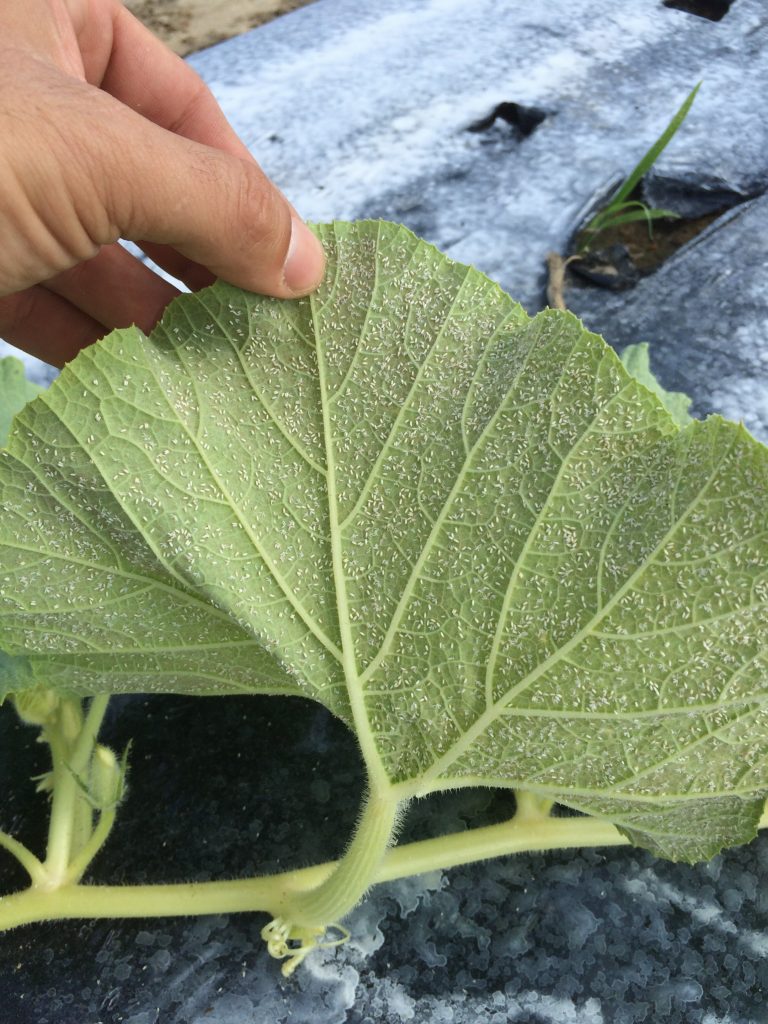
File photo shows how whiteflies can infest fall cucurbits.
University of Georgia Cooperative Extension vegetable entomologist Stormy Sparks is more optimistic about the ongoing whitefly problem that farmers are facing this fall – especially more than what he was feeling two weeks ago. His reason for optimism? Remnants from a hurricane and a drop in temperatures.
Remnants from Hurricane Sally and cooler weather this week should help knock back some of the whitefly populations, which were wreaking havoc on fall vegetable crops.
The rain amounts were extreme in certain places last Thursday when the storm moved across the state. More importantly, the rain was widespread.
“I would anticipate that the weather knocked down the adult populations and this cool weather will greatly delay or reduce the amount that they rebound. That’s what I would think would happen,” Sparks said. “The main thing was (the rain) was everywhere. We got some everywhere. That probably has much more impact than those local heavy rains that we normally get.”
Weather Conditions
According to the UGA Automated Weather Network, Cordele, Georgia received 5.3 inches on Thursday, Sept. 17, while Moultrie, Georgia received 2.36 inches.
Temperatures also dropped from 81 degrees Fahrenheit on Sept. 16 to 67 degrees F on Monday, Sept. 21 in Moultrie.
Whitefly Infestations
Whiteflies have been a problem all year, dating back to early spring. An abnormally mild winter did not kill off many of the wild hosts that whiteflies overwinter on. The result was they became mobile earlier this past spring.
Whiteflies cause feeding injury issues in vegetables and transmit two viruses: cucurbit leaf crumple virus and cucurbit yellow stunting disorder virus. Vegetables like squash, zucchini, cucumber, cantaloupe and snap beans are highly susceptible to these viruses. Commercial cultivars that have resistance or tolerance to these pathogens are not available.
UGA CAES photo/Ashfaq Sial is leading a multistate team of researchers to develop and implement long-term sustainable strategies to control spotted wing drosophila.
By Emily Cabrera for CAES News
The University of Georgia College of Agricultural and Environmental Sciences (CAES) has been awarded a $5.4 million grant by the U.S. Department of Agriculture’s National Institute of Food and Agriculture to develop long-term, sustainable methods for controlling the spotted wing drosophila (SWD).
Native to Asia, SWD is a tiny fly that was first detected in California in 2008 and has since emerged as a devastating pest of small and stone fruits throughout the U.S., valued at $5.8 billion in damage annually. It affects soft-skinned fruits such as blueberries, blackberries, raspberries, strawberries, cherries and others.
Blueberry entomologist and coordinator of the UGA Integrated Pest Management Program, Ashfaq Sial is leading a multistate team of researchers from 10 land-grant universities and the USDA to develop and implement long-term sustainable strategies to control SWD.
The pest has caused blueberry crop losses of up to 20% annually. Blueberries are Georgia’s top fruit crop and ninth-largest agricultural commodity with an estimated $300 million in value, according to UGA agricultural economists.
This project builds on previous work to develop control strategies in response to the crisis situation created after the detection and widespread distribution of this devastating invasive pest in all fruit-growing regions of the U.S. The team made substantial progress by refining monitoring tools, developing effective insecticide-based management programs, identifying effective cultural controls, and screening native and exotic biological control agents to address the drosophila invasion.
“The progress we’ve made is great, but SWD management is still highly insecticide dependent and is further challenged by secondary pest outbreaks, insecticide resistance and increased input costs,” explained Sial. “Because SWD has become established as a keystone pest throughout the U.S., it’s critical to develop more sustainable strategies to manage it.”
The goal of this new project is to pivot away from crisis response to build a long-term, integrated and systems-based approach to managing SWD. The team will work with region- and crop-specific teams of growers to implement best management programs, evaluate alternatives to insecticides, assess and reduce the risk of insecticide resistance development, and develop and disseminate actionable recommendations that enable producers to optimize pest management decisions for sustainable SWD management. They will also develop economically based decision aid tools to increase profitability and evaluate the impact of these initiatives.
The team aims to develop and deliver systems-based integrated management programs to berry and cherry growers that are cost effective and environmentally sustainable for long-term management of SWD in the U.S. Ultimately, implementing these solutions will directly contribute to the long-term profitability and sustainability of farms and farmers nationwide.
Joining Sial on this project is Kay Kelsey, a professor and evaluation expert in the CAES Department of Agricultural Leadership, Education and Communication. Other collaborators and their institutions include Hannah Burrack, North Carolina State University; Kent Daane, University of California Berkeley; Rufus Isaacs, Michigan State University; Greg Loeb and Miguel Gomez, Cornell University; Cesar Rodriguez-Saona, Rutgers University; Philip Fanning, University of Maine; Elizabeth Beers, Tobin Northfield, Karina Gallardo and Gwen Hoheisel, Washington State University; Vaughn Walton, Oregon State University; Joanna Chiu and Frank Zalom, University of California Davis; and Kim Hoelmer and Xingeng Wang, USDA Agricultural Research Service in Newark, Delaware.
The Southeast Regional Fruit and Vegetable Conference includes a trade show of hundreds of exhibitors. Photo courtesy of the Georgia Fruit and Vegetable Growers Association.
It has proven almost impossible to hold in-person conferences and trade shows amid the coronavirus pandemic. The Southeast Regional Fruit and Vegetable Conference is the latest to announce its intention to transition to a virtual event in 2021.
Charles Hall, executive director of the Georgia Fruit and Vegetable Growers Association confirmed in an announcement on Monday that the event scheduled for Jan. 5-7, 2021 will be held virtually.
“The Savannah conference is a unique conference, and everybody enjoys that conference because of the networking and the opportunities to see folks and the education quality and tradeshow and industry folks there. It became quite obvious that as we worked through how we do the conference in this Corona-19 guideline, it just became an impossibility,” Hall said. “If you look at one of our classrooms where we expect to have 100 people in there, if you social distance, you can get 19 people in that room. What happens is if we work to go forward with that, you’ve got 19 people getting an education and 80 people not getting an education.
“The effectiveness and ability with the conference to function is just not possible to have it.”
Normal Attendance
A normal attendance for the conference is between 3,200 and 3,500 people. The event targets fruit and vegetable crops like watermelons, peaches, blueberries and hemp with educational sessions led by University of Georgia Extension specialists.
Over the next two weeks, the organization will provide more information on exhibiting, sponsoring and attending the virtual event in January.
One benefit of this virtual format is that educational sessions will stay online for four months.
“There’s a lot of positives to the change but the networking and atmosphere of the Savannah conference is going to be missed this year,” Hall said.
Georgia pecan farmers escaped serious damage last week following Hurricane Sally’s trek through the Southeast. Alabama producers were not so lucky, however.
University of Georgia Extension pecan specialist Lenny Wells said Baldwin County, the heart of Alabama’s pecan production, was one of the counties hit hardest by Sally’s Category Two Hurricane status. According to the UGA Extension pecan blog, Wells said he has spoken with growers and pecan specialists in the area. The damage is worse than Hurricane Ivan in 2004.
“From the ones I’ve talked to down there, they’re going through the same thing we went through with Michael (in 2018) and the same thing they’ve been through before with Ivan and so many other storms,” Wells said. “It sounds pretty bad over there. I think it’s worse on one side of the bay than the other. I think the east side of the bay got the worst of it. But it’s pretty bad.”
Growers reported 25% to 75% of their trees down. That area received more than 20 inches of rain with 100 mph winds. Trees were laid on the ground and leaves and nuts were knocked off trees.
Impact on Georgia pecans
While Alabama producers were dealt a double whammy with excessive rainfall and high winds, Georgia’s pecan orchards experienced mainly flooding. There was between 6 to 8 inches of rainfall in some areas, according to the UGA Extension pecan blog.
“There wasn’t a lot of wind damage that I’ve heard about or seen yet,” Wells said.
Wells said this development may delay some growers from getting into orchards where Pawnees were ready for harvest. That is normally the earliest variety that is harvested. The remaining varieties will be ready in a few weeks.
“We’re probably three weeks away, maybe two, but two to three weeks away from really getting started with Elliott and some of the early October varieties that we harvest. Probably by mid-October, I imagine everything will be ready this year,” Wells said. “Crop is a little early.”
Photo provided by Chris Tyson/Shows onions being planted in 2019.
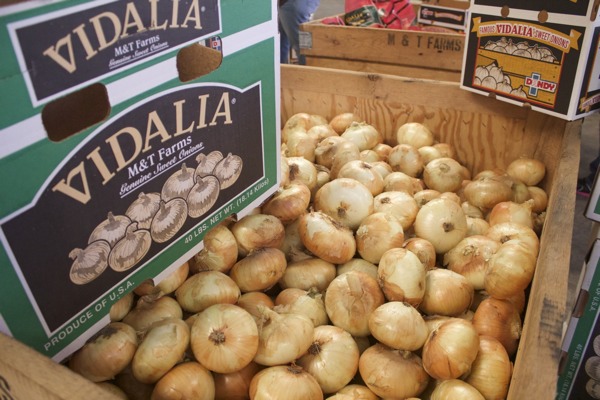
Georgia Vidalia onion growers will resume planting this year’s crop following rainfall from Hurricane-turned-Tropical Storm Sally this week, says Chris Tyson, University of Georgia Extension Area Onion Agent at the Vidalia Onion & Vegetable Research Center in Lyons, Georgia.
Tyson said the heavy rains that pummeled the Southeast on Wednesday did not impact his area as much in southeast Georgia. This should allow growers to resume planting next week.
“I’m going to plant my seedbeds next week. We had some people that planted some last week and this week, but I think a lot of farmers put the brakes on it this week because of this storm, just trying to see what it’s going to do,” Tyson said. “Looks like it’s going to clear out after this next day or two and then we’ll get back at it.”
Rain Totals
Tyson’s research farm is located between the Toombs County and Tattnall County line. According to the UGA Weather Automated Network, Vidalia, Georgia, which is located next to Lyons in Toombs County, received only 0.23 inches of rain on Wednesday; compared to 5.30 inches in Cordele, 2.55 inches in Tifton and 3.39 inches in Vienna. That lack of excessive moisture should allow plantings to resume.
“As long as it dries off a little bit and we don’t get much more rain, we’re going to plant our seedbeds for our research trials next week. I know the growers will get going back again too with their planting as well, as long as it’s not too wet,” Tyson said.
“We don’t want it to be too wet. We don’t want any extreme conditions, especially plants that are just coming up. Those seedlings are sensitive to rough winds or flooding or stuff like that. It always makes us nervous this time of year with these storms. The wind in itself, wind and sand blasting and blowing hard driving rain can be bad; not to mention flooding and washing out in places.”
Vidalia onion acreage the past two years has hovered around 9,300 acres, which is down from what it had been for several years prior. Tyson said this year’s acres could fluctuate some either way but doesn’t anticipate any huge changes in acreage.
Seedbeds will be planted in September through the first of October.
UGA photo/Yellow jacket encounters spike this time of year. As we spend more time outdoors, we’ll see yellow jackets and wasps foraging more often.
By Emily Cabrera for CAES News
As the weather cools across the state, several fall insects will begin to take center stage around Georgia homes. Be on the lookout for these nuisance pests and make preparations to deter them from entering your home for the winter.
Asian Needle Ants
University of Georgia entomologist Dan Suiter tells homeowners to be on the lookout for a particularly problematic ant called the Asian needle ant (Brachyponera chinensis). This invasive species was first reported in the U.S. in the 1930s in Decatur, Georgia.
“For decades, this ant hasn’t been considered an issue, but over the past several years population sizes have exploded, and they are now a major pest in Georgia, especially in the northeast and northwest,” explained Suiter.
Unlike the more widely known fire ant or Argentine ant — commonly referred to as the “sugar ant” — the Asian needle ant does not build mounds, so it can be difficult to spot this ant species. They establish colonies of up to a couple thousand ants by nesting under logs, stones and bark. When disturbed, they can deliver a very painful sting, similar to fire ants, but the venom can be quite toxic — even fatal, in some cases, should sting victims suffer from anaphylaxis.
Many pest ant species lay down pheromones to help establish a well-defined foraging trail for other ants of the same colony to locate food sources, but the Asian needle ant does not forage in this manner. They instead exhibit a very unusual behavior called “tandem carrying,” where one female worker ant will carry another worker ant in her mandibles. Once a food source is located, she will put her sister down and they will forage together.
“The other interesting and somewhat alarming thing about this species is its ability to quickly devastate other native ant species by either taking over their nest sites, consuming their food or by directly preying upon them,” Suiter said. “In the spring while temperatures are still cool, the Asian needle ant will become active and begin establishing colonies before other ant species, so they tend to dominate available habitat earlier and are driving local extinctions of other ant species where we’ve seen them colonizing.”
County University of Georgia Cooperative Extension agents and forest service employees have been reporting higher incidences of this species in the last few years, especially in northeast Georgia.
“We’re not exactly sure of their range yet, but they are probably not as common in south Georgia as they are in north Georgia,” said Suiter.
Argentine Ants
A familiar occurrence for anyone who lives in Georgia is the annual migration of Argentine ants into homes during the fall and winter months. “When we start having cold snaps beginning in October, this ant will start to invade homes looking for a warm place to overwinter,” explained Suiter.
Argentine ants don’t go into diapause like other insects, so this migration indoors is a survival mechanism to get through the winter. They will typically find overwintering spots in walls and around electrical devices that put off heat, such as printers or refrigerators.
“Argentine ants are what most of us call ‘sugar ants.’ They don’t really bother us during the summer, as they spend most of their time in trees foraging for honeydew from aphids and scale insects,” said Suiter. “This species can have hundreds of queens within a colony, so they spend all summer building their colonies and this is the time of year that population sizes peak — just before coming indoors — so they quickly become a nuisance of homeowners right about now and into winter.”
Suiter recommends heading off issues now before they become a problem in the upcoming weeks and months. He tells homeowners to clean up outside of structures to help prevent these ants from collecting and moving indoors. “Argentine ants thrive in mulch and leaf litter because they hold moisture, so horticultural mulches and leaf litter should be minimized. Try not to allow leaf litter to collect in gutters and around the base of homes,” instructed Suiter.
If insecticide use becomes necessary, available commercial products that contain fipronil, such as Termidor or Taurus — a liquid insecticide — can be mixed with water and applied directly to ants found outside. Never spray these products indoors!
“It is sometimes advisable to find ant nests in mulch and leaf litter and spray nests directly,” explained Suiter. “Typically, no more than 1 gallon of diluted, finished product is needed to control Argentine ants on the outside.”
Suiter reminds homeowners to always read and follow the product’s label, as the label contains the manufacturer’s directions for use and provides instructions on what can and cannot be done with the product. Many insecticides, for example, are toxic to fish and other aquatic life and should never be used in areas where they can get into water.
Wasps and Yellow Jackets
Lastly, be mindful of wasps and yellow jackets this time of year. As the weather becomes cooler and more tolerable, people tend to spend more time outdoors, where entertainment often includes food and drink. This is also the time of year that wasp and yellow jacket population sizes are at their peak.
“As we know, tailgating and fall barbecues are always a favorite pastime this time of year, but this is also the time that yellow jacket encounters spike,” explained Suiter. “When we see wasps and yellow jackets in these social settings it’s important to understand they are not approaching you in a protective or aggressive manner, as they aren’t trying to guard their nest. They’re interested only in foraging from whatever food you have lying around. So, we recommend that people not swat at them or panic, but just be sure to check your soda can before taking a sip to avoid being inadvertently stung.”
UGA photo shows damage from Hurricane Michael in Tift County. 10-11-18
Georgia pecan farmers are once again vulnerable to a fall storm as Hurricane Sally slowly moves across the state this week. Its presence reminds growers of Hurricane Michael in 2018.
While Hurricane Sally is not expected to bring similar damage, it still is a subtle reminder of the impact a storm can have on the state’s pecan crop, especially this close to harvest.
“Obviously, everybody gets nervous when you talk about a hurricane after what we saw a couple of years ago. In our forecast right now, we are seeing some 30 mph gusts in some of our pecan belt over in the west and even now in our area around Irwin, Ben Hill and Wilcox (counties) area,” said Phil Croft, manager of the Hudson Pecan Company. “We will lose some limbs, but we shouldn’t lose any trees. We’re hoping that thing will calm down before it gets to us. We’ll lose some limbs for sure, but hopefully, it won’t cause any severe damage.”
Hurricane Michael’s Impact
According to the UGA CAES Newswire, Georgia’s pecan industry suffered a $100 million loss plus $260 million in lost trees after Hurricane Michael moved through the Southeast in early October. Between 30% and 40% of the pecan trees were destroyed in Dougherty, Lee and Mitchell counties, where 30% of Georgia’s pecan crop is produced.
After a disappointing 2019 season, Georgia producers are expecting a bumper crop this season, though there’s still some uncertainty as to what the quantity will be.
“We’re interested to see what our max crop in Georgia’s going to be. We don’t really know. People are saying there’s a 100 million pound crop. I’ve heard 20 million pound crop; I’ve heard 80 million pounds,” Croft said. “The reason you’re seeing so much variance there is nobody knows the true impact that the hurricane had on us. We have a bumper crop this year, but what could Georgia produce? If we don’t have a severe storm from now to harvest, we’ll be able to tell what Georgia can produce now after the hurricane.”
A challenging season for Georgia grape producers is nearing an end as harvest is in full swing across the state. Grapes have been harvested for a month now with others maturing and ripening up.
Phil Brannen, University of Georgia Cooperative Extension Fruit Disease Specialist, said the excess rainfall has not impacted the quantity of the crop but the quality remains a question mark.
“It’s been a challenge because of the rainfall. We still have continued to get a good bit of rain and a good bit of cloud cover. I know that the grapes I have looked at, most of them have done pretty well as far as keeping diseases off. Some are better than others, as far as keeping rots at bay and that kind of stuff,” Brannen said. “The vast majority of them have pretty good production. We’ll have to see what the quality of the grapes are; trying to get the sugars up and the acidity balanced in the grapes before you bring them in is challenging in a year like this.”
Hurricane Sally
The challenge is expected to continue throughout the state this week as Hurricane Sally makes landfall and churns towards the northeast. In Athens, Georgia, where Brannen is located, there are high chances of rain all this week, including 100% on Thursday, according to weather.com.
While most crops like peanuts, cotton and pecans can use additional rainfall this time of year, that’s not the case for grape producers.
“The last two years have been wet, up to a point. It’s been a while since we’ve had a really dry harvest year. I think the last two have been challenging,” Brannen said. “I think it was about four years ago we had a dry harvest. That’s always just welcomed for us in the grape area. We’re always at odds with people that are like peanut producers and cotton producers where they need rainfall through the summer. When you get into August, we like to see everything shut down. It’d be great if it was bone dry for grape production at that point.”
Tough Region to Produce Grapes
When you factor in rain events, it is a lot more difficult to produce grapes in Georgia compared to California.
“It’s a challenge. You compare growing grapes in California where all the water is added through irrigation below the vine. They just don’t have the number of diseases to contend with,” Brannen said. “They really control their water flow. When they get into the harvest phase, they control that water and they can back it down. They can make a grape that has the sugars and the concentration of the acidity and everything that they want. For us, we’re just much more at the mercy of nature.”
Vidalia onion farmers are expected to begin planting the crop this week. Disease management is already on the minds of Georgia growers, following last year’s tough season with bacterial diseases, according to Chris Tyson, University of Georgia Extension Area Onion Agent at the Vidalia Onion & Vegetable Research Center in Lyons, Georgia.
“We had some bacterial disease issues this past season,” Tyson said. “That’s one of those things, that’s something that really didn’t show its head until the end of the season. It was hard to foresee that.
“Bacterial diseases are tough to control. They’re probably the most challenging pest we have in onions period. It’s a big deal for everybody.”
Systems-Wide Approach
According to the UGA Vidalia Onion Extension Blog, bacterial diseases cause more economic losses in Vidalia Onions than any other pest. Tyson recommends growers take a systems-wide approach, which includes fertility, variety selection, maturity, weed control, insect control, bactericides and post-harvest management.
“With it fresh on their memory like that, they’re probably going to take into consideration anything they can do; any management strategies to help with that. That could be a lot of things. It could be variety selection to a certain extent or what maturity class of onions they try to grow,” Tyson said. “Sometimes for instance, typically, bacterial diseases that we see at harvest are worse the later you get in the season, so sometimes, earlier maturing varieties may miss some of that disease pressure.”
Center Rot
According to a UGA Extension publication highlighting bacterial diseases, by Bhabesh Dutta and Ron Gitaitis in the Department of Plant Pathology, center rot remains a huge issue for onion producers. Foliar symptoms initially consist of water-soaked lesions that cause the leaf to become bleached and blighted. Center rot management requires an integrated approach that aims at reducing potential sources of inoculum to count the spread of the bacteria.
Unfortunately, there are not any commercially available onion cultivars that are resistant to the disease.
“This past year we saw a good bit of center rot but we also saw some other bacterial disease that looks very similar to center rot that the management strategies would be very similar to that too,” Tyson said.
Growers are advised to plant early-maturing or mid-maturing cultivars. Thrips vector the spread of the bacteria among plants and fields. Controlling thrips pressure can be a successful management option. Weed management is also recommended. By reducing weeds, growers can potentially reduce the initial inoculum.
Sour Skin
Sour skin was also worse last year for producers. It is usually more of a problem during harvest in the latter part of the growing season. As it thrives in warm conditions, symptoms can manifest earlier in the season depending on temperature. The disease can progress from the upper foliage to the leaves in the lower part of the plant and then to the bulb’s outer scales.
Bulbs that are infected with sour skin usually have an acrid, sour odor and other foul odors that are associated with secondary organisms. Bulbs will turn reddish-brown to brown in color over time, as the tissues rot and copious amounts of fluids are produced.
Crop rotation may help with sour skin management. Avoid using overhead irrigation near harvest season will also reduce yield losses. Also, tactics that reduce the chances of irrigation becoming contaminated with sour skin bacteria will be beneficial.
Irrigate from wells or clean ponds that are weed-free can reduce inoculum levels.
Sally, now a tropical storm, is predicted to become a hurricane and impact the Southeast.
The latest tropical system to impact the Southeast is expected to bring lots of rain to Georgia this week.
Tropical Storm Sally is forecast to become a hurricane by tonight, according to Pam Knox, University of Georgia Cooperative Extension Agricultural Climatologist.
In her blog, Knox said Tropical Storm Sally is bearing down on the Southeast and is expected to become a hurricane by tonight. It is expected to be a Category 2 hurricane when it makes landfall just east of New Orleans sometime on Tuesday. Sally is moving very slowly, which means opportunity for storm surge to develop and for winds to cause damage.
Georgia farmers need to be wary that the major impact from this storm will be rain. In some areas, there is potential for lots of rain. In western and northern Georgia, some areas could receive 4 to 6 inches as the storm slowly wanders and dissipates to our west and then moves back over Georgia as a post-tropical depression later this week.
Everywhere in the state can expect to receive at least 1 to 2 inches over the next five days. The western half of the state does have a chance of seeing some gusty winds, which could start as early as today but are more likely to start on Tuesday. With the saturated soil, that means any wind is more likely to blow over trees, leading to power outages and damage to roofs and buildings.
You can follow updates at the National Hurricane Center at https://www.nhc.noaa.gov/. Don’t focus on the center of the forecast cone. With slow-moving storms, the direction is very uncertain. Rain will spread far out from the center anyway.