The Georgia Department of Agriculture Produce Safety Team is offering a virtual two-day Produce Safety Alliance Grower Training via Zoom on Oct. 21 and Oct. 22 from 8 a.m.-noon.
Any produce grower who grows, packs, harvests and/or holds covered produce, makes more than $25,000 in annual produce sales (on average, based on the past three years of sales), and does not qualify for a Produce Safety Rule exemption is required to attend this training under new federal regulations.
This PSA Grower Training course satisfies the FSMA Produce Safety Rule requirement outlined in §112.22(c), which requires ‘At least one supervisor or responsible party for your farm must have successfully completed food safety training at least equivalent to that received under standardized curriculum recognized as adequate by the Food and Drug Administration.’
UGA photo/Symptoms of Alternaria leaf blight first appear on older leaves as small, dark spots that gradually enlarge with concentric rings. Brassica crops, including broccoli, collard and kale, are all susceptible to this plant disease.
By Josh Paine for UGA CAES News
A new multistate project will bring together researchers from the University of Georgia and partner universities to fight Alternaria leaf blight and head rot in broccoli, a plant disease that thrives in warm temperatures and humidity.
The U.S. Department of Agriculture’s National Institute of Food and Agriculture awarded a $2.7 million Specialty Crop Research Initiative (SCRI) grant to UGA College of Agricultural and Environmental Sciences faculty to study the Alternaria pathogens’ biology, population structure and fungicide resistance.
Due to developing fungicide resistance, Alternaria blight and head rot have severely impacted brassica production, according to Bhabesh Dutta, an associate professor of plant pathology and UGA Cooperative Extension vegetable disease specialist who is leading the multistate project.
The team’s research will build on previous surveillance work done in finding fungicide alternatives. Previous efforts to limit losses in fields have not been successful, possibly as a result of recent shifts in pathogen population and increasing resistance against fungicides.
The disease is a long-term threat that affects all brassica crops, which include cabbage, collards, kale and mustard greens. The fungus causes water-soaked spots on the head of the vegetable and dark, sooty, circular spots whose centers can fall out, leaving a shot-hole appearance.
The team of research and extension faculty will work to triangulate the disease by characterizing the pathogen or pathogens, host and environment. They will also develop diagnostic tools for identifying Alternaria sp., screen commercial varieties, and evaluate production practices including nitrogen levels and irrigation, which is how the disease spreads. The team will use what it learns to conduct economic assessments.
“The ultimate goal is to give a practical management option to stakeholders, ultimately limiting losses to this disease,” said Dutta.
Broccoli is a high-value crop that can be affected by a number of diseases. Head rot has been a particular concern in Georgia since late 2015, but it has been reported up the East Coast since 2013. Economic losses of up to 20% have been reported in some cases.
“Growers tend to overuse fungicides that are effective and, more often, that leads to the development of resistance,” explained Dutta. “Efforts to limit losses in fields and storage have not been successful, likely due to recent shifts in pathogen population and potential resistance development to ‘Quinone outside inhibitor (QoI)’ fungicides. This project will aid in developing molecular diagnostic tools for detecting QoI resistance in Alternaria, understanding the population structure of the pathogens, and developing management strategies that will reduce losses in broccoli across the production chain, maximizing productivity and profitability.”
Other UGA faculty members working on the grant are Pingsheng Ji, professor of vegetable diseases and applied microbiology; Andre da Silva, assistant professor of horticulture and Extension vegetable specialist; Tim Coolong, professor of horticulture; and Greg Colson, associate professor of agricultural and applied economics. Researchers from Virginia Tech, Cornell University and University of Nebraska-Lincoln will collaborate with the group.
An advisory panel of industry professionals, growers and other experts will provide guidance to the project, reinforcing the Eastern U.S. brassica industry as a team.
The production of brassica crops is a profitable industry for Georgia farmers. According to the UGA Center for Agribusiness and Economic Development, the state farm gate value for cabbage alone was nearly $42 million in 2018. Colquitt County is the largest producer of brassicas in the state, followed by nearby counties including Thomas, Grady, Echols and Tift.
For more information on the UGA Department of Plant Pathology, visit plantpath.caes.uga.edu.
South Georgia vegetable farmers are facing their share of challenges this fall. Between heavy whitefly infestations, increased disease pressure and extreme cloud cover over the past two weeks, producers continue to deal with obstacles during this fall production season, according to Jeremy Kichler, University of Georgia Colquitt County Extension Coordinator.
“When (Hurricane) Sally came through, we got anywhere from 5 to 6 inches. We finally dried at the end of last week,” Kichler said. “The weather started getting rainy and misty. (Wednesday) was finally the first clear day we’ve had in a while. It’s been challenging the last 10 days from a weather standpoint.”
Sally brought intense rainfall and high winds to parts of Southwest Alabama and Northwest Florida but also excessive moisture to areas in Georgia. With little sunshine to dry fields out over the last two weeks, excessive moisture led to a flare up in certain diseases like PCAP in squash and powdery mildew.
“Anytime you have moisture, excessive moisture, it tends to flare up things. When you have a lot of rainfall like we had, it tends to knock down adult whiteflies, but it also brings on disease problems, too,” Kichler said.
Sally’s presence on Sept. 16, helped knock back whitefly populations, which was needed. It’s the worst whitefly outbreak since 2017.
“Every fall we just kind of hold on tight. We’re starting to deal with these whiteflies with more timely insecticide applications. We’re getting a lot more comfortable with our management schemes with that,” Kichler said. “But it’s a still a challenge with silverleaf and some of these yellow squash and zuchinnis.”
“We are holding our own. I think prices are pretty good right now from what I’ve been told. The silverleaf pressure has been pretty bad because of the whitefly pressure that we’ve had. It’s been challenging.”
University of Georgia breeders developed the Orange Bulldog pumpkin.
By Cecilia McGregor and George Boyhan
Cucurbit crops are some of the most widely grown vegetable crops in the Southeast. However, the hot and humid climate is conducive to pest and disease development, which presents a challenge to growers. Cucurbit breeding at the University of Georgia (UGA) is focused on breeding pumpkin, watermelon and squash with excellent fruit quality and enhanced disease resistance.
PUMPKINS
Pumpkins are an important crop in the United States, particularly as decorations during the fall. Unfortunately, pumpkins are difficult to grow in the Southeast because of diseases. There are several diseases (particularly viruses) that affect traditional pumpkins. These diseases are transmitted by aphids in a non-persistent way. This means that as soon as the insect probes the tissue, the virus is transmitted. Control is difficult, because even with 90 to 95 percent insect control, the remaining 5 to 10 percent can effectively infect the crop.
UGA began a breeding program in 1996 with a collection of pumpkin seeds from Brazil. Seed from both elongated and flattened fruit of Cucurbita maxima were obtained and interplanted. Putative hybrids were collected. This began several years of selection for fruit with a round shape, pleasing color and open cavity. These pumpkins have a greater degree of virus resistance compared to traditional pumpkins (C. pepo), so they produce more consistently.
The resulting variety, Orange Bulldog, was released in 2006. Since there was no interest among seed companies, UGA has been handling sales. The primary audience for this variety is pick-your-own and roadside marketers. The vines hold up particularly well into the fall for direct marketers that “reseed” their pumpkin patch with new fruit each day.
Pumpkin research concentrated on developing disease resistance into commercially acceptable pumpkin lines has continued at UGA.
WATERMELON
UGA is also actively breeding for gummy stem blight and fusarium wilt resistance in watermelon. Resistance to gummy stem blight was first described in 1962 when it was discovered in a wild relative of watermelon, Citrullus amarus. This is the same species that was used to breed the fusarium-resistant, non-harvested SP pollinizer cultivars.
Breeding disease resistance into commercial, edible cultivars from this wild germplasm has proven difficult since the wild relative has hard, inedible flesh. This is further complicated by the fact that there are different species of the Stagonosporopsis pathogen that cause gummy stem blight and different races of Fusarium oxysporum var. niveum that cause fusarium wilt. The resistances to these diseases are quantitative, meaning that a single resistance gene does not give field-level resistance to the diseases. All these factors have delayed the development of cultivars resistant to these diseases.
Susceptible (left) and resistant (right) watermelon seedlings infected with gummy stem blight.
The breeding effort at UGA focuses on using modern selection methods to accelerate selection for resistance genes to speed up breeding efforts. Currently, selection is in progress for fusarium race 2 resistance and gummy stem blight resistance.
In addition to these disease-resistance breeding efforts, UGA breeds cultivars specifically for homeowners and farmers’ markets. The focus here is on novel traits like a variety of flesh colors and rind patterns and the egusi seed trait.
Egusi watermelon is very popular as an oilseed crop in many parts of Africa. The seeds are very high in oil (40 to 50 percent) and protein (25 percent) and are eaten as snacks or as a thickener in soups and stews. Egusi seed is large and flat with a unique fleshy outer layer that dries into a very thin seed coat that can easily be shelled. Traditional egusi watermelon has hard inedible flesh, which goes to waste. UGA is breeding egusi watermelon with edible flesh. These plants will produce fruit that pack the health benefits associated with the antioxidants in red- and orange-fleshed watermelon while also being a source of high oil and protein seed.
SUMMER SQUASH
In 2019, UGA started a squash breeding program. This program was launched in response to the severe yield losses experienced by Georgia growers in recent years due to whiteflies and whitefly-transmitted viruses.
The sweetpotato whitefly (Bemisia tabaci) can directly cause yield losses in many different crops due to feeding, but an even bigger cause of yield losses are the viruses it transmits. Sweetpotato whiteflies can transmit more than a hundred different viruses. Cucurbit leaf crumple virus (CuLCrV) and Cucurbit yellow stunting disorder virus (CYSDV) are some of the most important to squash growers.
Commercial squash cultivars have proven to be very susceptible to these viruses, and sources of resistance have not been identified. UGA, in collaboration with the University of Florida, has started large-scale evaluations of squash germplasm from all over the world in search of resistance. Several genotypes with resistance to CuLCrV and CYSDV were identified in 2019 and are now being evaluated further for use in the breeding program.
The UGA cucurbit breeding programs are committed to developing cultivars well adapted to the Southeast, with high disease resistance and exceptional fruit quality for both large- and small-scale growers in the region.
According to the UGA Extension Viticulture Blog, Pam Knox, UGA Extension climatologist, said the nights of Oct. 2-4 could see temperatures in the 30s across the Southern Appalachians and into northern Georgia and Alabama.
She said while most places won’t have temperatures that get down to freezing, areas that are frost pockets and prone to frost could freeze. A second outbreak could also happen the second week of October.
It’s still a ways off, so the predictions are likely to change somewhat in strength and timing, but something to keep an eye on if you have tender plants that could be impacted by the cold air. You can view these probabilistic threats at https://www.cpc.ncep.noaa.gov/products/predictions/threats/threats.php.
Photo courtesy of UGA College of Agricultural & Environmental Sciences.
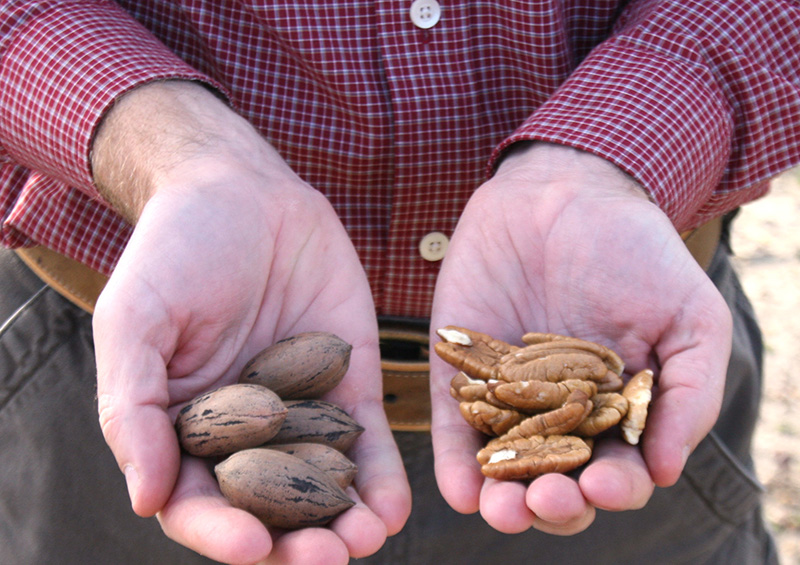
With some certainty, Georgia pecan producers are expecting a bumper crop this year. What remains uncertain is the market price farmers will receive at harvest.
As growers are currently harvesting Pawnees with other varieties expected to be harvested next month, there is still an unpredictability regarding the pecan market, according to Phil Croft, manager of the Hudson Pecan Company.
“Right now, we don’t 100% know this market trend. The only thing we can base it off of is what South Africa on the in-shell market sold into China. Those numbers are somewhere between $4.80 and $4.50 a kilogram, which relates back to $2.05 to $2.25 a pound delivered into China. That’s working it back to the grower level on a premium nut, $1.80, $1.90 a pound for our premium Desirables and qualities of that nature,” Croft said. “If China will come back in this thing and buy strong, I think that may be the bottom of the market, in my opinion. Nobody wants to hear that but at least it’s a starting point, and hopefully, it’s the bottom of it that where we can go up from there.
“I feel like we have an opportunity here for this market to increase pretty quickly if all the ducks line up.”
China
China is the biggest buyer of U.S. pecans. But the relationship between the two countries has been strained recently with the coronavirus pandemic and the trade war that involved tariffs being place on goods by both countries. They established a Phase One Agreement where China would increase its purchases of agricultural products, but it still lags in its pursuit of meeting those purchasing goals.
China’s role as a pecan purchaser cannot be understated.
“They have been some great customers for many years. We hope that will work out. We hope that they will buy Ag products,” Croft said. “We saw a report the other day that the almond market is booming in China and it’s because of lower prices. That’s maybe what it takes to get the market picked back up over there with some cheaper prices initially. Hopefully, it’ll turn around into a positive.”
Citrus production in Georgia is rapidly increasing each year. There are citrus plantings in backyards, production, and plant nurseries within at least 32 GA counties. The growth of citrus in Georgia is only expected to increase over time. However, there are some threats to expansion.
Citrus has many viroids, a tiny virus-like pathogen, that harm the plants throughout the world, but few have been found on citrus within Georgia. Hop stunt viroid (HSVd) is one of several viroids known to infect citrus. This viroid has been reported within Arizona, California, Florida, Texas, Washington state, and throughout the world. HSVd is typically transferred from plant to plant on contaminated grafting and pruning tools. HSVd can infect many different plants, including hops, grapevines and citrus. A large host range helps the pathogen spread.
In the United States, HSVd has been found on many different grapefruit, orange and tangelo varieties. Symptoms include discolored and gumming inner bark, pitting (small holes) in stems, bark splitting (coming apart) and stunted growth. There are typically not leaf or fruit symptoms. Some citrus varieties are resistant to HSVd, but others, including tangerines and their hybrids will show damage. There are also different types of HSVd, called cachexia and non-cachexia variants. “Cachexia” means severe chronic illness, so the cachexia variants are much more dangerous and the noncachexia variants typically do not cause damage.
In May and June of 2020, leaf samples were collected and tested for HSVd. The samples were collected from 12 different citrus plants from two nurseries located in southern Georgia. The cultivars sampled included Citrus reticulata ‘Dekopon’ and ‘Owari’ as well as Citrus unshiu ‘Miho Wase’ and ‘Brown Select’. The sampled trees looked relatively healthy with little or no signs of damage, but were selected for routine screening. Three to five leaves were taken per plant from throughout the leaf canopy.
Small pieces of leaves were cut and used for RNA extraction. Reverse transcription-polymerase chain reaction (RT-PCR) and sequencing was used to verify infection with HSVd. Recombinase-polymerase-amplification (RPA) technology was also used to further confirm positive samples as HSVd. Nine samples were negative for HSVd, but the other three were positive. The positive samples were all taken from Citrus reticulata ‘Dekopon’. The sequencing results revealed that the positive samples were non-cachexia HSVd variants.
This is the first time HSVd has been found in Georgia. This and other viroids could pose a threat to the growing citrus industry within Georgia in susceptible varieties.
Currently, only noncachexia variants have been found, but nursery stock infected with this viroid should still be destroyed to prevent spread. Georgia nursery producers and citrus growers should take appropriate precautions to prevent the spread of this viroid disease. Ensure that proper sanitization is used on citrus grafting and pruning tools. Further research is needed to determine the distribution of HSVd and its potential to impact commercial citrus production in Georgia.
Fungicide resistance in strawberries is a major problem, says University of Georgia Cooperative Extension plant pathologist Phil Brannen. He encourages producers to help researchers understand which fungicides are still active and provide protection against diseases like anthracnose and botrytis.
“(Fungicide resistance) has really come to the forefront in the last few years. In the last two or three years, we have seen a lot issues, particularly with anthracnose. Prior to that, we may have had some breakdown but not nearly as much,” Brannen said. “With those fungicides in general across a lot of commodities, (they) are now starting to lose their activity and it just finally happened for us in strawberries. They’ve had issues with that in Florida for now several years also; South Carolina, we all know this happens when you spray that fungicide class; over time, they eventually break down and quit working. We’ve got to get better resistance, and we’re probably seeing more of that in other areas, too; other fungicides, particularly on botrytis.
“When trying to control botrytis, we have quite a few of fungicides that no longer work. I just encourage producers to make sure they test. If they have the opportunity, they can actually send off their pathogens on the strawberries and they can be tested for which fungicides are still active. That’s helpful.”
According to the UGA Extension Viticulture Blog, University of Georgia researchers are asking grape producers if powdery mildew has been spotted in their vineyards. UGA would love to sample it, and it could mean that the fungicide program is breaking down due to resistance development in the powdery mildew fungus.
UGA graduate student Brooke Warres is working on QoI and DMI fungicide resistance in powdery mildew. She can take swab samples of the mildew from any part of the grapevine to test for mutations associated with resistance to these chemical classes. With this information, UGA can better understand resistance patterns in Georgia and determine how widespread these mutations are throughout the state.
As producers are scouting their vineyard at the end of the season, UGA suggests looking inside the canopy to check for white to gray fungal growth of powdery mildew — predominantly on the upper leaf surfaces. Depending on how well it has been controlled, it may also be self-evident on the canopy exterior. If you are finding this disease, please call Brooke at 678-642-2183 or email at Brooke.Warres@uga.edu so she can visit to take a quick sample. With these samples, she will be able to let you know if you currently have QoI and/or DMI resistant populations in your vineyard. This should help you to plan your spray program for next season.
According to the UGA Extension Pecan Blog, shuck decline in pecans is starting to manifest itself in orchards across the state.
Growers are starting to see symptoms of shuck decline in the orchard. Symptoms range from shucks turning all the way black to the tips, green shucks turning black and peeling back at the suture. In some cases, kernels are black and in other cases, there is no kernel. The degree of declining shucks varies from tree to tree.
For growers to minimize the problem moving forward, they need to continue to irrigate. This will be critical if the weather turns dry later this month and in October.
According to the UGA Extension Pecan Blog, the severity of shuck decline depends on when the decline started during development. If the shuck has already split open, likely, growers can still shake the nut from the tree and it will be fine. However, much of this dark color on the shucks beginning before they open may hurt yield and quality.
Shuck decline is mainly a stress-related issue. It can be worse on trees with a heavy crop load.