Category: Georgia

  • U.S. Horticulture Operations Report $13.8 Billion in Sales

    WASHINGTON, Dec. 8, 2020 – Today, the U.S. Department of Agriculture’s National Agricultural Statistics Service (NASS) released the 2019 Census of Horticultural Specialties report, the only source of detailed production and sales data for floriculture, nursery, and specialty crops for the entire United States.

    The data show that horticulture operations sold a total of $13.8 billion in floriculture, nursery and specialty crops in 2019, down fractionally from the sales in 2014. The number of horticulture operations in the United States decreased 11% during this time to 20,655.

    “First conducted in 1889, the horticulture census provides data on sectors for which there are no other comprehensive data sources,” said NASS Administrator Hubert Hamer. “It is a valuable tool to highlight the contribution horticulture growers bring to our local, state, and national economies as well as changes in the industry over the past five years.”Horticulture Map
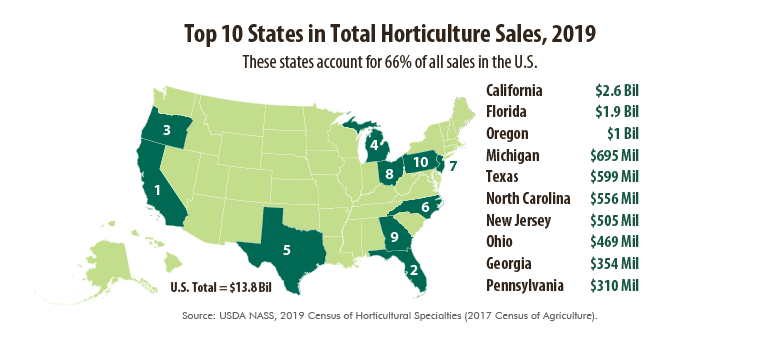
    Horticulture production occurred primarily in 10 states, which accounted for 66% of all U.S. horticulture sales in 2019. California ($2.63 billion), Florida ($1.93 billion) and Oregon ($1.02 billion) led the nation in sales.

    The top commodities in U.S. horticulture sales in 2019, and compared to 2014, were:

    • Nursery stock, $4.55 billion, up 7%
    • Annual bedding/garden plants, $2.24 billion, down 13%
    • Sod, sprigs and plugs, $1.27 billion, up 12%
    • Potted flowering plants, $1.2 billion, up 11%
    • Potted herbaceous perennials, $923 million, down 2%
    • Propagative horticultural materials, bareroot, and unfinished plant materials, $720 million, up 4%
    • Food crops under protection, $703 million, down 12%

    Other key findings from the 2019 Census of Horticultural Specialties report include:

    • Family- or individually-owned operations made up the largest number of operations, accounting for 52%, but corporately-owned operations accounted for 75% of sales ($10.3 billion).
    • Total industry expenses were up 6% since 2014, with labor being the largest cost, accounting for 42% of total expenses in 2019.

    The Census of Horticultural Specialties is part of the larger Census of Agriculture program. It provides information on the number and types of establishments engaged in horticultural production, value of sales, varieties of products, production expenses and more. All operations that reported producing and selling $10,000 or more of horticultural crops on the 2017 Census of Agriculture were included in this special study.

    For more information and to access the full report, visit www.nass.usda.gov/AgCensus.

  • Congressional Support Helps Lead to Potential Investigations of Imports of Cucumbers, Squash

    File photo of cucumbers.`

    Congressional support of Georgia’s vegetable and specialty crop sector has helped lead to potential investigative action regarding imports of cucumbers and squash.

    Letters from both Georgia U.S. Senators; David Perdue and Kelly Loeffler; as well from four Georgia Congressmen; Sanford Bishop (D-GA-02), Austin Scott (R-GA-08), Buddy Carter (R-GA-01) and Rick Allen (R-GA-12), were sent to U.S. Trade Representative (USTR) Robert Lighthizer, asking that the current Section 332 investigation for strawberries and bell peppers be expanded to include cucumbers and squash.

    USTR Responds

    The USTR requested on Friday investigations from the US International Trade Commission (ITC) into the imports of both commodities and the effect on domestic seasonal markets.

    It is much needed action for Georgia’s vegetable growers, says Charles Hall, executive director of the Georgia Fruit and Vegetable Growers Association.

    “We prepared a ‘white paper’ based on what was happening this fall. This fall, we saw squash prices and particularly some cucumber prices just drop out the bottom. Mexico products hit and the market and prices went to almost nothing. We prepared a ‘white paper’ for the Congressmen and asked for any help they could provide. Both the House Congressional staff and the Senate staff, they both submitted the letter to Lighthizer asking for support,” Hall said.

    “It’s very good from that standpoint that we’ve been able to get them to step in behind that. Those six offices have always been very supportive of our issues and concerned about USMCA as it was coming up for a vote.”

  • Low Pecan Prices Remain Stable for Georgia Growers

    Pecan prices have been depressingly low all harvest season. But they have not dropped much more in the last month or so, according to Lenny Wells, University of Georgia Cooperative Extension pecan specialist.

    “What I’ve been hearing, they’ve been fairly stable for the last two or three weeks. Good nuts have been selling in the range of a $1.15 to $1.35 (per pound), mostly, somewhere in that range. It doesn’t really matter what variety it is or anything. If it’s a decent nut, it’s selling in that range. Of course, the poor-quality stuff is well below $1,” Wells said.

    Low pecan prices were expected but not to the extreme levels that growers have experienced this year. While prices have not been good this year, pecan volume is the highest Georgia producers have seen in years.

    Wells estimates there will be between 120 million and 125 million pounds of pecans produced this year.

  • CFAP 2 Deadline is Dec. 11

    The U.S. Department of Agriculture reminds vegetable and specialty crop producers who wish to apply to the Coronavirus Food Assistance Program (CFAP) 2 that the deadline is Friday, Dec. 11.

    This program provides relief to farmers facing market disruptions and associated costs due to COVID-19.

    Rabinowitz

    It is a program that Adam Rabinowitz, Assistant Professor and Extension Economist at Auburn University, encourages all eligible farmers to take advantage of.

    “CFAP 2 covers a wide range of fruit and vegetables and specialty crops. It’s much broader coverage that’s typical from other government programs. For those that have experienced any type of marketing and production effects as a result of COVID-19, this is an excellent opportunity based on sales, just comparison sales. It’s a self-certification process, so there’s very little paperwork. It’s very easy access to be able to get these funds to assist with covering those losses,” Rabinowitz said.

    “It covers such a broad range of specialty crops, well over 200 different specialty crops. I think all fruit and vegetable producers really need to look at this and make sure they get to their FSA office and sign up for this program.”

    For More Information

    Producers can find eligible commodities, payment rates, calculations and options to apply on farmers.gov/cfap.

    CFAP 2 is a separate program from the first iteration of CFAP, now referred to as CFAP 1. Participating in CFAP 1 is not a prerequisite for participating in CFAP 2. Additionally, producers who applied for CFAP 1 will not be automatically enrolled in CFAP 2. They must complete a new application to be eligible for assistance.

  • Expect a Drop in Pecan Production in 2021

    UGA CAES photo shows pecans being cleaned.

    This year’s pecan crop in Georgia exceeded expectations. Producers need to brace themselves for a drop in volume next year, which is expected with pecan trees being alternate bearing plants.

    University of Georgia Cooperative Extension pecan specialist Lenny Wells fully expects the 2021 crop season to be a down year for Georgia growers.

    “From a volume perspective yes, I don’t really see how we can come back with this kind of crop statewide,” Wells said. “Now with the young trees that are out there, they’ll probably still come back with a decent crop. Anybody that fruit thins or manages their crop load will probably have a decent crop. Overall, I would expect next year to be an off year.”

    Alternate Bearing Cycle

    Since pecan trees are alternate bearing, if the trees produce a good crop one year, they are less likely to produce a similar result the following year. However, with the right management system, producers can still get the most out of their trees.

    “We had kind of leveled off to where before the hurricane we had gotten to be pretty even in our production. We would be up and down a little, but we didn’t have those big swings like we used to have. But the hurricane (Michael) kind of reset everything,” Wells said.

    “When you had all those trees that got broken up and they had to regrow new fruiting wood and all that, it reset the clock and sent everything back into a big alternate bearing cycle. Any growers that did not manage their crop load, those trees are going to be back into a big swing. There’s things they can do to manage that. A lot of them didn’t want to this year because it’s really been a couple of years since they’ve had a crop, which is understandable.”

    Georgia Crop This Year

    Wells estimates that this year’s Georgia pecan crop will net between 120 million and 125 million pounds.

    According to UGA Extension, Georgia is the country’s largest supplier of pecans, accounting for about a third of the U.S. pecan production.  

  • Georgia Pecan Volume Exceeded Expectations

    The worst pecan prices in recent memory are being countered by one of the biggest crops in recent years.

    Lenny Wells, University of Georgia Cooperative Extension pecan specialist, said this year’s crop has been welcomed by all producers, especially those still recovering from Hurricane Michael in 2018.

    Photo by Clint Thompson/Shows pecans being cleaned after harvest.

    “I think it has (exceeded expectations) from a volume standpoint. It’s hard to say exactly how much it’s going to be but I’m still going to say around 120 million or 125 million pounds which is more than we expected in the middle of the summer,” Wells said. “It does look like a pretty big crop. That has been the saving grace in all this. With the price being down so much, the volume has certainly helped a lot of growers with that.”

    Improved Production Season

    Wells was hoping for between 80 million and 100 million pounds, back in early April. That would have been a substantial increase from 2019 crop that generated just 67 million pounds. But last year’s crop came on the heels of Hurricane Michael the prior year. A down year was expected.  

    Low Prices

    A larger than expected crop is needed to combat extremely low prices that have forced some growers to store their pecans. The farmers are hoping for a market turnaround in doing so.

    “Pretty much every big grower that I have talked to is storing a considerable amount. Most large growers I think seem to be storing maybe somewhere around a third of their crop, at least. It’s quite a bit,” Wells said.

  • On Farm Readiness Reviews for Produce Growers in Georgia

    On Farm Readiness Reviews (OFRR) are now available for Georgia produce farmers. Schedule your OFRR by clicking the button below to visit georgiaproducesafety.com or by contacting Maggie or Elizabeth.

    Maggie H. Brown
    Produce Safety Education and Outreach Coordinator
    Maggie.brown@agr.georgia.gov
    Elizabeth S. Danforth
    Produce Safety Education and Outreach Associate
    Elizabeth.Danforth@agr.georgia.gov

    An OFRR is not an inspection but a method of educating before regulating. The goal of an OFRR is to provide farmers with useful information so they can comply with the federal Food Safety Modernization Act. We’re here to help.

  • GATE Renewal Still Open

    Annual renewal for the Georgia Agriculture Tax Exemption (GATE) program is open. Eligible farmers can renew their GATE card for 2021 online by visiting https://forms.agr.georgia.gov/GATE/.

    GATE cardholders who are to renew in 2021 will automatically be placed on the new three-year renewal program and will receive their renewal invoice in 2024. All current cards will expire Dec. 31, 2020. Cardholders currently on two and three-year renewals will receive their 2021 cards with the new expiration date of Dec. 31, 2021, and do not need to renew or apply for the 2021 year.

    The GATE program was created through legislation to offer qualified agriculture producers a sales tax exemption on agricultural equipment and production inputs. Qualified farmers and agricultural producers can apply to receive a certificate showing that they are eligible for this exemption. Farmers are required to present the current year GATE Card at the time of each purchase.

    Producers needing assistance can contact the GATE program team at 855-FARMTAX or farmtax@agr.georgia.gov.

  • December 2020 Final Outlook Shows No Strong Trend

    Graphic shows a drought outlook for the country for December.

    According to the UGA Extension Climate and Agriculture blog, the NOAA’s Climate Prediction Center released the latest 30-day climate outlook on Monday. It shows that there is no strong trend towards warmer or colder conditions in December except in southern Florida.

    Early December will be colder than normal. It is still expected to be warmer than normal in late December. Pam Knox, University of Georgia Extension Agricultural Climatologist, said the combination for the month as a whole could go either way, leading to a forecast of equal chances.

    The precipitation is also for equal chances of near, above or below normal except for a slight tilt towards dry conditions in Alabama. The latest drought outlook shows a large part of eastern Georgia and adjacent areas of South Carolina and Florida with likely development of drought.

  • Slug Management in Blueberries

    Photo by British Columbia Blueberry Field Guide

    Ash Sial, Associate Professor in the University of Georgia in the Department of Entomology, is receiving reports of slug infestations in Georgia blueberries.

    According to the UGA IPM blog, slugs generally lay between 3 and 40 small transparent eggs at one time. Each slug can lay up to 400 per year. The slugs can contaminate the harvested fruit once harvest season approaches. They can reduce the quality by leaving slime trails on the fruit.

    When do Producers Need to Monitor?

    Sial

    The best time to monitor for slug infestations is in early spring around March. Farmers can place small amounts of slug bait near a potential slug habitat. Habitats are the consistently wet and moist areas in the field. Check periodically for activity. Tolerance levels vary according to the end product usage and processor.

    Slugs and snails rarely cause economic damage in blueberries. Treatment is necessary to control them. Several slug baits are registered for use in blueberries. The most widely used and effective are baits with metaldehyde.

    It’s important to bait prior to harvest. This is common if slugs are known to be present.

    Preventative Strategies

    Preventative strategies are helpful for achieving long-term management.

    1. Trellis the blueberry plants to keep branches from touching the ground. This practice reduces the number of slugs gaining access to the plant.
    2. Mow or completely eliminate the vegetation in the plant row and between the berry rows. This can reduce slug habitat.
    3. Keep crates and pallets away from damp soil and grass. It prevents migration of slugs into and under crates taken to the field before harvest.
    4. Use geese as predators to control slug populations.
    5. Eliminate consistently wet/moist spots in the field with good drainage. This reduces favorable habitat for slugs.

    Slugs are soft-bodied mollusks. They do not have a shell. They can be as small as 0.25 inches to 10 inches longs. Their color can vary from yellow to green to brown to black. Some may even have spots or colored patterns.