Category: Georgia

  • North Florida to Feature More Late-Season Watermelons

    North Florida watermelons will be in supply later than normal, says Branford, Florida producer Laura Land. Land, who is also a member of the Florida Watermelon Association, says there will be more late-season watermelons this year in North Florida.

    “The increase in acreage that I’m seeing here in the North Florida area is pretty much that later crop,” Land said. “They’ve got their early crop like they’ve been having them, about the same acreage. Then they’ve put in 40 to 80 more acres for some later crops.”

    Additional acreage in North Florida could challenge South Georgia for the market in mid-summer. Both regions are hoping to duplicate last season’s success, where there were high yields and high prices for farmers.

    “Normally we try to be through before (Georgia) ever gets started. Georgia acreage doesn’t seem to have increased a lot. It’s staying pretty level. This (North Florida) area seems to be dropping their time back so that they’re coming in a little later,” Land said. “There seems to be a pretty good acreage. Crops all look very good. It’s acreage that’s scattered in all different ages.

    “Looks like from the 15th of May through the 15th of July, they’ll have watermelons here in North Florida.”

    Land said farmers in her region normally want to be done before the end of July, but some were still planting as of last week. That followed a freeze during Easter weekend that killed some watermelon plants. Farmers were forced to replant.

    “I think maybe acreage in the north Florida area has gone up a little bit but considerably little. It’s pretty much the same people that’s been growing watermelons, may have added 40 more acres,” Land said. “It could just be how their land worked out. Everybody in the watermelon business knows that no two years are ever the same. There’s a new challenge every year.”

    Current Market

    Land said prices are around 30 cents per pound right now with not a lot of availability. Watermelons are available mainly just in the South Florida area, around Immokalee. Land said producers in the Lake Placid, Arcadia regions should start harvesting this week or at least by the first of May.

  • Georgia Farmer: It’s Just a Mess Right Now

    South Georgia vegetable farmer Bill Brim had a couple of days to survey the damage following more than seven inches of rainfall on Saturday. The Tifton, Georgia producer’s response was simple: “It’s just a mess right now.”

    Photo shows water along Lower Ty Ty Road in Tifton, Georgia.

    Brim was one producer impacted by the excessive rainfall, high winds and some hail damage throughout Saturday in South Georgia. What started in mid-morning didn’t end until late that night. It was a devastating day for some growers.

    “We had some damage a little bit everywhere. We had some ponds that burst or washed off the back ends, we had a little bit of hail on some squash. It didn’t hurt the bush that bad, just dinged up the squash itself,” Brim said. “We just had a lot of rain, that’s the problem.

    “We got hurt all over a little bit. I think overall we’ll be okay. Our tree seedlings where we’ve got them on these pivots, it washed a bunch of seed out on them. We won’t know what the damage there’s going to be for another 10 days.”

    Flash Flooding

    Brim said of the seven-plus inches his farm received, three inches dropped in about an hour. Flash flooding was also a concern throughout the area.

    “All the field roads are washed away. Sewer pipes are overflowed. It’s just a mess. Something that we’ll have to get fixed; just cost you more money to fix it,” Brim said. “I’ve heard some guys that have got bare ground watermelons that (the weather) really hurt them pretty bad. They had hail down in Lake Park, real bad hail down in Lake Park that tore up cabbage and squash.

    “You get seven inches of rain, it’s just unbelievable what it does,” Brim added.

    According to the University of Georgia Automated Weather Network, Tifton, Georgia received 6.36 inches on Saturday.

  • Citrus Interest Growing in North Florida, South Georgia

    Interest in citrus continues to spike in North Florida and South Georgia. Georgia acres have doubled over the past year. North Florida has increased by another 300 to 400 this spring, says farmer Kim Jones, who owns a citrus packing facility in Monticello, Florida.

    “We’re seeing a whole lot of acres being planted. It’s hard to get trees. We’ve had some difficulties getting trees for Georgia growers and Florida growers,” Jones said. But there’s still a lot of demand and a lot of interest in planting them; a lot of cleaning up being done and wells put in and irrigation put in.

    “I’ve got 2,000 trees I can’t get. They won’t be here until next April. I ordered them in 2019 and won’t get them until next year.”

    Acreage

    Jones estimates North Florida acreage is up to around 1,200 to 1,300 acres. South Georgia’s acreage is around 2,000 acres. The acreage is increasing amid the Citrus Greening era that has devastated the crop in the rest of Florida.

    “We’re worried about it, but hopefully counting on there being a solution or a remedy to that before long. We’re just hoping and praying that’s the case,” Jones said. “It is a factor. We got it in Perry. We got it all along the Gulf Coast in East Point and Apalachicola and Panama City; those areas through there that have homeowner trees. No commercial groves yet.”

    Jones believes that since most of the citrus groves are isolated and spaced out, they should be able to fight the disease pretty good. Everybody is watching out for Asian citrus psyllids, which vectors Citrus Greening.

    “There’s not much that won’t kill a psyllid,” Jones added. “We’re not doing preventative sprays, but we’re already having to spray for the other insects; it helps keep them at bay.”

  • UGA Encourages Cleaning of Equipment to Reduce Spread of Neopestalotiopsis

    Neopestalotiopsis spots and pepper-like fruiting structures in spots (photo from Mark Frye; Wayne County Cooperative Extension Service)

    Neopestalotiopsis Fruit Rot is devastating strawberry fields in Georgia and Alabama.

    In an effort to reduce the pathogen’s spread, University of Georgia (UGA) Extension is encouraging strawberry producers to make sure farm equipment is clean before moving from field to field.

    According to the UGA Extension strawberry blog, washing equipment with soap and water after use in a field with the disease, may or may not be sufficient enough to kill the pathogen. But it needs to be done to reduce the spread through the removal of dirt, debris and plant residues left on the equipment.

    Equipment sanitizers can also be considered as well. Cleaning and disinfecting shoes should also be considered. They are also considered a potential means of disseminating the pathogen.

  • Vidalia Onion Harvests Underway

    Photo by Clint Thompson

    Vidalia onion harvests are underway in Georgia. It has been great harvest conditions for producers in the Southeast Georgia region. G&R Farms in Glennville, Georgia is one of the biggest Vidalia onion producers in the area. Pictured are photos from Thursday’s harvest.

    Photo by Aubrey Shirley/UGA

    G&R Farms will continue harvesting through mid-May.

    April 19 was the pack date this year for Georgia Vidalia onions. An advisory panel comprised of industry leaders determined that April 19 be the first day of the year consumers could buy Vidalia onions.

    Growers first dig onions and let them field cure. Then they’ll clip the onions and send to the grading house to be packaged and boxed up.

  • Imports Continue to Challenge Cucumber Market

    Florida and Georgia remain two of the leading cucumber-producing states in the country. Along with Michigan and North Carolina, they harvest more than 60% of the nation’s fresh market acres, according to USDA Vegetable and Pulses April Outlook.

    However, imports continue to challenge the two states for market supremacy, accounting for more than three-fourths of domestic availability, up from less than one-half in 2000.

    Imports of fresh cucumbers totaled 2.19 billion pounds in 2020 and are projected to increase in 2021 amid the pandemic. Mexico remains the leading source of imported cucumbers, averaging 80% of the annual volume from 2018-20. Canada provided 16% of import volume during that same timeframe.

    Imports accounted for 87% of domestic availability, up from 61% in 2010. From 2015 to 2019, cucumber imports increased by 5% every year.

    Greenhouse production accounts for 11% of the domestic cucumber production, up from 10% in 2014 and 3% in 2009. Greenhouse import share, which was 15% during 2010-12, is slowly increasing.

    Cucumbers and squash were the source of an investigation by the U.S. International Trade Commission. The hearing centered on the impact that imports are having on the domestic industry.

  • Second Source: Strawberry Disease Attributed to Another Nursery

    Dead and dying strawberry plants with Neopestalotiopsis (image from Shane Curry; Appling County Cooperative Extension Service).

    The strawberry disease that has ravaged crops in Florida and Georgia has now been attributed to two nursery sources.

    According to the University of Georgia Extension strawberry blog, a nursery in Canada received plants from a North Carolina nursery, which is the source of the pathogen related to Neopestalotiopsis Fruit Rot. Phil Brannen, University of Georgia Cooperative Extension Fruit Disease Specialist, said the Canadian nursery has been identified as a source of spread through transplants this year and has had difficulty cleaning up its operation.

    “For next year and moving forward, Georgia strawberry producers need to make sure that nursery sources do not have any connection to this pathogen. Once it is in a field, there is no evidence to date that we can get rid of it. It will reside in old residue or weeds in and around the field,” Brannen said in the blog. “The best thing to do is to keep it far away from your strawberry operation.”

    How Bad is it?

    Just how bad can this disease get? Just ask Tifton, Georgia farmer Bill Brim. His entire strawberry operation of 12 acres was wiped out because of Neopestalotiopsis Fruit Rot. Brim was not alone this year. Brannen said the disease devastated multiple strawberry farms in Georgia.

    Thiram and Switch are the only fungicides that have efficacy against this organism, though their activity is not 100%. The pathogen can reside in a field from season to season. It speaks to the importance of growers keeping it out of their fields altogether.

    Growers can remove spotted leaves, starting in the fall, and destroy them outside the field. This should be done when plants are dry to prevent further spread of the disease and infection through these activities.

    Producers need to rotate to another site for production next year if possible. This is if farmers had a problem with the disease this year.

  • Yes Please! Georgia Blueberry Growers Approve Continued Assessment

    Georgia blueberry growers overwhelmingly voted to extend the assessment of $5 per ton of marketed blueberries for an additional three years.  The extension was passed with nearly 82% of the eligible ballots returned with a ‘yes’ vote. The balloting period for the market order was conducted from March 1-30, 2021.  

    The Georgia Agriculture Commodity Commission for Blueberries utilizes funds for blueberry research, education and promotional projects. The Georgia Blueberry Commission has been actively supporting efforts to encourage the Federal Trade Commission to investigate trade practices of other countries for dumping blueberries into the U.S. market. 

    The Commission was established by the Georgia State Legislature in 2008 and has continued to support important projects for Georgia blueberry growers, with most of the funds committed to research projects on fertility, variety evaluation, insects, disease management and weed control.

  • Fungicide Sprays Vary for Various Pecan Varieties

    By Clint Thompson

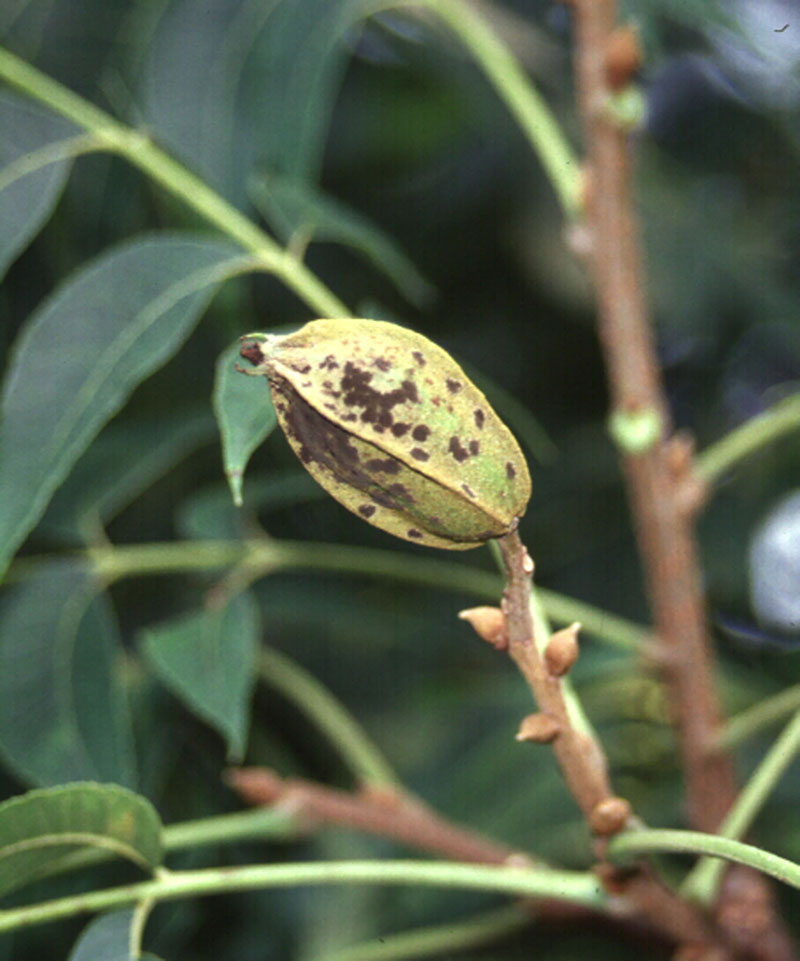
    It’s that time of year when Georgia pecan producers need to start protecting their trees against fungal diseases, including scab. According to the University of Georgia Extension pecan blog, sprays vary among the different cultivars and their specific level of resistance.

    Low Input Cultivars

    Pictured is what scab disease looks like on pecans.

    Those that are considered low input cultivars include Avalon, Elliot, Excel, Kanza, Lakota and McMillan. These require a minimum of three sprays which help manage minor diseases like powdery mildew, anthracnose and downy spot, while also maintaining scab resistance. UGA Extension recommends growers apply a phosphite in mid-to-late April; another in mid-to-late May; and an 11+3 mix in early-to-mid June.

    Medium Input Cultivars

    Those medium input cultivars include Creek, Kiowa, Oconee, Sumner, Zinner, Ellis and Gloria Grande. These require fungicides to manage scab, which can be controlled without an intensive spray program.

    Scab should be controlled with seven sprays. UGA Extension recommends growers apply a phosphite in mid-to-late April; a phosphite or 11+3 in mid-May; Miravis Top in early-to-mid June; Elast+Tin or phosphite in mid-to-late June; Miravis Top in early-to-mid July; Tin or Elast+Tin in mid-to-late July; and Miravis Top in early-to-mid August.

    High Input Cultivars

    Those high input cultivars include Byrd, Cunard, Desirable, Morrill, Pawnee and Treadwell. These must be sprayed intensively if growers expect to produce a crop. They require at least 10 sprays and likely more in some locations. If you need more than 10, continue rotating Miravis Top and Elast+Tin.

    UGA Extension recommends growers apply a phosphite; another phosphite; 11+3 mix; Miravis Top+phosphite; Elast+Tin; Miravis Top; Elast+Tin; Miravis Top; Elast+Tin; and Miravis Top.

    Those medium-high cultivars include Caddo, Cape Fear, Huffman, Schley, Stuart, Tanner, Tom and Whiddon. These could fall into either of the other two categories.

    Group 3 and Group 11 fungicides contain both a Triazole and Strobilurin fungicide chemistry.

    Fungicide sprays should continue through shell hardening.

  • Georgia Produce Farmer: (Mexico) Doesn’t Care About Costs

    Flickr photo shows a semi-truck.

    What should be an advantage to Southeast producers against Mexico is anything but, believes Georgia vegetable farmer Dick Minor.

    Freight prices continue to spike, which has only worsened since gas prices continue to increase. But that doesn’t matter to produce originating out of Mexico, Minor added.

    “High freight rates are our friend or should be technically our friend from a business point because Mexico’s got to transport it further than we’ve got to transport it. Every time freight goes up, that should help us, give us a competitive advantage,” Minor said. “The only problem is, they’re still shipping just as much product regardless of freight costs. That tells us, they don’t care. I know for a fact they’ve got boxes into New York for $1 a box net back to them. That doesn’t even pay for the box. They’re just trying to move product.

    “If they’re making real business decisions, when freight got really high like it did in ’11, ’12, and ’13 when we had $3.50 gasoline, they should have been shut down. But no, they still shipped product regardless of freight costs.”

    Freight was one of several points of contention during the most recent U.S. International Trade Commission hearing that centered on the impact of squash and cucumber imports on the Southeast domestic market.

    Increased Freight Costs

    Increased input costs are a challenge for Southeast producers. Freight is no exception. It was established during the hearing that between 2015 and 2020, freight costs have at least doubled. There are fewer drivers and more regulations on the road. Drivers must be shut down for eight hours.

    “Everything’s going up,” Florida farmer Sam Accursio said during the hearing. “Insurance is going up tremendously for these independent operators. Fuel has been fluctuating back and forth, but their biggest expense is tires and mechanics insurance. Their biggest complaint is insurance and tags.”

    Those same input costs are not swaying the intentions of Mexican producers who are focused on the U.S. markets. Whether it is strawberries, blueberries, squash, cucumbers, tomatoes, imports are increasing exponentially. Freight is just another factor that doesn’t seem to matter to Mexican growers.

    “The cheaper you can get the freight on a delivered price, then you can make more money,” added Georgia producer Bill Brim during the hearing. “If we take it on an open market and we ship it up there and have $6,000 in freight and they pay you $3 a pack, then you’ve lost your you know what.”