The 2021 Southeast Regional Fruit and Vegetable Conference is underway. The conference, which is normally held in January in Savannah, is being held virtually this year due to COVID-19 concerns. The three-day event will be held through Thursday, Jan. 7.
For more information, or to register for the event, click here.
With an interest in wildlife while possessing an expertise in food safety, Kristin Woods is concerned about risks bird populations have on fruit and vegetable production in the Southeast.
“It is possible to do both, have safe produce and maintain habitat for birds and other wildlife. But it really is an area we need more research in to know how to do that safely,” said Woods, Alabama Regional Extension agent, who specializes in food safety.
Does clearing habitat around produce fields put vegetable and specialty crops more at risks of birds potentially carrying deadly pathogens? On the other hand, if the natural habitat is left alone, are crops less at risk to be impacted? Those are questions Woods hopes to answer and will talk about further during the Southeast Regional Fruit and Vegetable Conference on Thursday at 4 p.m.
“I’m interested in ways that our commercial produce growers can maintain habitat for wildlife, as well as pollinators that they need for their produce without increasing food safety risks. There has been some line of thinking that clearing habitat is safer. Some of the emerging research is indicating that is not the case. When you clear habitat … you shift the species of birds into species that are more likely to carry pathogens,” Woods said.
“If we can maintain woody areas and habitats around our growing areas, then we attract native species of birds that have lower pathogen prevalence. They’re also species that are less likely to be visiting areas that have livestock. They’re less likely to be carrying things like E. coli and salmonella.”
IPM Strategy
Organic producers can also potentially incorporate birds into their integrated pest management (IPM) strategy if a natural habitat is maintained. It’s similar to how insects are used in an IPM system.
Chard and cauliflower crops show signs of freeze injury.
By Pam Knox and Tim Coolong
Untimely freezes can cause tremendous problems for fruit and vegetable crops.
Fall freezes quickly put an end to the growing season for most fruits and vegetables. If freezes come earlier than expected or before the crops are ready for harvest, they can provide a devastating blow to yields and reduce the value of the crops. Spring freezes may destroy blossoms on plants that have recently broken dormancy, reducing yield by eliminating potential fruit or destroying young plants.
Growers are sometimes able to reduce the impact of freezes by using frost- and freeze-protection measures to increase temperatures near the crops and prevent damage due to freezing temperatures.
TYPES OF FREEZES
There are two main types of freeze that can occur in fields, and freeze-protection methods depend in part on what type of freeze is expected to occur.
Mustard greens that were cultivated prior to a freeze resulted in some plant damage.
An advection freeze is caused by cold and dry air moving (“advecting”) into the production area, replacing the warmer, moister air that was already in place. An advection freeze is commonly associated with moderate to strong winds, a well-mixed air mass that does not have a temperature inversion, and low humidity. Temperatures will drop below freezing and may stay that way for an extended period.
It is difficult to protect against an advection freeze because the wind blows added heat away from the crops and makes formation of protective ice from sprinklers difficult. The lack of a temperature inversion means that wind-moving devices like tall fans or helicopters do not have access to a warmer layer of air to mix with surface air. The dry conditions also mean that irrigation is often not effective at keeping temperatures above freezing, which can lead to ice loading on the plants as the sprinklers try to keep up.
Radiation freezes occur when the sky is clear and winds are calm to light. Temperatures drop because with clear skies, radiation from the earth’s surface can quickly allow energy to escape to space. The coldest air tends to flow downhill because it is denser than the air around it, pooling in the lowest-lying areas (sometimes known as “frost pockets”). Radiation freezes are often accompanied by a temperature inversion aloft. This is a layer of air above the surface that is warmer than the air near the ground.
One freeze-protection method is to mix warmer air down to the ground using fans or helicopters, keeping the surface air warmer. Frost-protection methods are generally more effective in radiation freezes than in advection freezes, especially when strong inversions with plenty of warm air are present. Sometimes a night with cold air blowing into an area results in an advection freeze occurring the first night followed by a radiation freeze the second night when the winds die down. Therefore, growers may need to be prepared for both types of freezes.
FREEZE-PROTECTION METHODS
If temperatures are not expected to be much below freezing, heating at ground level can be employed to keep temperatures higher. This can be done using orchard heaters or even burning debris or bales of hay in open areas of the field to be protected. This method can be helpful when a radiation freeze is occurring, especially when a strong inversion is present to trap the heat near the surface, but it loses effectiveness with strong winds. It also puts out a lot of pollution and can be expensive to maintain because of the fuel and labor needed to keep the heaters burning.
If a strong inversion is present, methods for mixing the warmer air down to the surface can be used. This can include both wind machines such as large fans or helicopters. Helicopters have the advantage of being portable but are expensive to operate. Wind machines can be permanent installations or can be mobile, but only cover a limited area. If the inversion is weak, a wind machine could make matters worse by increasing evaporative cooling through the movement of the air.
Irrigation can be an effective tool for freeze protection if it is able to be applied at a rate that “keeps up” with the freezing conditions. The irrigation is applied continuously to the crops, forming ice on the crops which releases heat to the air around those crops by the latent heat released by changing liquid water into solid ice. The plant material under the ice is kept near freezing by the ice cover and transfer of energy into the plant.
Row covers can provide plants with some protection from frost, wind and insects.
If the air conditions are windy, air will mix with the ice, forming cloudy ice that is less effective at protecting the plants, which reduces their ability to survive the frost. Clear ice is a sign that the freeze protection is likely working. If the air is low in humidity, irrigation is not very successful because most irrigation systems cannot put out water at a high enough rate to keep up with the effects of the cold air. If the dew point temperature of the incoming air is below about 22° F, then irrigation is unlikely to be effective. Even higher dew point temperatures are no guarantee that irrigation will work, especially in an advection freeze where wind is a factor.
Sometimes growers will use center pivots to irrigate prior to a freeze event. Center pivots move far too slowly to directly protect a crop as described above. However, in some cases when the soil is dry, adding moisture to the soil can help it retain heat from the day, which can provide some protection in the evening. When the soil is already wet, further irrigating it will not help.
Covering plants with plastic tarps or row covers has been used with varying success. A plant can be covered by mulch or a cover overnight to keep the cold air from hitting the plant. The cover (particularly clear plastic) must be removed the next day or sunlight will heat the cover, causing potential damage to the plant from excessive heat. Floating row covers that allow 2 to 4° F of freeze protection and have various degrees of light transmission can be purchased and easily moved around fields. Row covers also provide some protection from wind and insects. Mulch or plastic covers will be most effective when the ground has been warmed by the sun during the day. They are also aided by moist soil conditions, which help hold heat in the ground.
Other methods such as cultivating ahead of a frost or spraying chemicals to prevent frost formation on the leaves have been tried by some growers. However, they have not proven to be effective in field trials and could cause additional damage to the plants, so should be undertaken with caution. In some cases, cultivation can expose roots to freezing temperatures and cause further damage.
See secure.caes.uga.edu/extension/publications/files/pdf/B%201479_1.PDF for more information about freeze-protection methods and how to run a frost protection irrigation system.
Florida Fruit and Vegetable Association (FFVA) Chair Aaron Troyer, on behalf of FFVA members, sent a letter to Gov. DeSantis this week urging for priority distribution of a COVID-19 vaccine for Florida’s agricultural workforce.
While FFVA strongly supports that healthcare workers and long-term care facilities receive first priority, Troyer urged for prioritizing Florida agriculture after those groups to ensure a continued safe and abundant food supply.
“The pandemic has shone a spotlight on the essential nature of agricultural workers, who are on the front lines putting healthy, nutritious food on consumers’ tables,” the letter stated. “As you well know, Florida is the ‘winter bread basket’ for the entire country and a key economic driver for the state. The health and well-being of the agriculture workforce is the top priority for Florida growers.”
Florida growers have already taken extraordinary measures, completed extensive training and made substantial investments in workforce protection against COVID-19 since the start. However, there is still concern for COVID-19 impacts on the workforce without access to a vaccine in the coming months.
See attached letter:
December 2, 2020
The Honorable Ron DeSantis
Governor, State of Florida
The Capitol400 S. Monroe St.Tallahassee, FL 32399-0001
Dear Governor DeSantis:
On behalf of the members of the Florida Fruit & Vegetable Association, I am writing to strongly urge that the state include agricultural workers among its top priorities for the COVID-19 vaccine allocation. We understand the state has begun preparations for the rollout of the initial vaccine and strongly support priority allocation to healthcare workers and long-term care facilities. Respectfully, prioritizing vaccinations for Florida’s agricultural workforce (after the aforementioned groups) is vital for a safe and abundant food supply.
The pandemic has shone a spotlight on the essential nature of agricultural workers, who are on the front lines putting healthy, nutritious food on consumers’ tables. As you well know, Florida is the “winter bread basket” for the entire country and a key economic driver for the state. The health and well-being of the agriculture workforce is the top priority for Florida growers, who have taken extraordinary measures, completed extensive training and made substantial investments in workforce protection against COVID-19 since the start. However, our growing season has only just begun, generating concern of anticipated impacts on our workforce heading in to the winter months if there is still no vaccine available.
Now more than ever, Florida agriculture plays an important role in our communities, and its workforce plays an even greater one in helping to feed the state and country. Despite best efforts, this virus has proven unstoppable, and no industry is immune to its impacts. But, this industry is resilient, and we will continue to do all we can to protect our workers. That said, priority distribution of a vaccine to agricultural workers ensures a healthy workforce and that food will continue to flow from the farm to consumers.
Thank you for your leadership and consideration of this request. We stand ready to partner to ensure all of Florida’s essential workers have access to vaccines when available.
A La Nina weather pattern is expected to last through early spring and bring warm and dry conditions to the Southeast.
According to the Climate and Agriculture in the Southeast blog, Pam Knox, University of Georgia Extension Agricultural Climatologist, said that the NOAA’s Climate Prediction Center predicts a 100% chance of a La Nina through the winter and better than 90% chance through early spring.
This scenario could be gloomy news for vegetable fruit farmers, especially peach growers in Alabama, Florida and Georgia who need chill hours to make a crop for the following year. It also means pests could linger longer than desired since the lack of cold temperatures will alive them to survive longer.
Pam Knox Comments
Knox
“In La Nina years, they’re much less likely to get the chill hours that they need. That’s going to be a problem for fruit producers,” Knox said.
“Another thing is when you have warm temperatures, it’s not cold enough to kill the bugs very effectively. So you have more overwintering of bugs like whiteflies and other things that will bring disease to the plants next year. They could get an earlier start, but they’re also going to be more numerous because they’ve been able to survive the winter because of the warmer temperatures.”
The lack of sufficient chill hours does not mean there will be zero cold weather. That’s still expected but will be overshadowed by the warmer temperatures to follow.
“Even in La Nina years, we have some outbreaks of cold weather. It’s still winter, so we’re still going to see some of those cold outbreaks. There’s a lot of variability over time. I would definitely expect to see some colder weather. We could have some pretty big outbreaks,” Knox said.
“It’s just that over the course of the whole winter, we’re likely to see those outbreaks punctuated by warmer spells. That’s not at all surprising. Winter is like that any way. It’s just that the whole average is a little higher. Those outbreaks come less frequently because the storm track is pushed to the north. The storm track is what controls whether we’re in the warmer air, because the warmer air is usually south of the storm track and also whether or not we’re getting rainfall because the rainfall usually happens along the storm track.”
Prolonged Dry Spell?
Winter is also a time when the soil moisture gets recharged due to rainfall. That’s not expected to happen this year amid La Nina, but it does appear the Southeast is in decent shape to withstand prolonged dry conditions.
“Temperatures are lower and evaporation is lower, and plants are dormant so they’re not using a lot of water. I think from a water standpoint, at least right now, it doesn’t look too bad,” Knox said.
According to the US Drought Monitor, southeastern counties in Georgia, as far south as Pierce and Ware, stretching as far north as Burke and Jefferson are classified as abnormally dry. The rest of Georgia, Alabama and Florida have sufficient moisture.
The Southeast Regional Fruit and Vegetable Conference typically includes a trade show of hundreds of exhibitors. This year it will be held virtually amid COVID-19. Photo courtesy of the Georgia Fruit and Vegetable Growers Association.
Registration is ongoing for the 2021 Southeast Regional Fruit and Vegetable Conference, which will be held virtually on Jan. 5 through Jan. 7, 2021.
All events this year, including the educational sessions from university researchers and industry leaders, will take place online this year amid COVID-19 concerns. The conference will have the latest in production and crop operational information that attendees have come to expect from the SE Regional Conference.
All educational and exhibitor content will be available for on-demand viewing until April 30 to all registered attendees.
An All Access pass is $125 and includes access to all educational sessions, virtual trade show, poster sessions and networking events until April 30. A Trade Show Pass is free and includes admission to the virtual trade show and networking sessions but does not include access to any educational sessions. Access to the trade show floor will be available until April 30.
You must register for the trade show to access the trade show floor.
Pruning of southern highbush blueberries is required to open the middles of the plants for machine harvesting from the top.
Pruning fruit trees is an important management tactic that producers and homeowners need to implement every year. Industry experts emphasize, though, the importance of growers waiting until the winter dormancy period before beginning the pruning process.
Gray
In doing so, producers will avoid damage from colder temperatures.
“Years ago, we used to prune our peach orchards, for example, in the fall. A lot of our growers did that to get it done. They had a lot of pruning to do. We learned over the years, (though), that makes the fruit trees bloom earlier,” said Gary Gray, Alabama Regional Extension agent.
More Susceptible to Colder Temps
According to a University of Georgia Extension blog, pruning stimulates the growth of the trees. That’s why industry experts insist growers wait until later in the dormant season to prune. If trees bloom early, they’re more susceptible to damage from a potential freeze.
“When we prune, that sets them up to bloom a little earlier and it causes them to be more cold sensitive as a result. The one aspect of that would be, for example, whenever you go in and prune and lets say we’re pruning … after Jan. 1 up until bloom, basically is a good time to get it done…a commercial grower who has a lot of trees, he can’t wait too late to get it done,” Gray said. “There’s a risk that if we had a freeze immediately following or really cold weather immediately following pruning that we might get increased damage on those trees.”
If growers wait until later in the dormancy period, it reduces the risk of being impacted by freezing temperatures since the weather starts to warm with the impending arrival of spring.
Why Prune?
UGA Extension says pruning is one of the most important cultural practices for maintaining woody plants. For fruiting plants, like peach trees, pruning plays an important role in improving overall fruit quality, primarily by increasing light penetration into the tree. But proper pruning requires understanding of how plants respond to the different pruning cuts.
That’s why it is essential that growers wait as long as possible before implementing the pruning process.
“If a grower or a home (owner) can wait, the later those trees are going to bloom. You’re not promoting the dormancy breaking process that happens when you prune. For example, if the buds are still dormant, we’d like for them to stay that way to reduce our risk of freeze damage in the spring,” Gray said.
A new report covers the increasing popularity of e-commerce and the unprecedented rise of in-home consumption triggered by COVID-19, including the continued growth of fresh fruit and vegetable sales.
Pictured is the strawberry cultivar, Keepsake.
United Fresh Produce Association released its Q2 2020 issue of FreshFacts on Retail this week. The report measures retail price and sales trends for the top 10 fruit and vegetable commodities and other value-added produce categories. The report says growth continues in fruit and vegetables as sales surge across categories driven by consumers seeking versatile cooking and salad staples for home meal preparation, and healthy home snack options.
Meanwhile, packaged salads are a top-selling organic produce commodity, followed by apples and strawberries. Consumer response to value-added fruit remains muted, while value-added vegetable sales grew. Products typically consumed in group settings declined, while products that are more challenging for consumers to handle and prepare at home drove consumer interest.
(From the National Association of Farm Broadcasters)
The Southeast Regional Fruit and Vegetable Conference includes a trade show of hundreds of exhibitors. Photo courtesy of the Georgia Fruit and Vegetable Growers Association.
It has proven almost impossible to hold in-person conferences and trade shows amid the coronavirus pandemic. The Southeast Regional Fruit and Vegetable Conference is the latest to announce its intention to transition to a virtual event in 2021.
Charles Hall, executive director of the Georgia Fruit and Vegetable Growers Association confirmed in an announcement on Monday that the event scheduled for Jan. 5-7, 2021 will be held virtually.
“The Savannah conference is a unique conference, and everybody enjoys that conference because of the networking and the opportunities to see folks and the education quality and tradeshow and industry folks there. It became quite obvious that as we worked through how we do the conference in this Corona-19 guideline, it just became an impossibility,” Hall said. “If you look at one of our classrooms where we expect to have 100 people in there, if you social distance, you can get 19 people in that room. What happens is if we work to go forward with that, you’ve got 19 people getting an education and 80 people not getting an education.
“The effectiveness and ability with the conference to function is just not possible to have it.”
Normal Attendance
A normal attendance for the conference is between 3,200 and 3,500 people. The event targets fruit and vegetable crops like watermelons, peaches, blueberries and hemp with educational sessions led by University of Georgia Extension specialists.
Over the next two weeks, the organization will provide more information on exhibiting, sponsoring and attending the virtual event in January.
One benefit of this virtual format is that educational sessions will stay online for four months.
“There’s a lot of positives to the change but the networking and atmosphere of the Savannah conference is going to be missed this year,” Hall said.
Figure 1. A new University of Florida strawberry variety is white with a slight pink blush and red seeds when fully ripe.
Photo credit: Cristina Carrizosa, UF/IFAS Communications
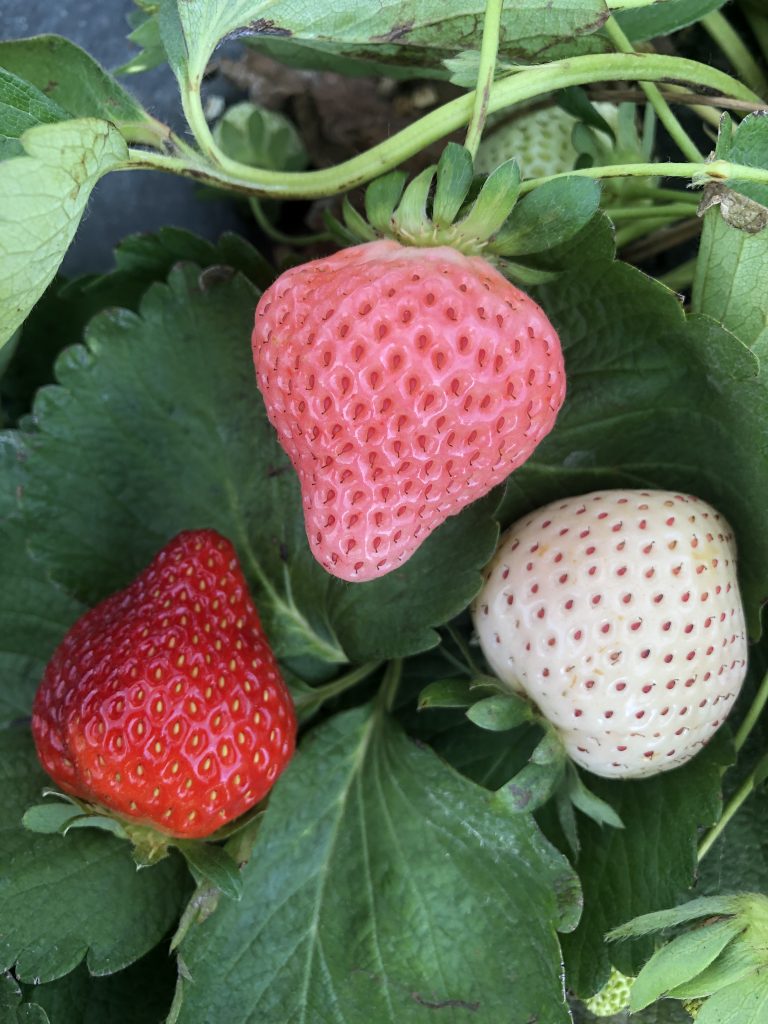
The University of Florida will soon commercialize a new strawberry variety. It doesn’t have a name yet, but it is already drawing attention for a very unusual characteristic. When it is ripe and ready to eat, it is white inside and out, with a slight pink blush on the exterior and red seeds. The flavor is very different from a typical strawberry, sweet but with a pineapple-like aroma. White strawberries have been popular for some time in Japan, but this is expected to be the first white strawberry on the market in the United States.
These unusual strawberries were not made in a lab. White strawberries are actually found in nature. Breeders have harnessed this naturally occurring trait, crossing white strawberries from the wild with modern strawberries to create something different in both appearance and taste.
WHY IT’S WHITE
The red color of the typical strawberry comes from pigments called anthocyanins. White strawberries produce much lower amounts of these compounds in their flesh than red strawberries. Recent research has shown that white strawberries of various types all have DNA sequence changes in a single gene called MYB10, which is involved in the synthesis of anthocyanins. These changes keep the gene from carrying out its normal function, essentially halting the chemical process in the fruit that produces red pigments.
HOW IT WAS DEVELOPED
In 2012, some strawberry seeds from fruit purchased in Japan were brought to the University of Florida. The seeds were sown, and a few small plants were recovered. The pollen from these plants were crossed with a Florida variety. The seedlings from this cross produced fruit that ranged from white to pink to red.
Further crosses with Florida varieties were made, ultimately resulting in a strawberry with similar hardiness and fruit characteristics to modern varieties but with white color. Commercial trials have been promising so far. Pickers can tell when the fruit is ripe when a slight pink blush develops on the sun-side of the fruit, and when most of the seeds turn red. By 2022, these new white strawberries should be available in U.S. grocery stores.
Figure 2. Florida strawberry varieties can be red, pink or white. Photo credit: Seonghee Lee
STRAWBERRY SPECIES
There are many different species of strawberry throughout the world, and white strawberries are naturally found within several of them.
Alpine Strawberry (Fragariavesca) Alpine strawberries are in the species F. vesca, which is an ancient ancestor of the modern strawberry. In Europe, this strawberry is referred to as “fraises des bois” and is prized among food connoisseurs for its aroma. While most members of the species have red fruits about the size of a fingernail, the fruits of some Alpine strawberries are yellow to white in color. More information is available from the University of Florida at edis.ifas.ufl.edu/hs1326 on how to grow Alpine strawberries.
Beach Strawberry (F. chiloensis) The beach strawberry is found in the wild along the Pacific coasts of North and South America. F. chiloensis is one of the most recent ancestors of the modern strawberry. Some of the beach strawberries found in South America are naturally white or pink. The fruit only grow about as large as a thumbnail and are very soft compared to modern strawberries. Some varieties of this species that are crossed between F. chiloensis and the modern strawberry (F. × ananassa) have been called “pineberries.” Some varieties of pineberries are available for home gardeners, but they are not large enough or firm enough to be produced and sold on a large scale.
Cultivated Strawberry (F. × ananassa) A white beach strawberry from Chile and another wild species from North America called F. virginiana with bright red fruits were collected by explorers and brought to Europe about 300 years ago. There they accidentally hybridized to produce the cultivated strawberry or “modern” strawberry, F. × ananassa, that we know today. Almost all the strawberries currently grown and produced in the United States are F. × ananassa. White cultivated strawberries have been bred for some time in Japan and sold at high prices as novelty items. However, white strawberries have not yet caught on as much in other areas of the world.
See programs.ifas.ufl.edu/plant-breeding/strawberry for more information on University of Florida strawberry breeding and genetics.