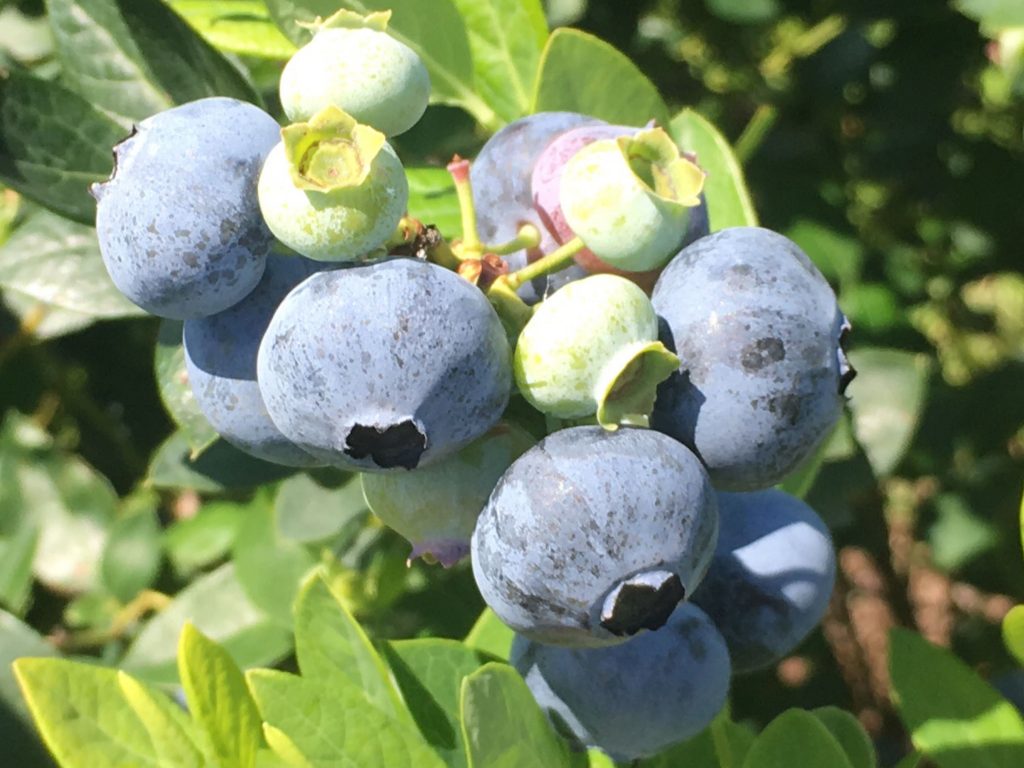
A late crop, a topsy-turvy market and a consistent influx of produce coming in from Mexico – just another challenging year for Florida’s blueberry growers.
Chuck Allison, blueberry farmer and owner of Wild Goose Farms in Umatilla, Florida, said the cooler winter has delayed harvests this year.
“We’re getting started. We picked last week a couple of times. We’re getting back this week, probably, and then next week we’ll probably be picking every day,” Allison said. “With the cool weather this past weekend, it kind of slowed things down again. A lot of early varieties are probably 7 to 14 days later than last year. It’s all about heat units. We just didn’t get the same heat units this year.”
As harvests begin to increase for Allison and other Florida farmers, the question is how will the market play out over the next month or two? That’s really unpredictable.
“It’s so hard to tell with the marketing and stuff. There’s so many dynamics going on with Mexico now, when Georgia would come in behind Florida; Chile’s going to end and be out of the market, which will help significantly. We’re hoping that Mexico will get some of their volume through the marketplace instead of storing fruit and leading it into the market later on,” Allison said. “We think Georgia may be late like we are, so there will be a normal transition there, and North Carolina even later. We may get a more normalized market with the transitions between states. I don’t know, it’s so hard to tell.”
Acquisition of Imperial Sugar provides U.S. Sugar’s and Imperial Sugar’s customers with increased production and distribution, a full suite of sugar products, and a more secure sugar supply
CLEWISTON, FLORIDA — An acquisition on Wednesday by U.S. Sugar returns Imperial Sugar to All-American owernship.
U.S. Sugar announced on Wednesday it has reached an agreement with Louis Dreyfus Company to acquire the business and assets of Imperial Sugar Company, which is a port refiner with operations in Georgia and Kentucky.
“We are excited to combine our operations with Imperial Sugar’s port refinery, consumer brands, and sugar processing capabilities,” said Robert H. Buker, Jr., President and CEO of U.S. Sugar. “Together, U.S. Sugar and Imperial Sugar will provide our customers with a more dependable, secure supply of sugar.”
“Imperial Sugar has a strong heritage as a family-owned business and could not be more proud to become part of the U.S. Sugar family,” said Mike Gorrell, CEO of Imperial Sugar. “This move will increase production and reduce costs at Imperial Sugar’s refinery, generating significant efficiencies that ultimately will benefit our customers.”
Imperial Sugar currently operates a refinery at Port Wentworth in Savannah, Georgia and a sugar transfer and liquification facility in Ludlow, Kentucky. The company primarily sources its raw sugar from Central and South America, and the Caribbean. Imperial Sugar’s various facilities, consumer brands and raw/refined sugar inventories will be included in the purchase.
“U.S. Sugar has a world-class sugar business focused solely in America, including a historic relationship with the Savannah refinery,” said Adrian Isman, Head of the North American Region at Louis Dreyfus Company. “Imperial Sugar’s port refining capabilities will be an excellent addition for the company, while enabling LDC to concentrate more fully on its global sugar merchandizing business.”
Prior to building its Clewiston refinery in 1998, U.S. Sugar sold and shipped its raw sugar to the Savannah refinery it is now acquiring for decades. The company sustainably farms more than 200,000 acres of sugarcane in South Florida and also owns and operates a short-line railroad, the South Central Florida Express, which facilitates shipping sugar products.
Acquisition to Expand Sugar Production, Increase Sugar Supply Security, Create Logistics and Shipping Synergies, and Improve Competition—All Which Will Ultimately Benefit American Customers and Farmers
Expand Sugar Production and Reduce Costs: U.S. Sugar will invest in Imperial’s refinery to expand production and reduce manufacturing costs. Adding Imperial’s facility will provide U.S. Sugar and its local Florida farmers with enough refining capacity to utilize all the sugarcane they farm.
Increase Domestic Sugar Supply Security: Increased production capacity and access to Imperial’s Savannah port refinery will supplement U.S. Sugar’s marketing cooperative’s sugar supply if supplies of domestic beet and cane crops are limited from freezes or hurricanes.
Create Logistics and Shipping Synergies: Adding Imperial Sugar’s operations to U.S. Sugar’s marketing cooperative will create substantial distribution synergies and cost savings that will benefit customers.
Improve Competition: The new combined company will be a better competitor, offering customers a full suite of sugar products (which U.S. Sugar does not supply today) and expanding distribution capabilities throughout the country. U.S. Sugar will continue to compete across the U.S. with both domestic and imported sugar refiners, along with independent resellers and distributors.
The transaction, expected to close in 2021, is subject to review under the Hart-Scott-Rodino Antitrust Improvements Act and other customary conditions. Wells Fargo Securities, LLC is serving as the exclusive financial advisor to U.S. Sugar. The transaction will be financed through committed debt financing provided by Wells Fargo Bank, N.A. and PGIM Agricultural Finance.
Tallahassee, FL — Florida Agriculture Commissioner Nikki Fried applauded the U.S. Department of Agriculture’s (USDA) $6 billion in expanded pandemic assistance on Wednesday. This will aid specialty crop and seasonal produce growers who did not benefit sufficiently from last year’s USDA assistance.
“Florida’s proud farmers, ranchers, and growers have had a tough year, working to overcome half a billion dollars in pandemic-related losses while keeping their workers safe and producing the domestic food supply on which 150 million American families rely. With USDA support last year slow in coming and inconsistent across agricultural sectors, Florida agriculture deeply appreciates this expanded, inclusive approach to federal support,” Fried said. “Our seasonal produce growers have been particularly hard-hit by COVID-19 and will benefit from additional specialty crop grant funding. PPE will help keep our farmworkers safe in fields and packing houses. Financial support for new, veteran and socially disadvantaged farmers will make our entire $147 billion agriculture industry stronger.”
This funding includes an additional:
$100 million for the Specialty Crop Block Grant Program
$100 million for local and regional agricultural marketing and expansion of direct-to-consumer agriculture
$75 million to support new/beginning, socially disadvantaged, and military veteran farmers and ranchers
$75 million for efforts to increase fresh fruit and vegetables purchases by low-income consumers
$28 million to state departments of agriculture for farm stress/mental health assistance
$20 million for improving animal disease prevention and response
The Florida Department of Agriculture and Consumer Services works to support Florida’s $147 billion agriculture industry, including seasonal produce growers who faced $522 million in pandemic-related losses, and oversees plant and animal disease detection and prevention in Florida.
Source: Florida Department of Agriculture and Consumer Services
What was once a booming industry in Florida is now running on fumes. Mexican imports and the U.S. International Trade Commission (USITC) have made it almost impossible for Florida blueberry producers to compete like they used to.
“Florida went through an increase from 2000 to 2015 or so. Now, I don’t know of anybody that’s putting blueberry acreage in because they see the writing on the wall,” said David Hill, owner of Southern Hill Farms in Clermont, Florida and vice chairman of the Florida Fruit and Vegetable Association. “What’s happening now is the smaller guys, they can’t hang. The margins aren’t there. They’re selling out. They’re either selling to developers trying to find somebody to buy their farm for cheap. Now you can get a blueberry farm cheaper than you can put one in. But I don’t see a lot of people wanting to get in the blueberry business.”
Why would any farmer want to try their hand in blueberries? Especially when the USITC decided in early February that blueberry imports were not a serious injury to the domestic market. The USITC voted 5-0. It was a devastating blow to Florida blueberry producers longing for relief.
Statistically Speaking
According to University of Florida Associate Professor Zhengfei Guan, Mexican imports of blueberries were non-existent before 2009. But in 2019 they totaled a little more than 90 million pounds, compared to Florida’s approximate 24 million pounds of production.
Hill compares the state of the blueberry industry to Florida’s tomato industry which was also decimated in recent years.
“It’s the same kind of thing. You’ve got to be big, and there’s only so many people that can be big, but the smaller guys, you just can’t afford to keep losing money. Things are looking worse,” Hill said. “Mexico is ramping up. The government is subsidizing the industry. The obvious is look at the labor costs. It makes it very difficult to compete.
“You’ve got all of this infrastructure you put in and you can’t get the returns. If you sell it as a blueberry farm, you’re selling it at a huge discount. That’s the only way you’re going to entice somebody to buy it as a blueberry farm.”
In the ongoing war between supporting local farmers against the influx of imports, American farmers need consumers to fight back.
The significance of where food originates may never be more important than it is right now. With imports continuing to flood markets for various commodities, the end result is farmers contemplating selling their land. Others are wondering what else can be done to slow the decline of the American farmer.
“As long as the decision of what’s in the grocery store is based on the consumer, I think we’ll be okay,” said Wade Purvis, who farms in Immokalee, Florida and is part of the Farmers Alliance. “But the problem is the decision that’s being made is, there’s an intermediate group of marketers that stand between the growers and the chain stores. They may have ‘family farms’ in their name or ‘something farms’ in their name, and the chain stores either don’t bother exploring it and figuring it out or are just too lazy to even worry about it.”
The deception continues to have a negative impact on local producers.
“The country-of-origin labeling is so adulterated in the grocery stores. It’s basically piled up in there with domestic stuff and there’s a little bitty captioning at the bottom back of the bag that says product of Mexico. It’s placed on a shelf under ‘Jimmy John and his family farms’ in Cairo, Georgia, and it’s clearly giving the perception that’s his stuff there when it absolutely isn’t,” Purvis said.
Year-Round Service
Chain stores need produce year-round, so the problem is exacerbated. Purvis said most farmers can’t invest millions of dollars into producing a crop 12 months out of the year. These deceivers are able to take advantage.
“Most farmers are regional. They have crops in Immokalee (Fla.), they have crops in South Georgia, they have crops in Central Florida. There’s just a small handful that have the wherewithal to have product 12 months out of the year,” Purvis said. “That being said, these marketers that I’m describing, they’ve got ‘x-y’ farms in their name and they have solved a problem for the chain stores. They’ve got a number they can call 12 months out of the year. They’ve got the product. They source it from anywhere and everywhere. That’s how that evolved.”
Consumers Asking Questions
Purvis believes that one positive from the ongoing pandemic is the consumer awareness of where their food originates. Now more than ever, they are asking about where their vegetables and specialty crops are coming from.
“I think you would find unanimous feedback from the chain stores that the consumer is becoming very much aware. They’re asking questions and putting pressure on them. ‘Why have I got Honduran watermelons in my supermarket in Naples when there’s watermelons in Immokalee that they can’t get rid of,’” Purvis said. “If we keep the heat on and the awareness out there, I think the consumer will put enough pressure on the retailer that it’ll make the difference.”
Enzymes are an essential element in the cells of all living plants. University of Florida research is tailored towards getting more mileage out of this essential component. Longer lasting enzymes could lead to increased yields in plants that are produced for food, fuel and fiber.
“Replacing enzymes is a huge energy cost to organisms, but no one had ever really asked, ‘How long do enzymes last and what determines that?’ If you want to improve enzymes’ lifespans, you need to know which enzymes to target,” said Hanson to UF/IFAS. He is the lead author of a new study in which researchers present a new benchmark for evaluating the durability of any enzyme.
Hanson compares the parts in a car and the enzymes in a cell to better explain CCR.
“If you’re bringing your car into the shop all the time to replace parts, that’s a big investment and it’s not very efficient. But plants we grow as crops, they spend a lot of energy on enzyme maintenance, which leaves less energy for growing the grain or other parts we harvest,” Hanson said. “Many enzymes in plants could be improved, and with the CCR, we know where to start.”
Temperatures are starting to warm considerably in South Florida. Vegetable farmers need to be mindful of various insects that thrive in hot conditions.
“It’s been warming up so you kind of expect to see a flush of pests in the near future. It’s kind of hit and miss in some places with whiteflies and things,” said Craig Frey, University of Florida/IFAS Hendry County Extension Director.
Conditions are certainly favorable for insect pressure to increase. According to the US Drought Monitor, Hendry County and most of South Florida are listed as abnormally dry.
“The life cycles of the insects tend to shorten some. It’s been a couple of weeks since we’ve had cold weather. Instead of it being moderate for a little while, it’s been pretty hot,” Frey said. “They’re just reproducing quickly and starting to become more of an issue in different areas.”
“Pepper weevils, definitely, if you’re growing peppers; whiteflies for a lot of different things. They can be an issue on beans, even. Thrips are an issue on beans and tomatoes. Really, thrips and whiteflies on most crops. They’re two of the big ones.”
The most recent scouting report for Asian bean thrips (ABT) from the University of Florida/IFAS shows that populations continue to vary from farm to farm and plantings to plantings.
Continuous management is necessary since it appears that two modes of action is not sufficient in reducing ABT populations.
Most farms in southeastern Hendry County averaged 0.2 ABT per bud and varied from 0.2 to 0.9 ABT per bloom. But in one instance, reports were as high as 12 ABT per bloom. Additionally, damage was reported on pods.
Bloom drop has also been reported in Homestead, Florida. But to what extent? It’s still being assessed.
ABT population levels ranged from 0.2 to 0.7 ABT per bloom at bloom and early pod development stages in northeastern Hendry County. Populations have stabilized in central Hendry County with levels at 0.1 to 0.5 ABT per bud or bloom.
Scouted beans are nearing harvest in northern Collier County. Populations of 4 ABT per bloom were recorded.
And in eastern Palm Beach County, reports show populations of 0.7 ABT per bloom or 0.5 ABT per plant. Growers must be aggressive with their insecticide programs to keep ABT at moderate levels. This plan of action includes 1 to 2 sprays before bloom to keep populations from building early in the season and more aggressive sprays at bloom and later.
According to the scouting report, there is no research to indicate thresholds to begin management. Thresholds that some scouts have reported using range from 1.0 to 3.0 ABT per bloom. Damage from high populations can occur at budding. Populations must, therefore, be monitored earlier in the growth cycle.
HOMESTEAD, Fla. – A specialty pumpkin traditionally used in Caribbean, South and Central American dishes, has caught the eye of University of Florida scientist Geoffrey Meru.
Meru, a vegetable geneticist at the UF/IFAS Tropical Research and Education Center, is leading a multi-institutional project aimed at adding value to the calabaza commodity chain by eliminating barriers in seed and cropping systems, as well as laying a foundation for novel and lucrative products. The study will determine whether the calabaza provides the right combination of profit, wider consumer demand and usefulness for a variety of industries. Meru will look at the calabaza as the next pumpkin of choice for those who specialize in the brewing, food, agriculture, manufacturing and health industries.
“The calabaza is a nutritional powerhouse that is easy to grow almost pest free, and an excellent crop you can use in rotation with others,” said Meru. “Because it is adapted to Florida’s tropical climate with minimal irrigation requirements, we want to take a closer look for its desirable qualities as a sustainable Florida crop.”
With help from a two-year, nearly $400,000 U.S. Department of Agriculture grant, Meru will lead a team of UF/IFAS researchers in food science, human nutrition and community sciences.
They will study the risks and benefits of crop production, predict the market interest for consumption of the calabaza’s flesh and other lucrative products, determine the nutritional value of this specialty pumpkin, and develop conventional and organic-cropping systems that suppress weeds and improve soil. They’ll also determine the best cultivars for the Florida, Georgia and Puerto Rico markets.
The grant, in collaboration with the universities of Puerto Rico and Georgia, is aptly named “Specialty Pumpkin: Laying the Groundwork for an Emerging Crop and Lucrative Products.”
Florida producers will continue to struggle if the issue of Mexican imports is not addressed, says Zhengfei Guan, UF/IFAS Associate Professor in the Food and Resource Economics Department.
United States of America and Mexico waving flag
Farmers in the Sunshine State will always face an uphill battle if imports of such crops like tomatoes, bell peppers, strawberries and blueberries are allowed to continue.
“They’re going to have a tough time if the Mexican imports issue is not addressed. Florida production of some major crops have been declining over the years. The imports have been increasing dramatically over the last two decades,” Guan said.
“Tomatoes, for example, back in the year 2000, we had more production than the imports from Mexico. The production from Florida was 20% higher than the imports from Mexico. But over the last 20 years, things have changed dramatically, Now, the Mexican imports in the United States market are five times more than Florida production. That’s a dramatic shift of the market position.”
Florida producers like Sam Accursio and Kim Jamerson have voiced their concerns about the impact that imports have had on their farming operations. Both have hinted at ending their farming careers. It’s not because their love for feeding the world has faded. But imports have made it unsustainable for American farmers to continue growing and producing food.
“Once (Mexico) got into the game, they caught up very fast. Basically, they started blueberry exports to the United States about 10 years ago, around 2009. In a period of 10 years, they increased exports to the United States by more than a 100-fold. That’s really, really dramatic,” Guan said.
Click here for more information from UF regarding the rise of imports.